
We are seated in the Milton Community Center witnessing the making of a documentary. Ten years ago, this small Nebraska town was rocked when the title character of Bobbie Clearly shot and killed Casey Welsh when she was 16 and he 14. For nearly 2 1/2 hours, we will hear from Bobbie and ten others about what led up to that horrific event and beyond it to present day. It will be as hard to see the next turn in their stories as it is to navigate the tall fields of corn where Casey’s body was found.
Avoiding the pitfalls of some of the seasons other issues-oriented productions, Bobbie Clearly focuses on the violent act’s human impact rather than on the shooting itself. Playwright Alex Lubischer has generously peppered his moving script with moments of humor, taking care to treat his characters with affection even when poking fun. Though primarily delivered in interview format (to an unseen host), the relationships sparkle. There are times when two people are telling separate segments using identical phrases, shining a light on the importance of context. Lubischer also captures a common progression of high school friendships, following four of Bobbie’s classmates from their summer jobs corn detasseling through their awkward fundraisers in Casey’s memory. Further, there is a profound exploration of the link between religion and forgiveness. Most importantly in this delicate time, Lubischer is careful not to take a stand on guns by making Casey’s father, Stanley, take delight in hunting as a distraction from his grief.
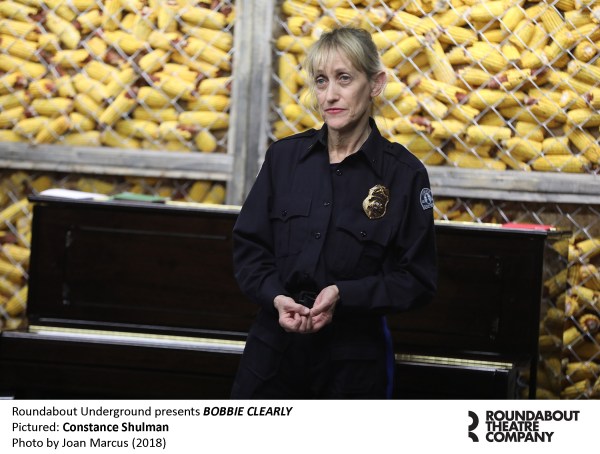
The entire cast is terrific, beginning with Ethan Dubin who — though used sparingly — manages to be both sweet and disturbing as Bobbie. Many will recognize the magnificent Constance Shulman from her equally wonderful ensemble work in television including Orange is the New Black. With her tiny wiry frame and high-pitched croak, she makes an unusual police officer, which is perfect given the unconventional bond she develops with Bobbie from the time he was the Sunday school bully to the day he makes his best attempt at repairing the huge hole he has ripped in his community. Her intensity is balanced by the performance of JD Taylor as Bobbie’s misguided and slightly goofy Big Brother Derek Nelson. As BF(F?)s and mismatched bookends Megan and Meghan, Talene Monahon and Sasha Diamond play off each other with great timing. And Tyler Lea taps into both vulnerability and inner strength as Casey’s younger brother, Eddie, the only witness to the murder.
The piece is performed in 3/4 round with what are essentially service doors to the space serving as entrances and exits. As directed by Will Davis, the energy flows consistently even through the silences. He may also be responsible for the brilliant choreography of two critical dance numbers, which call for very special talent. Kudos to Asta Bennie Hostetter for finding such great costumes-on-a-budget for those numbers as well as the more everyday items that fill in character details. Providing unsettling atmosphere are the smothering walls of dried corn that almost exclusively comprise the minimal set by Arnulfo Maldonado.
At $25 a ticket, Bobbie Clearly is superb bang for the theatrical experience buck. The play is presented as part of Roundabout Underground at The Black Box Theatre and is sure to keep developing its strengths. If you are looking for a who dunnit or even a why, look elsewhere. However, this slow-burn storytelling and honest examination of what is ultimately unknowable will leave you with your thoughts turning. For tickets, on sale through May 6, 2018, and information visit https://www.roundabouttheatre.org/Shows-Events/Bobbie-Clearly.aspx.
 The Unforgettable Line
This Flat Earth
“Are you there,” implores 13 year old Julie at both ends of This Flat Earth to anyone who’s listening. Nine students were recently killed in a school shooting, disrupting her feelings of peace, safety, and normalcy. This topic should be the springboard for compelling discussion. Indeed there are some threads about socioeconomic conditions and adolescent turning points that click. But for the most part, this is a ninety minute missed opportunity that ultimately promises that trauma will be all but lost beneath the unrelenting waves of everyday life.
Ella Kennedy Davis (Julie) and Lynda Gravátt (Cloris), Photo by Joan Marcus.
The piece is set in the recent past, and yet somehow Julie has no idea that hers is not the first school to have gone through such an experience. She believes that her persistent jealousy of a talented and popular girl who died might have caused the tragedy. In her program notes, playwright Lindsey Ferrentino tells how she experienced a similar sense of misplaced power when the incidents of 9/11 occurred the day after she had written a diary entry about the joys of peacetime. The transference of those feelings to sadly more common circumstance are diminishing to her main character. The excuse provided for Julie’s ignorance is that her father is too poor to have purchased a laptop. But even her best friend/would-be-boyfriend Zander seems to think the girl just hasn’t been paying attention.
The casting of Ella Kennedy Davis as Julie doesn’t do much to shore up the character as an interesting representative of her generation. While speaking too quickly at a very high pitch and slurring key words is all too realistic, it also left many of the audience members trying to keep up as they attempted to fill in the missed dialogue. Faring much better is the gifted Ian Saint-Germain, who captures the natural flow of Zander’s assuredness and awkwardness. Lucas Papaelias has trouble navigating the clumsy role of Julie’s father, Dan, but it is hard to tell how much of the difficulty is in the lines and how much in his interpretation. While no parent can protect a child from all dangers, widower Dan comes across as particularly ill-equipped and Papaelias often flails around in his skin. In the role of Lisa, a mother who lost a child in the tragedy, Cassie Beck is also constrained by her character’s limited responses. The only adult providing any constructive contribution is Lynda Gravátt’s upstairs neighbor Cloris. Naturally she can’t answer the impossible, but she delivers sincere and often amusing descriptions of effective coping mechanisms.
The talented director Rebecca Taichman does her best to underscore the truer emotions in the script by matching it with genuinely motivated physicality. Dane Laffrey’s two story set works wonderfully, though it could use a few more tonal touches. Costume designer Paloma Young has put together a fitting wardrobe, particularly with a bag of clothes that plays a critical role. Adding to the mood as well as forwarding the story is cellist Christine H. Kim under the musical direction of Christian Frederickson.
This Flat Earth is one of several recent productions that poses probing questions about the world we are leaving to the new generation. The Artistic Director claims it was never conceived as a production about gun violence, but opening just a month after events at Parkland it’s impossible to view it separate from that issue. Even when evaluated as an artistic expression, the play is wan when compared to similar offerings. While there are moments when the authentic psyches of the teens shine through, there are too many uninspiring stretches. Performances of this world premiere continue through April 29 at Playwrights Horizons. For tickets and information visit https://www.playwrightshorizons.org/shows/plays/flat-earth/.