
My first experience with Sunset Baby – Dominique Morisseau’s 2012 drama being revived at New York’s Signature Theatre – was a series of tweets from colleagues grumbling about the treatment of the playwright’s program insert. Indeed the tiny handout is a puzzling choice of physical manifestation for her enticing invitation to the audience to fully participate even vocally in her tale of a recently released social revolutionary, his traumatized daughter, and her loving thug of a boyfriend. But it wasn’t so much that the “Permissions of Engagement” were on a 4×6 piece of paper in nine point font. The more disappointing aspect was that the production did not elicit so much as a peep from Sunday’s audience.
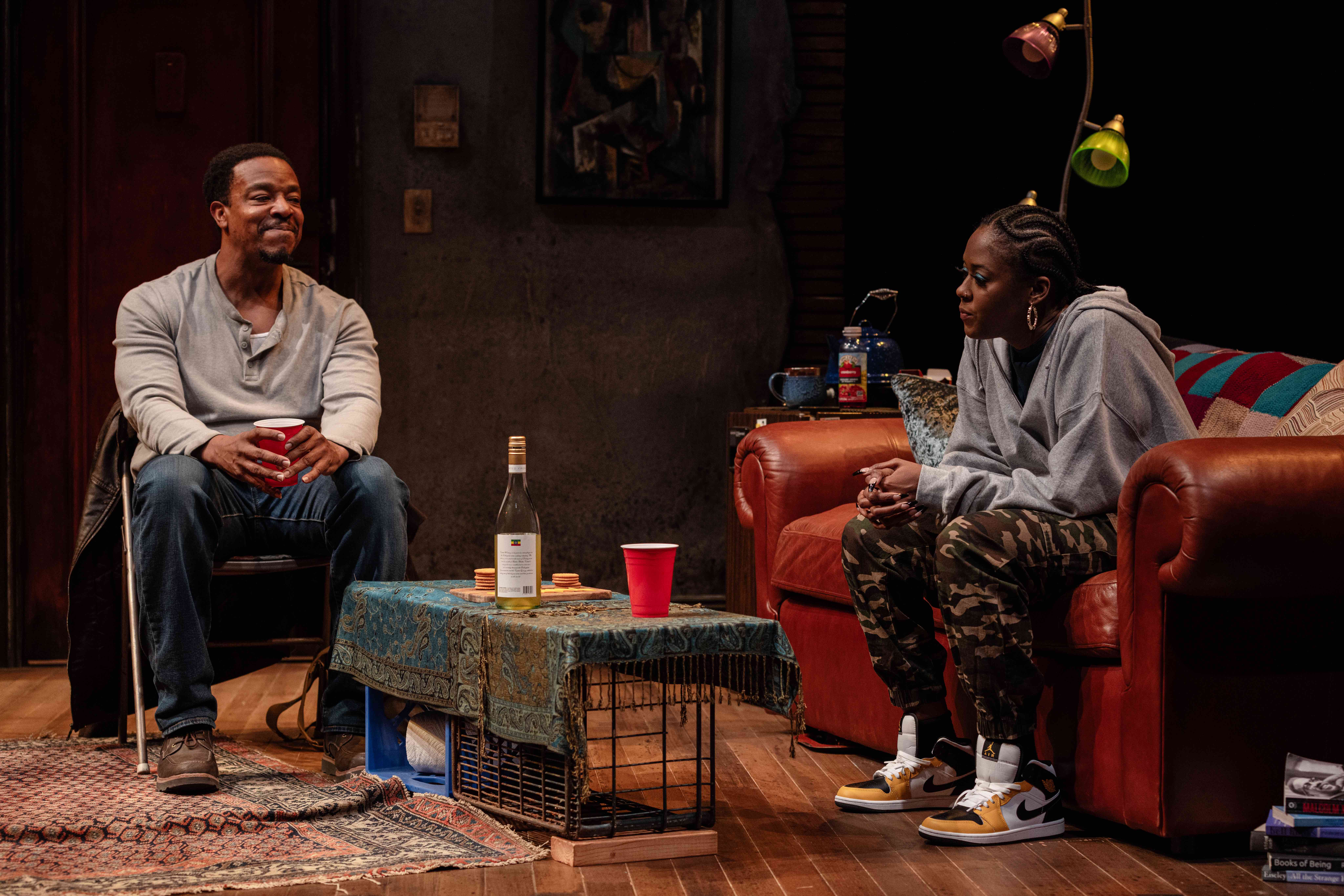
The ability to fulfill Sunset Baby’s promise is boldly displayed in the concise history of the show’s world displayed on the wall outside the theater door. It is visible in Wilson Chin’s economical yet thoughtful scenic design with its peeling paint, well-used furniture, and intriguing choice of artwork. The decision to move the proscenium forward and raise the rake between the rows increases the accessibility and brings the audience further into this room. Small touches from a shower caddy (props by M. Picciuto) to the nearby train (sound by Curtis Craig & Jimmy Keys) bring the setting into clearer focus. The promise is most palpable in the emotive performance of Russell Hornsby as Kenyatta, who in warm and slightly trembling tones opens the show by vividly describing not only the struggles of his role in the Black liberation movement and resulting incarceration, but of the bigger challenge of trying to be a loving father. And it occasionally pokes its head out in Morisseau’s careful plotting such as the discovery that Kenyatta’s daughter Nina expands her world beyond her rundown room in East New York by watching the Travel Channel. Indeed, Morisseau’s knowing and complex feelings about parenthood are strongly woven throughout the dialogue. But none of these sparks ever becomes flame in the frustratingly inert 90 minute runtime.
What seems to have put a dulled layer between the work and the experience of it are artistic choices by director Steven H. Broadnax III. The pacing is slow and there are false notes along the way. Nina comes home from her “job” as a fake hooker who helps her boyfriend, Damon, lure black men into dark alleys to rob them. She slips off her shiny royal blue thigh-high boots — among the apt selections by costume designer Emilio Sosa — only to wrap her cozy pink bathrobe around her skin-tight leather mini. Is this a symbol for her constant discomfort or an inability to smoothly incorporate a wardrobe change? The actress embodying Nina, Moses Ingram, has proven herself capable of deep emotional range. But here she is stuck at the pitch of a petulant teen. Nina’s lack of full development is most notable in a pivotal scene between her and Kenyatta. It should play like a musical movement that shifts from minor to major. Instead this sly turning point is tonally more like a repeated refrain. As her literal partner in crime, J. Alphonse Nicholson is also wedged into a single groove when the character could be providing meaningful counterpoint.
I deeply admire Signature Theatre as a surviving safe harbor of affordable, expansive community theater. The commitment to reexamine an older work by Dominique Morisseau that focuses on the personal impact of the socioeconomic divide is a timely one. But Sunset Baby 2024 misses an opportunity to more engagingly enlighten a new audience about the fallout from another period during which the Black community’s efforts to serve their own were villainized and politicized.
The first of three offerings this season, Sunset Baby runs through March 10 in the Romulus Linney Courtyard Theatre at the Pershing Square Signature Center (480 W. 42nd Street). Tickets are available at https://order.signaturetheatre.org/events and are $59/$79/$99/$119.
Tagged: Cathy Hammer, Curtis Craig, Dominique Morisseau, Emilio Sosa, J. Alphonse Nicholson, Jimmy Keys, M. Picciuto, Moses Ingram, Romulus Linney Courtyard, Russell Hornsby, Signature Theatre, Steven H. Broadnax III, Wilson Chin
 The Unforgettable Line
What say you?