Monthly Archives: February 2025

Grangeville

Grangeville is the county seat of Idaho County and the setting for and title of Samuel D. Hunter’s latest play exploring life in his home state.  Older brother Jerry still lives in this town of slightly over 3000 people.  He is newly separated from his high school sweetheart Stacey, raising two kids, acting as healthcare proxy for his mother, and doing his best to support himself by selling RVs.  Younger half brother Arnold has distanced himself from all the bullying he received at the hands of his family and classmates.  Married for nearly 17 years to Bram, he lives and creates works of art in Rotterdam, the Netherlands.  The only thing these two seem to have in common is a little DNA.  But when it comes to light that their critically ill mother has made Arnold her Executor and granted him Power of Attorney, the siblings have no choice but to reconnect.

What follows is 90 minutes of stirring and often witty dialogue delivered by two versatile actors.  Similar to Arnold, Hunter has created a piece of art that both mocks and celebrates his birthplace.  This script is his usual blend of profound human insight and bookish humor.  If you’ve enjoyed my spoiler-free reviews, you should jump to the last paragraph.  There is simply no way to discuss this production without revealing something that is better experienced for the first time in the moment.  

Arnold and Jerry are so different they don’t even share similar memories from their past. Their search for and avoidance of common ground is enthralling.  In the meatier of the roles, Brian J. Smith portrays Arnold, the brighter and more settled of the brothers.  Smith’s ability to navigate Arnold’s swift transitions of emotional state is impressive and endearing.  Smith also plays Stacey just by adding a measure of softness to his tone and gestures.  Paul Sparks takes on Jerry, a man full of deep regret about his conduct as a younger man and consumed by unhappiness with his current circumstances.  At first, Jerry verbally tiptoes towards Arnold in their video chats.  As his need increases, so does the urgency in his language.  With a subtle change in posture and a waffling accent, Sparks then moves to the role of Bram.
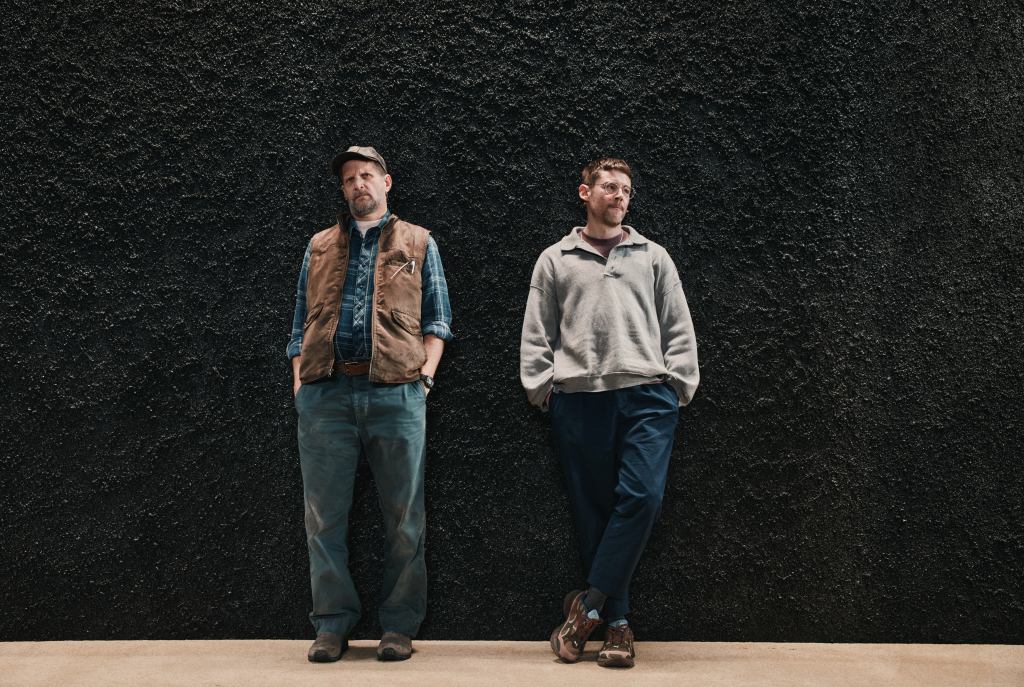
Paul Sparks and Brian J. Smith in Grangeville; Photo by Emilio Madrid

With the precision of an orchestra conductor, director Jack Serio enables his actors to delicately build towards an inevitable crescendo.  Initially we sit in darkness, fully tuned in to their choice of words and reflective pauses.  Movement is added as the exchanges increase in temperature and truthfulness.  Like Hunter’s characters, the black textured walls and dirty white door of the set by dots don’t fill out until far into the journey.  Stacey Derosier’s lighting and Chris Darbassie’s sound have similarly calculated arcs.  Props by Addison Heeren add the perfect punctuation.

Grangeville is a smartly written work that takes full advantage of live theater as a communication and entertainment vehicle.  The Signature-commissioned World Premiere continues through March 23 at The Alice Griffin Jewel Box Theatre, 480 West 42nd Street.  The house is shallow and well raked with the legroom of an economy seat on Spirit Airlines.  Run time is 90 minutes with no intermission and no re-entry permitted.  Tickets are available at https://signaturetheatre.org/show/grangeville/  and begin at $78 including fees.  Arrive early to take advantage of the pleasant cafe and small bookshop on the second floor.
Liberation

Tony nominee Bess Wohl’s latest endeavor, Liberation, is a memory play in which the narrator describes events from someone else’s experiences.  She imagines what it was like for her own mother in the early days of the fight for women’s equality.  Through a series of talking circles with her mother’s friends, she attempts to shine a light on the connection between personal decisions and societal evolution and gain a better understanding of her own choices.

A zestful Suzannah Flood takes on future mom Lizzie, Lizzie’s daughter, our leading lady, and the voice of the playwright.  Flood has an endearing everywoman quality and relatability.  Her opening monologue weaving together all four women is a highlight of the evening.  She addresses the herd of elephants in the room, beginning with the political victories that are slipping away.  To better appreciate The Now, Lizzie’s daughter will role-play her own mother.  The path Lizzie chose in her twenties led to our host’s very existence and we should become deeply invested.  But the ensuing storytelling is like learning ballet by drawing the steps on a blackboard.  We grasp the ideas intellectually, but without experiencing any authentic movement.

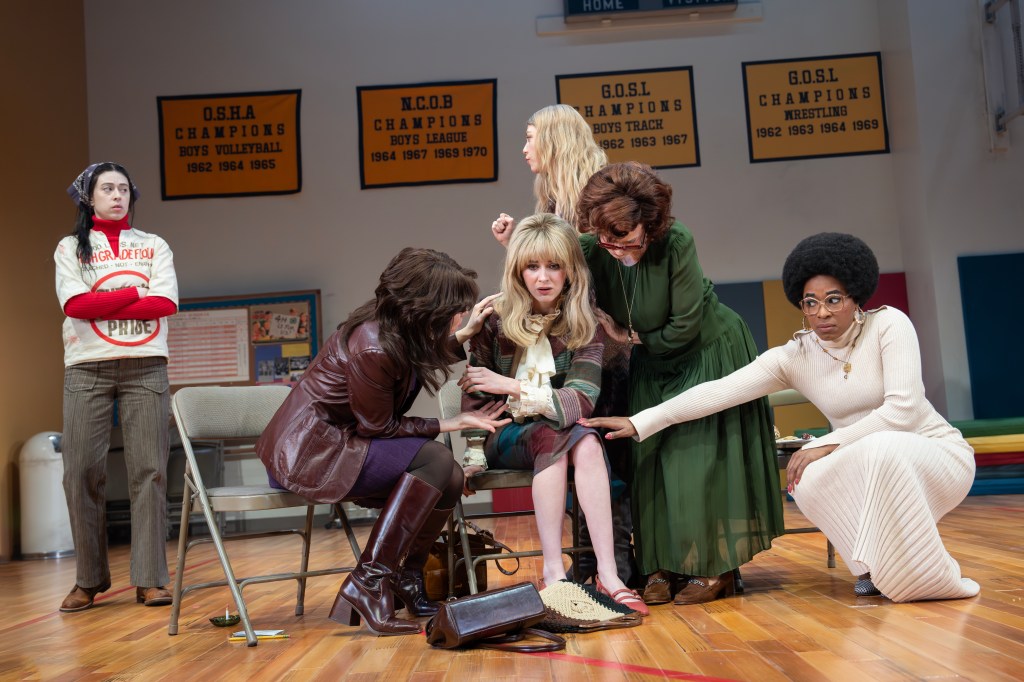
We are transported to Ohio in 1970 where budding journalist Lizzie is endeavoring to form a consciousness-raising group for women.  Five strangers have responded to her flyer and arrived at the local rec center.  Margie (Betsy Aidem) is a married woman with grown children whose entire life is consumed by caring for her family.  Dora (Audrey Corsa) is a young secretary whose intellect has been overlooked because she’s pretty.  Celeste (Kristolyn Lloyd)  — the lone woman of color — is an Ivy League graduate whose career has been blown off course by her ailing mother.  Isidora (Irene Sofia Lucio) is an Italian immigrant with creative ambitions who married for a green card and now wants out.  And Susi (Adina Verson) is living in her car and feeling completely exhausted by life.  Two others pass through the room.  Bill (Charlie Thurston) will eventually become the husband/father.  And Joanne (Kayla Davion) who arrives in search of her son’s lost backpack.  Her involvement in Act 2 provides one of the few exhilarating scenes in a series of otherwise predictable beats.

We are told these women are friends, but despite literally stripping themselves naked before one another, they do not truthfully reveal themselves.  Lizzie is too fearful of making a wrong move to be a leader or even anoint one.  We are reminded of the many limitations women faced in the days when they couldn’t open a bank account and no fault divorce was only legal in California.  But with only descriptions to go by, we experience a glancing blow rather than an enduring punch.  Stuck in chat mode, they all remain types from the era and never reach our hearts.

Adina Verson, Irene Sofia Lucio, Audrey Corsa, Susannah Flood, Betsy Aidem and Kristolyn Lloyd in Liberation; photo by Joan Marcus

The cast is up for the creative exercise, playing their counterparts in both past and present and occasionally stepping into the role of Lizzie when a situation would be awkward for her daughter to recreate.  Director Whitney White provides as much variation as she can, using the gym equipment to change the composition of bodies.  Set designer David Zinn adds some color with an unlikely rainbow of gym mats while costume designer Qween Jean seems to have had a blast at the local thrift shops to reconstruct that fabulous 70s look.

To protect the actresses from having nude images of themselves released by the public, all audience members must place their phones into a locked Yondr Pouch.  Unfortunately, no one at the venue was responsible for assuring that devices had been silenced or turned off, so the performance was punctuated by rings and pings.  The woman next to me could only kick her purse more deeply under her seat and smile sheepishly.

Liberation would be more successful in its mission if the characters generated the same level of support towards one another as the actresses seem to.  The message that even a little gesture can move a cause forward is an encouraging one, especially in a time when many of us feel like we are losing ground.  Instead, these characters inflict a concept of equality upon one another that feels more like another form of repression.  

An Off-Broadway entry to Roundabout’s season, Liberation continues through Sunday, March 30 at the Laura Pels (111 West 46th Street).  Tickets are available at https://www.roundabouttheatre.org/get-tickets/2024-2025/liberation and begin at $80 including fees.  Running time is 2 ½ hours including a 15 minute intermission.