Monthly Archives: July 2025

Polishing Shakespeare

When you hear the premise of Polishing Shakespeare — Dot-com billionaire, Grant, is bestowing generous grants to a team of eager writers prepared to translate the entire works of The Bard into *English*— it is easy to picture the original ten minute skit.   What is impressive is the full length skewering of the dangerous shifting landscape of the arts that the script has become.  Given the events of the last six month, it’s almost as if playwright Brian Dykstra is writing in real time.  And he’s doing so in iambic pentameter!  (In fact, the actors’ improv skills are all so sharp that actually did happen during the performance I attended.)

The clawing back of money for the arts from the current administration forms a solemn backdrop for this timely comedy.  Though it makes its point numerous times, the exaggerated set-up is moved forward by three characters, each with a strong motive.  Grant (silver-tongued playwright Dykstra) doesn’t want to have to think when he attends a live performance.  He sees his project as a way to make Shakespeare entertaining for the masses, ignoring, of course, that Shakespeare has been just that for hundreds of years.  Ms. Branch (a beautifully tightly wound Kate Levy), the company’s director is just trying to be financially responsible now that she is almost completely reliant on her board for funds.  And though she genuinely loves and appreciates the Folio, Jane (a brilliantly bold Kate Siahaan-Rigg) sees a way to use her acute observational skills and talent with a pen to get out of crushing debt.  Alliances shift as each seeks an opportunity to move closer to their goal with the help of one at the expense of the other. It becomes such a battle of wits, you can almost see the gleaming sabers.  
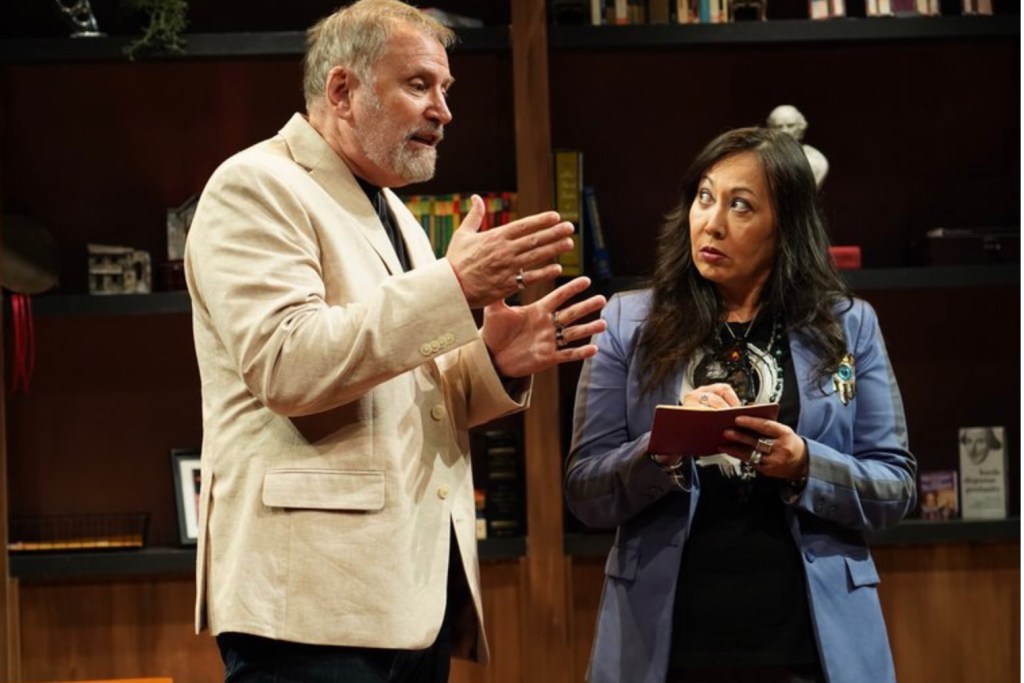
Brian Dykstra and Kate Siahaan-Rigg in Polishing Shakespeare; photo by Carol Rosegg

What makes the piece sparkle is the spirited speed with which the lines are delivered.  Only someone completely comfortable with Shakespeare could set the necessary tempo with wink-and-nod style.  There is an ease to Dykstra, who has not only performed roles in numerous productions of the real thing (King John, Much Ado About Nothing, Twelfth Night, and MacBeth among others) but also participated in Season 6 of Mos Def’s well respected spoken word poetry program on HBO.  He plays with the audience like a cat with an amused mouse.  Siahaan-Rigg is a marvel, rattling off several sublime soliloquies that celebrate all those who have been exploited and marginalized by the mass market.  Levy navigates the intricate pathway between the stuffiness of her character and the humor in her lines.

Director Margarett Perry’ s assured hand highlights the flows of power.  Supporting the rapid fire exchanges is the strategic lighting by Tyler M. Perry who also designed the hilarious Shakespeare tchotchke-ladened set.  

Eliciting both belly laughs and tummy knots, Polishing Shakespeare has been extended through August 24.  Performances run approximately 90 minutes with no intermission.  The show is presented in Theater B at 59e59.  $44 full price tickets ($30 for Members) can be purchased at https://www.59e59.org/shows/show-detail/polishing-shakespeare/

Joy: A new True Musical

Tired of not being able to answer the simple query, “how are you?” without sighing? Ken Davenport and AnnMarie Milazzo may have an answer.  Their creation Joy: A New True Musical is a type of musical optimism that has audience members returning from intermission wearing the freshly-purchased official T-shirt.  Its message of resolve and imagination envelops people in a purple and yellow cloud that even has them warmly hugging the mops they’ve been handed by the ensemble.

You may be familiar with Joy Mangano from her book “Inventing Joy: Dare to Build a Brave & Creative Life,” from seeing the 2015 movie simply entitled “Joy,” or maybe even from buying her products through the QVC home shopping network.  She was a young mother with a house full of people depending on her when she was suddenly laid off from a steady if uninspiring job.  In other words, she had much in common with women around the country who are behind in their mortgage and anxious to fully provide for their families.  Using a combination of vivid imagination, determination, and a few lucky breaks, she turned her life around.  

The musical retelling of her tale stars the dynamic Betsy Wolfe, who gained a wide range of fans with her Broadway turns in Waitress and & Juliet.  She’s surrounded by an accomplished cast including Adam Grupper as her well intentioned father Rudy, Jill Abramovitz as her overly cautious mother Toots, and Honor Blue Savage as the daughter Christie who only wants Mom to be able to come to her games.  Along her road to success she has dealings with Paul Whitty’s underhanded Cowboy Eddie, and Charl Brown’s experienced network exec Dan, both of whom are given showy performance numbers.  

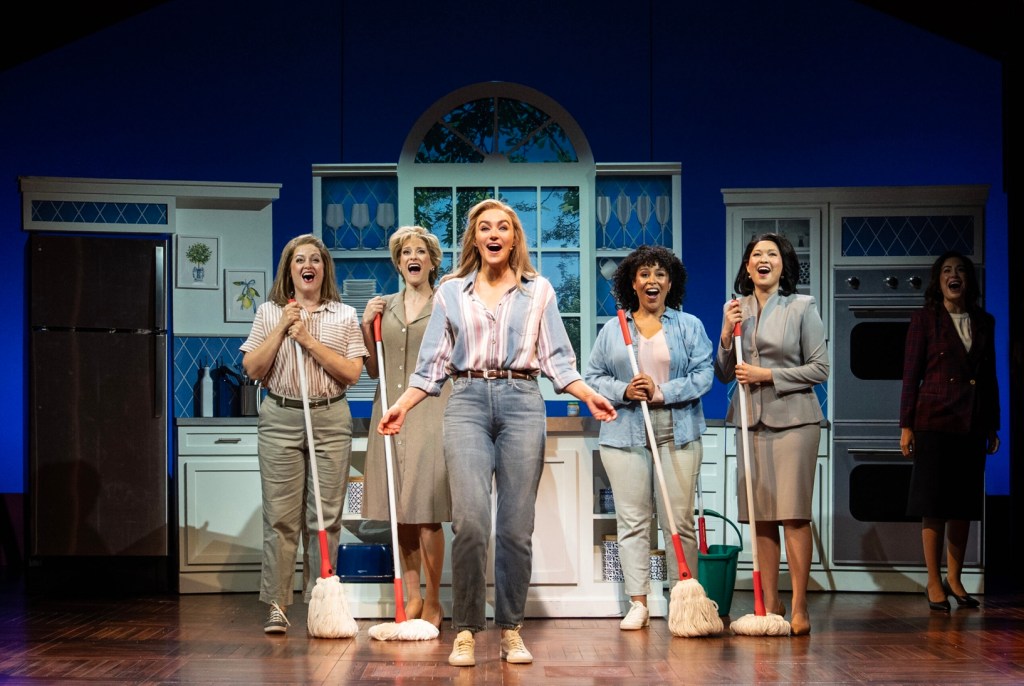
Betsy Wolfe (with ensemble members) in Joy: A New True Musical; Photo by Joan Marcus

It is easy to see why Wolfe is so popular that she gets a round of applause before she opens her mouth. Her very presence fills the house and she sings with much appreciated clarity and emotion.  Milazzo’s score isn’t the most varied and the refrains bleed into one another, but it is tuneful, carried along by Andy Einhorn’s arrangements.  The opening “Welcome to My World” does some heavy lifting, rapidly introducing us to a number of important characters and plot points.  The book by Davenport is considerably more assured than Hollywood’s interpretation of Mangano’s biography.  Filled with broad humor that makes a point, the plot gets bogged down in the second Act in part because it’s hard to top the momentum of Act I.  

Director Lorin Latarro uses her actors and limited space well, giving us glimpses of Bigger Show potential.  Likewise the choreography of Joshua Bergasse is muffled by shoulder shrugs and knee bends when it could eventually soar. The creative team has also delivered with vision but to scale.  Scenic designer Anna Louizos takes a lesson from the TV studios that brought Joy fame, filling a generic cityscape proscenium with small rolling set pieces.  Also taking a cue from television is David Bengali whose projections are critical to the storytelling.  Clever props including the co-staring Miracle Mop are designed by Andrew Diaz. Tina McCartney lets a few key outfits shine, and keeps the rest timely and simple. Liz Printz’s wigs and hair design age the lively Abramovitz and allow the ensemble to cover myriad roles.  Shout out to House Manager Dovber Dier and the incredible organization of the venue staff.

Who doesn’t welcome an upbeat story of success under trying circumstances?  Sure to be a crowd pleaser, the show is exactly what you’d expect from something called Joy: A New True Musical.  Performances are at the Laura Pels Theatre at the Harold and Miriam Steinberg Center for Theatre, 111 West 46th Street near 6th Avenue.  Running time is 2 hours including a 15 minute intermission.  The limited engagement is currently scheduled to end on August 17.  For more information and tickets starting at $72, visit https://joythemusical.com/.

OPEN

After a lengthy pause, Crystal Skillman’s award-winning play, OPEN, has been given a three-week Off-Broadway run at WP Theater.   Celebrating its 47th Season, WP Theater is the oldest and largest theatrical company in the country dedicated to fostering, producing and promoting the work of Women+ at every stage of their artistic development.  With LGBTQ rights under heightened threat, bringing OPEN’s heartfelt love story back to the stage could not be better timed.  Whatever impression the script left in 2019 has only been amplified by rising violence including a shooting near the fabled Stonewall Inn at the end of Pride Month.  

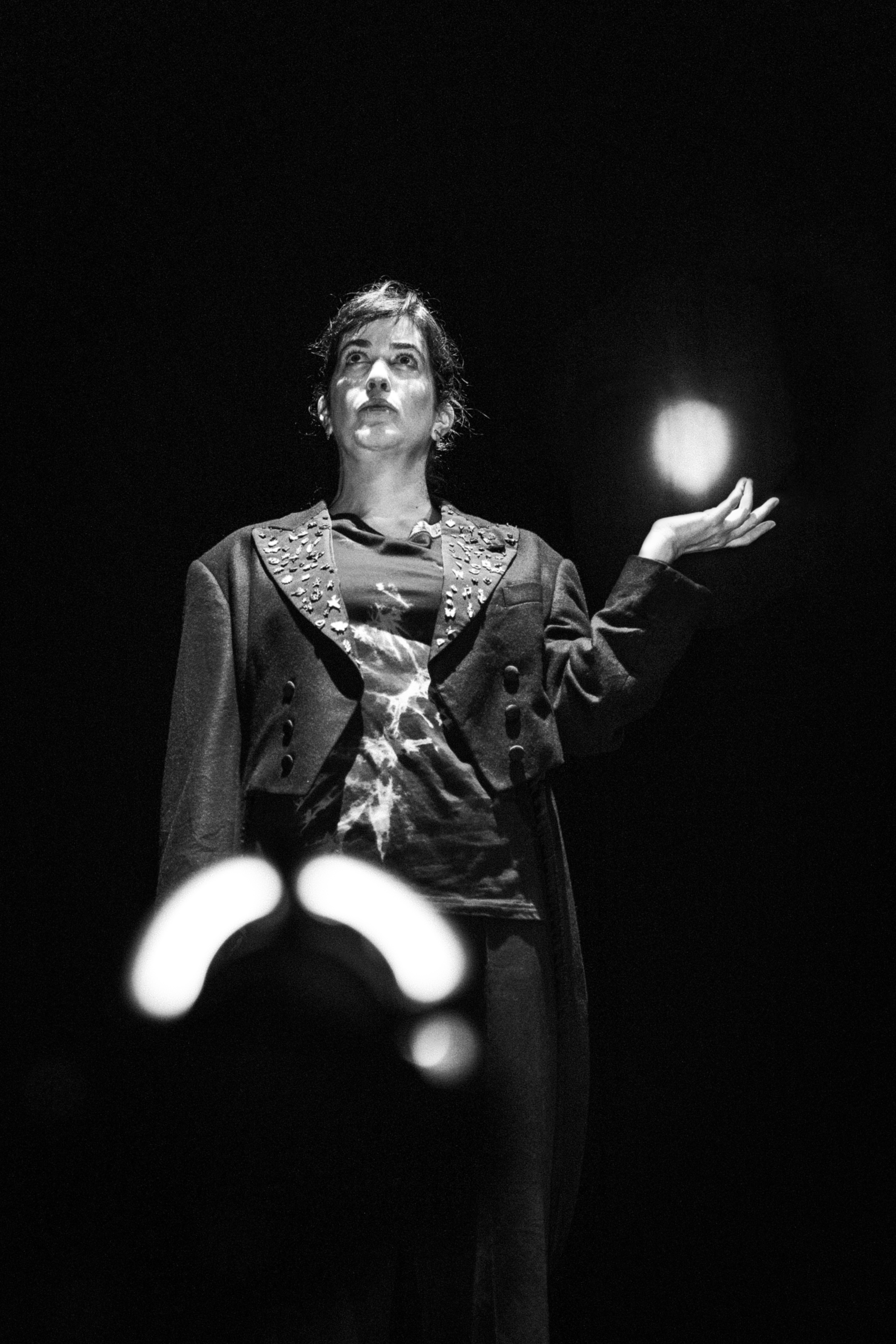
From a darkened space lined with lighting and sound equipment, Kristen invites the audience to join her for a three stage magic act consisting of Love, Commitment, and Sacrifice plus an extra promise.  To execute her wizardry, she has dressed in flashy top hat and tails (costume design by Madeline Wall) and taken on the persona of The Magician, a character inspired by “Night by Night” one of her own YA short stories. In it, a boy discovers that his make-believe skill as a conjurer has imbued him with real abilities.  In the lengthier version of her tale, he also falls in love with another boy.  Kristen hopes that she will experience a similar transformation in her powers as she struggles to reach out to her girlfriend, Jenny.

Over the course of 75 minutes, Kristen shares chapters from her and Jenny’s relationship.  She acknowledges that she has been deeply affected by a repressive upbringing in Indiana and lives cautiously: doubting her abilities and never “flaunting” being a lesbian.  Jenny, however, is out and singing with joy, surrounded by loving and accepting family and working with LGBT youth.  Not only is their meeting magical, but their life together requires all sorts of tricks from the juggling act of their needs to levitating above societal forces.  The very word OPEN performs a number of functions as in living openly gay, being open hearted, speaking openly and honestly, and opening the door to opportunity. 

Unlike most playwrights with a single character, Skillman does not give voice to her own words.  Instead the piece is brought to life by Megan Hill, who previously played The Magician at The Tank.  She is not the type of monologist who uses different vocal registers, but rather distinguishes her characters with tone and body language.  The most important ingredient in her success is engaging the imagination of audience members which she coaxes and nurtures.  The colorful details throughout the script make it easy to see with your inner eye and indeed “conjure” episodes from Kristen and Jenny’s life together.  At points, attendees function as magician’s assistants, filling out the invisible visuals with their willing participation.  

Megan Hill as The Magician in OPEN; photo by Jeremy Varner

The genuine slight of hand is performed by the creative team with impressively timed sound by Emma Wilk and lighting by Sarah Johnston (who also designed the set).  Director Jessi D. Hill and Magic Consultant Rachel Wax along with Wilk, and Johnston have collaborated beautifully on executing the physicality and visualization of the incantations without a ball, ring or flower in sight.  

Inventive, touching, and impactful, OPEN is a unique solo entertainment.  Performances continue at WP Theater, 2162 Broadway in New York, through July 27.  Tickets are $65 and available at https://wptheater.org/wp-space-program/open/. Pre-show acts and post-show talkbacks will incorporate the talents of the magicians who helped inspire Skillman’s story and the actors who portrayed The Magician in Broadway Licensing productions, drawing a through-line to the powerful role of magic within the LGBTQIA+ community.

Camera Ready

Throughout the 1980s, videographer Nelson Sullivan used his developing camera skills and sincere love of the downtown New York art scene to capture and preserve many of the distinctive talents of that special time and place.  In partnership with his childhood friend James “Dick” Richards, host of a long-running access channel LGBT variety show, he put RuPaul on a path to stardom.  As he experimented with newer equipment and continued to evolve his technique, he sometimes included himself in the frame.  When he died at 41 of an apparent heart attack, he left behind a body of work credited with forming the template for the type of short form personal videos that proliferate YouTube.  

Now a behind the scenes look at Sullivan’s life and work has been fashioned into Camera Ready, a new play with music written and directed by his friend, artist/playwright/filmmaker Gary LeGault.  The sprawling cast of twenty much resembles the streets outside with its array of ages, races, and body types.  The ensemble brings unadulterated enthusiasm to each scene such as “Friday Evening in New York,” a celebration of Nelson’s first night out on the town with his camera.  There is a genuine sweetness to Jack Warren Lewis’s uplifting interpretation of the documentarian.  Other standouts include Bryce Payne’s dazzling RuPaul, JC Augustin gravely voiced Jackie Curtis, and a versatile Alexa Echevarria as Sullivan’s mother, musician Rhonda Granger, and a truly horrible Mona Robson in rehearsal at La Mama.  Her performance in the upbeat “All the Money” is a hoot.

Jack Warren Lewis as Nelson Sullivan with the cast of Camera Ready

Though working on an obviously tight budget, creative thought has gone into the design. The majority of the songbook (arrangements by Chris Glik and Michael O’Dell) has a breezy, clubby style that comes through on the solo piano. The backdrop, drawn by LeGault, is reminiscent of Edward Hopper had the artist worked in crayon.  Lola Saenz, under the direction of set designer Lytza Colon, installed bricks which adorn the central staircase. Night scene costumes and wigs by Diana Chaiken have the perfect dramatic flair.  

Oddly, it is LeGault’s obvious affection for Sullivan that flattens the story.  He has recorded history with heart, which makes for a valid but blurry lens. There is too much emphasis on tiny interactions and it is doubtful anyone under the age of 60 would recognize the celebrities about whom Sullivan exclaims.  A key relationship with housemate Choux (Dave Onofre) is underdeveloped and the parade of houseguests doesn’t achieve substantial impact. The current script also skirts the remarkable implications of Sullivan’s legacy. Ultimately the piece gets bogged down in less significant details and crosses the finish line at a hefty 2 ½ hours. 

With the show having completed its off-off-Broadway run on July 6 at Theater for the New City, LeGault has an opportunity to expand his private portrait into a deeper, more meaningful tribute to Nelson’s work.  This would also further highlight the gifts of Drag Queens and trans performers featured in Sullivan’s videos.  A rethinking would likely require LeGault to collaborate with an editor who could provide enough distance to make the appropriate refinements.  However, a more examined celebration would elevate not just Nelson’s legacy but the contributors to the American art scene he so valued.