Monthly Archives: February 2026

Chinese Republicans

In Chinese Republicans, four women of Chinese heritage and spanning three generations are gathered for an Affinity Luncheon near their New York City office.  As co-workers at a stressful international investment banking firm, they look forward to these supportive gatherings, not to mention the turnip cakes.  Their stated purpose this time is to welcome their newest member — the pretty and giddy 24 year old Katie — and celebrate her recent promotion.  Managing Director Ellen has been acting as Katie’s mentor, giving her encouragement and hints about how best to reach the next rung of the ladder.  Corporate consultant Phyllis, who once held Ellen’s current job, plays healthy skeptic to Ellen’s cheerleader.  The most conservative of the group, she punctuates many of her observations with a pointed “Thanks, Obama.”  Also in attendance is Chinese citizen Iris.  She is in the US on a Work Visa and hoping her contributions to the firm will allow her to stay.  But from what we can see, her main responsibility is to get the lunch ordered correctly.

Over the course of numerous encounters and flashbacks, we watch the foursome jockey for position, sometimes in support of one another and more often in competition.  All four are trying to cope with pressures both cultural and corporate; sometimes responding in anger and other times tactically. Their varying viewpoints on what it means to be Chinese add an intriguing element to their sparring.
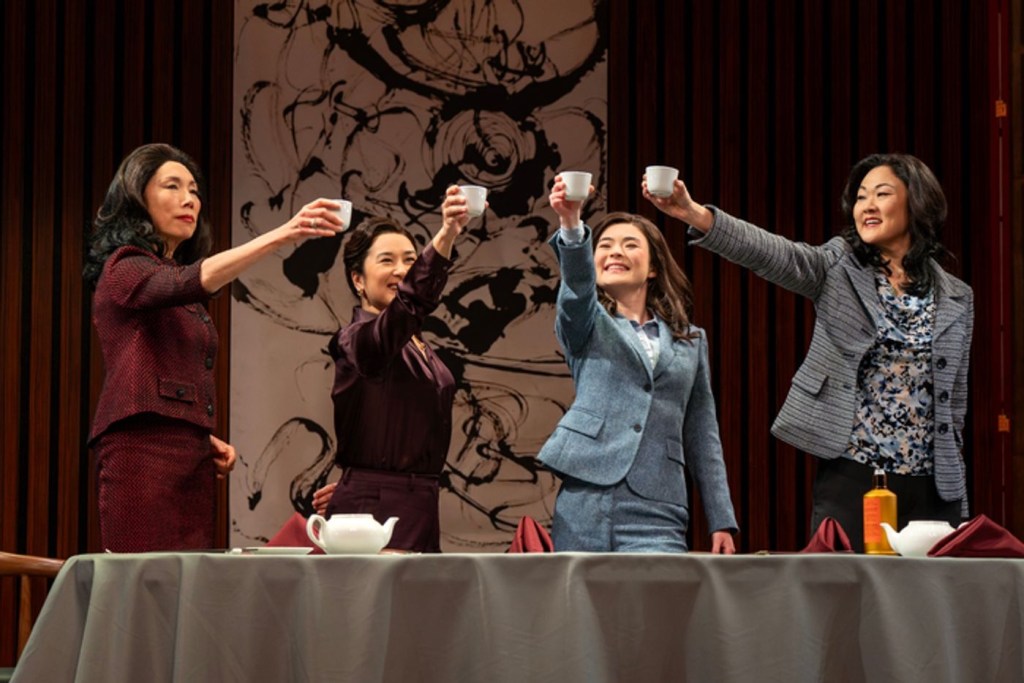
Jodi Long, Jennifer Ikeda, Anna Zavelson, and Jully Lee in Chinese Republicans; Photo by Joan Marcus

Quite a bit of obvious shorthand is used to backfill the women’s histories with the intention of clarifying their current motivations.  Such narrow definition of character leaves Jennifer Ikeda (Ellen), Jully Lee (Iris), Jodi Long (Phyllis), and Anna Zavelson (Katie) without the ability to shine at full wattage. Some right leaning political views are mixed in with the abbreviated development (whoosh hate crime, whoosh abortion, whoosh “me too”) and the placement of the action in 2019 avoids the most thorny topics.  Often director Chay Yew relies on elevated voices and manic gestures to take the place of more involving connection.

Playwright Alex Lin has generated enormous enthusiastic buzz, most recently for her Lear-inspired Laowang.  In Chinese Republicans, what she sacrifices in keener character arcs, she makes up for in startling imagery.  She demonstrates a flair for switching tones from heart attack-inducing conflict to door-slamming farce.  Based on Lin’s obvious talent and genuine interest in her subject matter, there is a deeper, more distinctive, and less strident script just beyond our reach. While it certainly never gets boring, as the piece approaches its final 15 minutes the plot losses focus.  

The play’s atmosphere is nicely detailed.  Costume designer Anita Yavich provides a wardrobe made for code switching, mixing business attire with Asian-inspired accessories.  The sound design by Fabian Obispo incorporates original music and big city hubbub. Impressive sets by Wilson Chin include an attractive modern restaurant and the imposing wall of the investment firm.  To prepare for the varying degrees of fluency in Mandarin, Cantonese, and English, the company enlisted dialogue coach Ka-Ling Cheung.

With a great deal to say and an unconventional blending of styles, Chinese Republicans is both a thrilling and a frustrating ride. The World Premiere production, part of Roundabout’s 2025-26 season, continues through April 5.  Performances are at the Harold and Miriam Steinberg Center for Theatre, Laura Pels Theatre, 111 West 46th Street.  Running time is 95 minutes without an intermission.  Seat prices range from very reasonable $69 – $102. The venue has superior sight lines and a small cafe on the lower level.  Visit https://www.roundabouttheatre.org/get-tickets/2025-2026-season/chinese-republicans?url=/get-tickets/2025-2026-season/chinese-republicans for more information and to purchase tickets.
Not Nobody

Retired professor McAlester Daily does not want to be labeled.  Given the nature of a spectrum, he posits, aren’t we all on it?  True, he insists on clarity: of the questions being asked of him and of the lines he is to stay within.  He also emphatically requests sufficient time to formulate and fully explain his answers. His unusually deep self-knowledge and above all his informed understanding of “the system” make for worrisome challenges when he becomes caught up in the investigation of a policeman’s murder.  This is the provocative set-up of Not Nobody, a blisteringly funny play by Brian Dykstra.  

Also starring, Dykstra brings to his character a genuine respect for the individual and concerns about the state of law and ethics in America.  That sincerity of purpose informs a properly studied performance of a man bouncing between fluster, fear and fervor.  McAlester is all too aware of how he and his disarming honesty are being perceived and judged by those around him. Consequently, he comes across as heartwarming as he is frustrating.  The supporting parts ranging from detectives to broadcasters are flatter but given pep and shading by Sheffield Chastain, Kathiamarice Lopez, and Kate Siahaan-Rigg who each take on multiple roles.  There is red meat aplenty, but who doesn’t enjoy a good burger every once in a while?  

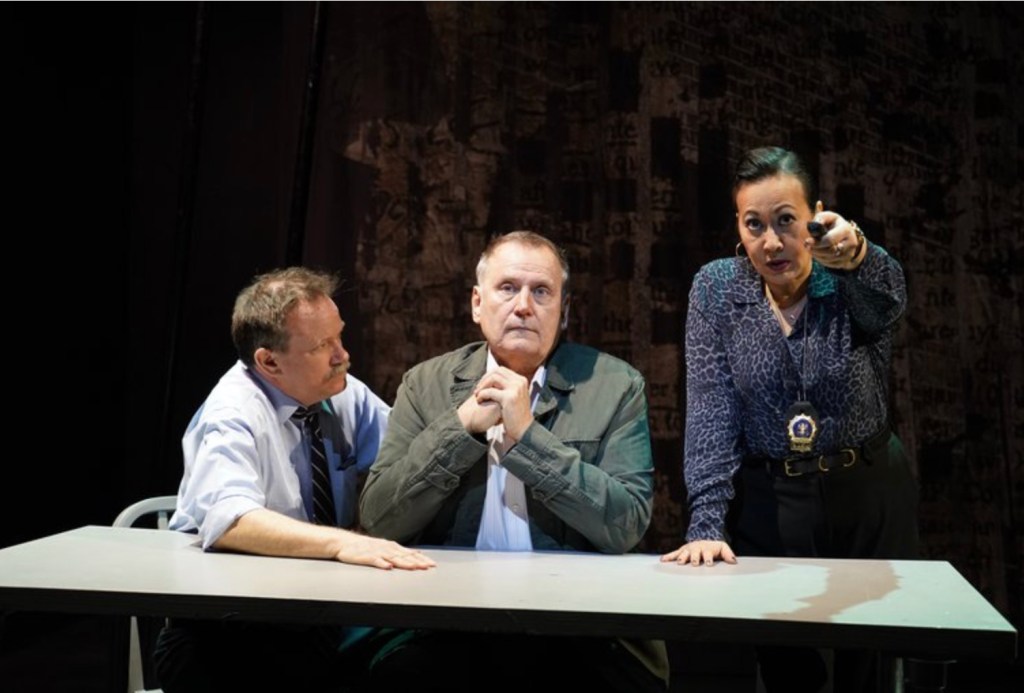
Sheffield Chastain, Brian Dykstra and Kate Saihaan-Rigg in Not Nobody; photo by Carol Rosegg


Director Margarett Perry has chosen to lean into the broader strokes of the script rather than refining them. This has the effect of further emphasizing McAlester’s exceptional world view and meticulous attention to detail.  While all of the actors skillfully handle the quick changes, there is an imprecision to the technical cues that would likely drive McAlester around the bend. Jen Leno lighting, which is designed to switch seamlessly between harshly lit offices and the more subtle glow of city streets, is diminished by off-target spots. Set designer Tyler M. Perry’s black and white cityscape with its swirl of letters and scribbles is distracting to anyone attempting to decipher it.  The askew poles and tumble of chairs — perhaps metaphors for seeing events from different angles — work better in support of the action.  Daniel Lawson’s costumes, primarily an array of “uniforms” of the trades, also help to move things along with identifiable shorthand.

As with Polishing Shakespeare — the best-selling show in the 21-year history of 59E59 Theater B — Dykstra’s Not Nobody finesses language and mines current events to create a work that holds laughter and pain comfortably side by side. It is a welcome addition to the winter season for those who like their comedies on the smartypants side.  Performances continue through March 1 in Theater B at 59E59 Theaters, 59 East 59th Street.  Running time is about an hour and a half without an intermission.  There is no late seating or re-entry.  Tickets are $44 for non members including all fees.  There are no bad seats in the house, just slightly treacherous steps up the middle aisle.  Visit https://www.59e59.org/shows/show-detail/not-nobody/ for tickets and further information.

The First Line of Dante’s Inferno

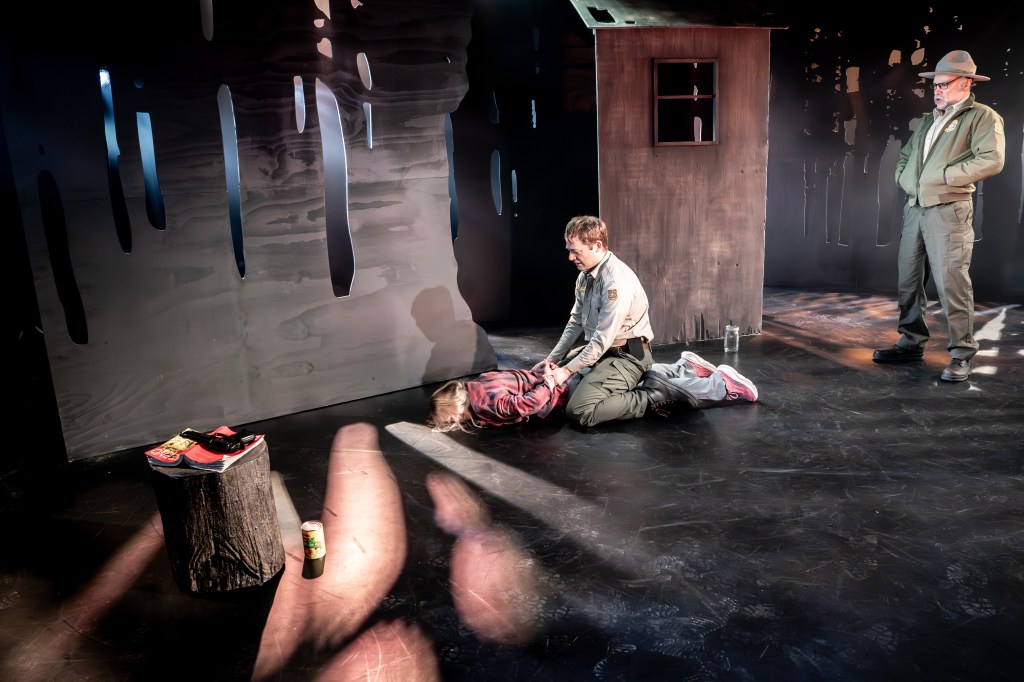
The presiding character in The First Line of Dante’s Inferno has no lines, but dominates and literally overhangs the dialogue.  It is the dark outlying woods represented by Lauren Helpern’s evocative set, with Jianzhi-esque  trees and a blackened canopy that flutters in the HVAC of La MaMa’s Downstairs Theatre.  This is where Ann (Kellie Overbey) has come, seeking her missing sister Carol.  As she shouts out to any creatures nearby, it becomes clear this is not her customary environment. Her tiny basecamp — a one room squatter’s cabin made of stolen plywood and containing a camping stove, a sleeping bag, a copy of Inferno, and some moonshine — has been under observation by a young ranger, Craig (Evan Sibley).  He has also been on Carol’s trail, though he is less optimistic about her being found.  With stunning speed, the two make an arrangement that will allow Ann to continue her search.  But the longer the duo stays within the forestland, the more feral they become, shedding social norms in favor of unfiltered instinct.  

Kellie Overbey, Evan Sibley and Greg Stuhr in The First Line of Dante’s Inferno; Photo credit Marina Levitskaya

Similar to the title’s narrative poem, Kirk Lynn’s emotionally gripping script is constructed in the style of Story Theater, with characters describing their actions.  First and third person are used interchangeably as if they too are fictionalized versions of themselves.  The shifting perspective often reveals more about the storytellers than the story.  The blending of facts, memories and psychological response is repeatedly illustrated by the telling phrase “As I remember…”  as if at heart they question whether their statements are 100% true.

Under Christian Parker’s direction, Overbey and Sibley truly play off each other, generating surprising wattage from an unlikely pairing.  Ann’s and Craig’s elevated honesty and rawness is refreshing and often funny.  So, too, is Craig’s older partner, Bill (Greg Stuhr) whose years of job experience have not necessarily made him wiser and certainly not a better shot.  He is more like an annoying big brother than a senior officer.

Carrying nearly as much weight as the scenic design is Bart Fasbender’s stirring soundscape of animal noises, vocalizations, and rustlings.  By contrast, lighting designer Zach Blane’s recreation of the shifting shadows and foliage sometimes pulls focus from the actors. Kanika Asavari Vaish designed the props, which include a suitably bright red copy of Inferno, that is used as a sort of divination tool. 

For 90 minutes, The First Line of Dante’s Inferno immerses the audience in its own musky world with a unique set of rules.  It is the debut production of Shadowed Forest, a multi-generational company that successfully elicited response from the broad swath of theater-goers who shared the space on a frigid Sunday.  Tickets are impressively priced at $30 for Adults, $25 for Students/Seniors and $10 for La MaMa Members and are available for advance purchase at https://lamama.org/the-first-line-of-dantes-inferno/.  Additionally, the first ten tickets for every performance are $10 each (limit 2 per person) and available first come, first served.  Performances of this World Premiere continue through February 22 at La MaMa’s Downstairs Theatre at 66 East 4th Street.  Recognized and rewarded for its support of experimental theater, this house offers comfortable seating, terrific sightlines, and even a few welcoming beverages for purchase.