Category Archives: Drama

Archduke

Of all the action leading up to World War I, the chapter most remembered by students of that era is the assassination of Archduke Franz Ferdinand, heir to the throne of the vast Austro-Hungary empire.  In Archduke, playwright Rajiv Joseph focuses less on explaining the political situation and more on the young, inept members of the assassination team.  Less interested in portraying history than in tinkering with it, Joseph compresses the time frame and leverages the lore surrounding the trio, particularly the role a sandwich played in the mythologizing of the bungled plot.

Set in the days leading up to the murder, there exists in Archduke a backbone of facts, from an overview of essential geography to pairs of uniting black gloves, a nod to the Black Hand nationalist group that aided in the real boys’ training.  Joseph recruits the Serbian Nationalist army officer and likely organizer of the plot, Dragutin Dimitrijević — better known by his nickname Apis — as a main character.  Religion is both a comfort and a tool for manipulation, with dreams, beliefs, and conscience playing roles equal to struggle for state independence.  In concentrating his story on the indoctrination of vulnerable teens, Joseph brings modern depth and understanding to a long-ago event.

Under the direction of Blanka Zizka, the artistic production at Philadelphia’s Wilma Theater in the spring was steeped in Eastern European influence. Serious themes of violence and conflict were mixed with theater of the absurd and old fashioned clowning.  Two middle aged women took on the roles of Gavrilo (Suli Holum) and Nedeljko (Sara Gliko) skillfully infusing their characters with adolescent discomfort.  The third less showy would-be assassin, Trifko, was played with comparable gravitas by Barrymore Award winner Brandon J. Pierce.  Steven Rishard with his Baldwinesque delivery portrayed Apis as a blustering moody fatherly figure.  For the lone female, Apis’s housekeeper  Sladjana, Zizka employed Black company member Melanye Finister, who gave the character a true touch of the Black Arts.

There was heavy emphasis on 3-D imagery designed by Jorge Cousineau to augment Thom Weaver’s traditional lighting that illuminated the vast dark space.  Intense projections reminiscent of the black light shows of the Czech Republic were among the most memorable features. So mesmerizing were the effects and so memorable were Zizka’s choices that the visual impact upstaged whatever was on the page.

I had the opportunity to revisit Archduke as Roundabout’s Off-Broadway fall offering.  Their rendition is directed by Darko Tresnjak who was born in Zemun where much of the action takes place.  As his set designer, he chose to work with frequent collaborator Alexander Dodge who emphasized topographical and language boundaries to set the scene.  More like acrobatics, the fight scenes with movement by Rocío Mendez have dance-like athleticism.  Gavrilo’s haunting visions are given aural presence in Jane Shaw’s sound design, but the images are left to our imagination.  

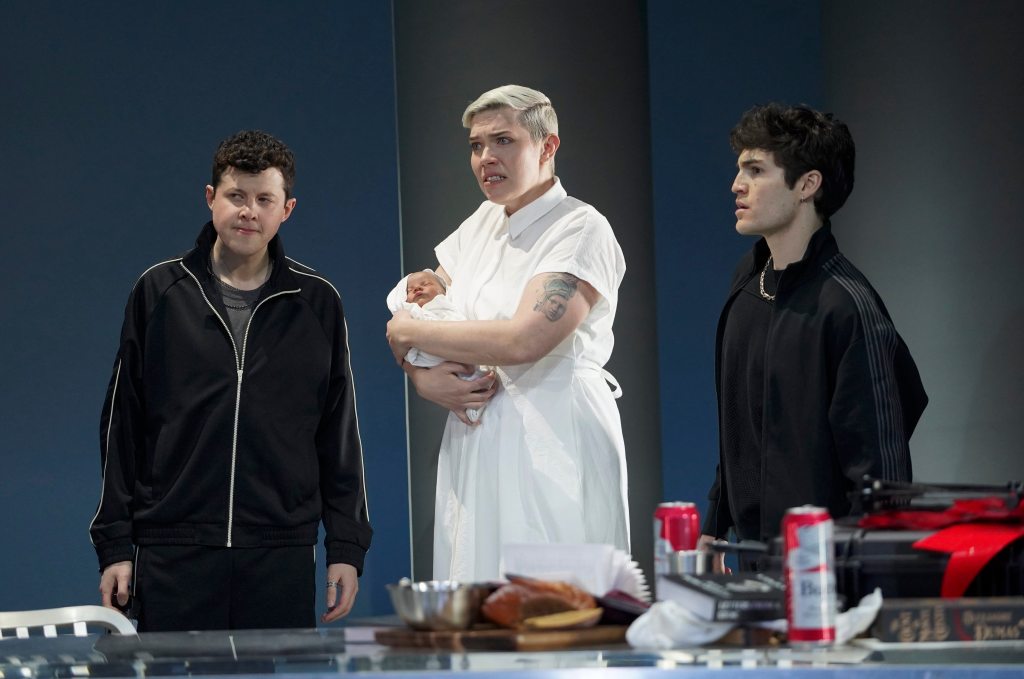
Patrick Page, Jason Sanchez, Adrien Rolet and Jake Berne in Archduke; photo by Joan Marcus

Tresnjak’s Gavrilo and Nedeljko are Jake Berne and Jason Sanchez, young men making their Off-Broadway debuts.  The third assassin in training is portrayed by Londoner Adrien Rolet in his first professional role.  There is a delightful freshness to all three performances.  As for the calculating Apis, Patrick Page, whose voice has become synonymous with chilly seduction, gives him a lowkey “I’ve got this” vibe.  Another Broadway vet, Kristine Nielsen, gnaws on Sladjana’s lines, coming across like a bewitched herbalist.

That two respected companies in two terrific theater cities — Philly’s Wilma and New York’s Roundabout — chose to include Archduke in their 2025 season is significant.  In a way, the script shares characteristics with the history that inspired its writing.  It isn’t the strongest of Joseph’s work which makes it ripe for differing emphasis and interpretation.  With all the talk of masculine toxicity taking up space in our national conversation, it’s important to be reminded that free will can overcome even the most enticing manipulation.

Archduke continues at the Laura Pels Theatre, 111 West 46th Street, through December 21.  Running time is about 2 hours with one intermission.  Tickets start at $69 and can be purchased at https://www.roundabouttheatre.org/get-tickets/2025-2026-season/archduke.

Meet the Cartozians

What establishes our identity?  Skin color?  Language?  Scientific evidence?  In a country comprised primarily of immigrants, how do we balance our cultural heritage with our recognition as Americans?  In Meet the Cartozians, Talene Monahon, “a playwright of actor descent,” explores these weighty and often murky issues with keen insight and a knowing sense of humor using an Armenian family as her instruments.  With its complex history and even more complicated geography,  Armenia provides a wellspring of arguments about nationality, culture, and sense of self.  And if the play’s title brings to mind the most famous Armenian American of all, that, too, is very intentional.

In Act 1 we meet Tatos Cartozian, a character based on the man who was at the center of an Oregon court case in 1924.  As was true for the real Tatos, Monahon’s variation has been classified as a non-white Asian and on those grounds had his citizenship revoked.  It does not help his argument that his company makes Persian “oriental” rugs and employs “Islamics”.  To say more would detract from the delights of experiencing the reasoning of the family — Tatos’s mother Markrid, son Vahan, and daughter Hazel — along with their lawyer Wallace McCamant as he guides them in their preparation.  Monahon’s ear for dialogue and director David Cromer’s meticulous direction of each exchange should be freshly savored.

Act 2 takes place 100 years later in the Glendale, California home of Leslie Malconian. Several other Armenian Americans have been asked to gather with her to discuss and celebrate their ancestral heritage.  Their conversation will be featured in a special holiday episode of a wildly popular reality television show.  Despite the passage of time as well as that of many congressional bills, the subject of whiteness is no less thorny.  But it has taken on a very different hue.

The same six actors — Raffi Barsoumian, Will Brill, Andrea Martin, Nael Nacer, Susan Pourfar, and Tamara Sevunts — play parts in both acts.  Martin delivers her characters’ retorts with the wry “who me?” inflection we’ve come to expect from the seasoned comedian.  Fellow Tony winner Will Brill gets even bigger laughs with his quiet earnestness.  But a work this dialogue-heavy only succeeds because of the talent of the entire ensemble. The 2 ½ hour piece sails along at a satisfying clip.

Will Brill, Andrea Martin, Nael Nacer in MEET THE CARTOZIANS ; Photo by Julieta Cervantes.

The artistry behind the scenes is equally accomplished, particularly Enver Chakartash Act 2 costumes in relation to their Act 1 counterparts.  Scenic designer Tatiana Kahvegian creates the illusion of expansive depth in both living room settings.  Stacey Derosier’s lighting shifts from the muted tones of low watt bulbs and filtered sunlight to the intensive glare of actual spotlights.

Those who, like me, consider our country to be less of a melting pot and more of a stew — with distinct ingredients that complement each other — will find the brainy banter of Meet the Cartozians a sparking and engrossing entertainment.  The story also serves as eye-opening education as we witness a renewed struggle against those who wish to “preserve America’s white, Christian identity”.  It’s an auspicious opening for the 47th Season for celebrated 2nd Stage.  Performances continue through December 7 in the Irene Diamond at the Pershing Square Signature Center, 408 West 42nd near 10th Avenue.  The house is comfortable and well raked, but noticeably breezy.  Tickets begin at $86 and can be purchased at https://2st.com/shows/meet-the-cartozians#info.

Robert Icke’s Oedipus

Restrict your liquids and buckle up for the ride.  Robert Icke’s multiple Olivier Award Winning Oedipus has landed on Broadway.  The writer/director phenom transforms the 2500 year old Greek myth to tell the story of Oedipus, a warm and ambitious politician on an election night that should be full of celebration.  Though he is an immigrant whose marriage to the widow of former ruler, Laius, has prompted gossip, his messages of acceptance and affordability have resonated with the voting public.  A landslide victory is all but assured.  Yet his promises to release his birth certificate and to investigate Laius’s death have stirred concerns among those closest to him.  Oedipus’s own uneasiness begins to rise when a futurist cult member, Teiresias, is admitted to campaign headquarters and utters a series of dire warnings.  To ensure the now-set ominous mood remains unbroken, the two-hour political thrill ride has a strict no late seating, no re-admittance policy.

Mark Strong and Lesley Manville in Oedipus; photo by Julieta Cervantes.

On stage for the majority of the running time, Mark Strong manifests a charismatic Oedipus, whose worthy purposefulness has a pronounced shadow side.  His chemistry with the radiant Lesley Manville as Jocasta makes their critical relationship positively pop off the stage.  Jordan Scowen, James Wilbraham and particularly Olivia Reis are terrific as their flawed offspring Eteocles, Polyneices, and Antigone.  (No Ismene exists in this edition.)  Joining the production for the US run is the steady John Carroll Lynch as Creon, Oedipus’s affable campaign manager and brother-in-law. Bhasker Patel brings stateliness to the faithful Corin.  Though his appearance is short, Samuel Brewer makes an affectively disturbing Teiresias.  While it is truth that Merope is supposed to be stressed and guilt-ridden, the usually stellar Anne Reid could use a bit of an energy boost to reach the cheap seats.

As an extension of the election night conceit, the lease is up on Oedipus’s campaign quarters.  This allows for the poetic disassembly of Hildegard Bechtler’s industrial modern set, starting with draining the color out of the space.  To illustrate the initially relaxed state of the characters, costume designer Wojciech Dziedzic has primarily adorned the family members in athleisurewear, with the formal attire set out for the approaching victory.  Tal Yarden’s videos add realism and reminders.  The ticking clock and mood music incorporated in Tom Gibbons’ sound design is aural gilding of the tension lily.  

For those unfamiliar with Studio 54 (254 West 54th Street), there are a few features to keep in mind.  The acoustics are particularly good throughout the space.  Though they get you closest to the action, there is almost no rake in the first dozen rows of the orchestra.  The front mezzanine, with the previous chair back only reaching to ones knees is a strategic alternative. But the steepness of the stairs left some white knuckling the handrail.  

Apologies to Liam Neeson, but it really takes a particular set of skills to tell a story with an ending so infamous it has its own complex and still keep an audience on the edge of their seats.  By tethering the tragedy of Oedipus so beautifully to today, Icke infuses what could be a cold classroom flashback with deep humanity and chilling emotion.  Tickets are being sold for performances through February 8, 2026.  Visit Oedipustheplay.com for details and to purchase tickets.

Road Kills

In art as in life, there is captivating drama to be mined when mismatched strangers are thrown together by circumstance.  So it is in Sophie McIntosh’s Road Kills currently in an Off-Off-Broadway run after a well-received series of readings.  Owen (D.B. Milliken) runs a small company responsible for collecting the carcasses of animals who have been hit by drivers too distracted to notice or care about the deer crossing sign.  He picks up extra money by taking on assistants who are working off their community service hours.  The current pair of hands belongs to Jaki (Mia Sinclair Jenness) who was arrested for drunk driving.  There is a spilling of guts along with the gut spills.  Together each Saturday on relatively deserted stretches of highway in Wisconsin there is little to do but pry open each other’s long-closed emotional doors. 

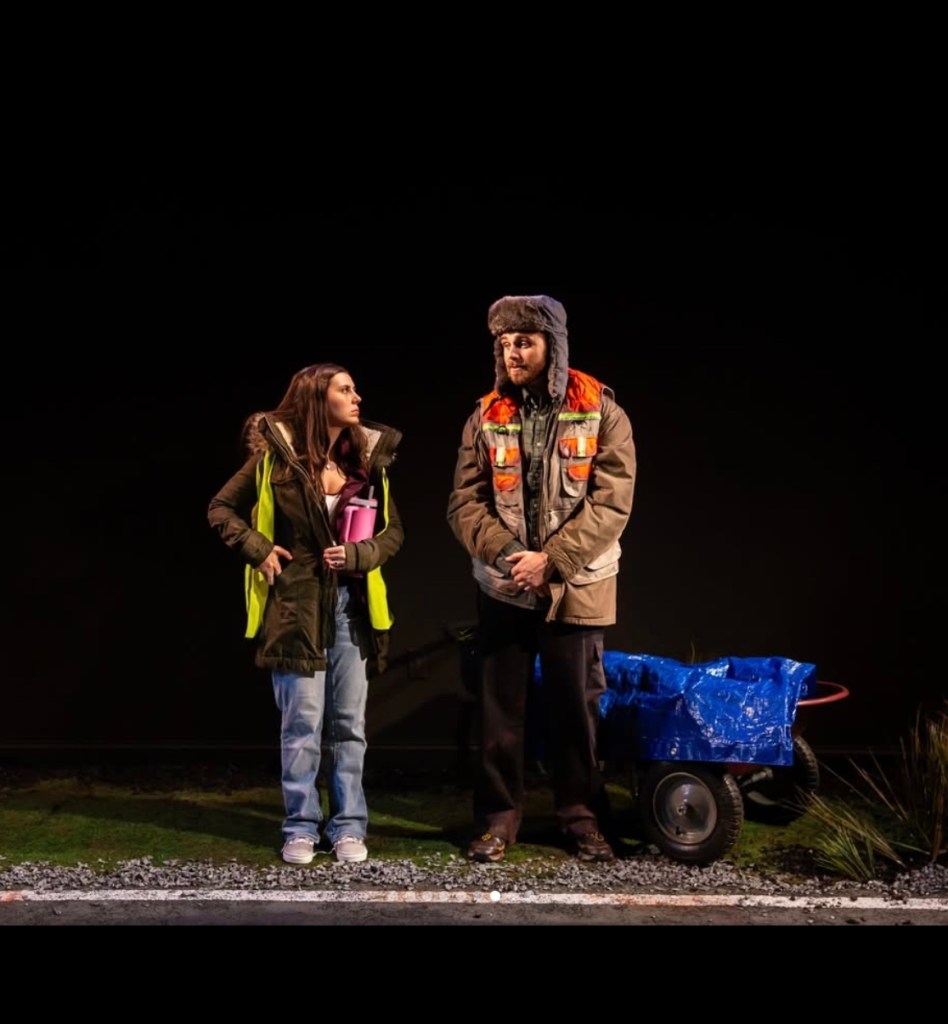
Mia Sinclair Jenness and D.B. Milliken in Road Kills; Photo by Nina Goodheart

Though some of the details are telegraphed, for the most part McIntosh’s biting script keeps us unbalanced.  With a title like Road Kills, it is unsurprising that the content has a high “ick” factor.  Warnings can be found on the production website in two flavors: “broad strokes” and “gory details”.  In the current space, everything is up close and deeply personal, but there is some sweetness mixed in with the ewwww.  

Since I prefer my readers to have the experience of allowing a play to unfold, I will only say that Owen’s and Jaki’s peculiar relationships to animals goes beyond their handling of mangled body parts.  Though their experiences as social outliers are dramatically different, the result is a similar inability to connect with humans in a traditionally healthy way.  Their expression of sexuality would likely be found in the DSM-5.  Protective reflexes are particularly askew in Jaki’s dealings with Neil and Miles, both portrayed by Michael Lepore.  (That the two characters look similar is a serendipitous plot enhancement.)

As staged by director Nina Goodheart in the three-row venue, the meticulous attention to detail heightens the intimacy of the performance.  We are seated at set designer Junran “Charlotte” Shi’s double yellow line where a dead fawn lies surrounded by dark red spots that are revealed to be frozen blood.  Passed-its-peak shrubbery lines the upstage side of the road.  Unlike most crews, stage manager Damayanti Wallace and team work silently in total darkness to set each scene.  From the black, the prerecorded voice-over cast of 11 depict the events that lead up to an accident, with each incident being an escalation of the previous one.  Lighting designer Paige Seber and sound designer Max Van add realistic sensory input.  Sean Frank’s props range from tragic to amusing.  While some audience members laughed though the disconcertion, it was the craftsmanship and care that I found comforting.  

Produced by McIntosh and Goodheart’s Good Apples Collective alongside ryan duncan-ayala, the twisted ride of Road Kills continues through September 6.  Runtime is approximately 85 minutes with no intermission.  Performances take place on the second floor of the Paradise Factory, 64 East 4th Street in New York.  Masks are strongly recommended and provided at the check-in desk.  The A/C is an overachiever and a sweater will come in handy.  Tickets begin at $18 and are available at https://www.goodapplescollective.com/road-kills.  

Lunar Eclipse

When the earth, moon, and sun are in alignment, the moon moves into earth’s shadow blocking light from reaching the moon’s surface.  This lunar eclipse is the featured event of Donald Margulies play of that name.  It also serves as a somewhat strained symbol for the darkness that has engulfed the long marriage of 70-something George and Em.

The piece opens with George alone on stage crying in the vastness of night in a field on his Kentucky farm.  Soon Em arrives with a gigantic bag filled with items that might make him more comfortable, though he doesn’t show much interest in her offerings.  They talk as they wait for the moon to take on its eery red glow.  The phases of the astronomical phenomenon — umbra, penumbra, total — are projected behind them, inserting breaks in flow of their conversation.  It soon becomes clear that much as the moon’s shine is being swallowed up, so have they been swallowing their fears and sadness.

George is intellectual with a particular interest in the stars and a strong need to stop and appreciate his surroundings.  Em is more an instinctual “city girl” and her relative ignorance allows George to explain events to us as well.  As time elapses and the bourbon flows, their increasing levels of honesty and respect break chinks in the wall between them.  Despite all the disappointments they’ve had to face, they are reminded why they chose each other in the first place.

Lisa Emery and Reed Birney in Lunar Eclipse; Photo by Joan Marcus

Marital every day moments and eventual strain is not new territory for playwright Margulies, who previously won the Pulitzer Prize for Drama in 2000 for Dinner with Friends.  Much of the terrain here is as well-ploughed as George’s family farm.  But director Kate Whoriskey has been blessed with her cast.  Lisa Emery and Reed Birney — reprising his role from Shakespeare & Company’s 2023 production in Lenox, Massachusetts — remain two of the most reliable stage performers and watching their exchange is enthralling.  The dialogue may not be radical, but much is communicated in a touch, a look, or a pause. Their poetic descriptions of worry, loss, and grief ring true, though the fog doesn’t just roll across the skies.  

Scenic designer Walt Spangler has created a thick black box around the proscenium, restricting the space and cushioning the actors’ movements with earth (though what that does to the audience view from the first few rows is unwelcome.)  Just a few wild flowers add color to the landscape.  The tinkling of a piano lulls the audience upon entry to the theater.  Occasionally the soft sounds of the surrounding nature join Sinan Refik Zafar’s soundscape.  Lighting by Amith Chandrashaker provides metaphoric bright and shadow building to the crescendo of S. Katy Tucker’s video.

Unsurprisingly, though seeped in tragedy, Lunar Eclipse with its slow reveals and well-earned sorrow, is a master class in acting.  Performances take place on The Irene Diamond Stage in the Pershing Square Signature Center, 480 West 42nd Street. Runtime is approximately 90 minutes without an intermission.  Tickets are available through June 22 at https://2st.com/shows/lunareclipse