Category Archives: Live Stream

Eboni Booth: Story/Teller

Eboni Booth’s Pulitzer Prize winning Primary Trust is currently one of the most performed plays regionally.  It is the kind of work that people say leaves them “shattered,” “undone” and “wrecked” and they mean that in a good way.  The New York Premiere was my return to live theater after more than three years because of COVID.  The themes explored, especially when delivered by the incomparable William Jackson Harper, could not have provided a more perfect balm.  Though written in May of 2023, that review remains my second most read.  (You can read it for yourself here: https://theunforgettableline.com/2023/05/30/primary-trust/)   

To celebrate the printing of the Primary Trust script, TCG, dramatic literature’s largest independent trade publisher, presented an evening with Ms. Booth. The book’s cover shows a small town street with each side mirrored in the other, beautifully reflecting the feelings evoked by the original set design. 

The evening opened with a short reading by Harper accompanied by original composer/perform Luke Wygodny on cello and the bell meant to represent the way in which our thoughts frequently interrupt themselves.  These scenes gave newcomers a taste of Primary Trust’s beauty and provided a strong reminder to anyone who saw the full production.  
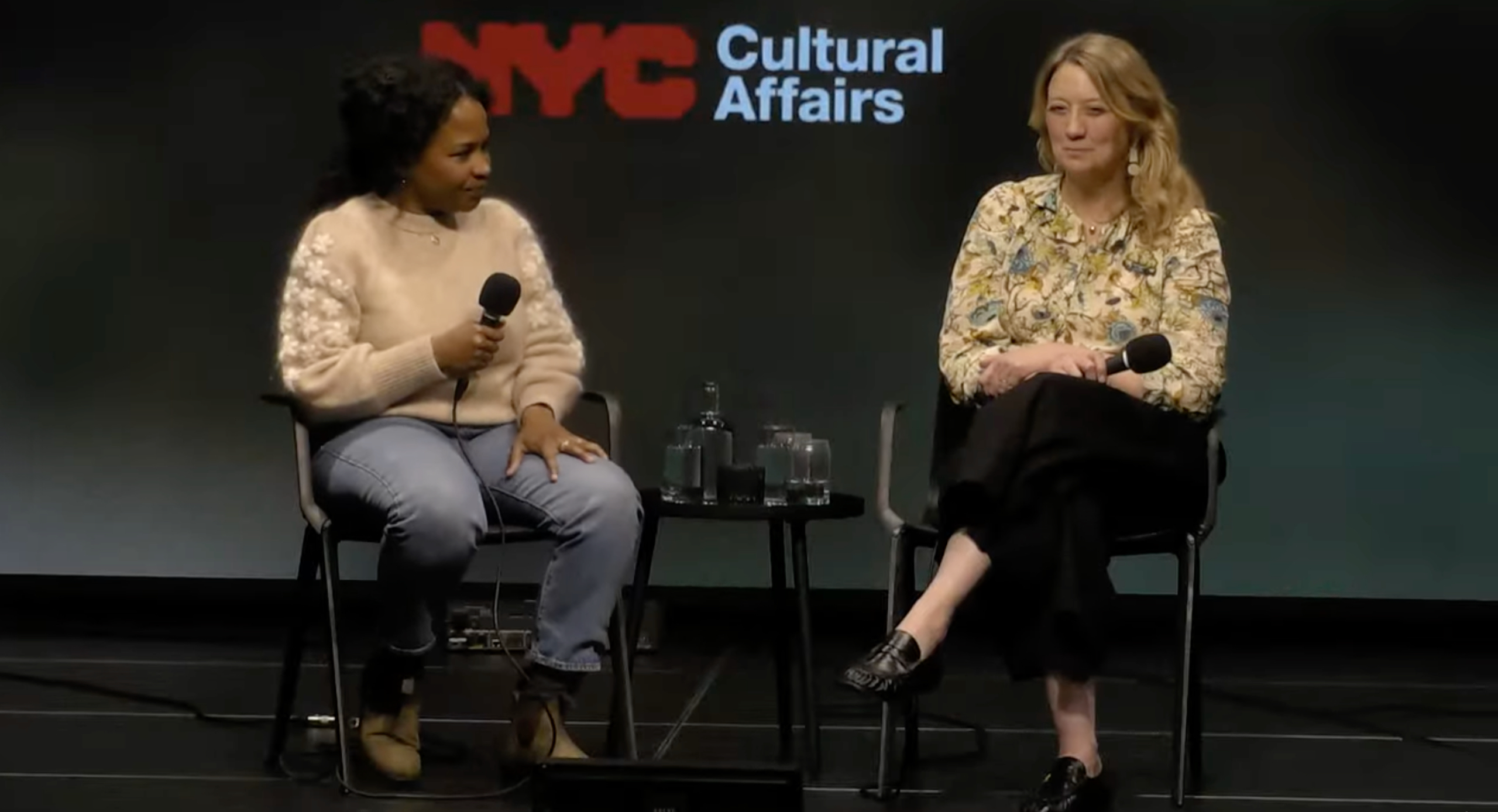
Eboni Booth and Heidi Schreck on April 16, 2025

The conversation was hosted by another recognizable actress turned playwright, Heidi Schreck (What the Constitution Means to Me).  Both women have participated in the collaborative incubator, Clubbed Thumb, and are raising families in New York City.  This provided plenty of common ground.  The two comfortably chatted as if in their own local tiki bar about writing, acting, and what keeps them up at night.  

Ms. Booth came to playwriting in her late 30s when she pivoted away from acting and got herself into an advanced program at Juilliard in Manhattan.  She is honest about her sometimes clumsy first steps and counts David Adair and Marsha Norman among her teachers/guides to success.  

As with most powerful work, Primary Trust arose from a genuine place both personally and professionally.  Booth believes in the power of kindness from strangers, vividly remembering an encounter on the subway when the person next to her saw her crying and offered a tissue.  The notion that small steps can be life changing eventually grew into lead character Kenneth’s way of being.  By tapping into the discomfort left by prolonged COVID isolation and the need for tenderness towards one another, the audience became deeply invested in his wellbeing.

 All four cast members have rich material to work with. As a former struggling actress, Ms. Booth has distrain for the type of roles that serve a plot purpose but don’t give the performer anything meaty to do.  Booth’s style is more like that of a fiction writer, with long prosaic passages.  Shreck speculated that the radical structure of the play was likely one element that drew the attention of the Pulitzer jury and ultimately won her the prize.  

The event took place at the Center for Fiction, a 200 year old cultural non-profit in Brooklyn that promotes the values of engaging with fiction at all levels.  It was streamed through their YouTube channel (https://www.youtube.com/@TheCenterforFiction/streams) and will soon be available to view.
Sojourners

Sojourners is part one of Nigerian-American writer Mfoniso Udofia ambitious interconnected nine play Ufot Cycle which intimately explores a multi-generational immigrant experience.  Over a dozen theaters including New York Theater Workshop, The Denver Center, and Berkeley Rep have introduced audiences across the United States to these deeply personal stories and unique characters.  Now the Huntington Theatre in Boston is bringing this special origin story directly into peoples’ homes with a live capture of a performance from their current season.  Directed by Dawn M. Simmons, this distinctive piece works well on a screen, within scenic frames designed by Jason Ardizzone-West.  

Woven into Udofia’s lines of dialogue are numerous details of the characters’ lives growing up in Etinan, an oil-rich area of Nigeria with its own local government.  Well educated and now residing in Houston, Texas on student visas, Ukpong and his pregnant wife Abasiama sit on a well worn couch in their small apartment reliving the days when they were first introduced for an arranged match.  Ama, as she is called, is following her superintendent father’s plan and studying hard to achieve the degree in biology that should assure her future. Her heart remains in her family’s compound as she cooks familiar foods and sings in her native language to her unborn child.  Ukpong, however, has been seduced away from his economic studies by the flash of rallies, Motown, and beer.  His lack of stick-to-itiveness is contrasted with goal-oriented Disciple, another Nigerian student who uses traditional African religious practices to focus his energies.  

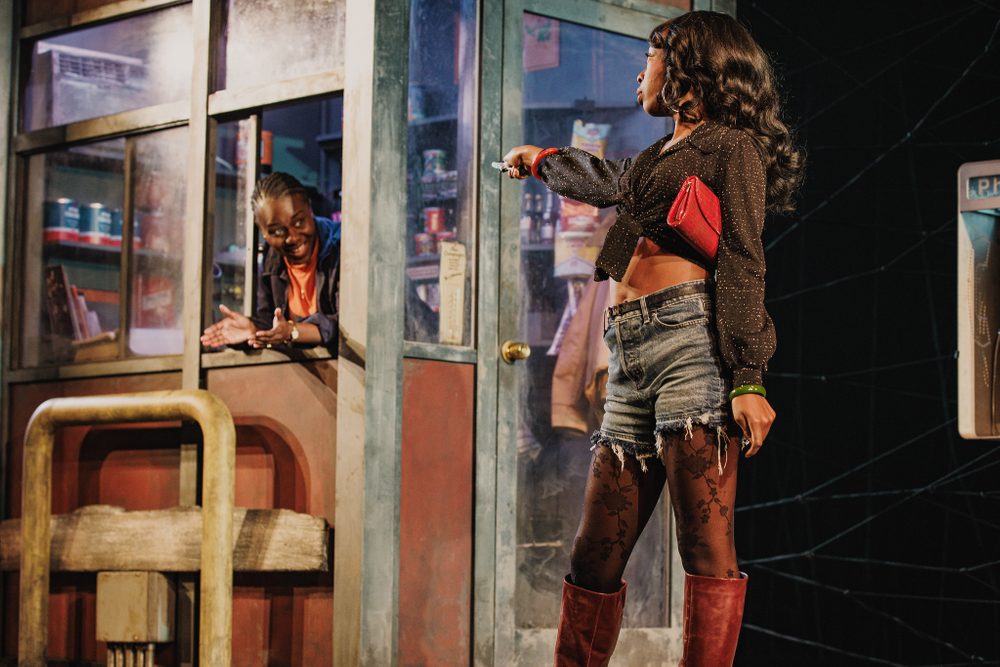
Nomè SiDone brings charm and swagger to the role of husband, but while the couple is playful, their abode is “not home; it’s something else.” Ama’s night shift at the local Fiesta Mart and Gas Station has brought her in contact with Moxie, an illiterate streetwalker with ambitions of her own.  Despite her socioeconomic level, the native born Moxie initially looks down on the woman she simply calls “Africa.”  Abigail C. Onwunali is brilliantly expressive as Ama, a woman who knows her worth and can’t believe the many ways people have been careless with her.  So there is singular warmth that emanates from Ama’s scenes with Asha Basha Duniani’s vulnerable yet defiant Moxie.  Their unexpected relationship forms the true heartbeat of this story, along with inspiring a strong craving for Snickers.  Ama’s interaction’s with Joshua Olumide’s Disciple are more uneasy, though the discord adds an interesting flavor to the pot.

Abigail C. Onwunali and Asha Basha Duniani in Sojourners; photo by Marc J. Franklin

As a first chapter in a longer tale, the 1978-set Sojourners unsurprisingly draws to an end, but with an open-ended conclusion.  We are left wanting to know what possibilities await and what will have to be shed in order to reach the next target.  Fortunately, we won’t have long to wait.  The second play in the series, The Grove, begins performances at the Huntington Calderwood (527 Tremont St. Boston) on February 7, 2025.  Udofia completed that piece before Sojourners and its foundation should be set by this solid first layer. 

Digital tickets to Sojourners begin at $30 and can be used until midnight on December 29.  An introduction to the performance is delivered in two languages, perfectly setting up our 2:20 journey.  The platform is stable and the well-directed feed includes closed captioning.  Visit https://www.huntingtontheatre.org/whats-on/sojourners/ to purchase and read more information.

twenty50

Oddly, one of the best distractions from the tumultuous election before us comes in the form of a drama about a political contest taking place 25 years from now.  In twenty50, playwright Tony Meneses sets his fresh and calculated thriller in an America in which the southern border is completely closed and Latinos — most of whom have fully assimilated — make up the majority of citizens.  Against this backdrop, farm owner Andres Salazar (who goes by Andy) is running for congress somewhere in the middle of the country.  With his campaign manager urging him to drop references to his background in order to appeal to a wider electorate, he finds himself torn between his traditional mother and his inquisitive daughter who doesn’t know a word of Spanish.  Though the bilingual dialogue sometimes blunts the pacing, it’s essential to the unfolding of the story.  Meneses is drawing on a deeply personal understanding of how much can change in a single generation.  His family moved from Guadalajara, Mexico, and he was raised in Albuquerque and Dallas.  The result of his honest excavation is a fair weighing of the many sides of culture, authenticity, and the desire to belong that are not exclusively LatinX.

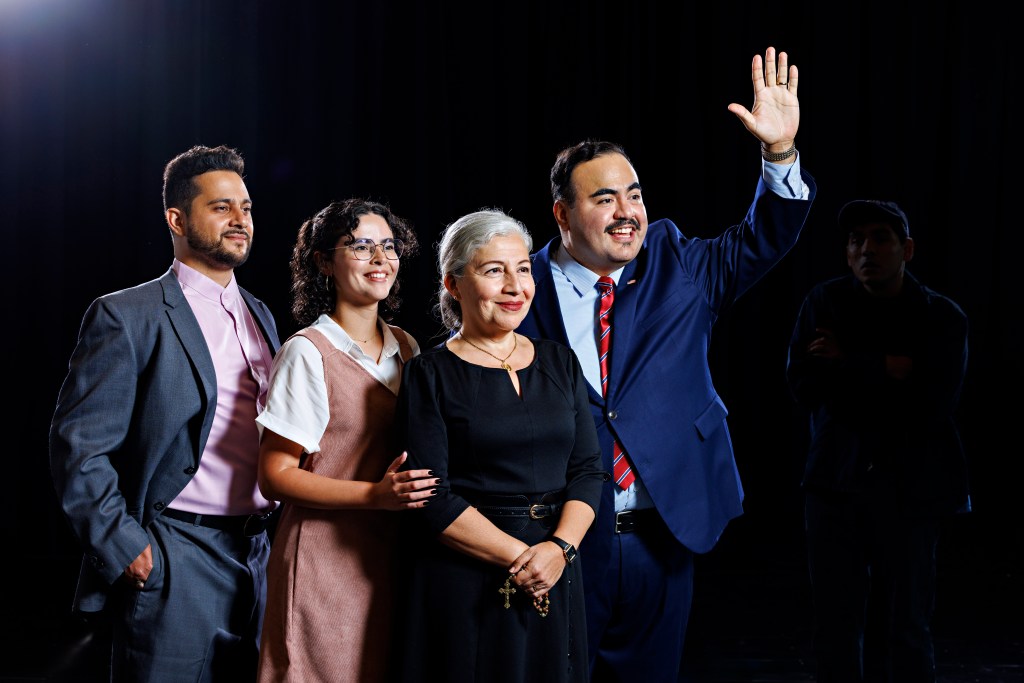
In creative partnership with scenic designer Tanya Orellana, director Rebecca Rivas has reshaped T2’s intimate space to represent a house with a sloping roof that engulfs the audience placed on either side of a thrust stage. Lighting Designer Nita Mendoza adds emphasis to this metaphorical container.  The clever use of “farmhands” as stagehands, helps convert the landscape for the final scene.  Within the dwelling, the characters circle one another, trying to find their equilibrium.  Orlando Arriaga makes Salazar both approachable and questioning.  It is his genuine warmth that provides the production with a solid center.  He is particularly strong in exchanges with Isabel Quintero as the mother whose memories of the recent past wash in waves over the present.  Cary Hite as the farm’s manager presents an opportunity for another variation of Andy’s balancing act.  Yet a third foil is Gabriella Perez’s policewoman Lydia, the most obviously futuristic character.  As daughter Jenny, Alyssa Martinez is unnecessarily burdened with a childish wardrobe and mannerisms.  She is best when she leans into the role’s purity instead of relying on these distracting crutches.  Ricardo Pérez Dávila and Freddy Acevedo round out the cast.

Ricardo Pérez Dávila (Sebastian), Alyssa Martinez (Jenny), Isabel Quintero (Irene) , Orlando Arriaga (Andres), Freddy Acevedo (Oscar) | Photo Credit: Wesley Hitt

In a brisk 90 minutes, twenty50 offers a buffet table ladened with food for thought. This is only the second time this play has been mounted and the rhetoric around immigrants has only grown louder and more destructive.  It’s a coup for TheatreSquared and their loyal audience. As the Executive and Artist Directors say, this insightful work “serves as both mirror and beacon.” Note that the content is written for adults, though there is nothing overtly “mature” in the action. 

The best way to see the performance is live for as little as $20, coming face to face with your fellow attendees at TheatreSquared’s Spring Theatre in Arkansas.  But those of us who cannot easily get to downtown Fayetteville should take advantage of the digital tickets to get in on the experience any way they can.  The camera switches house sides in an attempt to bring us fully into the thick of things.  Individual streams are $25 and household streams are $35.  Both types of links are good for 24 hours.  Tickets for performances through November 3 are available by calling (479) 777-7477 or visiting theatre2.org/twenty50.

FRIGID’s Little Shakespeare Festival

Saturday marked the closing night of FRIGID New York’s 4th annual Little Shakespeare Festival.  Known for their emphasis on creativity, collaboration, and affordability, this year’s line-up included seven original pieces.  Each one act script was built around the theme of Camaraderie and Community using the vast oeuvre of the Bard as a jumping off point.  

Festival curator, Conor D. Mullen, points out that Shakespeare himself was an independent artist whose casts were often composed of close friends who were given too little rehearsal time. Having a stripped down set and costumes “designed” by Goodwill is a fitting way to present productions inspired by his work.  Highlights included Mindy Mawhirter’s and Alyssa Cokinis’s The Lark and the Nightingale, which gave Juliet and Desdemona a second chance at love and happiness, and the bravely improvised As You Will created by Conor D Mullen, David Brummer, and George Hider.

Unfortunately FRIGID’s current home at UNDER St. Marks (94 St Marks Place) is literally “under,” in a basement and not fully accessible.  Aiming to remain truly inclusive, the producers added live-stream performances throughout the run.  This was how I was able to watch Hamlet Isn’t Dead’s utterly delightful When My Cue Comes with my elderly mother.  While I hope it won’t be too long before they find a space that more fully meets their needs, I encourage them to keep this option for those with mobility and caregiving issues and to reach out to audiences beyond New York. 

When My Cue Comes depicts a time when Hamlet’s Reynaldo, As You Like It’s Jaques de Boys, The Tempest’s Boatswain, and a very overworked Messenger find themselves deserted in a Waiting Room.  They had believed themselves to be essential workers.  Instead, they’ve been clipped from many a modern production and slowly bond while awaiting their next cue from The Playwright.  Quick witted and cleverly timed by writer/director B. Carty, the comical work also manages to be touching and relevant to today’s disconnected times.  

Jaques de Boys (Aaron Moore) tries to find himself with support from Reynaldo (Reid Watson), Messenger (Natalie Deboer), and Boatswain (Gabriel Ethridge) in When My Cue Comes.

This off-off-Broadway offering may be low budget, but it’s definitely not low talent.  Much of joy in this production radiates from the exuberant cast.  With perky energy possibility derived from a morning bowl of cookie crunch, Natalie Deboer’s Messenger punches through the fourth wall.  Reid Watson brings warm devotion to the abandoned Reynaldo.  As played by Aaron Moore, Jaques de Boys is profoundly rattled by his exile.  Mining every line for comic gems, Gabriel Ethridge’s Boatswain has never been more at sea.  Grounding them as long as she can is Madeline Parks, whose Playwright isn’t in as much control as she’d like.  The ease of the entire ensemble was palpable even at a distance.

Having (mostly) recovered from lockdown, FRIGID New York recently resumed their resident artists program.  Last week they announced the programming for their very full 27th season. This includes their annual Days of the Dead Festival, a celebration of nothing less than life and death, taking place October 17 to November 2. This will be followed November 3 through 17 by the 12th Gotham Storytelling Festival.  A complete schedule and ticketing information can be found at https://www.frigid.nyc/

Dragon Lady

Sara Porkalob had received praise for playing a white Founding Father, Edward Rutledge, in the Broadway revival of 1776.  But she had never had the opportunity to represent someone with her Filipino background until she wrote a role for herself.  Her solo performance — Dragon Lady — tells the colorful story of Porkalob’s grandmother, Maria Porkalob Sr.  A karaoke-loving daughter of a gangster, Maria I moved from the Philippines to the Pacific Northwest as a pregnant newly wed wife of an American soldier.  (Senior made a cameo in the show until her death in 2022 and now appears in projection.)  The show premiered in 2017 and has been touring the country, now joined by Dragon Mama, another Porkalob creation told from Sara’s mother’s perspective.

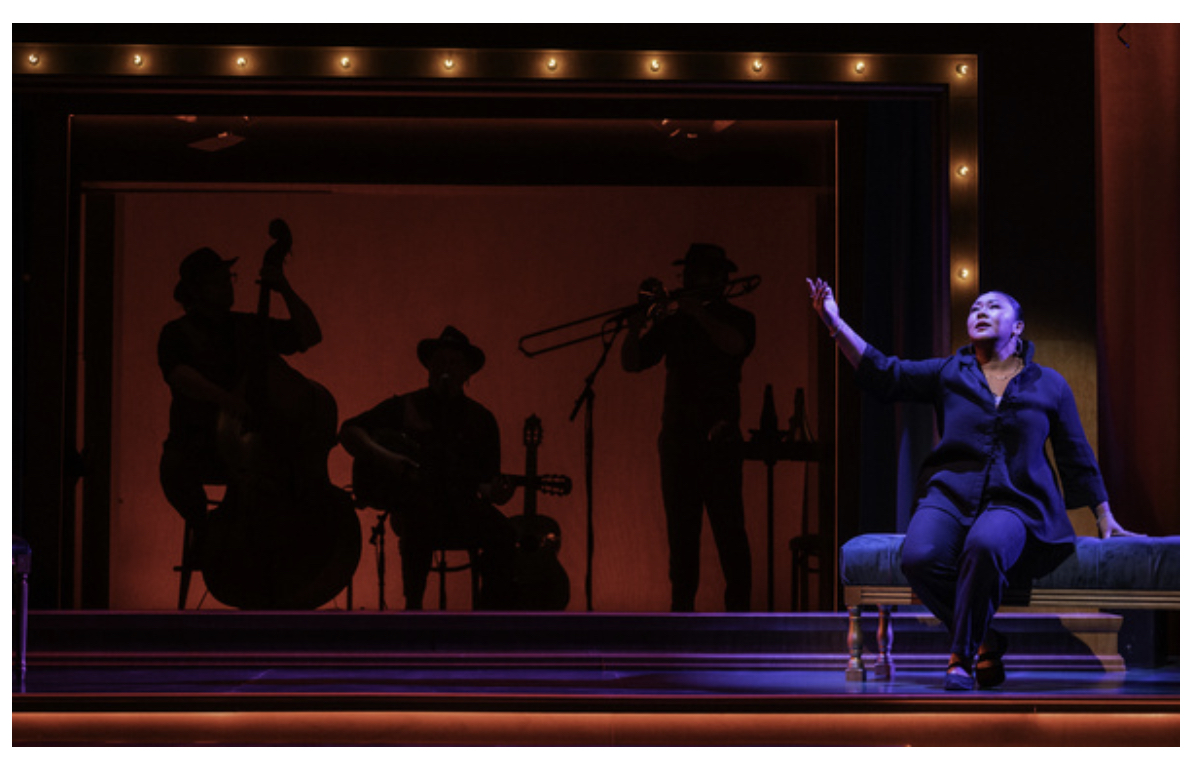
The Pittsburg Public Theater recently shared Dragon Lady with a broader audience through the League of Live Stream Theater, a non-profit that works primarily with regional theaters to broadcast their productions in real time.  Built tenderly from a 9 minute senior year workshop assignment, the production runs 2:15 and spans over 40 years.  Designed in a framework of a cabaret act with a three piece band, Hot Damn Scandal (Pete Irving, Jimmy Austin, and Mickey Stylin), the performance is engaging and freeing.  On the night before her 60th birthday, Maria Sr. pulls her granddaughter aside in order to share some family secrets.  Sara’s mother, Maria Jr., is obviously not the matriarch’s biggest fan.  By revealing some less-than-flattering elements of her history, the elder Porkalob hopes to at least elicit understanding of if not forgiveness for her past actions from the newest generation.

Sasha Jin Schwartz’s set, bathed in blue with its raised rounded platforms and crisscross patterns, conveys the essence of a casino or nightclub.  Under the guiding hand of director Andrew Russell and leveraging the intimacy of this ¾ round space, Porkalob changes skins in a flash, portraying those closest to Maria Sr. including her father, lovers, and five children. Each relationship shines a little more light into the painful darker corners (physical lighting by Spense Matubang).  There is a particularly lovely and insightful exchange between Maria Sr’s two sons, Ron and Charlie, when they were younger.  Sara’s singing voice is remarkably strong and soaring as she delivers a range of musical numbers from torchlight to jukebox.  Mixed with atmospheric sound by Erin Bednarz, the selections help shift the mood and lighten the load.  

Sara Porkalob backed by the Hot Damn Scandal in Dragon Lady at Pittsburg Public Theater

Having broken away from the comfort of scene partners and backdrops, Porkalob has had to tap deeply into her own power as an artist.  By appreciating the value of a personal story and sharing a genuine human experience, Porkalob has given us a work that resonates far beyond her own family.  The language and themes are decidedly R-rated and intended for audiences over 18.  A third play, Dragon Baby, told from Sara’s vantage point, as well as a TV adaptation of the entire cycle are currently in development. 

For more information about Sara Porkalob and The Dragon Cycle, visit http://www.saraporkalob.com/.  To explore the rest of the Pittsburg Public Theater Season, visit https://ppt.org/.  To learn more about upcoming real-time simulcasts by the League of Live Stream, visit https://www.lolst.org/.  

Young, Gifted, and Black

Young, Gifted and Black lived up to its title with a lineup of talented musicians of color ranging in age from 12 to early 30s.  Most grew up in the neighborhood of the Classical Theatre of Harlem, which produced the evening as part of Bryant Park’s Picnic Performances.  Made available by Bank of America as a free first-come-first-serve live event with a streaming simulcast, the concert was enjoyed by over 4000 people according to Producing Artistic Director, Ty Jones, who hosted with sincere enthusiasm and praise.

The poised 12 year old pianist, Emery Mason, opened with three short pieces punctuated by the rapidly changing tempos of Debussy’s Cakewalk.  She was followed by 16-year-old Kaden Kennedy, a cellist who somehow also finds time to compete in track and field.  His selections honored both beauty with  Camille Saint-Saëns’ “Le Cygne” (“The Swan”) and pain with Élégie, Op. 24, which Gabriel Fauré wrote for his deceased wife.  Kennedy later returned to play Johann Sebastian Bach’s Cello Suite No. 1 in G major, an ambition of his since the age of 7.  Accomplished 15 year old Melissa Mosley — an attendee of the Special Music High School who recently returned from concerts in Canada — closed out the first part of the program with Chopin’s Nocturne in C-sharp minor and the downright jazzy 1984 composition by Nikolai Kapustin, Concert Etude, Op. 40, No. 3: Toccatina.

For her solo, 14 year old Roen Jones, who has performed in prominent public spaces including the Metropolitan Museum, chose Violin Partita No. 3 in E major by Johann Sebastian Bach, a work she said has made her a better violinist.  Wrapping up the instrumental portion was the extraordinary violinist/composer/teacher Edward W. Hardy.  He began with his own composition, Evolution, which required employing a variety of styles in a single song.  Commencing with musical phrases from Wading in the Water and inspired by the evolution of Black music, the piece was included in the opening night program at the Smithsonian’s African American Museum in Washington D.C.  After a smooth re-arrangement of Chopin and a swirling Tennessee Whiskey dedicated to his “Colorado Family” at the University of Northern Colorado, Hardy switched gears. As a child, his mother had encouraged him to play his violin in the subway as a way to build confidence in front of a crowd.  So he reached back to his hits previously heard in the 103rd street station.  Shouts of “OK!” and grass-muted toe-taps accompanied his rendition of If I Ain’t Got You by Alicia Keys.  He ultimately brought the crowd to its feet with his mind-blowing twist on Freddie Mercury’s Bohemian Rhapsody.   

As a coda to a lovely evening, Tony nominee Crystal Lucas-Perry interpreted a monologue from “Mother to Son” by Langston Hughes.  The words honored those who have smoothed the way and the power of a community to elevate others.  Then the mezzo-soprano ended on a literal high note with her performance of Greatest Love of All by Michael Masser.

With its approachable blend of classical and modern selections, The Classical Theatre of Harlem’s Young, Gifted and Black fulfilled its goal of shining a well-earned spotlight on the exceptional Black youth of New York City.  The full show is available to stream on demand at https://bryantpark.org/calendar/event/the-classical-theatre-of-harlem/2023-09-01.

A Nagging Feeling Best Not Ignored – Live Stream

January 6th will never again be just a date, but rather an historic occurrence.  Some consider what happened in 2021 to be the most serious attack against democracy.  Others saw brave patriots who took action when they felt those same institutions had betrayed them and their leader.  A third group finds the entire episode to be just so much more political blah-blah-blah that has nothing to do with them.  All of these viewpoints are presented by the unreliable narrator and sole character in Roland Tec’s A Nagging Feeling Best Not Ignored, a live Zoom-based theatrical event.

A ticket to this happening comes with precise instructions.  We have volunteered for a citizen panel.  Check-in is at 7:45 PM and while the piece will conclude by 9:00PM we are requested to stay for “processing”.  In order to participate fully, we will keep our cameras and microphones on and wear headphones to eliminate extraneous noise.  (I further recommend using the Full Screen mode and Do Not Disturb to block out any notifications.)  After hearing his story, our judgement of “the subject” will be legally binding.

Roland Tec is The Subject in A Nagging Feeling Best Not Ignored

These directions set the expectation for a serious and intense engagement with the solitary character, Benj.  Eery music and distant voices that we hear upon entry only heighten the mood.  As portrayed by writer Tec, Benj is an attempt to create an Everyman in what is becoming the everyday experience of many.  Shot at a slight diagonal, this man clearly needs to clean house in all the meanings of that phrase.   His headphones are askew and there’s a ladder and a towel behind him hinting at a mess beyond.  COVID has kept him home alone more than at any time in his life.  Most of his news is delivered through social media.  New connections are only made online, where it is often hard to tell who is genuine and who is a bot.  The valley has never been more uncanny than in Benj’s landscape.

As directed by Leigh Strimbeck, Benj speaks in a manner that alternates between rushed and halting.  He shares his circumstances just before and shortly after the actions that took place on January 6th, with asides that give insight into his personal life. How deeply you are touched will depend on how well you are managing your own feelings.  

The distractions are many.  Chat has been left open, which allows for some important intervention but also unnecessary prattle.  One of the disadvantages of conversations over Zoom is that the highlighted speaker is the loudest instead of the most important.  With over 30 microphones open, those featured including a man with a persistent cough, a woman making clattering noises, and several very personal laughs.  Perhaps this is meant as a metaphor for how easily our attention is diverted from discomfort.  How deeply can we ever react to something on a screen?  But there is no question that the technical set-up made it difficult to remain fully absorbed in what we had been told was a civic duty.  

The section that leaves a lasting impression is the post show discussion, which on the night I attended was led by retired psychologist Henry “Hank” Greenspan, a playwright/historian whose work focuses on survivors of genocide.  Our audience was less invested in whether Benj should suffer any consequence than in finding productive outlets for their own grief and discouragement.  Reactions were only partially to the play and the rest to very real life.  One woman pointed out that her feelings are not nagging at all, but in her face screaming 24/7.  

That a short work like A Nagging Feeling Best Not Ignored could bring forth that level of emotion at this time of perpetual overwhelm is noteworthy.  And while there are problems with Zoom, it does allow for sharing of the work across the country.  There is one more scheduled opportunity to be a witness on Wednesday, September 7, at 8PM.  Tickets are $22.50 and can be purchases on Eventbrite at  https://www.eventbrite.com/e/302460416247.

The Orchard – NYC and Live Stream

Long before Joni Mitchell decried the paving of paradise to put up a parking lot, Anton Chekhov’s emotionally paralyzed Ranevskaya family auctioned off their cherished cherry orchard to make way for summer homes. His last play, The Cherry Orchard, centers on Madame Lyubov who is hopelessly in debt after years of living in Paris.  She and her daughters have returned to their estate for one last party and it is only then that they reflect on the once-prized fruit trees that will be chopped down to make way for modernization.  Like many of Chekhov’s works, there is a sense that happier alternatives have simply slipped out of reach.  

In Arlekin’s (zero-G) imaginative retelling, The Orchard, the work is simultaneously performed live and streamed to a global audience.  Typically, live streams have been made available because there was no audience permitted at the theater or it was presented in a way meant to simulate as closely as possible the live experience.  This is the first theatrical piece I’ve seen that deliberately gives those watching from home a different experience from those seated at the venue. 

While it is simply wonderful to make this production available worldwide and Ukrainian director Igor Golyak has unique experience using virtual reality to enhance traditional theater, it seems unnecessary to have augmented this particular work with an interactive component. The video-game-like curtain-raiser features various rooms of the house containing Mikhail Baryshnikov as Chekhov reading some the author’s more personal words in the original Russian.  Much of the interaction during the play involves being able to select something other than the main camera, though the few times I switched to another unit, it wasn’t revealing so much as disorienting.  And it was impossible to avoid FOMO when just before the auction of the property — during which the audience makes non-binding bids with proceeds going to support the company — the home audience was addressed directly by matriarch Lyubov Ranevskaya while a completely different scene was taking place on stage.

Furthermore, the production is straight-up terrific and needs no embellishment.  Golyak, whose homeland is currently undergoing life changing destruction and loss, has harnessed those feelings of disconnection and grief and made additions to the work that are engaging and meaningful.  The elegant script was translated by Carol Rocamora, who preserves the poetry while tightening the storyline and punching up the more farcical elements.  On scenic designer  Anna Fedorova’s all-blue stage, blossoms litter the floor and even the nursery room teddy bear and hobby horse appear melancholy.  The backdrop envelops the players in dramatic projections by Alex Basco Koch, including lines of dialogue, stars and planets, and the faces of the enraptured audience. The onstage robotics by Tom Sepe lend an eery futuristic and fatalistic feel to the tale.  

Denisova, Hecht, Brett and Nelson in The Orchard; photo by Maria Baranova

The cast is led by the sublime Jessica Hecht, who gives Ranevskaya’s delicacy meaning and tenderness.  Baryshnikov appears again as Firs, the faithful older servant.  His interpretation of an aging, submissive body practically collapses in on itself and he never stops being fully present, even providing a warm interaction with a mechanical dog.  The clowning of Arlekin Players regular Darya Denisova as Charlotta  the soon-to-be-displaced governess, adds appropriately discordant levity.  While Nael Nacer’s booming voice is just perfect for sounding the alarm as Lopakhin, the man best positioned to win the orchard his ancestors tended to as slaves.  John McGinty has been cast as Trofimov, though it’s unclear whether making the perpetual student deaf is a comment on communication between characters or Golyak just appreciates McGinty’s talent.  Juliet Brett, Elise Kibler, Mark Nelson, and Ilia Volok round out the company.

As a fresh take on a classic, The Orchard blossoms under Golyak’s knowing hand.  The themes of class division, misplaced materialism, and cultural loss are sadly timely and touching.  A quick read of The Cherry Orchard will only deepen your understanding of events.  Live performances run through Sunday, July 3, and take place at the Baryshnikov Arts Center at 450 West 37th Street (between 9th and 10th Avenues) .  Showtimes are Tuesday – Thursday at 7PM, Friday – Saturday at 8PM, with matinees on Saturday and Sunday at 2PM.  Proof of vaccination is required for entry and face masks must be worn throughout the two hour runtime.  Prices for the intimate live show run from $39 to $125.  The virtual experience — which requires a plugged-in laptop or desktop — is $29.  There are bundles to purchase both live and streaming together.  For tickets and additional information, visit www.TheOrchardOffBroadway.com.  

Witness – Live Stream

Streaming multi-media production Witness arrives on our screens at a time when anti-semitism is on the rise in our country.  Incorporating material from the United States Holocaust Memorial Museum and employing live actors in a virtual space, the docudrama uses the journey of the MS St. Louis to explore the history of persecution of the Jews.  In May of 1939, the cruise ship filled with Jews escaping the Nazis was on its way to Havana.  According to museum records, of the 937 onboard, only 18 were granted visas.  The rest were turned away from both Cuba and the United States and sent back to Western Europe.  Conceived and directed by Igor Golyak, the work threads together the lives of those ill-fated passengers with stories of more recent Russian Jewish immigrants like Golyak himself as well as contemporary headline-making hate crimes.

Audience members are requested to arrive at the site ten minutes early dressed in period costume with drink in hand.  “Joining” the crowd on the ship is easy and a quick sound check ensures that you will get the full audio experience (or take a moment to reload the page.)  Dialogue is spoken in multiple languages and subtitled in English.

The first act uses as a framework the talent show that was an actual shipboard activity.  Against a beautifully rendered virtual environment created by Daniel Cormino, the production pulls us into the main room of the ship for a performance which blends vaudevillian entertainment with experiences of the real passengers.  Director Golyak allows the camera to wander as our eyes might.  Two women cleverly “figure skate” using their fingers in sand while recounting the Kristallnacht.  A man builds a house of cards while vividly describing the displacement of families.  After each one, the audience is asked to award one to four stars.  Throughout, the Emcee (Gene Ravvin) — seemingly the only character who knows he is in a green screen studio — uses slapstick humor to keep the energy flowing.  And Lady Liberty (Darya Denisova) selects the lottery numbers which summon the next participant to the stage.  It is an uneasy blend that is quite effective at times, particularly when the ghostly shipboard audience is in view. 

Gene Ravvin in Witness; Photo provided by The Arlekin Players

An audio-only second act crafted by Viktor Semenov is the most impactful, with members of the cast reading correspondence from the museum archive.  Audience members are encouraged to wear high quality headphones in order to experience the pull of the Binaural audio, designed to create a sense of 3D sound.  Studies have shown that people believe what they see over what they hear.  Deprived of visuals we have no option but to focus on the words of the people involved.

Staged primarily in the hallway of the ship, Act III takes place in the present.  The conversation is dominated by Leah (Lauren Elias) who is incensed about the growing calls for Jews to assimilate.  As someone who can’t be bothered to distinguish between a woman of Puerto Rican decent, a Somali immigrant, a first generation Palestinian American, and the first Black woman to represent Massachusetts in the House— the state in which all the characters reside — and who also discusses the current political backdrop while leaving out our historically significant Jewish Second Husband, she is a flawed spokesperson for her viewpoint.  A counterposition that the Oslo Accords were a lost opportunity is dispatched in a few sentences delivered by Joseph (Nathan Malin) without sufficient context to enlighten anyone who isn’t familiar with that 1993 event.  The most emotionally charged outlook is expressed by the Emcee who is trying to reconcile the view he has of himself as a true American with the ways in which he and his family are perceived by others.

An artful entry into the developing world of online theater, Witness hints at the future of the form.  It has important information to share, though the jarring shifts in tone of Nana Grinstein’s script result in a lack of cohesion.  It’s technically ambitious and unsurprisingly I encountered video glitches and broken links.  Those did not mar a generally involving experience.  What is truly disappointing is to be invited to join a conversation and find instead that one is attending a lecture, even if it is a well researched and reasoned one.  

Presented by Zero Gravity (zero-G) Virtual Theater Lab and Boston’s Arlekin Players Theatre, performances are scheduled through next weekend, January 21-23. Though played out in real time, the web-based show can be accessed from anywhere with a good internet connection.  Tickets are $25.  Running time is approximately 90 minutes with an additional 30 minute talk-back.  Visit https://www.zerogravity.art for more details.

Starting Here, Starting Now – SF Playhouse and On Demand

Closing out the San Francisco Playhouse’s 2020-2021 season is Starting Here, Starting Now, comprised of 24 songs with lyrics by Richard Maltby Jr. and music by David Shire.  The lively and upbeat musical review was originally created to save the Manhattan Theater Club’s then-new nightclub space.  The songs are taken from shows that either never got produced or closed prematurely, so they have that familiar-yet-not feel.  Maltby directed the original production while Shire shored up the work with newly created connective tissue.  Performed in this instance by a cast of four (one more than the original production) the show is an often humorous exploration of relationships of various dimensions, some made modern with a gender-bending twist.  Each piece is sung in character — though those change throughout — so they require solid actors to make them work.  Equally important to their success is the jazzy trio, placed behind them right on the stage.

Directed by Susi Damilano with choreography by Nicole Helfer, this incarnation moves breezily along for 90 minutes not including intermission.  Though the cast members are all seasoned performers, it is Keith Pinto who demonstrates the most strength from his perfect articulation of rapid lyrics to his physical antics and sincere engagement with the audience.  He elicits laughs in We Can Talk to Each Other and knowing nods in I Don’t Remember Christmas. Wilson Jermaine Heredia, who won the Tony Award for his turn as Angel in Rent, provides a gentler and more touching tone in solos including A Girl Should Know.  Rinabeth Apostol adds bad ass energy in I’m Going to Make You Beautiful and several duets.  Melissa Wolfklain rounds out the ensemble with quick wit, though she sometimes missed a note. (She sings my favorite in the line-up, Crossword Puzzle.) 

Starting Here Starting Now Cast sings “I Don’t Believe It”; Photo by Jessica Palopoli

Costume designer Rachael Heiman has wisely outfitted the cast elegantly in pure white, the better to project whatever is needed as they move swiftly from character to character.  The set designed by Heather Kenyon has a touch of nightclub flair, especially as lit by Kurt Landisman in an array of rainbow shades.  The musical trio, under the musical direction of David Dobrusky on piano with Amanda Wu on bass and Russ Gold handling percussion, is top notch and well suited to sharing the spotlight.

Like aural chicken soup for your tired soul, Starting Here, Starting Now goes down easy and leaves a warm feeling behind.  There is no twisted plot to follow or deep roles to keep straight, just pleasing harmonies, light movement, and plenty of charm.  It is playing at the San Francisco Playhouse at 450 Post Street in San Francisco with strict COVID-19 protocols in place ( https://www.sfplayhouse.org/sfph/covid-safety/. )  It is also available to stream online, which is how I was able to enjoy it all the way in New York City.  Tickets are available for either format at sfplayhouse.org for performances though October 2.  In-person tickets are $30-$100; with access to the On Demand video starting at $15.