Category Archives: Musical

Friends! The Unauthorized Musical Parody

My friends will confirm:  I am not a Carrie, Miranda, Charlotte or Samantha.  I am a Monica.  If that doesn’t conjure up a distinct image, Friends! The Unauthorized Musical Parody is not for you.  If I have to explain that the plot revolves around six 20-somethings living a suspiciously upscale lifestyle in 1990s Manhattan, you are unlikely to be in on the jokes.  From the Smelly Cat cocktail onward, this two-hour jovial send-up is for fans who indulged in repeated TV viewings (thank you streaming).  The current open-ended Off-Broadway run began in 2021 and has spawned productions across the country and overseas.

The current core cast members — Francesco DiFlora, Anthony Gjelaj, Corinne Holland, Piper Loebach, Sam Massey, and Briana Sky Riley — remind us how gifted actors give their all for love of the craft in its myriad forms.  They have wonderfully clear voices and terrific timing beyond what is required for a light-as-a-feather production like this one.  DiFlora in particular must be eating his Wheaties (or whatever kids do these days) taking on a host of supporting roles along with the much beloved Chandler Bing.  And Holland’s Phoebe gets that hopeful opening guitar strum just right every time.  Andie Angel played the suitably thankless role of Gunther at the performance I attended.

The book by Bob and Tobly McSmith isn’t particularly clever, instead leaning into token tributes to every trope and tag line of Friends’ 10 year run.  Their lyrics set to Asaf Gleizner’s music are sharper, with the winking “495 Grove Street – How Can We Afford This Place?,” an ode to Pivoting, and a salute to salaries — set to a tune quite similar to one sung by a very different group of buddies — providing highlights.  The pre-recorded back-up chorus (sound design by John Hartman and Brad Sievers) adds depth in the shallow house.

Director Ryan Barto keeps things moving on the singular set with flipping panels that switch between Central Perk — New York City’s only coffee shop — and Monica’s spotless apartment complete with purple front door. There is not much in the way of character development.  The assumption is you know these people as well as you know your actual friends.  But the wigs by Conor Donnelly do more than the usual share of heavy lifting when it comes to helpful visual reminders.  

Friends! The Unauthorized Musical Parody is to the performing arts as Cheez Doodles are to Époisses de Bourgogne.  It offers suitable bang for the buck and goes down well with a Janice Double Wine.  The show is playing at the Jerry Orbach Theater, 210 West 50th Street, 3rd Floor.  The seats are softer than a sofa found in an alleyway, but the staff is as warm and gracious as the one at the newly reopened Waldorf.  Running time is approximately 2 hours with one intermission.  Content is PG-13 and will be funniest to those fluent in Friends culture.  Tickets are currently on sale through January 1 at https://www.friendsoffbroadway.com/ which often has BOGO offers.

Joy: A new True Musical

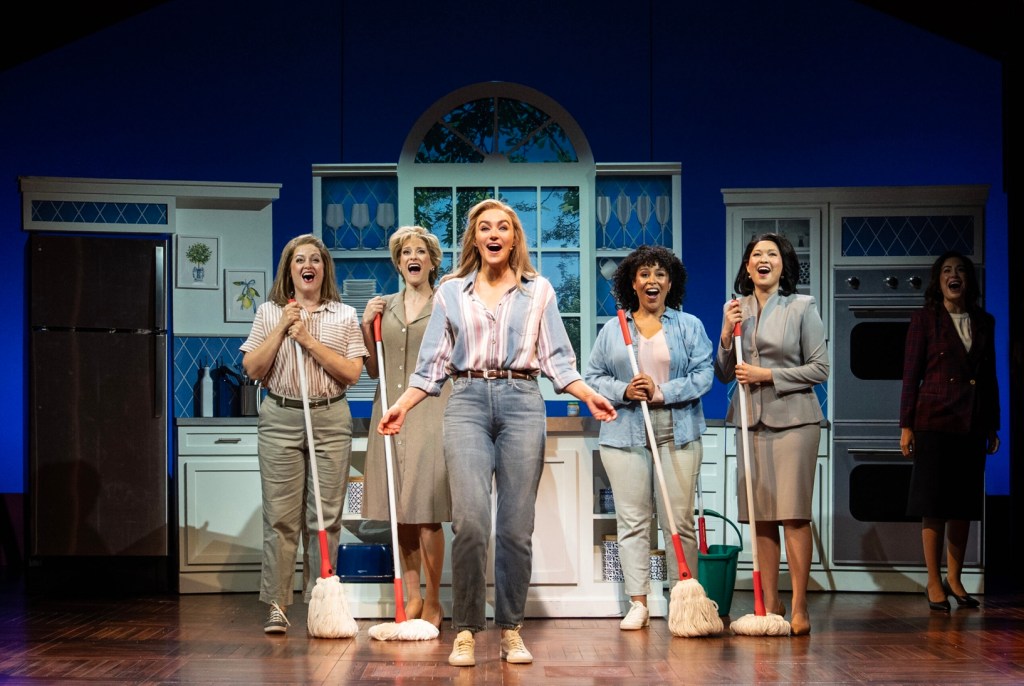
Tired of not being able to answer the simple query, “how are you?” without sighing? Ken Davenport and AnnMarie Milazzo may have an answer.  Their creation Joy: A New True Musical is a type of musical optimism that has audience members returning from intermission wearing the freshly-purchased official T-shirt.  Its message of resolve and imagination envelops people in a purple and yellow cloud that even has them warmly hugging the mops they’ve been handed by the ensemble.

You may be familiar with Joy Mangano from her book “Inventing Joy: Dare to Build a Brave & Creative Life,” from seeing the 2015 movie simply entitled “Joy,” or maybe even from buying her products through the QVC home shopping network.  She was a young mother with a house full of people depending on her when she was suddenly laid off from a steady if uninspiring job.  In other words, she had much in common with women around the country who are behind in their mortgage and anxious to fully provide for their families.  Using a combination of vivid imagination, determination, and a few lucky breaks, she turned her life around.  

The musical retelling of her tale stars the dynamic Betsy Wolfe, who gained a wide range of fans with her Broadway turns in Waitress and & Juliet.  She’s surrounded by an accomplished cast including Adam Grupper as her well intentioned father Rudy, Jill Abramovitz as her overly cautious mother Toots, and Honor Blue Savage as the daughter Christie who only wants Mom to be able to come to her games.  Along her road to success she has dealings with Paul Whitty’s underhanded Cowboy Eddie, and Charl Brown’s experienced network exec Dan, both of whom are given showy performance numbers.  

Betsy Wolfe (with ensemble members) in Joy: A New True Musical; Photo by Joan Marcus

It is easy to see why Wolfe is so popular that she gets a round of applause before she opens her mouth. Her very presence fills the house and she sings with much appreciated clarity and emotion.  Milazzo’s score isn’t the most varied and the refrains bleed into one another, but it is tuneful, carried along by Andy Einhorn’s arrangements.  The opening “Welcome to My World” does some heavy lifting, rapidly introducing us to a number of important characters and plot points.  The book by Davenport is considerably more assured than Hollywood’s interpretation of Mangano’s biography.  Filled with broad humor that makes a point, the plot gets bogged down in the second Act in part because it’s hard to top the momentum of Act I.  

Director Lorin Latarro uses her actors and limited space well, giving us glimpses of Bigger Show potential.  Likewise the choreography of Joshua Bergasse is muffled by shoulder shrugs and knee bends when it could eventually soar. The creative team has also delivered with vision but to scale.  Scenic designer Anna Louizos takes a lesson from the TV studios that brought Joy fame, filling a generic cityscape proscenium with small rolling set pieces.  Also taking a cue from television is David Bengali whose projections are critical to the storytelling.  Clever props including the co-staring Miracle Mop are designed by Andrew Diaz. Tina McCartney lets a few key outfits shine, and keeps the rest timely and simple. Liz Printz’s wigs and hair design age the lively Abramovitz and allow the ensemble to cover myriad roles.  Shout out to House Manager Dovber Dier and the incredible organization of the venue staff.

Who doesn’t welcome an upbeat story of success under trying circumstances?  Sure to be a crowd pleaser, the show is exactly what you’d expect from something called Joy: A New True Musical.  Performances are at the Laura Pels Theatre at the Harold and Miriam Steinberg Center for Theatre, 111 West 46th Street near 6th Avenue.  Running time is 2 hours including a 15 minute intermission.  The limited engagement is currently scheduled to end on August 17.  For more information and tickets starting at $72, visit https://joythemusical.com/.

Camera Ready

Throughout the 1980s, videographer Nelson Sullivan used his developing camera skills and sincere love of the downtown New York art scene to capture and preserve many of the distinctive talents of that special time and place.  In partnership with his childhood friend James “Dick” Richards, host of a long-running access channel LGBT variety show, he put RuPaul on a path to stardom.  As he experimented with newer equipment and continued to evolve his technique, he sometimes included himself in the frame.  When he died at 41 of an apparent heart attack, he left behind a body of work credited with forming the template for the type of short form personal videos that proliferate YouTube.  

Now a behind the scenes look at Sullivan’s life and work has been fashioned into Camera Ready, a new play with music written and directed by his friend, artist/playwright/filmmaker Gary LeGault.  The sprawling cast of twenty much resembles the streets outside with its array of ages, races, and body types.  The ensemble brings unadulterated enthusiasm to each scene such as “Friday Evening in New York,” a celebration of Nelson’s first night out on the town with his camera.  There is a genuine sweetness to Jack Warren Lewis’s uplifting interpretation of the documentarian.  Other standouts include Bryce Payne’s dazzling RuPaul, JC Augustin gravely voiced Jackie Curtis, and a versatile Alexa Echevarria as Sullivan’s mother, musician Rhonda Granger, and a truly horrible Mona Robson in rehearsal at La Mama.  Her performance in the upbeat “All the Money” is a hoot.

Jack Warren Lewis as Nelson Sullivan with the cast of Camera Ready

Though working on an obviously tight budget, creative thought has gone into the design. The majority of the songbook (arrangements by Chris Glik and Michael O’Dell) has a breezy, clubby style that comes through on the solo piano. The backdrop, drawn by LeGault, is reminiscent of Edward Hopper had the artist worked in crayon.  Lola Saenz, under the direction of set designer Lytza Colon, installed bricks which adorn the central staircase. Night scene costumes and wigs by Diana Chaiken have the perfect dramatic flair.  

Oddly, it is LeGault’s obvious affection for Sullivan that flattens the story.  He has recorded history with heart, which makes for a valid but blurry lens. There is too much emphasis on tiny interactions and it is doubtful anyone under the age of 60 would recognize the celebrities about whom Sullivan exclaims.  A key relationship with housemate Choux (Dave Onofre) is underdeveloped and the parade of houseguests doesn’t achieve substantial impact. The current script also skirts the remarkable implications of Sullivan’s legacy. Ultimately the piece gets bogged down in less significant details and crosses the finish line at a hefty 2 ½ hours. 

With the show having completed its off-off-Broadway run on July 6 at Theater for the New City, LeGault has an opportunity to expand his private portrait into a deeper, more meaningful tribute to Nelson’s work.  This would also further highlight the gifts of Drag Queens and trans performers featured in Sullivan’s videos.  A rethinking would likely require LeGault to collaborate with an editor who could provide enough distance to make the appropriate refinements.  However, a more examined celebration would elevate not just Nelson’s legacy but the contributors to the American art scene he so valued.  

EPIC’s Seussical the Musical

Seussical the Musical was not exactly a hit with the critics when it ran on Broadway about 25 years ago.  Nonetheless, the familiarity of the characters and its themes, including the consequences of cronyism and the importance of staying true to yourself, resonated with audiences.  It continues to be performed regionally with its “junior” version popular in schools throughout the country.  These messages also make it a fitting selection for EPIC’s diverse troupe.  The cast’s palpable joy in performing a work that embraces such a delightful and distinctive population makes for an easy-to-love experience for the whole family.

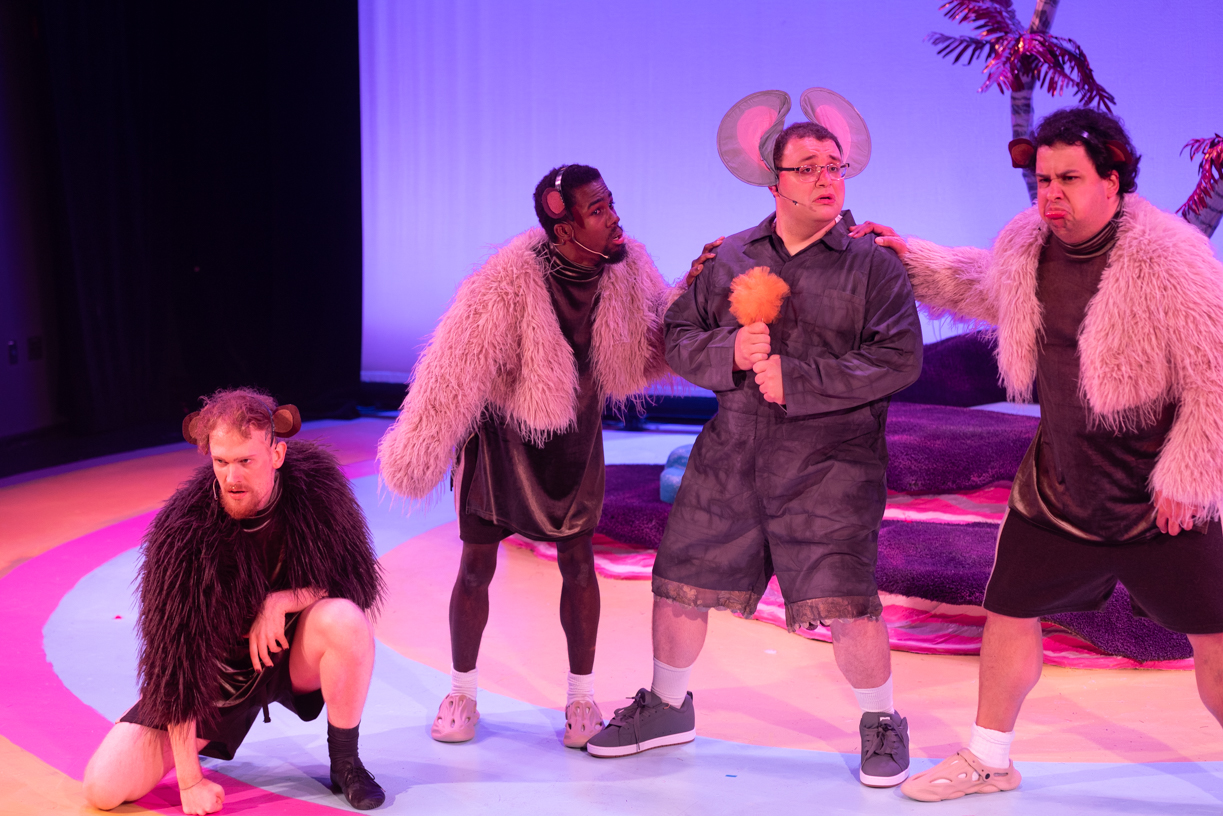
Horton the Elephant (Gianluca Cirafici) surrounded by the Wickersham Brothers

For those unfamiliar with the script, it is adapted from several children’s books written and illustrated by Theodor Geisel aka Dr. Seuss.  Music is by Stephen Flaherty with lyrics by Lynn Ahrens.  Two of the plots feature a compassionate elephant portrayed by an endearing Gianluca Cirafici sporting soft floppy ears.  The third story line moves the focus to his love-struck neighbor, Gertrude McFuzz, depicted with pizzazz and warmth by Natalie Kaiser, accompanying herself on kazoo.  To attract Horton’s attention, the self-conscious bird grows an impressive tail with the help of Dr Dake (Ethan Jones).  Other Seuss inventions that make appearances large and small are the famous trickster The Cat in the Hat (Shoshanna Gleich), a bluesy Sour Kangaroo (Emily DeMaio) and her Baby (Anjel Bell), a judicious Yertle the Turtle (Prince Hurst), and the Wickersham Brothers (Miles Butler, Ethan Homan, Nick Moscato, Sven W) who never get tired of literally monkeying around.

Gertrude McFuzz (Natalie Kaiser, center) growing a tail with the help of Dr Dake (Ethan Jones) and encouragement from The Cat in the Hat (Shoshanna Gleich).

The opening is primarily based on Horton Hears a Who. Finding an entire populated planet on a clover, Horton appoints himself protector aided by the Smallest Who of All, Jojo embodied in the tiny but mighty Christine Newberry.  It is she who calls forth a universe of Seussian creations with her unbridled imagination.  Standout Matt Tierney has a wonderful time soliciting both laughs and donations from the audience as her father the Mayor.  Sandy Gladstone Karpe is Mrs. Mayor rendered with overflowing glass of chardonnay in hand.

Jojo (Christine Newberry) with her disapproving parents, Mrs. Mayor (Sandy Gladstone Karpe) and Mr. Mayor (Matt Tierney)

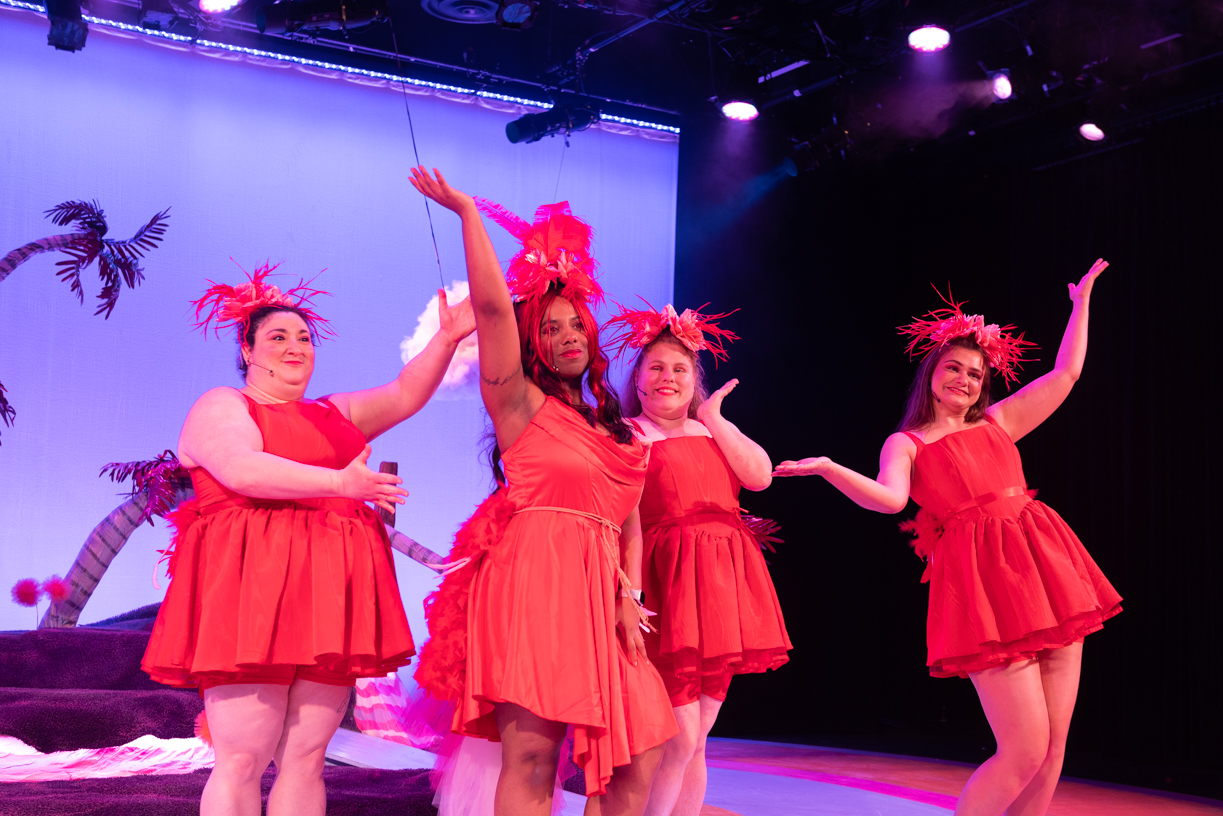
As if the Whos of Whoville and their speck of dust world (Bre Baron, Sami Binder, Miles Butler, Tess Carvelli, Shafer Gootkind, Prince Hurst, Ethan Jones, Genesis Solivan) weren’t responsibility enough, Horton then falls for the manipulations of Mayzie Labird, taken on with sass a-plenty by Kayla Robinson, who tricks him into sitting on her egg.  As is appropriate, all the birds, including Kaiser and Robinson plus the powerhouse “Bad Girls” trio of Alice Frannsen, Rachel Paine, and Elisa Weiss, bring vocal purity to all of their songs. 

Mayzie Labird (Kayla Robinson, second from the left) with the Bad Girls: Alice Frannsen, Rachel Paine, and Elisa Weiss

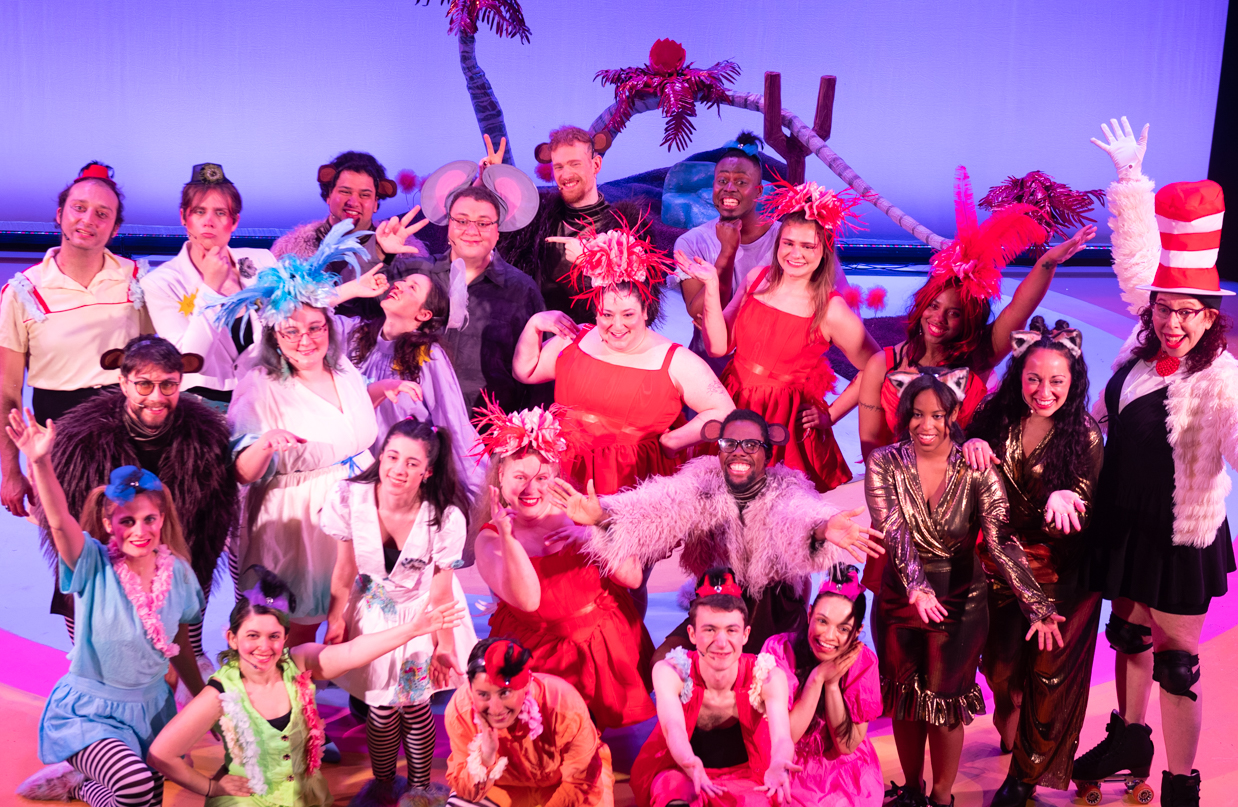
Scenic designer Christian Flemming has done an admirable job capturing Seuss’s drawing style in three dimensions encircled by an “Oh, the Places You’ll Go” rainbow sidewalk.  Likewise Izzy Kitch’s whimsical costumes and elaborate headgear.  Props by Dana Weintraub include miniature everyday items for the Whos and of course a Red Fish and a Blue Fish.  Against this background, Artistic Director Aubrie Therrien and her Co-Director Meggan Dodd have added their usual high-energy interaction.  Choreographer Travis Burbee provides several effervescent dance numbers. 

The Cast of EPIC Players’ Seussical the Musical

Since 2016, EPIC Players (Empower, Perform, Include, Create) has been dedicated to creating professional performing arts opportunities and a supportive social environment for Neurodivergent and Disabled artists.  With its wonderful range of colorful characters, Seussical the Musical is a perfect match for their talents and mission.  As a Mother’s Day “gift,” on Sunday May 11th their performance will be relaxed with ASL interpretation.  There couldn’t be a better time to deliver the message that “a person’s a person’s no matter how small.”  So if you could use a reminder of How Lucky You Are, head to ART/NY The Mezzanine Theatre, 502 W 53rd St. now through May 18.  Tickets are $35-$65 and can be purchased online at https://epicplayers.ticketspice.com/epic-players-presents-seussical.  

Photos by Zui Gomez

All The World’s a Stage: First Look

Only two weeks into previews, the World Premiere of All the World’s a Stage is developing into a warm and enjoyable spring offering.  Though set in 1996 in small-town Pennsylvania, sadly the themes covered could be ripped from today’s headlines.  Adam Gwon’s lyrics are dense and expressive, but despite the many complex subjects he explores — bullying, book banning, religious indoctrination, and the very human need to be seen — it is hopefulness that is heard above them all.  Pair that with a memorable score and a quartet of talented performers, and this tale of a gay math teacher and the unusual student he mentors add up to a winning piece of entertainment.

The actors work together like four limbs of the same magical being.  Eliza Pagelle is wonderfully squirmy, adrift in her baggy cloths as unpopular high school senior Sam.  Matt Rodin embraces both the nerdiness and attractiveness of her protective closeted teacher Ricky.  Jon-Michael Reese and his big bold voice are perfectly suited to self-possessed bookstore owner Michael, who is out accompanied by trumpets and klieg lights.  And Elizabeth Stanley puts a relatable chink in the armor of by-the-book administrator Dede.  

Matt Rodin, Elizabeth Stanley and Eliza Pagelle in All the World’s a Stage at Theatre Row
Production Photography: Richard Termine

Keen Company’s Artistic Director, Jonathan Silverstein, takes the helm as the director of this lovely work.  The effect employed to create the unseen school principal is an example of his clever approach to promoting the big things in this small package.  Set designer Steven Kemp has made the most of the tight space in Theatre Row’s Theater 5, placing a short cinder block wall around the musicians and steps downstage to add more dimension.  Jennifer Paar has built an impressive wardrobe for each of the four central characters giving them even more to work with.   

Gwon’s book is filled with cultural references that have traveled well through time, especially the admiration for Tony Kushner’s Angels in America which was recently revived in New York and London.  Many lines earn a laugh of recognition from the audience.  (Who among us didn’t prefer listening to the cast album of Chess over following the stock market?)  His love for and knowledge of the theater is particularly needed at this time when the art form has been under attack.  The musical numbers cover a wide range of styles from the jingly “Saturday Night in a Small Auditorium”, through the campy “The Show Must Go On,” to the heartfelt “Mirrors” which had the hulk of a man sitting next to me weeping hard enough to wiggle my seat.  The four musicians under the direction of Andrea Grody stay wonderfully engaged with the onstage happenings without calling attention to themselves.

All the World’s a Stage packs a lot of emotion and life lessons into its current runtime of an hour and 40 minutes without getting preachy or losing its humanity.  It’s a compact work with enough heart to feel expansive.  Performances continue at Theatre Row thought May 10.  Tickets beginning at $25 can be purchased  online at www.keencompany.org, by phone at 212-714-2442 ex 45, or at Theatre Row Box Office at 410 W 42nd Street.  

Welcome to the Big Dipper

Almost ten years ago, playwright Catherine Filloux took a break from delivering hard hitting dramas that deeply examine the human condition and began working on something far lighter.  The genesis was an episode from her mother’s life involving a busload of Amish and another carrying a troupe of crossdressing singers.  These vastly different groups were forced to stay at the same motel during a snowstorm.  

Now complete with music and lyrics by Jimmy Roberts (I Love You, You’re Perfect, Now Change) and a book co-written by John Daggett, the musical Welcome to the Big Dipper is having its World Premiere directed by DeMone Seraphin at the Theatre at St. Jeans.  Even with this unique origin story, almost everything about the dialogue, songs, and movement evokes memories of other shows.  Whether you find this humdrum or comforting will depend very much on your love of the musical form in general.

Strictly religious widower Amos King (Robert Cuccioli) is returning from a wedding with his daughter Rebecca (Mia Pinero) and their neighbor, Sarah (Jillian Louis).  Trans choreographer Carly (Jayae Riley, Jr.) is taking the Sirens of Syracuse (Pablo Torres and and Darius Harper) fronted by Jacky/Jake Barnes (Michael Yeshion) to The Ladies of the Lake singing contest.  After their buses collide during a blinding blizzard not far from Niagara Falls, the city of Bigelow finds them shelter at the Big Dipper Inn.  The inn’s owner — Black single mother Joan Wilkes (Debra Walton) — was about to sell her treasured family property to a development firm represented by Bonnie (Jennifer Byrne) in order to cover the cost of college for her brilliant son Dez (Christian Magby).  But she removes the “closed” sign from her desk and agrees to provide sanctuary to the travelers.  Though they have brought few possessions, there’s baggage aplenty.

Jillian Louis, Mia Pinero, Robert Cuccioli, Pablo Torres, Darius Harper, Jayae Riley, Jr., Michael Yeshion; Photo by Carol Rosegg

Despite their proximity and the wild set-up, there is almost no catalytic energy among the guests.  Doorways on wheels in Brian Pacelli’s scenic design facilitate moving between narratives, though the static elements of the set don’t meld easily with all storylines.  Slavery, religious devotion, personal ambition, and romantic attachments whiz by without much investigation.  Filloux’s drive to understand how people respond to one another in crisis occasionally pokes a hole in the thin fabric of plot.  The casting by Michael Cassara is deliberately and appropriately inclusive.  But with so many tropes employed, it is hard to determine who is being lifted up and who is being sent up.  This is not a reflection on the actors, who all seem committed to the constructs provided.  Musical numbers are delivered with polish and passion.  Post-performance discussions with represented community members including transgender social organization CDI and the production’s Amish consultant, J.P. Miller, should add much needed perspective. It’s just unfortunate not to be able to experience more of it directly from the work.

If the rush of the modern world has you feeling anxious, settling into the snowy surroundings of the Big Dipper Inn and the singing talents those walls contain provides 90 minutes of shelter from the storm.  Though little ground is broken, the kindness of the characters and bow-wrapped epilogue are well-suited to the holiday season. 

Welcome to the Big Dipper continues through December 29 at The Theatre at St. Jeans, 150 East 76th Street, between Third and Lexington. (No performance Thanksgiving or Christmas Day.) Tickets can be purchased at https://web.ovationtix.com/trs/cal/34375/1730433600000.  $20 senior and student Rush tickets are available in-person beginning one hour prior to performances, subject to availability. The York Theatre’s Gen York program also offers $30 tickets for patrons under 35. 

We Live in Cairo

In 2011, a number of Egyptian youth groups gathered together in Tahrir (Liberation) Square to protest the corrupt authoritarian rule of President Hosni Mubarak.  His 30 year stranglehold on power had led to economic stagnation, human rights violations, and media restrictions.  The young peoples’ acts of civil disobedience in concert with a series of labor strikes forced Mubarak’s resignation and brought about a democratic election.  Their victory was short lived, however, and Egypt now stands at a miserable 18 out of 100 on the Freedom House scale.  

Inspired by a photo of several of the activist artists, brothers Daniel and Patrick Lazour wrote We Live in Cairo, developing the score and book over ten years.  The results are inconsistent in their ability to sway the audience, primarily carried along on waves of tuneful music.  Most numbers combine instruments and musical themes from Egypt with traditional structures including love ballads and rock anthems.  Director Taibi Magar joined the collaboration to add depth and movement to song.  The voices of the all-Arab ensemble blend beautifully (vocal arrangements by Madeline Benson) even when their characters falter.  For the scene depicting the toughest days of uprising, the musicians join the actors center stage, enveloping them with melody.

Michael Khalid Karadsheh, Ali Louis Bourzgui, Rotana Tarabzouni, Nadina Hassan, Drew Elhamalawy and John El-Jor in WE LIVE IN CAIRO at New York Theatre Workshop; Photo by Joan Marcus

The atmosphere developed by the design team wraps the audience in the sights and sounds of the struggle for freedom.  Tilly Grimes’ set is kept simple with a collection of pillows, rugs, lamps and household items filling a few shelves. The visual emphasis is on the evocative projections designed by David Bengali, some of which appear overhead.  He and lighting designer Bradley King added their graphical layers to the look and feel when they joined the crew during the run at A.R.T. in Boston.

Unfortunately, the story, though it was restructured several times, lacks the same level of vibrancy.  While the idea of looking at this revolution through varying lenses of artistry, policy, and simple human compassion is an interesting concept, the issues are all frustratingly abbreviated and the actions poorly motivated. Initially apolitical and fearful, Layla (Nadina Hassan) suddenly turns her entire life inside out based on exposure to a single image.  The societal significance of her boyfriend, Amir (Ali Louis Bourzgui), and his brother Hany (Michael Khalid Karadsheh) living as Coptic Christians in the majority Muslim country is mentioned, but never meaningfully explored.  Fadwa (Rotana Tarabzouni) is so driven by her identity as the child of dissidents that her every opinion becomes a cause which muddies their significance.  The attraction between the majestic Karim (John El-Jor) and the tentative Hassan (Drew Elhamalawy) is covered over as quickly as one of Karim’s satiric murals.  The vagaries of this critical thread border on homophobic.  Even the impact from country’s former status as a British colony doesn’t receive more than a single line.

New York Theater Workshop, which has been helping to nourish this production for nearly 7 of the 10 development years, has done what they can to broaden the world of the play beyond the walls of the theater.  E-tickets include the promotion of local Egyptian restaurants, invitations to post-show topical talkbacks at their sister space, and lighter cultural fare like a hummus-making contest.   A brief historical timeline and the “origin story” of the production are inserted into the program.

Like the ending of the Arab Spring it depicts, We Live in Cairo ultimately fizzles.  But it leaves behind a feeling of purpose that makes the experience worthwhile at this delicate point in our own history.  The Off-Broadway premiere continues through November 24 at New York Theatre Workshop, 79 East 4th Street in Manhattan. The performance runs 2 ½ hours with one intermission and contains images and sounds of a violent nature.  Tickets begin at $49 and can be purchased at https://www.nytw.org/show/we-live-in-cairo/tickets/ or by calling the NYTW box office at 212-460-5475.  You will get a better sense of place seated further back from the stage.  This is the first play of four in the NYTW 2024-25 season and subscriptions are still available for as little as $230.

Lifeline

If you combined a biopic with a public service announcement and a Scottish jam session, you’d have Lifeline, the musical that opened Wednesday night at the Pershing Square Signature Theater.  Lifeline tells the story of Alexander Fleming, the Scottish microbiologist who stumbled upon Penicillin and introduced the world to the lifesaving power of antibiotics.  From the outset, Fleming recognized that if used incorrectly his discovery could lead to the formation of “superbugs,”: bacteria that becomes resistant to the drugs.  In tandem with Fleming’s history is the fictional tale of a rising musician, Aaron, and his childhood sweetheart now his attending physician, Jess.  While out on his first tour, Aaron had developed serious digestive issues and began taking antibiotics to relieve his symptoms.  Eventually seeking proper medical attention at Jess’s hospital, he underwent successful surgery, but developed a post-operative infection that won’t abate.  

With a book by Becky Hope-Palmer and music and lyrics by Robin Hiley and his songwriting partner James Ross, Lifeline was brought to New York by Hiley’s Charades Theatre Company, a charity that promotes community and social issues through their work.  The production started life at the Edinburgh Fringe as “The Man Behind the Mould,” and continued to evolve over six years as it toured London and D.C. among other stops.  The current rendition is described as “reinvented” and quotes from critics who reviewed the earlier two-time sell-out do not rightfully represent this run.

Drawing inspiration from practicing doctors and scientists who have engaged with the piece, the playwright does a splendid job of underlining the parallels between Fleming’s findings and current events.  Though the storyline is tough to witness and the outcome telegraphed from the outset, the first act of Hope-Palmer’s time-hopping script moves along briskly, buoyed by the musical talents of and chemistry between Scott McClure’s Aaron and Kirsty MacLaren’s Jess and the sincerity of Matthew Malthouse as the grounding Alexander Fleming.  (McClure doubles as Fleming’s war buddy, Clowes.) Alone, it would have been enough to amplify the threat that antimicrobial resistance (AMR) poses for the entire world.   Act II goes deeper into Fleming’s past and the aftermath of Aaron’s failed treatment.  But except for “I’ve Done All that I Can”, a song about the proliferation of antibiotics in our food and water delivered by Julian (Robbie Scott) a politician friend, there is little that adds to our understanding of the problem. And at a running time of 2:35, the endeavor becomes relentless — more likely to overwhelm than impress — and ends in a way that may be pure but is not satisfying.  The most thrilling twist, revealed in the last moments, concerns some of the cast members rather than the characters they portray.

In its current form, the production also seems better suited to a much larger space.  The leads are backed by five ensemble players and a rotating chorus of twelve.  A spirited band performs upstage throughout.  Alice McNicholas’s set is anchored by an illuminated turntable.  It so dominates the stage that Alex Howarth’s direction is primarily comprised of walking in circles and standing back to back while Wayne Parsons’ dance numbers featuring alter-egos and younger selves are forced to be nearly vertical.  The scenic arrangement also requires the cast to repeatedly hoist Aaron’s hospital bed on and off the platform.  Wonderfully creative visuals by Will Monks blend film, hand drawing, and helpful facts.  They are projected onto hospital privacy curtains to fill out the look, though some of Monks’ lighting is nearly blinding mid-house.

Aaron/Clowes (Scott McClure) is assisted by medical staff in Lifeline; photo by Andrew Patino

In light of a movement to have drug companies sell medications directly to patients, Lifeline provides palatable critical counsel about a rarely discussed healthcare crisis.  As a celebration of medical professionals, it’s superior to the beating of pots and pans.  As an introduction to Fleming and his achievements, it’s a shame that the whimsy of the original piece has been shed in favor of glum earnestness.  

It would be easier to recommend Lifeline as a daring artistic experiment if regular tickets were not $72 and premium seating $91, though that is understandable given the number of professionals involved who deserve to be making more than bus fare. The show continues through September 28 at the Alice Griffin Jewel Box at 480 West 42nd Street in New York.  Tickets are available at https://www.lifelinemusical.com/.   The current run is ironically sponsored in part by biopharma company GSK and pharmaceutical giant Merck.  Despite requests to turn off your phone in the lobby, don’t.  The only way to access the Playbill is with a QR code.  

Three Houses

For a play named after a family dwelling, Dave Malloy’s Three Houses has surprisingly little structure.  Set in a magical cocktail bar with an orchestra that can follow along in any key, three strangers share their experiences in a confessional open-mic night.  When the pandemic broke out, each one of them had just gone through a break-up with a partner and found themselves secluded and struggling mentally.  While there are similar strands within their tales, their ordeals only lightly touch, like their pinkies when they finally share a table.  Along the way, there are some wonderfully creative moments and beautiful melodies.  But like the current drive along the crumbling Highway 1 in Big Sur, a final point remains illusive.

In House #1, Susan (Margo Seibert) had been researching her next novel in Finland when COVID hit.  Unable to get back to the United States, she retreats to her grandmother’s abandoned house in the Latvian woods.  In a haze of red current wine, weed, and OCD, she uses the time to learn what she can about her ancestor.  House #2 is set to more uptempo tunes as we move from the deep woods to the sunny desert.  When her aunt returns to Korea leaving her New Mexico home unoccupied, Sadie (Mia Pak) takes refuge there.  Painfully missing her girlfriend, she further retreats into a SIM she has meticulously modeled on memories of her grandparents.  House #3 is actually a small basement apartment into which Beckett (J.D. Mollison) has moved after the end of his marriage.  On every level, it becomes the darkest of the dwellings, especially after he learns that his grandparents have just passed away in Ireland and paranoia sets in.  

Three Houses is the final piece of Malloy’s trilogy which includes Ghost Quartet and the memorable Octet.  Having written the music, lyrics, book and orchestrations, this work completely embraces his usual fascination with fables.  As they grapple with the effects of isolation and regret, each of our storytellers develops a relationship with a fictional being represented by puppets with tremendous personality designed by James Ortiz.  Elements of The Three Little Pigs play key roles and even show up in a sweater.  But when the inevitable wolf finally makes it to the door, he is dressed in grandma’s nightgown, which for fairytale purists will be perplexing.  

Mia Pak (with Pookie the Household Dragon) and Margo Seibert in Three Houses

All three soloists are terrific and support each other vocally and energetically.  Henry Stram and Ching Valdes-Aran appear as all of the mystical grandparents.  Scott Stangland rounds out the cast exuding something between command and menace as the bartender/MC Wolf.  However, Annie Tippe’s direction is both mystifying and maddening, especially given her assured hand with Octet.  The same black box space has been splendidly designed by the imaginative team of dots to feel warm and inclusive and a tad old-fashioned.  Fabric is draped all along the mezzanine, and the orchestra members sit in armchairs adorned with crocheted throws.  Center stage is an elaborate wooden bar, but even from the middle of the side section — normally a great spot in ¾ round — I could not make out what was on the changing backdrop behind it.  The vast majority of the staging is forward facing with the actors sometimes positioned side-by-side blocking each other from view.  Lighting designer Christopher Bowser has added some attention-getting effects and Haydee Zelideth costumes are a likewise literally colorful component that visually adds to the stories.  Nick Kourtides envelops the audience with his sound design, which appropriately alternates between feeling comforting and smothering.

Ultimately, Three Houses is more like a trio of discontinuous chapters of an unfinished novel than a fully fleshed out musical.  While the emotive songs and fanciful imagery of Octet have carried over, the clear interconnection of  those characters is missing here.  But there is some interesting terrain explored in finding discipline amid chaos and all the ways in which you can and can’t get to know someone else and — through them — yourself: vast themes to cover in a mere 100 minutes.  The production runs through June 9 at the Signature Theatre  (480 West 42nd Street) where Malloy is Premiere Resident.  Tickets ($49 – $124) and information are available at https://signaturetheatre.org/show/three-houses/

EPIC Players’ Spring Awakening

For their current musical production, EPIC  — an acronym for Empower, Perform, Include and Create — has chosen Spring Awakening.  Boasting memorable harmonies by Duncan Sheik and scathing lyrics by Steven Sater, it was a Tony winner for the original Broadway production and nominated again for its revival.  It famously gave rise to the careers of Jonathan Groff and Lea Michele.  But despite its starry origins, it is best remembered for the bluntness with which it explores abuse, neglect, and desperation. The seemingly insurmountable challenges of adolescence are what resonated particularly strongly with the neurodivergent cast, whose community is often desexualized, infantilized, and sometimes even mistreated.  (Cast members are all over the age of 16 and on the spectrum of autism.) 

Based on a 19th century work by German playwright Frank Wedekind that was subtitled A Children’s Tragedy, there are unfortunate ripples in today’s world in which healthcare for women and protections for the queer community are being restricted.  The Romeo and Juliet of sorts are Melchior (William Ketter) and Wendla (Sydney Kurland), his former childhood friend.  Her deeply repressed childhood has left her ill-equipped to take care of herself and longing to feel absolutely anything.  In a classroom where there is no room for critical thinking, he has read so much unsanctioned material that he has figured out the mysterious world of sex.  Their collision course is set.

Sydney Kurland and William Ketter

More lost to each other are Mina Cuesta’s Ilse and Reuben Baron’s Moritz.  Both have been abandoned by family, but she has found freedom and shelter within an artistic community, while he is utterly adrift.  Arguably the most charismatic pair are Hanschen played by deaf actor Samuel Langshteyn and his voice emotively interpreted by Chloe Rose Solomon.  Their literal intertwining provides many of the most bewitching moments.  All are backed by a chorus exemplifying range and expressiveness. 

Chloe Rose Solomon and Samuel Langshteyn

EPIC has always excelled in their musicality and this production is no exception.  The orchestra under musical director Blake Bauer is lyrical and clear.  Cast member Laisha Gonzalez delivers Martha’s solo in “The Dark I Know Well” with an Amy Winehouse soulfulness.  Cuesta provides Ilse with the voice of an angel complete with a wing-like shawl (costumes by Nicole Zausmer) that she bestows on a thoroughly dispirited Moritz in “Blue Wind”. And in an Act II showstopper, “Totally Fucked”, Ketter grabs a hand-mic to transform into full-on rock idol.

Mina Cuesta and Reuben Baron

Director Travis Burbee has placed his cast down the middle of the black box space so the attendees provide support from both sides.  The layout constricts the range of motion possible by the large troop of actors, but it boost the level of intimacy with the audience. Burbee also handles the violence in a way that is visceral without being unnecessarily graphic. (The team worked with a Mental Health Counselor, an Access Coordinator, and an Intimacy and Fight Director to support the cast throughout the development process.)  The set by designer Matthew Imhoff is centered around a long plot of earth, which at times symbolically nourishes the affection-starved teens.  Soft banks of lights by Cameron Filepas rise like plantings on either end.  

Deeply meaningful to a generation, Spring Awakening gives the EPIC cast a darker voice.  A content warning is announced before the lights dim.  Noise cancelation headphones are available and audience members are invited to decompress in the lobby if needed. Running time is 2 hours and 10 minutes.  Performances are Wednesday through Sunday until May 19 at ART/ NY’s The Mezzanine Theatre, 502 West 53rd Street, 2nd floor.  General admission Tickets start at $35. $20 Video streaming tickets will be available during the second week of shows. All tickets can be purchased online at https://epicplayers.ticketspice.com/epic-players-presents-spring-awakening-.

EPIC Players’ Spring Awakening

CAST:
Wendla: Sydney Kurland 
Martha: Laisha Gonzalez 
Thea: Rachel Barcellona 
Anna: Katherine Tepan 
Ilse: Mina Cuesta
Melchior: Will Ketter
Moritz: Reuben Baron
Hanschen: Samuel Langshteyn
Ernst: Josh Cartagena
Georg: Rafiq Tate
Otto: Shafer Gootkind
Adult Women 1:  Shoshanna Gleich
Adult Women 2: Samantha Elisofon
Adult Man 1: Gerard Riley
Adult Man 2: Max Tunney
Ensemble: Henry Houghton
Ensemble: Emy Ramos
Voice of Hanschen: Chloe Rose Solomon 

CREATIVE TEAM AND CREW:

Director: Travis Burbee
Assistant Director:  Gabe Girson 
Music Director: Blake Brauer
Choreographer: Miles Butler
Stage Manager: Sydnee Davis
Production Manager: William Morris
Assistant Stage Manager: Carol Hoverman
Assistant Stage Manager: Cassidy Kaye
Director of Artistic Sign Language: Kailyn Aaron-Lozano
Intimacy and Fight Director: Hannah “Rock” Roccisano
Intimacy and Fight Assistant: Scarlet Yousif
Scenic Designer: Matthew Imhoff
Sound Designer: Sean Ramos
Costume Designer: Nicole Zausmer
Props Designer: Madisen Frazier
Light Designer: Cameron Filepas 

Executive Artistic Director: Aubrie Therrien
Front of House:  Talia Eapen
Access Coordinator: Jamie Rose Hays
Mental Health Counselor: Taupa Fogo-Toussaint

Production Photos: Zui Gomez