Category Archives: On Demand

Malcolm X & Redd Foxx Washing Dishes at Jimmy’s Chicken Shack in Harlem

In June of 1943, Malcolm Little and John Elroy Sanford crossed paths as dishwashers in the same Harlem fried chicken joint.  At ages 19 and 20 respectively, they were still finding their footing as Black men at a time when they were encouraged to give their lives for the country, but not being given societal or economic opportunity.  His father having died early and his mother hospitalized after a breakdown, Little was a petty criminal, frustrated to keep finding himself on that path.  Foxy was an aspiring comic who already handled his finances so poorly he was living on a rooftop.  The engaging Malcolm X & Redd Foxx Washing Dishes at Jimmy’s Chicken Shack in Harlem opens an imaginative window into the relationship between these two men long before fame found them.  

Though familiarity with the raunchy comedian and the inspirational Muslim leader is helpful, at heart Jonathan Norton — who won the American Theatre Critics/Journalists’ M. Elizabeth Osborn New Play Award  for Mississippi Godddamn — has here written a thoughtful exploration of friendship.  Though Foxy and Little share concerns, they have divergent approaches for overcoming them.  By turns, they build each other up and tear each other down, eventually bringing out something special in one another that perhaps no one else would unearth.  Always running in the background is the pre-civil-rights society that literally and metaphorically deprives the two of the music in life.  

Squat and expressive, with an ability to swing from insecurity to dominance, Trey Smith-Mills plays Foxy.  The long and suave Edwin Green — who has been with the production since its 2024 Off-Broadway reading — makes a terrific counterpart as Little.  Director Dexter J. Singleton heightens the required physicality and timing in both performances.

Trey Smith-Mills and Edwin Green as Foxy and Little; Photo by Wesley Hitt

Costume designer Claudia Brownlee provides the right style-on-a budget wardrobe, particularly with a red and white suit and outrageous hat for Foxy.  Jennifer McClory’s wigs mimic the chemically treated reddish hair that was popular in that period.  The shabby back-kitchen set with its stained walls and gurgling drain is designed by Kimberly Powers.  Blackouts and hot spots (lighting by Levi J. Wilkins) along with jazz standards and order-up bells (sound by Howard Patterson) work cleverly together to illustrate the passage of long summer days.

Malcolm X & Redd Foxx Washing Dishes at Jimmy’s Chicken Shack in Harlem is a captivating two hander about people you think you know in an era you think you understand.  Above all, it is the evolution of a friendship that reverberated throughout two meaningful lives.  This World Premiere was commissioned by TheatreSquared, and is a co-production of T2, City Theatre Company, Virginia Stage Company and Dallas Theater Center.  The run has been extended until November 2nd.  Live performances take place at Spring Theatre (477 W. Spring St., Fayetteville, AR).  The streaming version is shot casually (odd angles, heads in the way, uneven audio) but is a wonderful option for those with mobility or childcare issues and those of us who live at too great a distance from the the venue.  Content is for mature audiences, with simulated drug use and adult language.  Runtime is an hour and forty minutes with no intermission.  Both live tickets ($$25-$71) and streaming tickets ($25-$35) are available at theatre2.org/jimmys-chicken or by calling (479) 777-7477.

Twelfth Night

Twelfth Night is arguably the most lovely of all of Shakespeare’s comedies.  It reflects the same lighthearted and celebratory nature as the Christmas holiday for which it is named.  Set along the sun-kissed coast of Illyria with happily-ever-after always in view, it includes many of the playwright’s favorite motifs — tangled affections, mistaken identify, and class contrasts — and blends them into a frothy mixture.  Now playwright Alison Carey has given it a delicate layer of modern polish, increasing the ease of comprehension while leaving the most memorable lines intact.  Her translation is being produced at TheatreSquared and performed by the National Asian American Theatre Company (NAATCO) who co-present along with Play On Shakespeare.  Further enlivened by new music soaringly sung by Joyce Meimei Zheng, it’s a delightful family-friendly entertainment.

Nima Rakhshanifar, Karen Li, Eston J. Fung, and Anula Navlekar are among the National Asian American Theatre Company cast members of Twelfth Night at TheatreSquared, now streaming.

At the opening we are introduced to Count Orsino (Eston J. Fung) who pines for the lovely Olivia (Karen Li).  But the lady is in mourning over the recent death of her brother and is not open to his wooing.  She is protected and served by the crafty Maria (Nandita Shenoy).  Living with them is Olivia’s uncle, Sir Toby Belch (Victor Chi), who spends much of his time drinking and playing tricks on those around him.  He hopes his niece will accept a proposal of marriage from his good friend, the sweet but foolish Sir Andrew Aguecheek (Alex Lydon).  The two other members of this household could not be less alike.  Her house manager, the self-important Malvolio (audience favorite Rajesh Bose), is the most humorless man in the realm, while her fool, Feste, (Joyce Meimei Zheng) is often seen around town entertaining everyone with jokes and songs.

Meanwhile, a shipwreck just off shore has separated devoted twins Viola (Anula Navlekar) and Sebastian (Nima Rakhshanifar).  Each believes the other to be drowned.  Recognizing the potential perils of living as a woman alone in a strange land, Viola has disguised herself as a young man and now serves as a page to the broken-hearted Orsino.  When she is sent to court Olivia in the Count’s name in her male garb, she inadvertently wins the woman’s heart for herself.

Vibrantly directed by Aneesha Kudtarkar making her T2 debut, the cast whizzes through nearly 2 ½ hours of poetry, music and storytelling.  An amusingly choreographed duel is a highlight.  Each line is spoken clearly and with natural rhythm.  The set by scenic designer Chika Shimizu provides ladders, platforms, and a bridge that promote physicality and an openness that is bathed by Marie Yokoyama’s seaside-colored lighting.  Costume designer Mariko Ohigashi adorns the actors in warmly colored relaxed fabrics that move with them, further enhancing the ease and fluidity of the entire play.

The welcome comfort is palpable in this Twelfth Night.  While I was anticipating some form of cultural spin, what I saw was a first rate production of an easy-to-like play.  Illyria can be reimagined to be anywhere where the only person who is mocked is the one who stomps on everyone else’s delight.  The point is not what these people look like, but rather the joy they take in each other’s company.  TheatreSquared is located at 477 W. Spring St. in downtown Fayetteville, Arkansas.  In person tickets ($30-$60) as well as an on-demand stream ($25/$35) are available on the TheaterSquared website (https://www.theatre2.org/twelfth-night).  Performances continue through Sunday, March 30.

Away on Australian National Theatre Live

Michael Gow’s Away remains one of the most produced plays in Australia.  First performed nearly 40 years ago and set in 1967/68, it explores grief, family relationships, and xenophobia against the backdrop of a distant war in Vietnam.  Away may be considered uniquely Australian, but those themes are timeless and have continued to reverberate, making this play forever relevant and moving.  Fortunately for those of us in this hemisphere, an all-around excellent production from 2017 — a co-production of the Malthouse Theatre and Sydney Theatre Company — is available to watch on Australian National Theatre Live.  With a first rate cast led by Heather Mitchell at her biting best as Gwen, this layered revival makes for a fulfilling 1:40 for any theater fan.

Bookended by the words of William Shakespeare, the action opens with the final scene of an emotive and balletic high school production of A Midsummer Night’s Dream.  The evening is hosted by the outwardly jovial Roy, whose wife Coral is consumed with depression over their son who died in battle.  Puck has been played by the sweetly awkward Tom, the only child of working class English expats, Harry and Vic.  He has fallen for his costar, Margaret, whose nouveau riche parents, Jim and Gwen, aren’t thrilled about the boy’s attentions.  All three families leave for beachside holidays over Christmas break, but at three very different levels.  Roy and Coral are flying to a ritzy resort where they’ve been regulars.  Margaret, Gwen and Jim are off to an upscale caravan park in their luxury camper-van packed with fishing equipment and other gear.  Meanwhile, Tom, Harry, and Vic load their lean-to pup tent into the family car.

Playwright Gow seamlessly blends lighthearted humor, social commentary, and surreal fantasy.  The three parallel stories beautifully and economically unfold, with all the actors playing ancillary characters in each other’s tales.  The juxtaposition of the high anxiety of Gwen with the genuine warmth of Vic set up the confrontations that ripple through each encounter.  There is no situation Gwen can’t make worse nor one that Vic can’t see the best side of.  The young couples’ exchanges ring true and are deeply touching.   There continue to be reverberations of Midsummer with an increasing number of besotted Bottoms among the dancers and a Shakespearean-sized storm brewing.  Tom often watches from the sidelines, like Puck overseeing his handiwork, though Tom has little control over any story, especially his own.  

Cast of Away (2017); Production Photo by Prudence Upton

Even through the lens of a camera crew, the top notch design shines through.  Powerfully directed by Malthouse Artistic Director Matthew Lutton, the staging includes several etherial dances choreographed by Stephanie Lake.  Though the stage remains nearly bare throughout, there is always a strong sense of place centered around an almost-magical wardrobe (set and costumes designed by Dale Ferguson).  Most of the surroundings are conveyed in light and sound with Paul Jackson’s lighting providing the eery warm glow of backstage, garish pink of a dance floor and stark whiteness of a deserted beach.  The atmosphere is made more jarring by the discordant sound design of J. David Franzke.  In addition to Ms. Mitchell, the cast includes Liam Nunan (Tom), Naomi Rukavina (Margaret), Glenn Hazeldine (Roy), Wadih Dona (Harry), Julia Davis (Vic), Marco Chiappi (Jim), and Natasha Herbert (Coral).

This stirring production of Away was among the first dramas uploaded to Australian National Theatre Live during the pandemic.  While there is no substitute for being in a darkened room with strangers, the service (https://australiantheatre.live/) does a first rate job of sharing a range of quality work live-captured by Peter Hiscock and his crew.  The concept is to allow a wide audience to enjoy these productions regardless of their location, income level, or physical limitation.  Subscriptions are $7.99 per month or $74.99 per year and a free trial is available.

John Proctor is the Villain

Writers are often told to write what they know.  Playwright Kimberly Belflower has gone several steps further.  In John Proctor is the Villain she has boldly written from her very marrow, jangling the skeletons in our collective social-values closet.  Raised in Appalachian Georgia, Belflower sets her piece in a one stoplight town in her home state, using the locally accepted ways and belief systems to draw parallels between a circle of high school sophomore girlfriends and the characters in Arthur Miller’s The Crucible.  The year is 2018 and there is much in these young women’s lives that was not solved by Harvey Weinstein’s arrest.

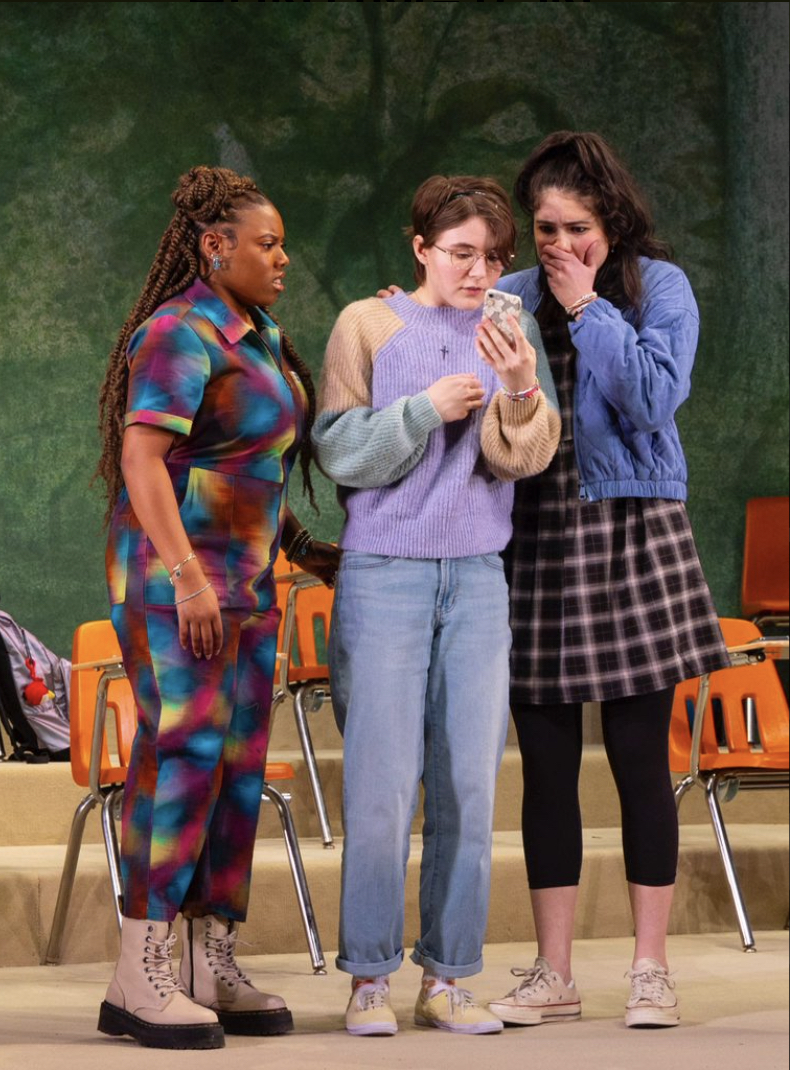
Victoria Omoregie, Jules Talbot, Haley Wong in John Proctor is the Villain; directed by Margot Bordelon; photo by T Charles Erickson

The dialogue is wicked-smart, filled with references from classic literature to song lyrics.  Though all are understandable because of clever context, only one is fully explained.  Belflower begins Act 1 in a classroom where sex education has been buried inside English-Lit, all the better to rush through the uneasy curriculum.  Along with getting a quick hit of each of “Villain’s” characters, this opening enables teacher Carter Smith (a  charmingly approachable Japhet Balaban) to also introduce any audience members not already familiar with Miller’s work to the major themes of The Crucible and the historical background of Witch Hunts.  It also becomes clear very quickly how much the study of the arts is giving meaning and purpose to the lives of these students

While serious issues of feminism, sexuality, body positivity and all varieties of belief run under the surface, front and center is a story of the power of female friendship.  The young ladies are created with some stereotypical DNA, but every one is layered with unique and endearing details.  Caught in a very personal #MeToo scandal through the actions of her father is Ivy Watkins (a warm Brianna Martinez).  Her former best friend Shelby Holcomb (a thorny Isabel Van Natta) has just returned to school after an unexplained “sabbatical” which might be connected.  Often speaking truth to power is Nell Shaw (a high-octane Victoria Omoregie) bringing “worldly wisdom” to the conversation from her upbringing in Atlanta.  At the other end of the confidence spectrum is Raelynn Nix (a fabulously wriggly Haley Wong) the local preacher’s daughter. The ultra serious Beth Powell (a ready-to-spring Jules Talbot) launches a feminist club in part to boost her college application but also to give them a container for discussing their feelings. They have a developing ally in Mason Adams (a sweetly awkward Maanav Aryan Goyal ) who experiences a particularly lovely character arc.   Filling out the attendance sheet is Raelynn’s ex-boyfriend Lee (Benjamin Izaak) and the class guidance councilor Bailey (Olivia Hebert) who are essential to the plot.

Seasoned director Margot Bordelon, who has a history of amplifying new voices, seems to have deep love for these characters, bringing out every delicate moment of discomfort and rage with authenticity.  The school room’s simple set by Kristen Robinson changes temperament with the help of Aja M. Jackson’s lighting.  Sound designer Sinan Refik mixes snippets of pop tunes with school bells and eery noises to further shift the tone of the room.  The girls also make themselves heard in their choice of wardrobe (Zoë Sundra) and in Raelynn’s case evolving eye make-up.

Whether it is exploring weighty matters (like why is “too much” simply parental shorthand for “a girl)” or making us laugh in solidarity, John Proctor is the Villain always keeps us entertained.  True enjoyment requires the ability to think big and a tolerance of of other points of view.  It is available as an On Demand stream from The Huntington Theatre in Boston through March 24.  Running time is about 100 minutes with no intermission. Digital tickets are available at four price points starting at $30 and can be purchased at https://bostontheatrescene.huntingtontheatre.org/28317/28319.  

Australian Theatre Live – Emerald City

In 2014, when the artistic director of the Griffin Theatre Company,  Lee Lewis, had the opportunity to direct any play she wished, she reached back nearly 30 years to David Williamson’s comedic drama Emerald City.  The work continues to travel maddeningly well through time.  Using his own experience as a springboard, the Australian playwright examines the struggle between artistic passion and the desire for money and power.  Available to stream on the relatively-new-to-the US Australian Theatre Live, it is a treat for those who missed it during an early run produced by New York Theater Workshop.

The city in question is not the one Dorothy visited, but rather the glittery harbor-famed Sydney where in-demand screenwriter Colin (Mitchell Butel) has recently relocated his family from the more staid and traditional Melbourne.  He hopes the colorful energy of his new surroundings will be creatively renewing after his latest film disappointed at the box office.  But a new partnership with the well-connected vulgarian Mike (Ben Winspear) plays havoc with Colin’s priorities and reputation.  A secondary plot involving Colin’s wife of 18 years, Kate, (Lucy Bell) centers on book publishing and the question of who can tell a story, once-again relevant in the season of The Killers of the Flower Moon.  Colin’s agent, Elaine, (Jennifer Hagan), his bank manager, Malcolm, (Gareth Yuen) and Mike’s live-in girlfriend, Helen, (Kelly Paterniti) play pivotal roles in the unfolding of events.

Kelly Paterniti as Helen and Ben Winspear as Mike in Emerald City;
photo by Brett Boardman

There are two main reasons why the play still resonates.  While there has been an increase in the appetite for quality on screens big and small, there is still little profit to be made in arthouse projects: a dilemma for talent.  But there is also a timelessness to Williamson’s satiric conversation and smartly drawn characters.  His observational ability is on full display, especially when actors break the fourth wall and make us coconspirators.  Focus whips between them connecting with their audience and being in the moment, providing side-by-side viewpoints.  Butel is particularly skilled at humorously parroting the others.  Though it is the men who take up most of the 125 minute runtime with their posturing and machismo, the women with their deeper combination of beauty and brains are the ones behind the more surprising and memorable moments.  The piece begins to drag a bit towards the end, though that may be my post-pandemic attention span unaccustomed to two full acts.

Designer Ken Done supports the central conflict with his backdrop for Act I playfully drawn and the one for Act II dressed for business, shrouded in beige fabric.  A single couch and coffee table serve as all living rooms and a sole desk and sectional Everyman’s office.  This allows director Lewis to squeeze every millimeter from the tiny stage, including the area between staircases, and facilitates seamless handoffs between characters at a brisk pace.  Lighting designer Luiz Pampolha provides emphasis as does costumer designer Sophie Fletcher’s pops of color.

The Griffin was launched by actors and remains artisan-focused.  In his introduction to the digital version of Emerald City, Williamson makes clear that this is not a film but rather a first rate production viewed from the best seat in the house.  Indeed the camerawork is smooth and obviously well rehearsed, the sound is pristine, and the acting style genuinely theatrical.  Closed captioning is available as is a 10 second back button.  The stream costs $7.99 at https://stream.australiantheatre.live/ and is just one entry in a growing library developed with the intention of expanding access to Australian performing arts.

The Heart Sellers – Streaming

There are many recent plays and movies that investigate the immigrant experience.  Most scout the important but familiar terrain of fear and pain resulting from being in our country illegally.  The Heart Sellers takes on far less explored territory by rolling back to the early 1970s.  The two young women involved — one from the Philippines, the other from Korea — have been able to move to the United States under the provisions of the Hart-Celler Act.  This law made major changes to our immigration policy, making it easier for people from Asia and other areas previously discriminated against to come here for work.  In the case of Luna and Jane, their husbands are both in residential rotation at the local hospital.  But the wives have had to leave their dreams and most of what had given their lives meaning back in their home countries.  When fate brings them together in the supermarket on Thanksgiving, they make the most of the opportunity to find connection in what has been a very lonely world.

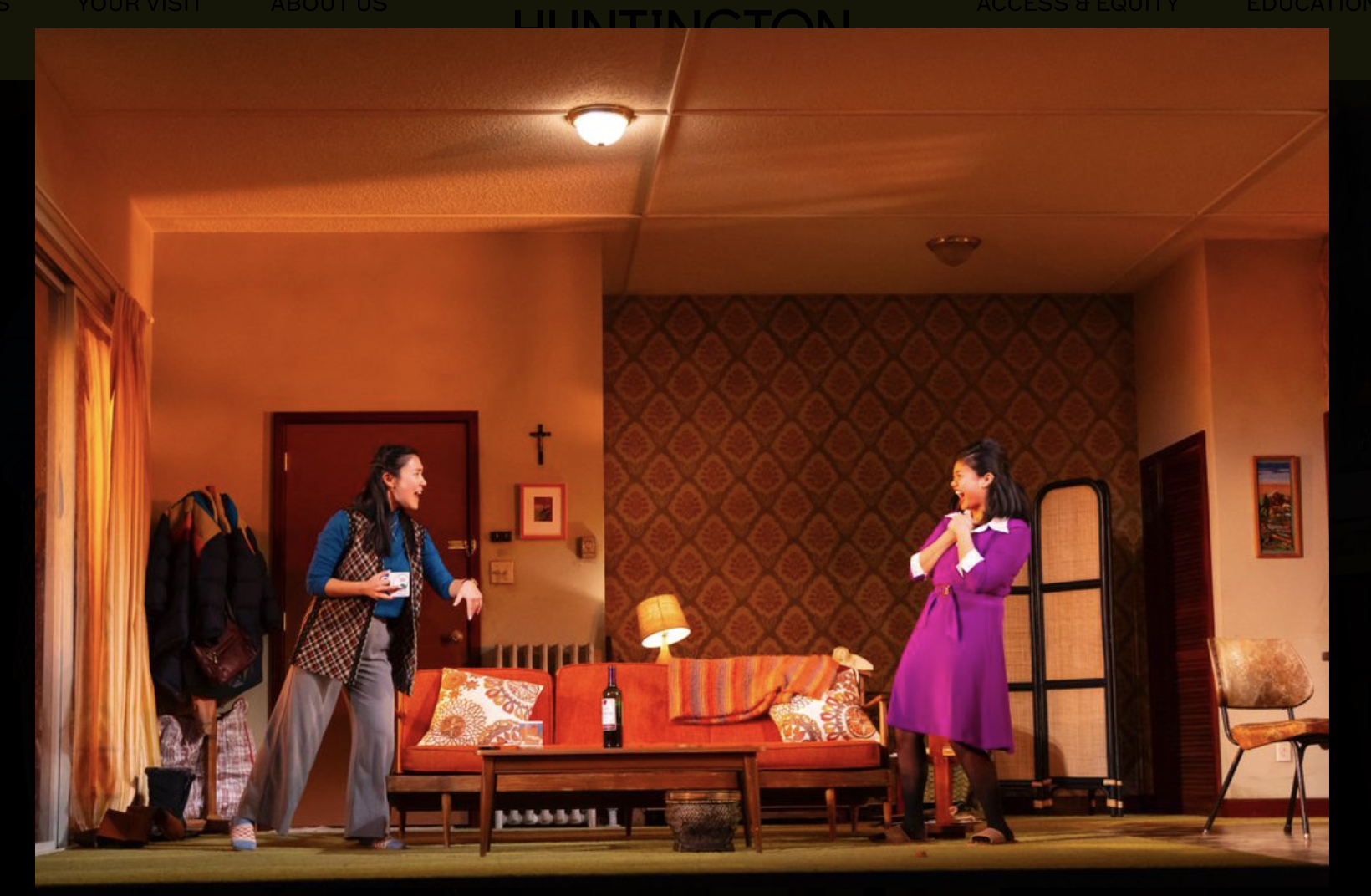
With an adept ear for dialogue, playwright Lloyd Suh treats us to a fabric of rich detail while keeping the conversation flowing.  His examination of the cultural norms of 1970s America is both funny and touching.  Luna and Jane’s exchange is at first realistically halting as they each employ their second language in search of common ground.  Scenic and costume designer Junghyun Georgia Lee sets the perfect tone, literally putting the two women in a tiny box that encloses the stage.  Luna’s apartment is dressed in wild and warm shades and the character herself appears in bright pink.  Matching that colorful energy, Jenna Agbayani’s Luna is buzzy and overly familiar, high on adrenaline from her daring step of inviting Jane into her home.  In contrast, Judy Song, making her North American stage debut, keeps Jane as fact-based as her earth and sky outfit would suggest.  Only when she changes into Luna’s flowered “house clothes” does her imagination soar.  

Judy Song, Jenna Agbayani; photo by T Charles Erickson

Echoing the characters’ testing of their lives’ constrictions, director May Adrales has created something of a dance for Luna and Jane within the small space.  The pacing of the piece is as zestful as the women’s search for friendship.  With its mixture of viewpoints and high level of intimacy, The Heart Sellers is a great choice for a hybrid production.  The On-Demand version was filmed at the Huntington’s Calderwood Pavilion in Boston on December 6 and is beautifully produced and edited by Kligerman Productions.

Though set during a November holiday, The Heart Sellers is a delightful treat for the end of a tough year and a hopeful start to the new one.  It is as warm and sweet as the yams the women devour with joy and gusto.  $30 digital tickets are still available at https://www.huntingtontheatre.org/whats-on/the-heart-sellers/  and can be used any time before January 6, 2024.  Playback is smooth and easy, with quality sound and image.  Runtime is 95 minutes.

Australian Theatre Live – Orange Thrower

For a little over a year, the non-profit Australian Theatre Live has made some of that continent’s most innovative stage productions available on demand.  Much like the New York Public Library’s Theatre on Film and Tape Archive, the platform also serves to preserve the works of a variety of performing artists. ATL is making their official US debut by hosting two public screenings — the second of which is in New York tomorrow* — as a springboard for building a relationship with a new audience. In addition to attracting theater lovers and fellow artists, they are offering an education-specific subscription service to bring this enriching content into the classroom.

For my introduction to the platform, I chose Kirsty Marillier’s Orange Thrower presented by the Griffin Theatre Company.  Griffin is Australia’s only theatre company that is dedicated exclusively to producing new playwrights.  Their Stables Theatre is a 105 seat house with a “kite shaped” stage that promotes a distinct and intimate relationship between performers and viewers.  That vibrancy translated well to the digital realm where director Peter Hiscock used three cameras to bring the home audience into the world created on stage by director/musician/performer Zindzi Okenyo.

The 80 minute comedic drama covers familiar territory from a unique perspective.  There is a layer of the mystical which is fittingly never fully explained.  This is not just a coming-of-age story, but rather one of coming-into-being.  We meet Zadie (Gabriela Van Wyk), a young woman of African decent living in a white suburban development, ironically called Paradise.  While she has code switched to the point of being almost permanently “on,” her younger sister Vimsey (Mariama Whitton) cannot wait to escape to a big city like Johannesburg where she’d find more people who look like her and share her perspective.  Their conflicting views are heightened when the two girls receive an unexpected visitor, Stekkie (director Okenyo) while their parents are away in South Africa.  Rounding out the cast is Callan Colley who provides brightness and levity in his two catalytic roles.  

Gabriela Van Wyk, Mariama Whitton and Callan Colley in Orange Thrower, a Griffin Theatre Company production available on ATL; photo by Brett Boardman

Designer Jeremy Allen’s set is centered around an open rectangle which is both a physical and a metaphorical window.  The moody lighting by Verity Hampson and a soundscape by Benjamin Pierpoint in which memories make a noise add to the feeling of otherworldliness.  Easily changed costumes topped off by Dynae Wood’s perfect wigs complete the imagery.  There is a warning that the production includes depictions of drug use, gun violence and mature themes, though these moments are nearly dreamlike.

During the pandemic, some American theatre companies offered a streaming option, but more often in the US the art form has been entangled in red tape and mismanagement. The on-demand vault of Australian Theatre Live currently has 26 entries created in partnership with nearly two dozen theatres and arts organizations.  It illustrates the value of making theatre accessible to everyone whether they live miles from a venue, have limited income, or have mobility issues.  As important, every cent of a $7.99 per month subscription goes to supporting the artists.  Learn more at https://australiantheatre.live/.  

* New Yorkers: You can join ATL for the New York debut of Indigenous artist Dylan Van Den Berg’s Whitefella Yella Tree, another Griffin Theatre Company production, at the Australian Theatre Festival (1350 Avenue of the Americas, Suite 2400), on November 16, at 7:30 p.m. (doors open at 7:00 p.m.)  To  register your interest in attending, please fill out this form.

Puffs (On Demand)

Imagine being one of the likely terrified lesser-known students at Hogwarts during the time of Harry Potter’s attendance.  That is the delightful conceit of Matt Cox’s Puffs, or Seven Increasingly Eventful Years at a Certain School of Magic and Magic, which ended its very successful New York run in August of 2019.  Wonderfully captured on film by its stage director Kristin McCarthy Parker with support from VirtualArtsTV, the show is coming to BroadwayHD beginning August 15.  Though performed with farcical pace and style, like the Boy Who Lived, Puffs never loses its soul.  The sendups are executed with obvious love for the original world and characters, which makes them far more potent and enjoyable for the true fans that make up the target audience.  

We are guided through the 7-year journey by a narrator (a quick and snappy A.J. Ditty) whose identity will eventually be revealed.  Around the time of Mr. Potter’s birth, another boy, Wayne Hopkins (a warm and sweet Zac Moon) was born and orphaned in England and then whisked away to his Uncle Dave in New Mexico.  One day, a passing owl drops a letter into their living room inviting the nerdy child to a school in his home country.  He finds himself sitting under a famed hat which determines he is a Puff, a House of seeming misfits. They are led by a very polite Cedric (an amusingly servile James Fouhey) and live in the school’s basement somewhere near the kitchen.  Wayne and his new friends Oliver Rivers (adorkable Langston Belton) and Megan Jones (Julie Ann Earls on the right side of edgy) hope to distinguish themselves and contribute to Cedric’s goal of “third place or nothing”.

(Front row) Jessie Cannizzaro, Zac Moon, James Fouhey, Stephen Stout, (Back row) Madeleine Bundy, Langston Belton, Andy Miller, Eleanor Philips (L-R); photo by HUNTER CANNING

Their story plays out Rosencrantz and Guildenstern-like, with that of Harry (a pointedly irritating Madeleine Bundy), Hermione (a wig) and Ron (a mop) unspooling in the background.  Cast members take on over three dozen characters with admirable range and assurance.  A knowledge of the Harry Potter film series is essential for truly appreciating the hilarious and multilayered impressions from Stephen Stout’s spot-on Alan Rickman as a Certain Potions Teacher to Eleanor Philips as a squeamish Death Eater.  Familiarity with a certain 2008 rom-com will add laughs to Nick Carrillo’s wild about-last-night improv.  The ensemble is rounded out by Jessie Cannizzaro and Andy Miller playing opposite ends of the outcast spectrum among other roles.

Cox’s inventive script is a total triumph. The visual wizardry emanates from director Parker’s stagecraft along with the talents of her remarkable artistic team. Magical elements  — including a Dementor so smartly designed it should get its own standing-o — are made possible by sets, props and costumes all impressively conceived by Madeleine Bundy.  These clever and colorful elements are supported by lighting effects by Herrick Goldman and original music by Brian Hoes that recalls just enough of John William’s themes.

Shown in theaters for only two nights, Puffs, or Seven Increasingly Eventful Years at a Certain School of Magic and Magic will be available On Demand at BroadwayHD.  The production is recommended for those 13+ and runs just short of 2 hours.  The mid-credit outtakes add an extra sprinkle of joy to the fun-filled viewing.

Peter Pan Goes Wrong

Conceived in 2008 by students at the London Academy of Music and Dramatic Arts and nourished during an Edinburgh Fringe Festival, the Olivier Award winning Mischief Theatre has made being silly into a sincere mission.  Their Goes Wrong… series has won dedicated fans around the English-speaking world.  Fortunately for those who don’t have one of their creations nearby, several of their plays are available for streaming.  Just added to the line-up is Peter Pan Goes Wrong, the kind of crowd pleaser that gets nominated for three Broadway.com Audience Choice Awards.  

The performance on BroadwayHD originally aired on BBC1 on New Years Eve of 2016. It features David Suchet as the narrator, a role currently portrayed by Neil Patrick Harris in the Broadway production that was inspired by this special.  Using five cameras, the show was filmed in front of a very enthusiastic and in-the-know live audience. Director Dewi Humphreys made use of the television studio setting to add comedic elements. Close-ups that reinforce the physical gags are the trade-off for not being able to take in the entire stage.  The colorful staging earned a lighting award for designer Martin Kempton.  

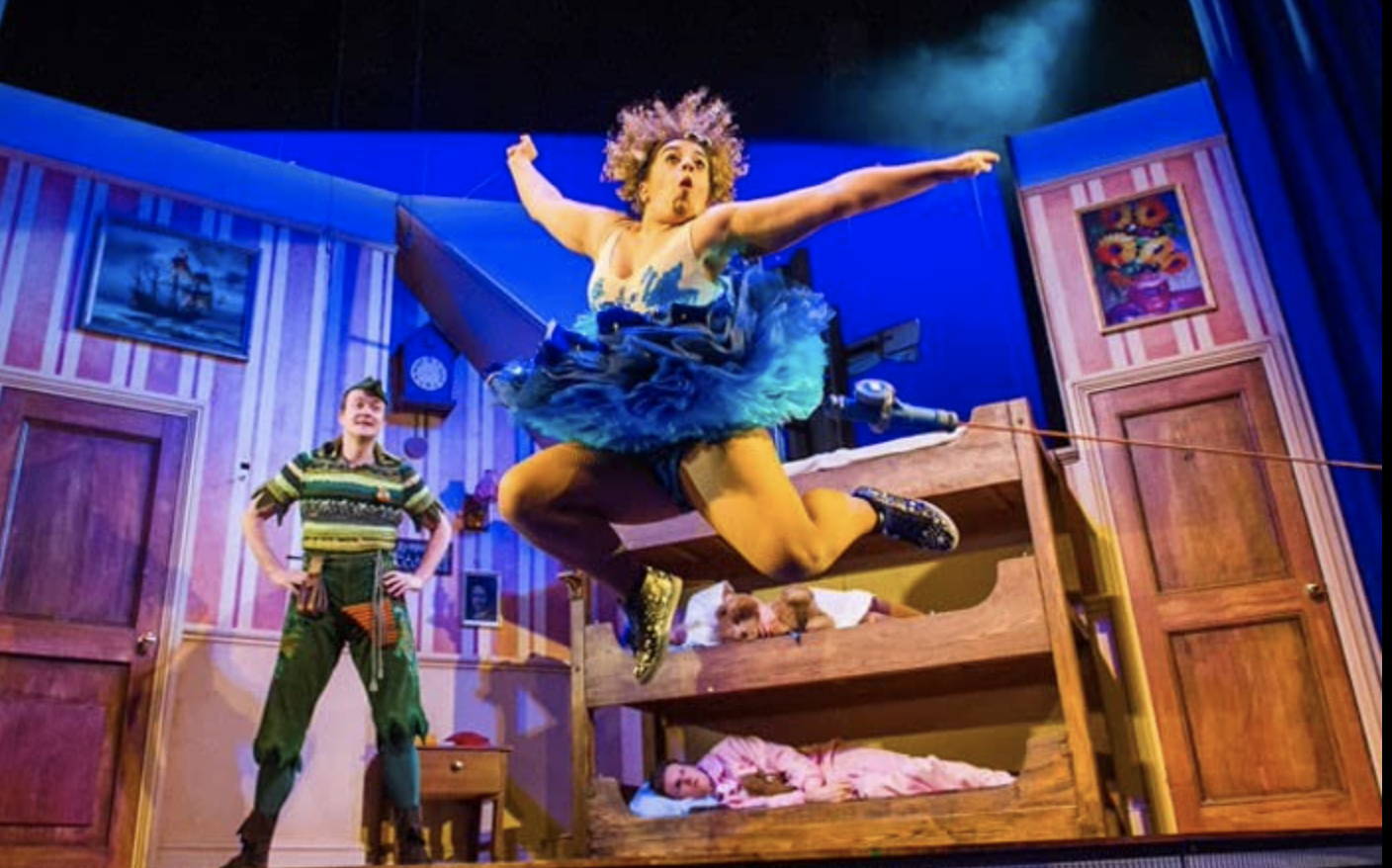
A zesty example of Mischief’s body of work, Pan stars David Hearn, Henry Lewis, Charlie Russell, Jonathan Sayer, Henry Shield, and Nancy Zamit who are still with the company.  Current members in smaller roles are Harry Kershaw, Bryony Corrigan and Mike Brodie.  The ensemble is rounded out by Chris Leask, Ellie Morris, Adam Meegido (who directed the original stage version), Greg Tannahill.  It is hard to single out any one performer since they are so interdependent.  But my admiration is boundless for Zamit who flies through more than just Tinkerbell with the aid of break-away costumes by Roberto Surace.  Songs by Mischief’s Rob Falconer and Richard Baker remind us of the shear talent of this troupe.

Nancy Zamit, Greg Tannahill, and Dave Hearn in Peter Pan Goes Wrong

Mischief members Henry Lewis, Jonathan Sayer, and Henry Shields liberally adapted J.M. Barrie’s story of the boy who wouldn’t grow up.  Their loose interpretation opens backstage where Suchet introduces us to the fictional Cornley Drama Society mockumentary style, providing background for jokes that will unfold over the course of the show.  Some of the well-known story elements remain: Peter Pan comes to the Darlings’ home to retrieve his shadow.  The children fly away with him to Neverland where the nasty Captain Hook seeks revenge for the loss of his hand to a crocodile.  But as the piece’s title would suggest, the production is plagued by issues from actors who forget their lines to designer Harry Banks’s fanciful sets that don’t work as intended.  It is quite a feat to pretend to be so terrible while being genuinely funny.  Even when you sense a set-up, the pay-off is always somewhere to the left of what you expected.  Several bits have their origins in “panto,” a comedic British theatrical form that uses well-known fairytales and encourages the audience to shout out to the players.  Some reactions were practiced, but one particularly witty off-the-cuff heckle was left in the final cut.

With a run-time of just over an hour and an emphasis on physical humor, Peter Pan Goes Wrong is a true family entertainment.  Also available on BroadwayHD are The Goes Wrong Show —12 half hour episodes — and A Christmas Carol Goes Wrong co-starring the magnificent Diana Rigg and Derek Jacobi.  You can learn more at https://www.broadwayhd.com/categories/recently-added.

From The Mint Vault — Days To Come

“Lost Plays Found Here.”  So says The Mint Theater punningly about their mission.  Founded in 1992 by Artist Director Jonathan Bank, the company gives new life to neglected plays primarily from the 1930s.  Always polished, frequently charming, and often stunningly relevant, the line-up has included The Voysey Inheritance by Harley Granville-Barker, Rachel Crothers’ A Little Journey, and several works by the nearly forgotten Teresa Deevy.  They have made their home in several comfortable venues around Manhattan, most recently City Center and Theater Row.  

Financially slammed like every other small theater during COVID, The Mint occasionally opens their vault of recorded shows as a passive income stream.  Their current offering is the intense drama, Days to Come.  Written by Lillian Hellman between two better known plays — The Children’s Hour and Little Foxes — the plot unfolds over the course of a month in 1936 during a strike against a factory in a small Ohio town.  Hellman chose to focus on the social impact the strike has on the close community.   She conducted interviews with workers and management of the Wooster Brush Company to help her create characters of depth and conviction without the aim of solving their issues.  Andrew Rodman, the owner, and Thomas Firth,  the most vocal of the workers, are friends.  Their long-term relationship makes their conflict more complex, especially when outside forces intervene.  As events unfold it becomes clear that simply knowing a person over time doesn’t guarantee you can anticipate their actions. 

Director J.R. Sullivan builds the tension between various pairs of characters, each with a distinct style and agenda.  Larry Bull is the heart of the show, imbuing Andrew with surprising sensitivity and self-awareness.  In contrast, Chris Henry Coffey’s Tom is all gut reaction.  Coming between them is Ted Deasy’s Henry Elliot, a lawyer who’s wealth and style mask a grimy interior.  In arguably the most difficult role, Mary Bacon successfully balances the symptoms of Andrew’s sister, Cora’s, mental illness with genuine if misguided concern.  The rest of the cast includes Janie Brookshire, Dan Daily, Roderick Hill, Betsy Hogg, Geoffrey Allen, Kim Martin-Cotten, Wendy Rich Stetson and Evan Zes.

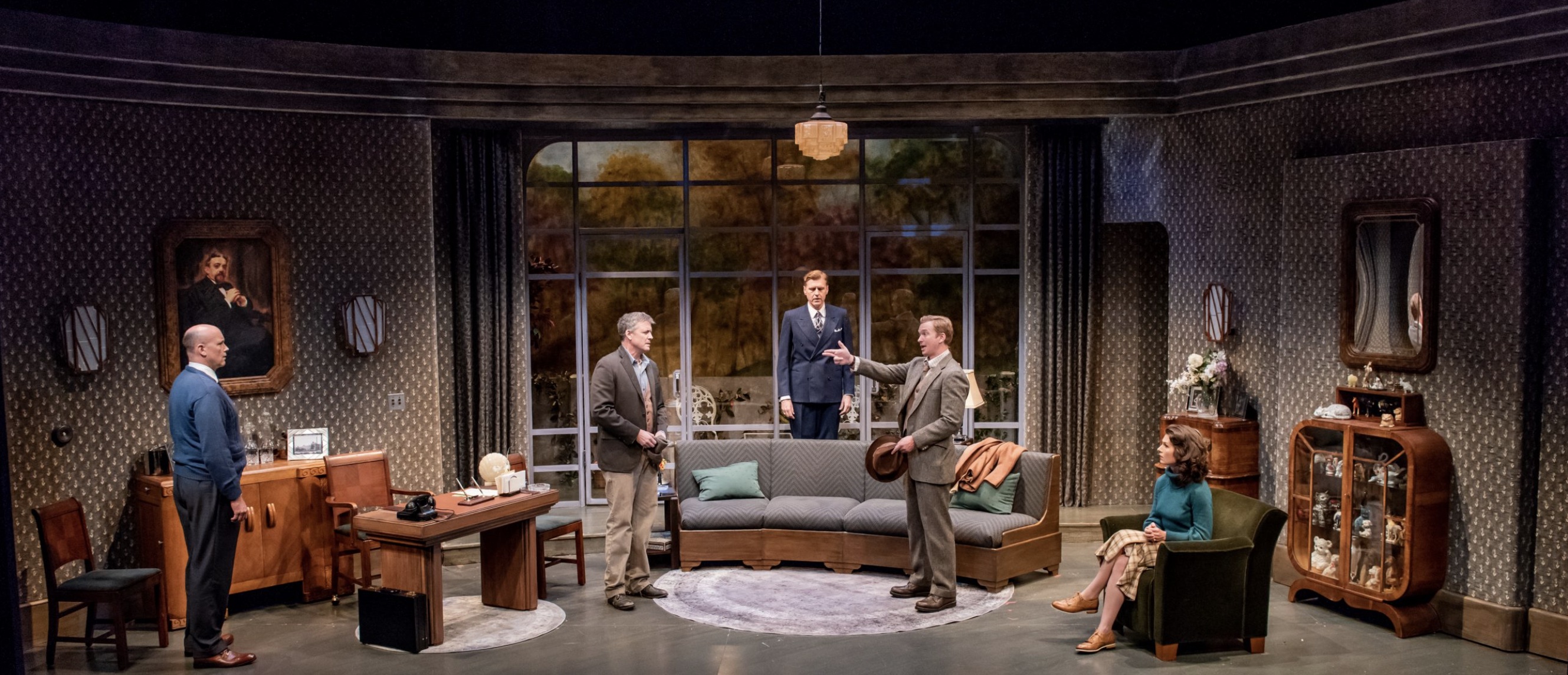
Larry Bull, Chris Henry Coffey, Ted Deasy, Roderick Hill, and Janie Brookshire in Days to Come; Photo by Todd Cerveris

Recorded in August of 2018, the stream is very stable and there’s no log in process, though a valid email address is required.  Audio quality is excellent and subtitles easy to read. It is shot from the audience viewpoint with straightforward camera work which never distracts.  Costume designer Andrea Varga sets the tone with wonderful fabrics, which can be seen with increased clarity.   And even on a small screen, the Rodman’s living room designed by Harry Feiner is lush with decorative detail. 

The original Broadway production of Days to Come was a disaster.  The influential William Randolph Hearst stormed out and the run lasted a mere seven days.  While the work isn’t the most relatable or smooth of The Mint’s productions, it is well worth the two hour investment.  It’s available On Demand at https://minttheater.org/ free of charge though April 2.  A request for support will appear in the upper right hand corner at the end, by which time I hope you, too, are a fan.