Category Archives: Play

Predictor

Too few productions hit that magical sweet spot of addressing a pressing issue while remaining entertaining and even funny.  This is what makes Predictor such a refreshing addition to the winter Off-Broadway lineup.  Jennifer Blackmer has written an inspired bio-comedy about Meg Crane, the inventor of the home pregnancy test whose name has been all but erased by the male-led corporation that swindled her out of her patent.  Choosing her words and micro aggressions with loving exactitude, Blackmer combines fact with recognizable cultural references circa 1967 to fill out Crane’s little-known history.  It is no surprise that the 2024 winner of the  American Theatre Critics Association/Harold and Mimi Steinberg Foundation Citation for Best New American Play (for I Carry Your Heart With Me) would tell this story with artfully applied fury and humor.

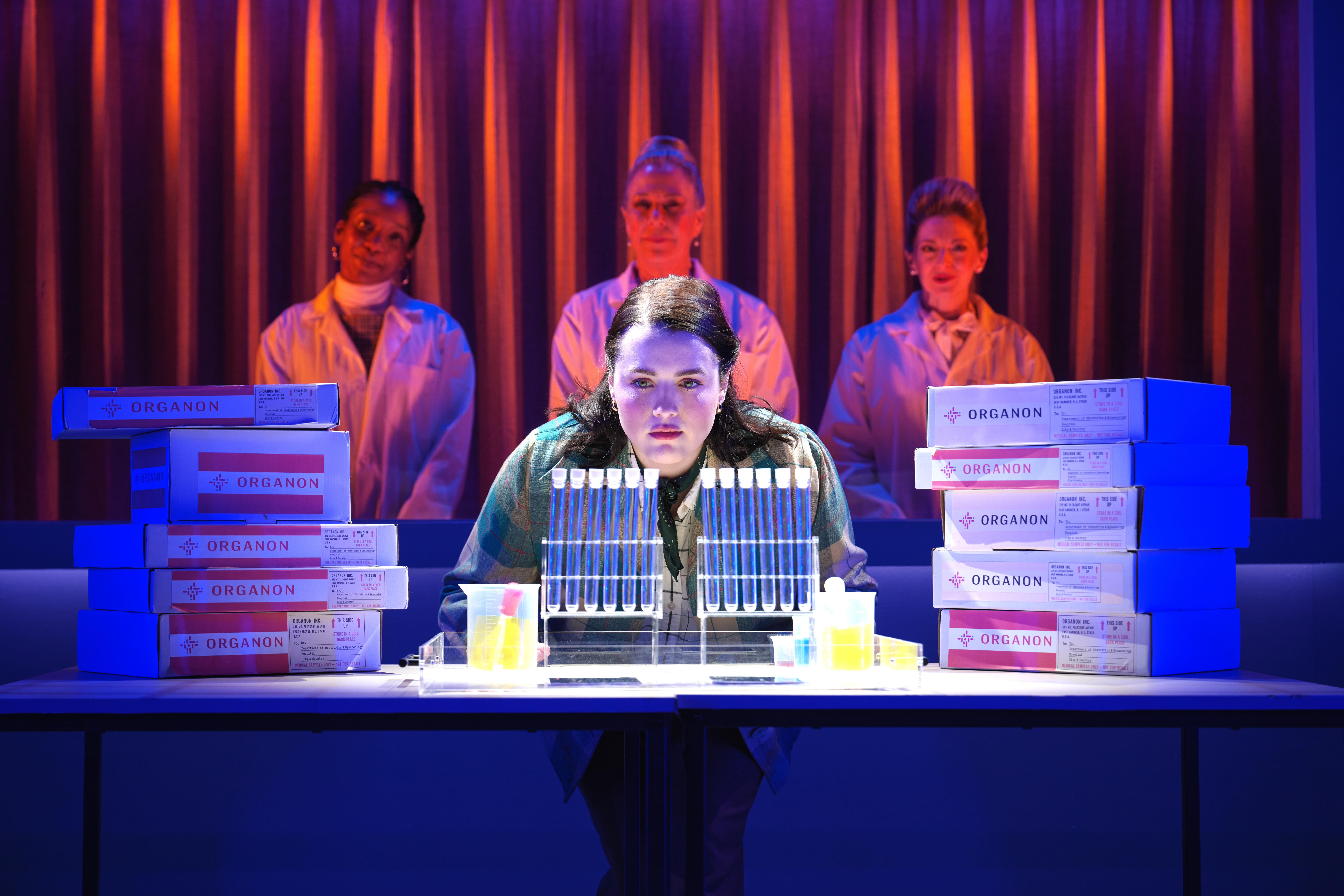
Predictor featuring Jes Washington, April Ortiz, Lauren Molina (r) and Caitlin Kinnunen (f);
Photo credit Valerie Terranova

Though fans of Mad Men are well acquainted with the corporate culture of companies like Organon Pharmaceuticals, it may be hard for anyone under the age of 40 to picture a world in which a woman’s husband had to accompany her to a physician’s appointment.  Then she would wait several crucial weeks in order to know for certain whether or not she was pregnant.  Blackmer uses the popular television of the times including a Donna Reed-like family portrait and a buzzy game show to convey the impactful images and genuine emotions related to this lack of agency.  The sound design by Daniela Hart, Noel Nichols, and Bailey Trierweiler includes original music that invokes the tunes and tones used in these programs, adding an intergenerationally-familiar period element.  Cat Raynor’s scenic design features medicinal green walls, delightfully dated harvest gold chairs and an upstage glass enclosed “control booth”.   These enhance the storytelling while also providing the small stage space with an expansive feeling.  Colorfully illuminated side panels similar to ones used on TV are incorporated into the lighting design by Zach Blane.  Like parochial school uniforms— another theme from Crane’s life —  costumes by Alicia Austin consist of coordinated plaid dresses for the ladies and suits for the gentlemen who grab sweaters, jackets, and glasses to differentiate their multitude of characters.

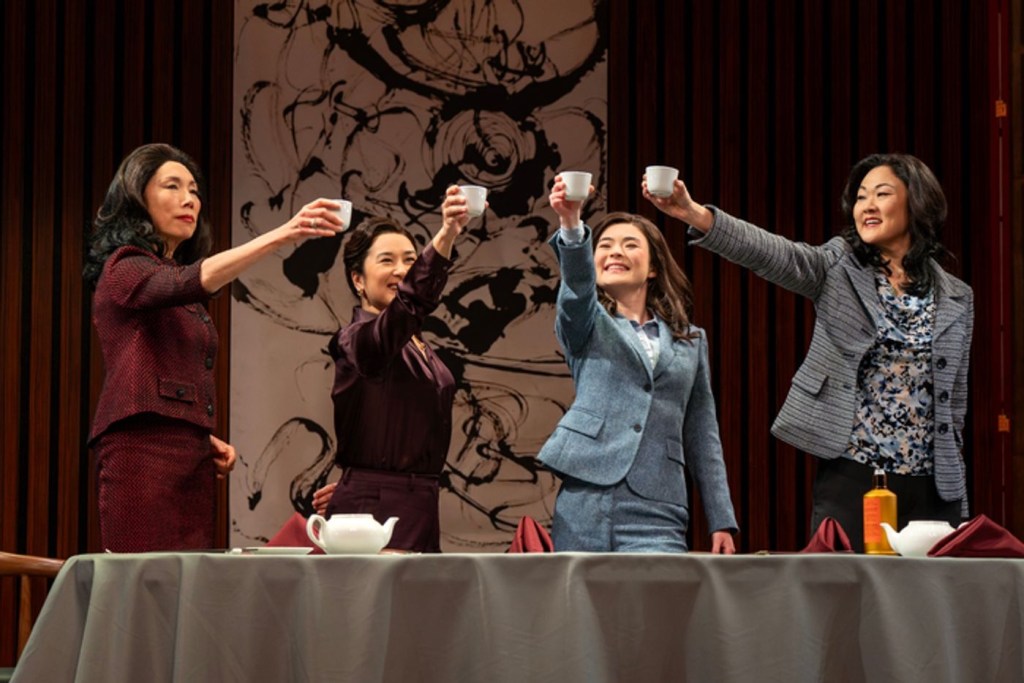
Alex Keegan’s deft direction fits each script beat so perfectly she and Blackmer could be creative twins.  The action all takes place inside Meg’s head and has both very real and very dreamy qualities as a result.  The essential Meg Crane character is played by Tony nominee Caitlin Kinnunen, who came to prominence during her run as Emma Nolan in The Prom.  She lends that same flustered-but-right affectation to the graphic artist who finds her muse in an outer building of a pharmaceutical company.  Kinnunen is lifted up by a crack ensemble with seemingly boundless energy as they take on a broad range of supporting roles.  Lauren Molina can add “credible tears on cue” to her many hyphens with her compassionate turn as Crane’s deeply religious mother as well as Mary, a comically earnest executive assistant.  April Ortiz gives depth to the more conservative female roles including Crane’s teacher Sister Bernadette and Crane’s grandmother.  Nick Piacente is flirty and sweet as Bertie, a friendly lab assistant, and Ira, an experienced marketing executive.  Amping up the blowhard factor is Eric Tabach’s Jack, the executive to whom the home pregnancy project is assigned.  Taking on both father figures and Crane’s actual father is a down-to-earth John Leonard Thompson.  A refined Jes Washington portrays Jody, Crane’s encouraging roommate, and Lillian, a troubled secretary from Organon’s pool among others.

Predictor paints a vivid backdrop to our times when Roe is gone, Planned Parenthood is under attack, and the FDA itself is being tested.  But it also provides a portrait of a selfless and remarkable crusader and moments of genuine laughter.  While you may feel Crane’s grit and frustration, ultimately its exhilarating to share time with her and Blackmer’s sharp dialogue.  Predictor runs through January 18th at The AMT Theater, (354 W 45th St) with performances at 7PM Tuesday through Sunday and 2PM matinees on weekends.  Runtime is two hours and fifteen minutes including an intermission.  The house is small, but comfortable with good sightlines even from seats against the far wall.  Tickets ($49-$110) are available for advance purchase at www.predictorplay.com.

Malcolm X & Redd Foxx Washing Dishes at Jimmy’s Chicken Shack in Harlem

In June of 1943, Malcolm Little and John Elroy Sanford crossed paths as dishwashers in the same Harlem fried chicken joint.  At ages 19 and 20 respectively, they were still finding their footing as Black men at a time when they were encouraged to give their lives for the country, but not being given societal or economic opportunity.  His father having died early and his mother hospitalized after a breakdown, Little was a petty criminal, frustrated to keep finding himself on that path.  Foxy was an aspiring comic who already handled his finances so poorly he was living on a rooftop.  The engaging Malcolm X & Redd Foxx Washing Dishes at Jimmy’s Chicken Shack in Harlem opens an imaginative window into the relationship between these two men long before fame found them.  

Though familiarity with the raunchy comedian and the inspirational Muslim leader is helpful, at heart Jonathan Norton — who won the American Theatre Critics/Journalists’ M. Elizabeth Osborn New Play Award  for Mississippi Godddamn — has here written a thoughtful exploration of friendship.  Though Foxy and Little share concerns, they have divergent approaches for overcoming them.  By turns, they build each other up and tear each other down, eventually bringing out something special in one another that perhaps no one else would unearth.  Always running in the background is the pre-civil-rights society that literally and metaphorically deprives the two of the music in life.  

Squat and expressive, with an ability to swing from insecurity to dominance, Trey Smith-Mills plays Foxy.  The long and suave Edwin Green — who has been with the production since its 2024 Off-Broadway reading — makes a terrific counterpart as Little.  Director Dexter J. Singleton heightens the required physicality and timing in both performances.

Trey Smith-Mills and Edwin Green as Foxy and Little; Photo by Wesley Hitt

Costume designer Claudia Brownlee provides the right style-on-a budget wardrobe, particularly with a red and white suit and outrageous hat for Foxy.  Jennifer McClory’s wigs mimic the chemically treated reddish hair that was popular in that period.  The shabby back-kitchen set with its stained walls and gurgling drain is designed by Kimberly Powers.  Blackouts and hot spots (lighting by Levi J. Wilkins) along with jazz standards and order-up bells (sound by Howard Patterson) work cleverly together to illustrate the passage of long summer days.

Malcolm X & Redd Foxx Washing Dishes at Jimmy’s Chicken Shack in Harlem is a captivating two hander about people you think you know in an era you think you understand.  Above all, it is the evolution of a friendship that reverberated throughout two meaningful lives.  This World Premiere was commissioned by TheatreSquared, and is a co-production of T2, City Theatre Company, Virginia Stage Company and Dallas Theater Center.  The run has been extended until November 2nd.  Live performances take place at Spring Theatre (477 W. Spring St., Fayetteville, AR).  The streaming version is shot casually (odd angles, heads in the way, uneven audio) but is a wonderful option for those with mobility or childcare issues and those of us who live at too great a distance from the the venue.  Content is for mature audiences, with simulated drug use and adult language.  Runtime is an hour and forty minutes with no intermission.  Both live tickets ($$25-$71) and streaming tickets ($25-$35) are available at theatre2.org/jimmys-chicken or by calling (479) 777-7477.

Perfect Crime

In a secluded stately home in the Connecticut woods, a married team of well-educated psychiatrists uses psychodrama to help their troubled patients work through trauma.  One night, their cook witnesses a young redhead murdering the husband.  A handsome police detective is called to the scene.  The therapists claim it was merely a client acting out a dream.  A series of clues to the truth are dropped over seven scenes representing a single week.  This is the set-up of Perfect Crime, an Off-Broadway mystery with a record-breaking run.  So why is this production still so unsure of its storytelling capabilities that each audience member is handed a 17 point solution sheet upon exit?

The viewing experience begins cleverly enough.  The comfortable lobby centers on a massive mugshot board with a bucket of props beside it for taking selfies.  Tips for committing the perfect crime are hung on the the pillars around a welcoming bar offering an array of theme cocktails.  The producers have thoughtfully paid for Wordly, a translation and caption service that can provide the play’s dialogue in a number of languages.  

Upon entry to the 194 seat house, one sees an authoritative set designed by Jay Stone dressed with Neo-Gothic furniture and leather bound books.  Other creative elements could use an update.  An intricate brick mural that provides a critical plot point has become dull with time.  A talk show clip obviously filmed years ago no longer fits the time frame.  Musical cues, though significant to the plot, are loud enough to intrude on conversation and an important recorded message has become garbled.  

Playwright Warren Manzi, a Yale School of Drama graduate, wrote the original script for Perfect Crime when he was only in his mid 20s.  Reviews at the time indicated it was too complex to absorb, so he continually refined it.  Mr. Manzi’s legal counsel is executive producing the current run.  The piece still begins with a stereotypical phone call in a storm, but this is quickly revealed to be part of a therapeutic reenactment.  Along the way, there are several of these unusual, even sophisticated elements.  

It is the performance of Guinness Book of World Records holder Catherine Russell as famed therapist Dr. Margaret Thorne Brent that makes this playful mystery descend into rubbish.  Lines are ejected from her mouth without any differentiation, as if written as a single run-on sentence.  She never genuinely reacts to any of her scene partners, a basic tenet of the craft.  Her physicality is equally hasty.  For example, when her character juggles multiple phone calls, she often forgets to press the hold button on the phone until she has spoken several sentences to the incorrect person.  I found references to Ms. Russell’s somnambulism dating back at least three years.  The Show Score — usually an enthusiastic measurement — stands at equal parts positive and negative.  She may pride herself on only missing four performances over the years, but in all the important ways she has stopped showing up.

The rest of the cast, most of whom are making their Off-Broadway debuts, struggle along with what they are handed.  David Butler is the most successful as the multi-layered W. Harrison Brent.  Taking on the role of the bored and probably alcoholic Inspector James Ascher is a charming Adam Bradley.  I had the pleasure of seeing Mark Epperson — understudy for all the male roles — as Lionel McAuley, a particularly unhinged yet clever patient of Margaret’s. Seen only on video, Patrick Robustelli plays talk show host David Breuer.  

Catherine Russell was a treasured member of the theatrical community.  Her image was captured by famed illustrator Al Hirschfeld. She was a lead producer of the legendary revival of The Fantastics.  Her proceeds were used in part to build The Theater Center which houses Perfect Crime and several other stages that can be rented out for daring works in development and entertaining parody musicals.  Why, in a time when theater is under threat and yet remains filled with energetic talent, has she chosen to turn in a thoroughly careless performance devoid of heart? That, my dear readers, is perfectly criminal.

Perfect Crime is playing at the Anne L. Bernstein Theater at The Theater Center, 120 West 50th Street. Seats purchased through numerous discounted services are assigned by the box office, which stuffs the first few rows of the low raked house.  Performances are evenings Thursday – Tuesday with matinees on Saturday and Sunday. Running time is about two hours with the intermission.  A detailed plot is available on Wikipedia, which would add greatly to your ability to follow along with the curveballs. For more information, visit https://www.perfect-crime.com.

The Glitch

In a world in which AI has seemingly infiltrated every aspect of life, it is not hard to imagine a lab like the one featured in Kipp Koenig’s The Glitch.  “Future Child” allows want-to-be parents to interact with DNA-based projections of their teenage offspring.  The technology orchestrated by Aurora — an AI combination therapist and diagnostic program — is still a work in progress.  The simulation developed for their ninth client hit a raw nerve and resulted in an unanticipated traumatic reaction.  After a great deal of upgrading and testing, company founder Wyatt and his more cautious second in command Wendy feel prepared for client #10.  But when she turns out to be a woman from Wyatt’s past, the outcome of If/Else commands becomes even less predictable.  

Though the question of whether AI is capable of improving our quality of life drifts along in the background, front and center are more approachable and relatable topics.  What parent isn’t terrified of giving birth to someone who might not be “good” in the way they envision?  What child doesn’t say something hurtful in haste or engage in a rash act of rebellion?  And who hasn’t experienced that moment of horror when the sound of their parents comes flying out of their own mouths?  

Koenig has clearly drawn from his years working in technology to concoct the plausible atmosphere of a visionary and delicate start-up.  Scenic design by Josh Oberlander featuring hospital-white blocks and levered doors gleaming under Zack Lobel’s bright florescent lighting accompanied by Philip Glass-y music brings us right into the scene.  Director Mark Koenig (no relation) makes clever use of the aisles to expand the movement of the highly conversational script. Though there are a few too many short cuts in the plotting, they are necessary for squeezing all the required thought and sentiment into a tight 100 minute package.

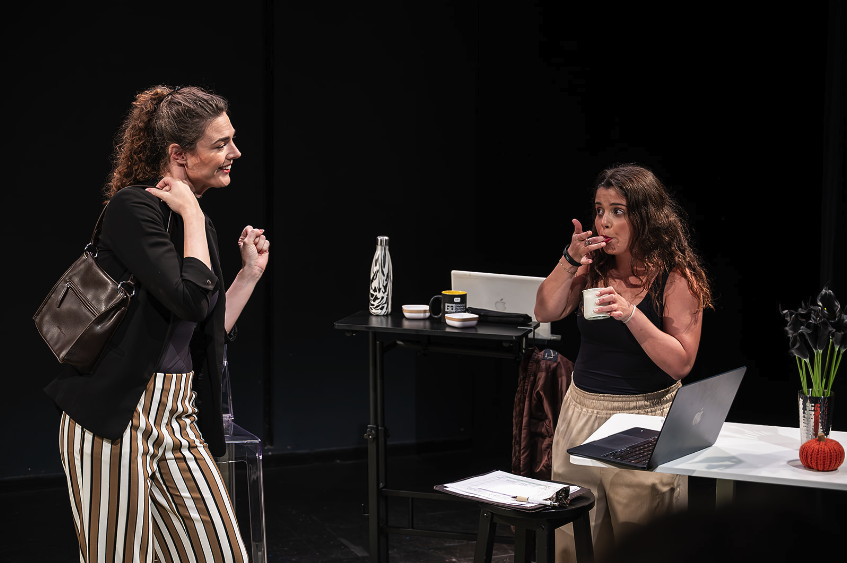
Danielle Augustine and Jacquie Bonnet in The Glitch; photo by Thomas Mundell

As Hailey the holographic daughter, Hannah Rose Doherty is a revelation, striking the perfect vocal tone of a tween at once loving and frustrated.  At times she was little more than 3’ from me.  Covered in silvery sparkles, she remained engaged and reactive: physically exploring her “projected” body, flipping her hair before she was given arms, and quivering with excitement as she was allowed to develop.  The comic relief lands primarily in the feet of Jacquie Bonnet’s Wendy.  Both the actress and the character deserve a more meaningful domain given the story arc.  A grounded Sunny Makwana brings warmth and the right touch of neurosis to the Omar Sharif-loving Wyatt, providing sufficient credibility to the string of coincidences in the story.  This makes for a less persuasive connection with Danielle Augustine whose Amy sounds forced.  To be fair, the actress is challenged by prolonged interaction with a disembodied voice and having to express a complex emotional life based on falsehoods.  The commanding presence of Aurora is given breadth and wit by Amilia Shaw, who takes a well deserved bow with the rest of the three dimensional cast.  

At a time when so many playwrights are exploring current events with fear and loathing, it’s refreshing to see playwright Koenig take a different path.  The Glitch proposes that with kindness and compassion tempered by a dose of healthy skepticism we are still capable of doing good for one another.  You can experience this for $50 ( $70 if you’d like to increase your support to premium level).  Performances are 2PM Wednesdays, 4PM Fridays and 6PM Sundays.  The limited engagement at The Theater Center, 210 West 50th near Broadway, ends November 2nd.  Visit https://theglitchplay.com/ for a sneak peek and purchasing information.

This is Government

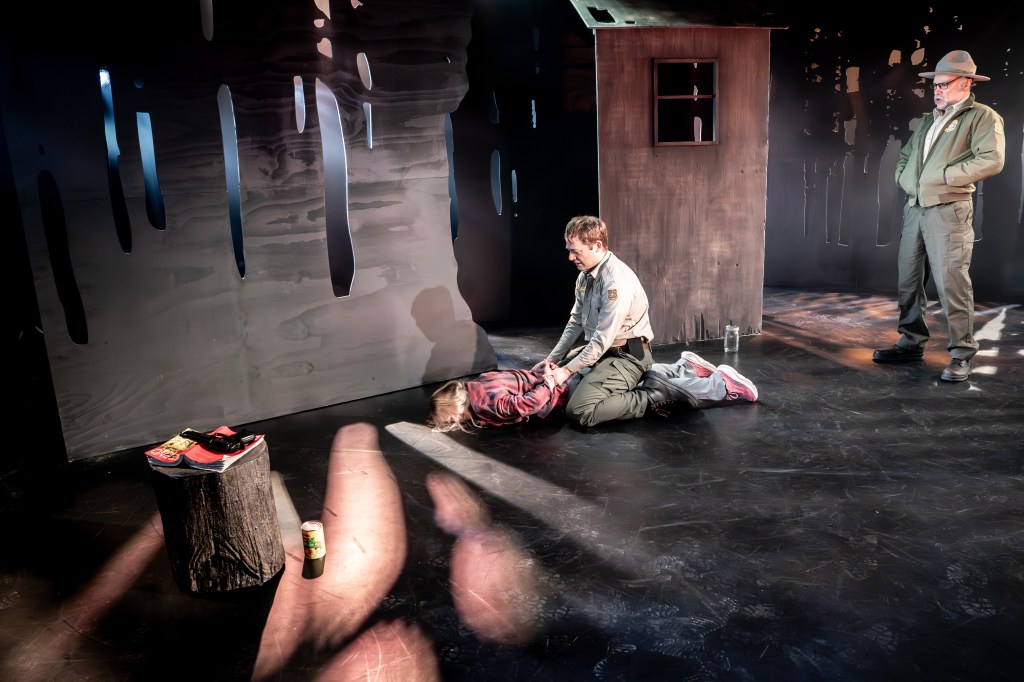
There is a mighty fine line between “timely” and “too close to home.”  No one at 59E59 could have predicted that Trump ally and conservative activist Charlie Kirk would be shot and killed a few days after This is Government began previews.  But the horrifying uptick in our political violence had to be on the minds of everyone watching a play about a bomb threat taking place outside a Washington D.C. Senate office building.  While Nina Kissinger has infused her dark subject with humor, it feels too gracious to meet the brittle moment.

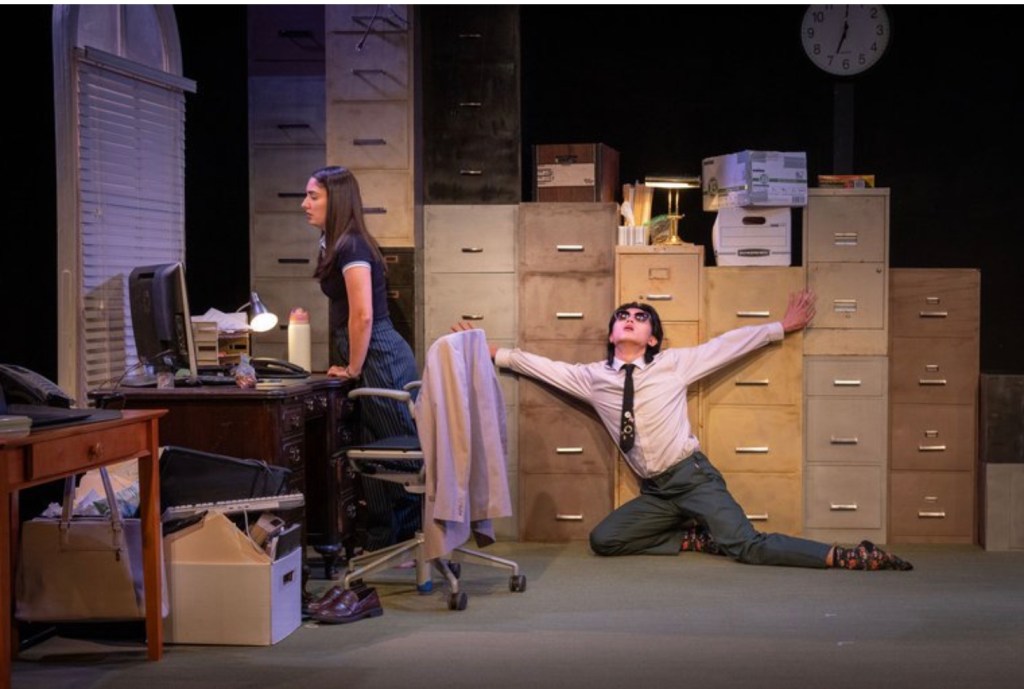
Scenic designer Daniel Allen sets the scene within an off-kilter office.  To serve the direction, file cabinets are piled across the back in a staircase formation and the third desk floats chairless mid-stage.  Within these strange walls are the interns for Senator Bachmann whose vote will determine the fate of a critical healthcare funding bill.  Rudderless and crippled by anxiety is recent college grad Emi (Kleo Mitrokostas).  One year younger, Tip (Charles Hsu) is four times more interested in influencing the world through his monologues than within the bureaucratic structure.  Their supervisor is former intern Kaz (Vann Dukes), a non-binary pragmatist with political ambitions of their own.  The three have been receiving regular calls from Stevie (Susan Lynskey), whose pleas to speak with the Senator have grown increasingly frequent and agitated.

Mitrokostas and most of the creative team are resident artists of the New Light Project which co-produced with Pendragon Theatre.  Director Sarah Norris has done what she can to mine the script for variation, but a regular rhythm sets in quickly.  Tip attempts to lead the way with dramatic flair and a touch of recklessness driven by his romantic world view.  Draped in mismatched navy business casual (Krista Grevas, Costume Design), Emi follows with apprehension and self-doubt.  At intervals, the passage of time literally ticks by (Jennie Gorn, Sound Design), the lights flicker (Hayley Garcia Parnell, Lighting Design), and someone climbs the cabinets to move the clock hands forward (Yasmyn Sumiyoshi, Movement Direction).  There surely was a more impactful way to illustrate the “real-time consequences” that should be driving the action.

Kleo Mitrokostas and Charles Hsu in This is Government; photo by Burdette Parks

Much of the opening banter is character background and a the building of a familiar framework of government by bluster.  When Kaz surrenders to Tip’s plan, the plot takes on more elements of a detective procedural.  But Kissinger hasn’t so much dropped breadcrumbs as built a pullman loaf walkway.  There is less talk of fueling political change than there is of understanding the bomber’s motives.  The serious exploration of meaningful themes is obscured by broad comedy and near absurdism.  The fates of our would-be heroes feel underdeveloped and ultimately unearned.

Nina Kissinger is a distinguished voice in new generation of playwrights. But though it has been only three years since This is Government won the Agnes Nixon Playwriting Festival at Northwestern University, the political landscape has shifted sharply and is less supportive of her message.  At the performance I attended, nearly half the audience was under 30.  In her curator’s note, Artistic Director Val Day says she hopes these Gen Zers will hear this piece as a call to action.  I sincerely hope they do, even if it’s to gather for another shared experience at live theater.

This is Government is playing in Theater B at 59e59 Theaters, 59 East 59th Street in Manhattan.  Tickets are $44 and available at https://www.59e59.org/shows/show-detail/this-is-government/.  Running time is approximately 85 minutes without intermission.  Content is recommend for those 14 and up.

Sulfur Bottom

Recently I took a tour of the history of New York City’s electrical system.  Most of the infrastructure had been placed in marginalized neighborhoods.  That this is not new news made it no less distressing to witness.  These projects are essential for supporting modern day conveniences, but it’s always at the expense of those with less money and power to push them into someone else’s backyard.  

That lack of equity is at the heart of Rishi Varma’s Sulfur Bottom.  But this is not an “issues play.”  Instead, by blending naturism with otherworldliness, playwright Varma has crafted a bewitching modern day folktale.  It may be as ugly and bloodstained as the rug featured in the central family home, but it’s centered.  Resonant themes of familial connections, hard-won second chances, and the importance of home are woven in.  This distinctive approach draws in an audience that might not listen otherwise.  To make an even more meaningful point, the production has partner with WE ACT for Environmental Justice (https://weact.org/) for their Off Broadway run.

Director Megumi Nakamura has done an incredible job of pile driving down to the bedrock of emotions underlying the sophisticated, fantastical plot.  And we are surrounded by sound and sight cues that keep us “in it” with the characters. Each revelation comes with a musical theme (composer Jacob Brandt).  The location of the house in question is on land so polluted the house literally groans in pain (sound design by Sid Diamond).  Even the flowered wallpaper and aforementioned rug are slowly poisoned (set design by Daniel Prosky).  The overhead lights saturate the space in appropriate jaundice-yellow tones (lighting design Sam Weiser).  While there is no olfactory component, it’s easy to conjure up the corresponding odor of decay.

Of course it is the cast that lures us in.  There is tension between Sir Cavin (Kevin Richard Best) and his teenage daughter Fran (Kendyl Grace Davis).  She has killed [another?] deer which is now lying on a cutting block near their much-disliked rug.  It’s clear their conversation about the circle of life has been playing on repeat.  Sir Cavin’s belief in this interconnection has been his North Star.  But Fran finds the animals that surround them both noisy and dangerous.

Joyah Dominique, Feyisola Soetan (foreground) and Kevin Richard Best in Sulfur Bottom;
photo by Austin Pogrob


Also in the home is Sir Cavin sister Melissa (Joyah Dominique).  Though she once hoped to move to San Francisco to be a performer, she has resigned herself to keeping a watchful eye on her niece.  As the piece drifts back and forth through time over the course of 40 years— sometimes spanning two decades simultaneously — we meet Fran’s husband Winter (Eric Easter) and daughter Maeve (Feyisola Soetan) as well as Sir Cavin’s friend Copal (Aaron Dorelien) whose ambition perverts the course of their lives.

Performances of Sulfur Bottom are Wednesdays at 7:30 and Saturdays at 1:00 at The Jerry Orbach Theater, 210 West 50th Street, 3rd Floor.  Tickets are available through October 11 at https://www.sulfurbottom.com/.  The shallow venue is ¾ round with well loved seats and over-achieving air conditioning.  A colorful beverage from the bar might add to your feeling of joining the characters in their living room.  

If the ancients had spun a tradition myth about the spirits of environmental justice, it would share DNA with Sulfur Bottom.   It is a cautionary tale, but told with warmth, love, and a touch of humor.  We all want a better life for our children.  But some have a whale of a chance of making it happen.

Polishing Shakespeare

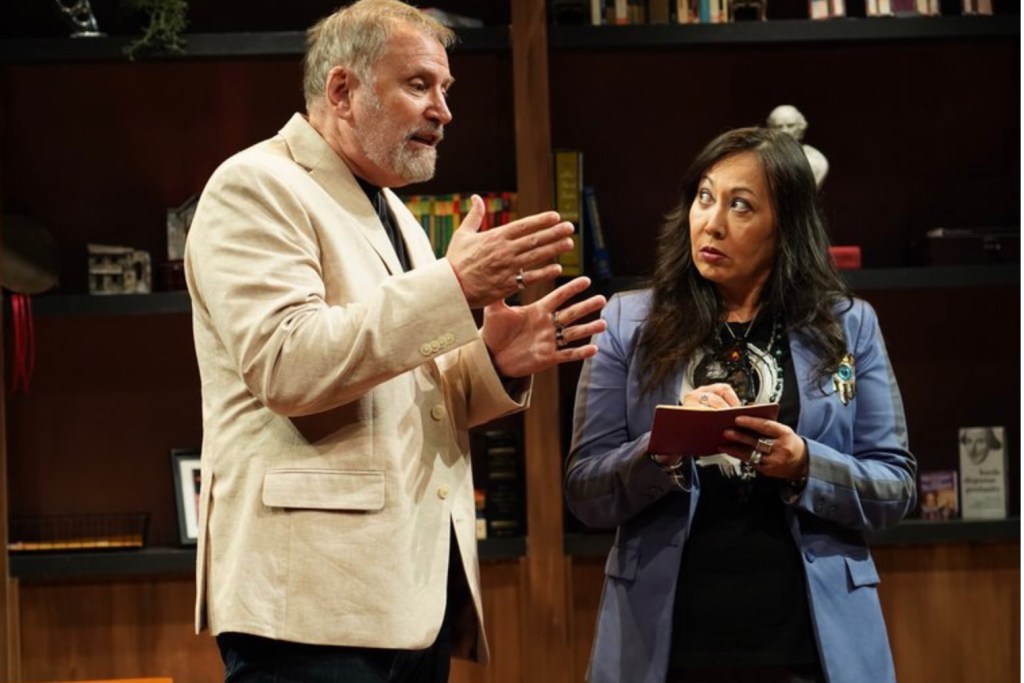
When you hear the premise of Polishing Shakespeare — Dot-com billionaire, Grant, is bestowing generous grants to a team of eager writers prepared to translate the entire works of The Bard into *English*— it is easy to picture the original ten minute skit.   What is impressive is the full length skewering of the dangerous shifting landscape of the arts that the script has become.  Given the events of the last six month, it’s almost as if playwright Brian Dykstra is writing in real time.  And he’s doing so in iambic pentameter!  (In fact, the actors’ improv skills are all so sharp that actually did happen during the performance I attended.)

The clawing back of money for the arts from the current administration forms a solemn backdrop for this timely comedy.  Though it makes its point numerous times, the exaggerated set-up is moved forward by three characters, each with a strong motive.  Grant (silver-tongued playwright Dykstra) doesn’t want to have to think when he attends a live performance.  He sees his project as a way to make Shakespeare entertaining for the masses, ignoring, of course, that Shakespeare has been just that for hundreds of years.  Ms. Branch (a beautifully tightly wound Kate Levy), the company’s director is just trying to be financially responsible now that she is almost completely reliant on her board for funds.  And though she genuinely loves and appreciates the Folio, Jane (a brilliantly bold Kate Siahaan-Rigg) sees a way to use her acute observational skills and talent with a pen to get out of crushing debt.  Alliances shift as each seeks an opportunity to move closer to their goal with the help of one at the expense of the other. It becomes such a battle of wits, you can almost see the gleaming sabers.  

Brian Dykstra and Kate Siahaan-Rigg in Polishing Shakespeare; photo by Carol Rosegg

What makes the piece sparkle is the spirited speed with which the lines are delivered.  Only someone completely comfortable with Shakespeare could set the necessary tempo with wink-and-nod style.  There is an ease to Dykstra, who has not only performed roles in numerous productions of the real thing (King John, Much Ado About Nothing, Twelfth Night, and MacBeth among others) but also participated in Season 6 of Mos Def’s well respected spoken word poetry program on HBO.  He plays with the audience like a cat with an amused mouse.  Siahaan-Rigg is a marvel, rattling off several sublime soliloquies that celebrate all those who have been exploited and marginalized by the mass market.  Levy navigates the intricate pathway between the stuffiness of her character and the humor in her lines.

Director Margarett Perry’ s assured hand highlights the flows of power.  Supporting the rapid fire exchanges is the strategic lighting by Tyler M. Perry who also designed the hilarious Shakespeare tchotchke-ladened set.  

Eliciting both belly laughs and tummy knots, Polishing Shakespeare has been extended through August 24.  Performances run approximately 90 minutes with no intermission.  The show is presented in Theater B at 59e59.  $44 full price tickets ($30 for Members) can be purchased at https://www.59e59.org/shows/show-detail/polishing-shakespeare/

OPEN

After a lengthy pause, Crystal Skillman’s award-winning play, OPEN, has been given a three-week Off-Broadway run at WP Theater.   Celebrating its 47th Season, WP Theater is the oldest and largest theatrical company in the country dedicated to fostering, producing and promoting the work of Women+ at every stage of their artistic development.  With LGBTQ rights under heightened threat, bringing OPEN’s heartfelt love story back to the stage could not be better timed.  Whatever impression the script left in 2019 has only been amplified by rising violence including a shooting near the fabled Stonewall Inn at the end of Pride Month.  

From a darkened space lined with lighting and sound equipment, Kristen invites the audience to join her for a three stage magic act consisting of Love, Commitment, and Sacrifice plus an extra promise.  To execute her wizardry, she has dressed in flashy top hat and tails (costume design by Madeline Wall) and taken on the persona of The Magician, a character inspired by “Night by Night” one of her own YA short stories. In it, a boy discovers that his make-believe skill as a conjurer has imbued him with real abilities.  In the lengthier version of her tale, he also falls in love with another boy.  Kristen hopes that she will experience a similar transformation in her powers as she struggles to reach out to her girlfriend, Jenny.

Over the course of 75 minutes, Kristen shares chapters from her and Jenny’s relationship.  She acknowledges that she has been deeply affected by a repressive upbringing in Indiana and lives cautiously: doubting her abilities and never “flaunting” being a lesbian.  Jenny, however, is out and singing with joy, surrounded by loving and accepting family and working with LGBT youth.  Not only is their meeting magical, but their life together requires all sorts of tricks from the juggling act of their needs to levitating above societal forces.  The very word OPEN performs a number of functions as in living openly gay, being open hearted, speaking openly and honestly, and opening the door to opportunity. 

Unlike most playwrights with a single character, Skillman does not give voice to her own words.  Instead the piece is brought to life by Megan Hill, who previously played The Magician at The Tank.  She is not the type of monologist who uses different vocal registers, but rather distinguishes her characters with tone and body language.  The most important ingredient in her success is engaging the imagination of audience members which she coaxes and nurtures.  The colorful details throughout the script make it easy to see with your inner eye and indeed “conjure” episodes from Kristen and Jenny’s life together.  At points, attendees function as magician’s assistants, filling out the invisible visuals with their willing participation.  

Megan Hill as The Magician in OPEN; photo by Jeremy Varner

The genuine slight of hand is performed by the creative team with impressively timed sound by Emma Wilk and lighting by Sarah Johnston (who also designed the set).  Director Jessi D. Hill and Magic Consultant Rachel Wax along with Wilk, and Johnston have collaborated beautifully on executing the physicality and visualization of the incantations without a ball, ring or flower in sight.  

Inventive, touching, and impactful, OPEN is a unique solo entertainment.  Performances continue at WP Theater, 2162 Broadway in New York, through July 27.  Tickets are $65 and available at https://wptheater.org/wp-space-program/open/. Pre-show acts and post-show talkbacks will incorporate the talents of the magicians who helped inspire Skillman’s story and the actors who portrayed The Magician in Broadway Licensing productions, drawing a through-line to the powerful role of magic within the LGBTQIA+ community.

Trophy Boys

It all comes down to gray areas according to Jared, the second debater on the undefeated team at the center of Emmanuelle Mattana’s Trophy Boys.  The same could be said of the entire play, now in its American debut at MCC Theater. The most immediate and obvious dichotomy is that each of the four boys on stage is portrayed by an actor who is non-cis male.  In truth, almost every aspect of the piece is non-conforming.  It is a comedy permeated by devastation and a tragedy that contains plenty of laughs.

At opening, four seniors from an elite New York high school are preparing for the debate of their scholastic lives. Win, and they are all one giant step closer to achieving the lofty professional goals they’ve set for themselves.  Lose, and all of their ambitious plans could be sidelined.  In their favor is the well-honed collaborative technique they’ve developed over the year.  Though they’ve just learned that they are to argue in the affirmative that feminism has failed women — against the team from an all-girls school no less — their brainstorming is exuberant.  But when a catastrophic piece of information is introduced into their planning session, it throws everyone off balance.

Mattana has drawn from their own experience as a debater, a skill which often required them to argue for cases they didn’t believe.  “It was no wonder,” they reflect in the program, “ that this ethos seeped so dangerously into other parts of these boys’ lives.”  She has also given herself the juicy role of Owen, the socially awkward debate team closer who to his very roots believes he is the smartest person in the room.  

The other three teammates have their own reasons for seeing themselves as superior to the rest.  In the first spot is the bi-curious physically dominant Scott, portrayed by the always magnetic Esco Jouléy.  Backing him up is the creative lover-of-women Jared, an all-too-recognizable Louisa Jacobson.  In forth place is Terry Hu’s David, the strict administrator.   As an acting ensemble, they smoothly cede the spotlight to the next player even when their characters do not.  

Emmanuelle Mattana, Louisa Jacobson, Esco Jouléy, and Terry Hu; Photo by Valerie Terranova

Director Danya Taymor has great familiarity with young males, having recently won the Tony Award for The Outsiders.  She has injected that extreme physicality into her cast. The music pumps as the audience enters, preparing them for the energetic onslaught.  At points the cast members literally bounce off the furniture, depicting what their nervous systems are experiencing.  Vigorous dance moves include humping their notebooks to show their dominance over the material.  Passions hot and cold run deep and lines are delivered at a barely digestible rate of speed.  One can only imagine the sensitivity with which the more emotional exchanges were developed with a sensitivity specialist (Ann James) and DEI consultant (Nicole Johnson) working alongside Taymor to mold the scenes. 

There is a through-line from the contradictions of ideas that runs across all the creative elements.  It is far into the term, but Matt Saunders’ desks, chairs and whiteboard remain immaculate.  Images of important women through history adorn the walls but appear cartoonish.  The students are 17 years old and Márion Talán de la Rosa has dressed them in short pants usually reserved for under-classmates.  Cha See’s lighting is natural and then morphs to profoundly exaggerated.  

Ultimately, Trophy Boys is a sincere and thoughtful exploration of the non-binary nature of the world.  No person represented is just one thing and neither is any aspect of the content.  Most noticeable of all is our feelings which are completely adrift by the end of an increasingly taut 70 minutes.  We are left in that all-important gray area.  Performances continue through July 27 at MCC Theater, 511 West 52nd Street.  Dynamically priced tickets start at $74 and are available at https://mcctheater.org/tix/trophy-boys/.

The United States vs Ulysses

In 1933, the landmark trial of “United States v. One Book Called Ulysses” cleared the way for the publication of many significant works of literature that include sexual content and adult language.  Though James Joyce’s seminal novel was readily available in Europe at the time, it had twice been deemed obscene by a New York court. Random House founder, Bennett Cerf, determined that being the first in America to print the book in its entirety would launch them into the big leagues.  To that end, his company attorney, Morris Ernst, strategized what became a test case for freedom of expression.  Judge Woolsey’s deeply considered decision is practically a literary work in itself.

The events of the trial — its echos reverberating off the walls of today’s public libraries and scholastic institutions — form the foundation of The United States vs Ulysses currently running at the Irish Arts Center.  Playwright Colin Murphy takes the name of the actual case to heart, positioning sections of the book in the role of defendant.  He also fuses the courtroom drama with a rather unrefined behind the scenes look at the live reenactment produced by CBS’s The March of Time.  

This multilayered investigation is executed by a skillful cast of six under the adept hand of director Conall Morrison.  The send-up of the radio broadcast gives way to a serious lesson in interpretive performance.  The ensemble moves through characters historic and fictional, often brushing one against the other.  Jonathan White provides cohesion even while portraying a number of different narrator types.  Clare Barrett is an utter delight as Molly Bloom, especially in her interactions with Morgan C. Jones’s cerebral Judge Woolsey.  Ali White serves as a counterbalance to Barrett’s wild abandon, taking on the sterner female roles.  Ross Gaynor pulls off playing Bennett Cerf and the prosecuting lawyer as well as Molly’s oily lover.  Ernst is rendered by Mark Lambert, personifying this production’s blend of honest reflection and sharp-edged humor.  

The Cast of The United States vs Ulysses; Photo by Nir Arieli

The entire design team facilitates the slide between modes of storytelling. The actors are able to switch roles with the rapid exchange of a hat, the wrapping of a scarf or the removal of glasses (costumes by Catherine Fay).  Liam Doona’s set is like a gift box, with sound proofed radio studio opening to reveal Paris, Dublin, and the Southern District of New York.  Each state of the narrative is given its own tonal palette thanks in large part to John Comiskey’s lighting.  Music and sound by Simon Kenny enhance the atmosphere.

Combining elements of history, literature, law, society and culture, The United States vs Ulysses reminds us of the fight which won us the right to read whatever we choose.  Along the way, it pokes fun at the powerful men who tried to silence a fictional woman for being a sexual being.  Performances continue through Sunday, June 1, at The JL Greene Theatre in the Irish Arts Center,  726 11th Avenue.  There is a lovely cafe in the lobby that is open before and after the show.  Runtime is a sleek 85 minutes.  Tickets start at $25 and are available at https://irishartscenter.org/event/the-united-states-vs-ulysses.