Category Archives: Play

twenty50

Oddly, one of the best distractions from the tumultuous election before us comes in the form of a drama about a political contest taking place 25 years from now.  In twenty50, playwright Tony Meneses sets his fresh and calculated thriller in an America in which the southern border is completely closed and Latinos — most of whom have fully assimilated — make up the majority of citizens.  Against this backdrop, farm owner Andres Salazar (who goes by Andy) is running for congress somewhere in the middle of the country.  With his campaign manager urging him to drop references to his background in order to appeal to a wider electorate, he finds himself torn between his traditional mother and his inquisitive daughter who doesn’t know a word of Spanish.  Though the bilingual dialogue sometimes blunts the pacing, it’s essential to the unfolding of the story.  Meneses is drawing on a deeply personal understanding of how much can change in a single generation.  His family moved from Guadalajara, Mexico, and he was raised in Albuquerque and Dallas.  The result of his honest excavation is a fair weighing of the many sides of culture, authenticity, and the desire to belong that are not exclusively LatinX.

In creative partnership with scenic designer Tanya Orellana, director Rebecca Rivas has reshaped T2’s intimate space to represent a house with a sloping roof that engulfs the audience placed on either side of a thrust stage. Lighting Designer Nita Mendoza adds emphasis to this metaphorical container.  The clever use of “farmhands” as stagehands, helps convert the landscape for the final scene.  Within the dwelling, the characters circle one another, trying to find their equilibrium.  Orlando Arriaga makes Salazar both approachable and questioning.  It is his genuine warmth that provides the production with a solid center.  He is particularly strong in exchanges with Isabel Quintero as the mother whose memories of the recent past wash in waves over the present.  Cary Hite as the farm’s manager presents an opportunity for another variation of Andy’s balancing act.  Yet a third foil is Gabriella Perez’s policewoman Lydia, the most obviously futuristic character.  As daughter Jenny, Alyssa Martinez is unnecessarily burdened with a childish wardrobe and mannerisms.  She is best when she leans into the role’s purity instead of relying on these distracting crutches.  Ricardo Pérez Dávila and Freddy Acevedo round out the cast.

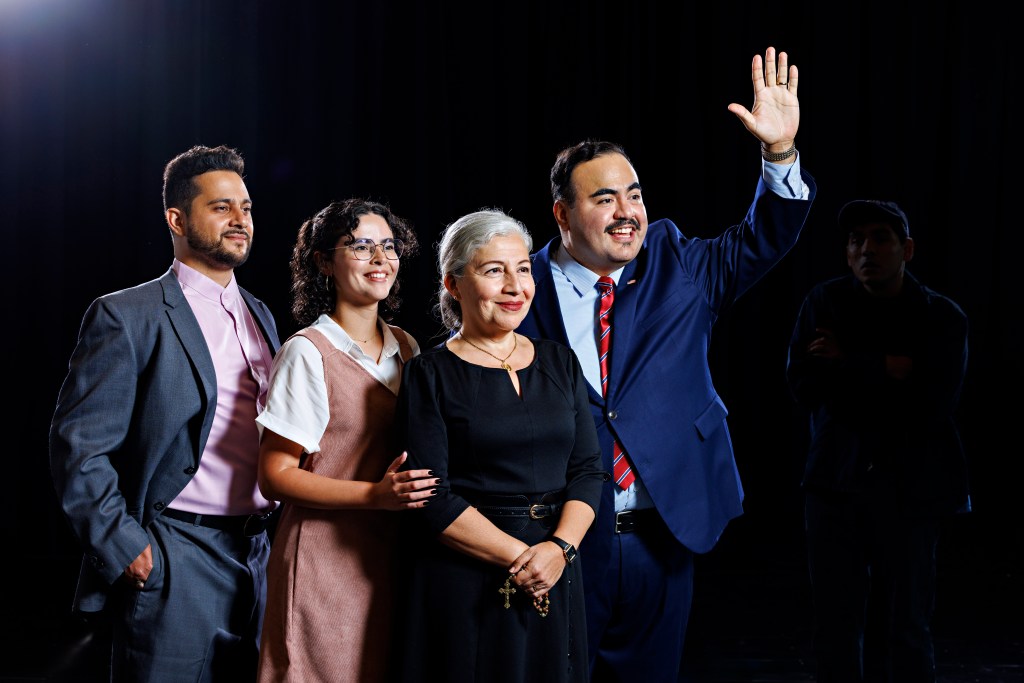
Ricardo Pérez Dávila (Sebastian), Alyssa Martinez (Jenny), Isabel Quintero (Irene) , Orlando Arriaga (Andres), Freddy Acevedo (Oscar) | Photo Credit: Wesley Hitt

In a brisk 90 minutes, twenty50 offers a buffet table ladened with food for thought. This is only the second time this play has been mounted and the rhetoric around immigrants has only grown louder and more destructive.  It’s a coup for TheatreSquared and their loyal audience. As the Executive and Artist Directors say, this insightful work “serves as both mirror and beacon.” Note that the content is written for adults, though there is nothing overtly “mature” in the action. 

The best way to see the performance is live for as little as $20, coming face to face with your fellow attendees at TheatreSquared’s Spring Theatre in Arkansas.  But those of us who cannot easily get to downtown Fayetteville should take advantage of the digital tickets to get in on the experience any way they can.  The camera switches house sides in an attempt to bring us fully into the thick of things.  Individual streams are $25 and household streams are $35.  Both types of links are good for 24 hours.  Tickets for performances through November 3 are available by calling (479) 777-7477 or visiting theatre2.org/twenty50.

The Counter

Your ability to feel liberated by the story that unfolds in The Counter will depend greatly and how well the aftermath of the COVID pandemic and the current political climate have treated you.  The Playbill makes clear that the actions take place a few years ago, seemingly before we were all cut off from one another while living under extreme conditions.  If you have maintained or regained the muscle memory of a singular connection with someone in your life, Meghan Kennedy’s newest work will leave you with an increased sense of appreciation.  If, however, you remain in the grip of isolation and anxiety, the honesty with which the playwright confronts those feelings may overwhelm the more pleasant sensations of watching skillful actors drawing generously from sincere emotional wells.

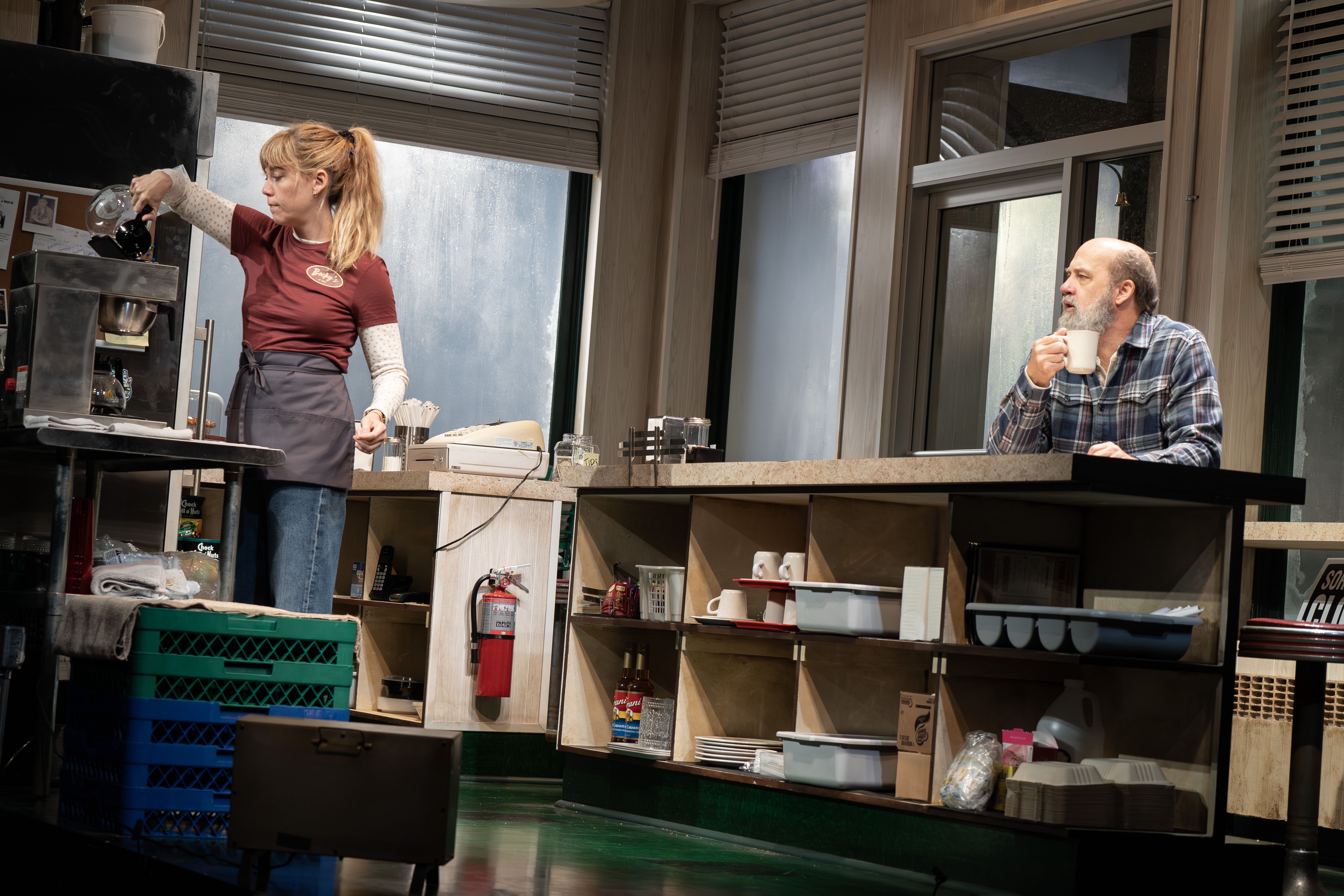
Susannah Flood and Anthony Edwards in
Roundabout Theatre Company’s The Counter; Photo by Joan Marcus

In an economic 75 minutes, Kennedy explores universal themes of grief and opportunities lost and found in a much more successful way than most of the COVID-panic-inspired plays I’ve reviewed this year (see Three Houses, Staff Meal and Six Characters).  Paul (a wholehearted Anthony Edwards nearly unrecognizable under a bushy beard) is a retired firefighter in small town New York close to the Canadian border.  He has an endearing ability to perceive, remember, and value the tiny gestures that make those around him special.  For reasons that come increasingly into focus, his life never fully launched.  Katie (Susannah Flood spreading her gloriously skittish wings) owns the cafe where Paul eats breakfast six mornings a week.  Unlike Paul, she has chosen this quiet and contained life.  With his frank urging, the two begin to form a friendship.   Amy Warren portrays third character, Peg, in a scene made pivotal by all we hear about her character before her entrance. 

Kennedy takes many shortcuts that some may find manipulative in order to move her story along to the key moments that propel each of them down their destined paths.  But in playing out their stories at 1 ½ speed, she accelerates our emotional investment in them both.  With increasing trust, they share “tough talk” with each other and us.  The balance of power shifts frequently, offering us fresh perspective with each twirl.

The scene is laid out in realistic detail by designer Walt Spangler, whose museum-worthy sets always provide an evocative sense of place.  The cafe is set on a angle, coming to a point audience center so everyone gets a pure view of every exchange.  Award-winning director David Cromer gives the central couple just enough business to heighten the small yet critical variation in the day-to-day.  Stacey Derosier’s lightening and Christopher Darbassie’s sound move the emphasis from exterior to interior dialogue and practically allow the windy world outside to swirl around our knees.  

We often hear about the importance of meeting people where they are.  The Counter illustrates exactly how powerful this connection point can be.  The underlying notes around self-care could also not come at a more appropriate time.  This limited engagement — part of Roundabout’s 2024-25 season — runs through November 17 at the Laura Pels Theatre (111 W 46th St).  Full priced tickets start at $58 and are available by calling 212.719.1300, or online at roundabouttheatre.org.

Someone Spectacular

When their grief counselor, Beth, fails to show up for their group therapy session, the majority of her six clients vote to go on without her.  The revelation of their interaction is not in the manifestation of their grief.  Theirs is the expected cocktail of misplaced guilt, regret for things both said and unsaid, and the pain caused by the absence of “their person.”   Rather, the eye-opening moments of Someone Spectacular stem from each participant’s attempt to move the meeting — and the others in attendance— forward.  Do you keep your feelings to yourself?  Do you breathe, sleep or eat your way through?  Do you force yourself to take an obvious next step?  Can anyone just snap you out of it?

Playwright Doménica Feraud has dedicated this warm play to her mother, Nathalie Feraud-Salame, who had nurtured her through a crippling eating disorder.  It is Feraud-Salame’s whose passions and heart run through each of the characters.  Doménica’s deep understanding of Nathalie’s way of being has enabled her to use knowing shorthand to tell us much about each character in just 90 minutes.  Feraud’s genuine affection for each of her creations shines through even when she has to rely on a few tropes to find essential connections and get to her point.

The confident ensemble brings out the best in the material.  Delia Cunningham’s delicate Jude attracts attention even before the official start of the piece, dashing off stage as the audience is still finding their seats.  A moody Lily played by Ana Cruz Kayne makes herself known with a bang of her bag, a thump of her tiny rump, and a conspicuous costume adjustment. Next to catch our eyes and ears is Shakur Tolliver’s Julian, drumming on the back of his chair with a discomfort that has taken over every aspect of his life.  Dressed for business even on a Sunday afternoon, Damian Young’s Thom seems more invested in taking phone calls than in staying present.  It is Alison Cimmet’s crisp and impatient Nelle who pushes for action.  And Gamze Ceylan elegant and vulnerable Evelyn who brings the most skilled therapeutic elements to their time together.  Though Beth hasn’t arrived, her essence takes shape through their interpretation of her techniques and motivations.

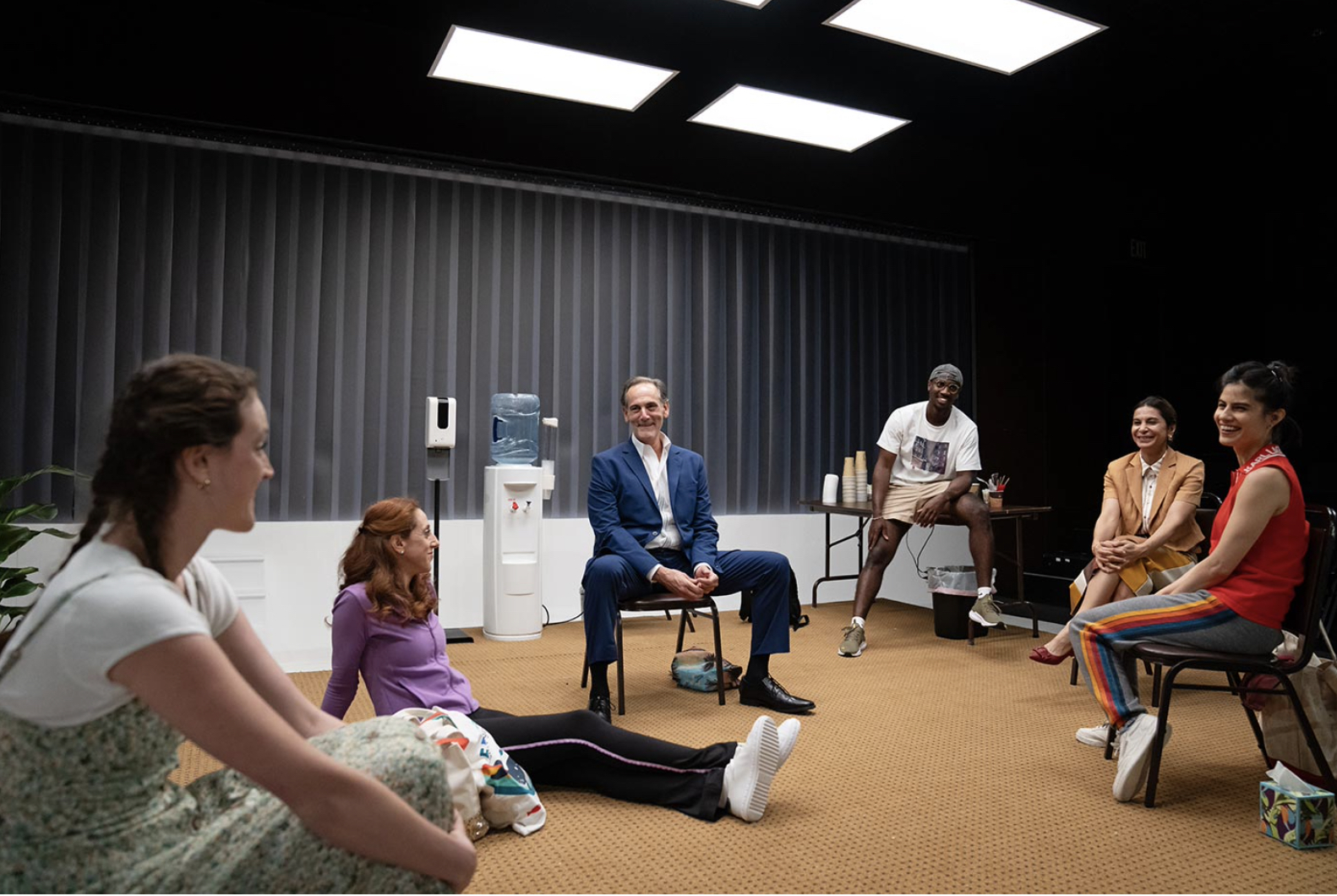
Delia Cunningham, Alison Cimmet, Damian Young, Shakur Tolliver, Gamze Ceylan and Ana Cruz Kayne; Photo by Julieta Cervantes

With the exception of Thom, Director Tatiana Pandiani moves the restless mourners around the traditional talking circle of chairs.  Scenic design team dots provides them with plenty to work with from the children’s toys in the corner, the dying plant upstage, an unexplained helium balloon hugging the ceiling, and the sparse coffee set-up stage left.  This gives each audience section an opportunity to experience everyone as they literally jockey for their rightful place. 

Writing this play may have been cathartic for Feraud and it certainly is for the audience.  The more serious conversations are interspersed with understandable snark and amusing insight.  I saw friends and couples touching hands and heads in connection.  A young woman got as far as an exit door only to return to her seat and watch the remainder of the piece clutching her purse. The majority laughed and nodded in recognition.  There are plenty of moments for all present to breathe.

Grief is obviously not a problem that has a solution.  But Doménica Feraud has turned a discussion about this tough experience into an engaging and touching theatrical work.  The world premiere of Someone Spectacular has been extended at the Pershing Square Signature Center, 480 West 42nd Street,  through September 7.  (Note that it is not a Signature Theater production, but the first creation of B3-A12, a partnership which was founded in honor of Nathalie Feraud-Salame.)  The action starts promptly on the hour and there is no intermission.  Tickets range from $39 to $119.  For more information and to purchase tickets, visit https://someonespectacularplay.com/.  

NY Classical’s Henry IV

It’s summertime, the season of delightful outdoor (mostly free) performances.  Among my favorite companies is New York Classical Theatre.  Artistic Director Stephen Burdman has a one-of-a-kind flair for molding even the densest of texts into a compact and entertaining two hours.  This year he has impressively taken on Shakespeare’s Henry IV Parts I and II.  More than any of the history plays, Henry IV is a love letter to Shakespeare’s country and all its colorful facets.  Part I covers the early years of Henry’s reign soon after he has taken the crown from his weaker cousin Richard II.  He was not Richard’s chosen successor and rebellion is brewing.  To make his situation even more precarious, the King’s heir, Prince Hal, is far more interested in palling around with his jolly friend Jack Falstaff and his wayward circle than in taking his rightful place at court.  Part II continues the story, ending with a post-battle Hal stepping into his role as responsible King Henry V and disavowing his relationship with Sir Falstaff.  

Burdman has cut away much of Henry’s lamentations, but despite the title these were never Henry’s plays.  Falstaff is what we would call a fan favorite (so much so that Shakespeare gave him a cross-over role in The Merry Wives of Windsor.)  In this production, he is played with wit, charisma, and a dose of self-awareness by NYCT artistic associate John Michalski.  Counterpoint is Hotspur, a hero in an old-fashioned mold, who begins as a Henry ally and ends as a central force among the rebels.  Even passersby could identify this personification of gallantry by Damian Jermaine Thompson’s ramrod posture and elegant demeanor, two qualities he sheds when he also plays the meeker John of Lancaster.  As a nod to the power of Queen Elizabeth I who was on the throne in Shakespeare’s time, Burdman has changed Mortimer’s gender.  This allows us the pleasure of more time with magnetic Anique Clements, who also takes on Beth (formerly Ned) Poins, Hal’s closest friend.  Burdman has also converted Worcester to a Countess interpreted by Carine Montbertrand who doubles as put-upon tavern owner Mistress Quickly.  Her physical and verbal shifts between classes earns her special appreciation.  The overly self-confident Owen Glendower gets plenty of exuberance from Ian Gould who also portrays the King’s Brother-in-Law Westmoreland.  Ian Antal, another of the artistic associates, plays young Prince Hal with a devilish smile and much whipping of lustrous hair. The remaining cast members — Briana Gibson Reeves, Nuah Ozryel, Nick Salamone, and Juan Luis Acevedo — help move the story along with the high energy and wonderful timing this production demands.  

In most settings, this company has the audience change locations several times.  In Carl Schurz Park they are more physically restricted, so the actors move through the crowd.  They speak their lines cheating to the viewers and those who suddenly find themselves at the back are given permission to stand.  The trees form a lovely backdrop and the birds add to the soundtrack.  You have only to look at the long list of fight, movement, and vocal professionals in the program to get a sense of what it took to get this well-rounded creation on its many feet.

Henry IV and all his parts is a particularly welcome offering in the year when the Delacorte, home of the Public Theater’s Shakespeare in the Park, is shuttered for renovations.  It can best be enjoyed with friends, a snack and perhaps a well-behaved dog.  A perusal of the cleverly written program notes beforehand (https://theunforgettableline.com/wp-content/uploads/2024/07/efd4d-dramaturgyh42324.pdf ) is highly recommended.  You can catch New York Classical Theatre’s Henry IV among greenery at Carl Schurz Park through Sunday, July 7 or with water and an actual castle July 9 through 14 at Clinton Castle at Battery Park.  To make a free reservation and for more information visit https://nyclassical.org/

Responders

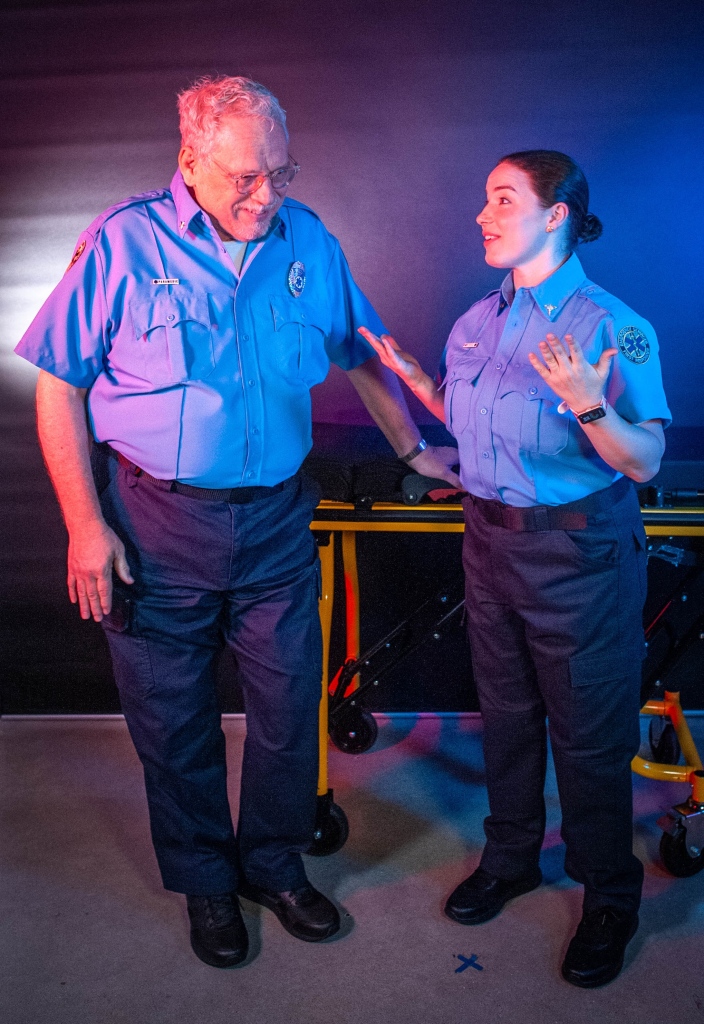
As Tucker’s mother sees it, everything happens at the same time: the good, the bad, and the random.  That paradigm is evident in Responders, Joseph Scott Ford’s new play currently running at Arkansas’s TheatreSquared. The good, is the apparent affection the characters hold for one another, even the squabbling exes Daryl and Suzie. The bad is the suicide paramedic Daryl and his newly minted partner Ang have found hanging from a billboard near the highway.  The police who should be first responders are running late because of a flat tire.  The school buses will soon be driving by and Ang — deeply concerned about the impact the gruesome sight will have on the town’s young children — is considering bending the rules and disturbing the scene.  But Suzie, an ambitious local news reporter, needs a big story. She would rather capture every traumatized face with her loyal cameraman, Tucker.  The random will not be spoiled here except to say it completes Ford’s exploration of mental distress through a droll and compassionate lens.  

An Arkansas native, Ford applies a distinctive perspective to rural middle American life that is simultaneously loving and probative. This Oklahoma town is so small that the Uber service is simply “Sandra.”  The contained setting promotes both the closeness and the friction that makes the action and the dialogue click.  The banter is relaxed and humorous even when the situation clearly isn’t.

Director vickie washington, who collaborated with Ford when the piece was being developed at T2’s 2022 Arkansas New Play Festival, returns to the helm.  She leverages the obvious comfort between her cast members, all of whom appeared in previous incarnations of the work.  From the outset, the body remains mostly obscured by a stark and dusty roadside set designed by Sydney Lynne, chillingly a prop more than a person.  The victim’s suit jacket and polished shoes (props by Brodie Jasch) sadly hang on fencing nearby.  Kelsey Claire’s plain-speaking Ang and Bradley Campbell’s world-weary Daryl arrive with the gurney through an aisle between the two perpendicular audience sections, immediately drawing everyone into the action.  The two actors play warmly together and each one is given an intimate scene with Edwin Green’s recently returned veteran Tucker.  The conversation between Daryl and Tucker, built on the awareness that their jobs have warped their senses of humor, is particularly moving.  Though her dialogue also offers glimpses of a tender side, Miranda Jane remains too shrill and edgy to give Suzie the balance that is evident in Ford’s script.  Costume designer Jennifer McClory has taken care to ensure her character literally stands out in fuchsia against the uniforms and earth tones of the others, so this further push is unnecessary.  Levi J. Wilkins’s lighting offers gentle shading where it’s needed.

Bradley Campbell and Kelsey Claire in Joseph Scott Ford’s Responders.
Photo credit: TheatreSquared

By blending clever repartee with straightforward talk, Responders finds the sweet spot between entertainment and message.  It is a true homegrown product marking the fourth co-production of the Fayetteville, Arkansas based TheatreSquared and Arkansas Repertory in Little Rock.  Running time is an hour and 15 minutes with no intermission.  This World Premiere continue through June 30 at the Spring Theatre on 477 W. Spring Street in downtown Fayetteville, Arkansas. Tickets are $43-$68.  Digital tickets are available through T2 at Home for just $25.  Though the audio is slightly muffled and best experienced with headphones, it’s a nice option if you are unable to get to a live performance.  Visit https://www.theatre2.org/ for more information and to purchase tickets.  

Appraisal (Preview)

Plato said, “One of the penalties for refusing to participate in politics is that you end up being governed by your inferiors.”  This sagacious line — quoted about halfway through the dark comedy Appraisal — summarizes Nicky’s worst fear as she enters the political minefield of her annual review. Her evaluation will be conducted by Jo, a man she’s privately told others is lazy among other shortcomings.  Nicky has admitted to making a few missteps in her ten years of supervising her team.  Like many office workers, she’s frustrated by the amount of paperwork and meetings that have chewed up her time.  But by traditional standards, she is a caring and dedicated employee who delivers measurable results.  Unfortunately for Nicky, Jo isn’t applying traditional standards.  His professional agenda — which falls somewhere below his desire for a better golf swing — is revealed turn by turn.  

As constructed by playwright Tim Marriott, who also portrays Jo, Appraisal travels some well-known pathways.  Having us settle into a rhythm of comfortably nodding our heads only serves to make the arrival at less familiar territory more jarring.  Director Margarett Perry has given the affable Marriott some wonderfully revealing staging.  He increasingly displays the physicality and emotional intelligence of a spider.  With a baring of his teeth that he hopes passes for a smile and some inappropriately chummy body language, Jo is off-putting even when he’s delivering something of a compliment.  Alex Sunderhaus’s Nicky is, engagingly, harder to peg.  The only questionable artistic decision is to dress her in a sleeveless yellow striped pantsuit (presumably from the actresses’s own closet since no costume design credit is given) topped off with messy hair held back by dime store barrettes.  It’s an incongruous look for an astute corporate player and an unnecessary distraction from a strong edgy performance.

Marriott and Sunderhaus in Appraisal; photo by Carol Rosegg

The power struggle between Jo and Nicky is relatable even to those who have never held an executive position.  There is a universality in the desire to be heard and valued and a general loathing of the dysfunctional hierarchies that seemingly weed out talent.  Another strength of Marriott’s lightly humorous script is the succinct yet vivid descriptions of characters we never get to see including Nicky’s child, Sam, and her co-workers, Cassie and Kat.  

With an peppy work-related soundtrack (Morning Train, Nine to Five, Manic Monday), 59e59 Street Theaters sets the tone for a pleasant and distracting hour of entertainment fitting for a hot summer evening.  Appraisal continues through June 30 in their Theater B as part of their Brits Off Broadway Season. Tim Marriott’s Smokescreen, a contemporary issues-based production company, co-produces with Twilight Theatre Company, a non-profit that supports the development of new works primarily by emerging UK artists.  Tickets are $30 for members and $44 for non-members.  Due to the intimacy of the space, there is no late seating and no reentry.  For more information visit https://www.59e59.org/shows/show-detail/appraisal/

Coach Coach

Dr. Meredith Martin is not just any old coach.  She is an esteemed coach coach running a very exclusive program for coaches who are struggling.  Her current retreat — held in an aging and overstuff rental home centered between an airport for convenience and the woods for aesthetics — is so exclusive there are only four attendees.  Each of the participants hopes Dr. Martin will elevate her practice and perhaps even give her a place on the insider team.  

This is the set-up of Bailey Williams’ new comedy Coach Coach, the second entry of  Clubbed Thumb’s 2024 Summerworks.  Commissioned by the daring incubator, the script is not as wholly satisfying as some of their past offerings.  Williams has fun playing with the language of psycho babble and marketing spin and earns many chuckles, but the work could be far more expansive in its views of what is admittedly a poorly regulated speciality and more probing in its observations about the sway of some players within it.  While each soliloquy highlights an aspect of a character’s struggle, collectively they give a choppiness to the unfolding of events without significantly varying the tone or the emotional undercurrent.  

Despite its shortcomings it is, in the words of one CT insider, very “on brand”: thoughtful, explorative, and marching to the beat of its own rhythm section.  Also in keeping with Clubbed Thumb’s deserved reputation, all the artistic elements are of high quality.  The cast  — Purva Bedi, Cindy Cheung, Becca Lish, Kelly McAndrew, Susannah Millonzi and Zuzanna Szadkowski — is terrific both as individuals and as a well orchestrated ensemble. Even when the characters are not fully listening to one another, the actresses clearly are.  Director Sarah Blush has mined the recursive dialogue for maximum impact, for example having death coach Velma (Millonzi) slither over the furniture with reptilian delight and often leaving the deflated Patti (Cheung) perched at the end of her chair as if she isn’t sure she deserves to even sit.  Dan Wang’s costumes are color coded for each specialty: green for business, hot pink for romance, black for death and so on.  His initial wardrobe choice for assistant coach Margo (Szadkowski) received its own round of applause.  Scenic designer Colleen Murray’s selection of furnishing styles lends the right oppressive air. And lighting design by Masha Tsimring and sound design by Johnny Gasper lean heavily into the eeriness of the ill-fated gathering.  

Margo (Zuzanna Szadkowdki) contemplates her options in Clubbed Thumb’s Coach Coach; photo by Maria Baranova

Coach Coach runs through June 13 at the Wild Project on 3rd Street between Avenues A and B.  Running time is 75 minutes with no intermission.  Evening performances are almost completely sold out, but there are newly posted 3:00pm matinees on June 12 and 13.  Tickets are $25 for students, $30 for general admission, and $40 for a reserved seat (highly recommended.)  You can also “pay it forward” for $60.  And if you find yourself too late to secure a spot for this very limited run, consider being ahead of the curve for Crystal Finn’s Find Me Here opening on June 19.  With its starry cast and notable design team, this final entry of the season is sure to be a Clubbed Thumb treat.  Visit https://www.clubbedthumb.org/productions/2024/ for more tickets and information.

Breaking the Story

Alexis Scheer’s Breaking the Story begins quite literally with a bang.  A shell has just exploded next to conflict journalist Marina and her cameraman/romantic partner, Bear.  Renowned for unearthing the human side of war, she’s made a bad call while covering yet another war zone.  Missing and presumed dead, headlines featuring Marina’s many accomplishments dominate the news cycle.  Then as the lights come up a second time, all is peaceful at the large house in Wellesley, Massachusetts that  Marina has just purchased.  Due to receive a distinguished achievement award for her 20 years of service, she decides to tack on a wedding and hastily proposes to Bear.  She invites all those who are closest to her for the double celebration.  Attempting to devote herself to this new life, she promises her mother, daughter, and best friend that she’s ready to hang up her flak jacket for good.

It is immediately obvious that whatever she says, Marina is not at home here.  In scenic designer Myung Hee Cho’s set and Elaine J. McCarthy’s projections, the grass is too green, the flowers are several feet high, and the house is an empty frame. Her professional drive is at war with whatever love she feels for those around her.  Her trauma-triggered nightmares keep intruding on this world. Lighting designer Jeff Croiter ensures that everything is uncomfortably bright around her.  Noises from the front penetrate the sound design of Darron L West.  Even as she plans her wedding, costume designer Emilio Sosa never switches up her khaki and black garb.

Julie Halston and Maggie Siff in Breaking the Story; photo by Joan Marcus

It also becomes evident that though her coverage of the perpetrators and victims of battle are deep and affecting, Marina has never been able to properly tell her own story.  For that report, the lead has been taken by Nikki, a fan and rival with a podcast about Marina’s work. As a very-long-distance Mom, she has relinquished her say in the life of her daughter Cruz, an 18 year old aspiring singer. Marina’s mother — known to all as Gummy — has woven her own personal motivation into the history of her daughter’s chosen profession. Her bestie, Sonia, considers herself one step ahead of her friend, though she might not be on the same road at all.  Even Bear really only knows her under extraordinary, often perilous circumstances.

Though the overarching themes of war and politics are handled with brutal honesty, Scheer’s dialogue is full of humor, warmth and insight.  The effect is simultaneously funny and horrifying.  Director Jo Bonney brings out the best in her entire cast, helping them smoothly ride the changing emotional waves.  Maggie Siff’s Marina is at once delightful and infuriating.  In perfect contrast, Tala Ashe brings perky polish to Nikki.  With a gorgeous voice and a sullen look, Gabrielle Policano fleshes out young Cruz while the invaluable Julie Halston delivers Gummy with her well-known spunk and wit.  Sonia is total class and business in the hands of Geneva Carr.  And Louis Ozawa lends his warmth and charm to Bear.  Matthew Saldívar makes a brief but memorable appearance as Marina’s suave ex-husband, Fed.

Breaking the Story is a captivating and intelligent night of theater.  With wars in Ukraine and Gaza regularly leading the news, it’s an opportune moment to dive into the world of those who take risks — sometimes fatal ones — to put faces to these tragedies. It also marks the penultimate production Second Stage will present in their longtime home at 305 West 43rd Street and it’s a shame to be losing this venue.  Even towards the back of the house, the sound was crisp and the sightlines clear.  Performances are available through June 23.  Running time is an absorbing 85 minutes.  Curtain is at 7PM with matinees on the weekends.  Tickets begin at a bargain $35 and can be purchased at https://2st.com/shows/breakingthestory.

Away on Australian National Theatre Live

Michael Gow’s Away remains one of the most produced plays in Australia.  First performed nearly 40 years ago and set in 1967/68, it explores grief, family relationships, and xenophobia against the backdrop of a distant war in Vietnam.  Away may be considered uniquely Australian, but those themes are timeless and have continued to reverberate, making this play forever relevant and moving.  Fortunately for those of us in this hemisphere, an all-around excellent production from 2017 — a co-production of the Malthouse Theatre and Sydney Theatre Company — is available to watch on Australian National Theatre Live.  With a first rate cast led by Heather Mitchell at her biting best as Gwen, this layered revival makes for a fulfilling 1:40 for any theater fan.

Bookended by the words of William Shakespeare, the action opens with the final scene of an emotive and balletic high school production of A Midsummer Night’s Dream.  The evening is hosted by the outwardly jovial Roy, whose wife Coral is consumed with depression over their son who died in battle.  Puck has been played by the sweetly awkward Tom, the only child of working class English expats, Harry and Vic.  He has fallen for his costar, Margaret, whose nouveau riche parents, Jim and Gwen, aren’t thrilled about the boy’s attentions.  All three families leave for beachside holidays over Christmas break, but at three very different levels.  Roy and Coral are flying to a ritzy resort where they’ve been regulars.  Margaret, Gwen and Jim are off to an upscale caravan park in their luxury camper-van packed with fishing equipment and other gear.  Meanwhile, Tom, Harry, and Vic load their lean-to pup tent into the family car.

Playwright Gow seamlessly blends lighthearted humor, social commentary, and surreal fantasy.  The three parallel stories beautifully and economically unfold, with all the actors playing ancillary characters in each other’s tales.  The juxtaposition of the high anxiety of Gwen with the genuine warmth of Vic set up the confrontations that ripple through each encounter.  There is no situation Gwen can’t make worse nor one that Vic can’t see the best side of.  The young couples’ exchanges ring true and are deeply touching.   There continue to be reverberations of Midsummer with an increasing number of besotted Bottoms among the dancers and a Shakespearean-sized storm brewing.  Tom often watches from the sidelines, like Puck overseeing his handiwork, though Tom has little control over any story, especially his own.  

Cast of Away (2017); Production Photo by Prudence Upton

Even through the lens of a camera crew, the top notch design shines through.  Powerfully directed by Malthouse Artistic Director Matthew Lutton, the staging includes several etherial dances choreographed by Stephanie Lake.  Though the stage remains nearly bare throughout, there is always a strong sense of place centered around an almost-magical wardrobe (set and costumes designed by Dale Ferguson).  Most of the surroundings are conveyed in light and sound with Paul Jackson’s lighting providing the eery warm glow of backstage, garish pink of a dance floor and stark whiteness of a deserted beach.  The atmosphere is made more jarring by the discordant sound design of J. David Franzke.  In addition to Ms. Mitchell, the cast includes Liam Nunan (Tom), Naomi Rukavina (Margaret), Glenn Hazeldine (Roy), Wadih Dona (Harry), Julia Davis (Vic), Marco Chiappi (Jim), and Natasha Herbert (Coral).

This stirring production of Away was among the first dramas uploaded to Australian National Theatre Live during the pandemic.  While there is no substitute for being in a darkened room with strangers, the service (https://australiantheatre.live/) does a first rate job of sharing a range of quality work live-captured by Peter Hiscock and his crew.  The concept is to allow a wide audience to enjoy these productions regardless of their location, income level, or physical limitation.  Subscriptions are $7.99 per month or $74.99 per year and a free trial is available.

Shimmer and Herringbone

At the opening of its full and fleeting 85 minutes, Shimmer and Herringbone introduces us to a range of people each trying on a pile of clothing and judging themselves in a mirror.  It’s a familiar dance with capes and belts as unhelpful partners.  Their search is not just for the right look, but the right feeling; one they might just find at the titular vintage clothing store.  

With witty and insightful rapid-fire exchanges written by Ellen Maddow (who appears within the play as Rhonda, the over-sharing dressing room lady) and Paul Zimet (who directs with deep understanding), the play is located in a city sophisticated enough to be home to a semi-famous soap actor (Jack Wetherall), a townhouse-owning retired teacher (James Tigger! Ferguson), and the aforementioned boutique.  But it is also small enough to enable the chance encounters and meaningful interactions that only happen in a true neighborhood.  Maddow also wrote the music played by a live string trio (Rachel Feldhaus, Marija Kovacevic, and Agustin Uriburu who good-naturedly appear on stage and fully participate) which the characters acknowledge as the soundtrack to their actions.  In their lightest moments, they are moved to dance in celebration, guided by choreographer Sean Donovan.

From details in the dialogue, the story is unfolding shortly after the toughest winter of the pandemic.  Residents are no longer wearing masks of the N95 variety, but they are still veiled.  Their outfits shape how they feel about themselves and also how they wish to be perceived by others.  Each is slightly oddball, but utterly endearing.  We meet Louise Smith’s Grace, a real estate agent who is forever staging her surroundings, and her former best friend Lizzie Olesker’s Lilly, an ornithologist who seems to relate quite strongly to the pigeons she studies.  There is also Lilly’s struggling entrepreneur daughter Bree (Ebony Davis) and Bree’s possible business partner, a former actress named Melanie played by Talking Band co-founder Tina Shepard.  The actors seem to be having a blast and the audience is tickled just to be in their company.

James Tigger! Ferguson, Louise Smith and Lizzie Olesker; photo by Maria Baranova

The true star of the show is arguably Serbian costume designer Olivera Gajic.  She has stocked the central store and surrounding closets with a delightful and nearly indescribable wardrobe.  Our attention is further captured by the deceptively simple set and revealing videos of Anna Kiraly.  Additional color is brought forth by Mary Ellen Stebbins’s lighting.

Like a small scale and less mysterious Tales of the City, Shimmer and Herringbone is above all about self-acceptance and living comfortably in ones own skin.  It also provides a humorous and uplifting visit with literally colorful characters who form a most-welcome community.  A creation of the 50 year old interdisciplinary company, Talking Band, this play with music continues through May 19 at Mabou Mines’ Second Floor Theater at 122CC, at 150 First Avenue near Saint Marks Square in Manhattan. Performances take place Wednesday – Saturday at 7pm and Sundays at 2pm.  Tickets are $30-$35 and can be purchased at https://talkingband.org/works/shimmer-and-herringbone/.