Tag Archives: 59E59 Theaters

This is Government

There is a mighty fine line between “timely” and “too close to home.”  No one at 59E59 could have predicted that Trump ally and conservative activist Charlie Kirk would be shot and killed a few days after This is Government began previews.  But the horrifying uptick in our political violence had to be on the minds of everyone watching a play about a bomb threat taking place outside a Washington D.C. Senate office building.  While Nina Kissinger has infused her dark subject with humor, it feels too gracious to meet the brittle moment.

Scenic designer Daniel Allen sets the scene within an off-kilter office.  To serve the direction, file cabinets are piled across the back in a staircase formation and the third desk floats chairless mid-stage.  Within these strange walls are the interns for Senator Bachmann whose vote will determine the fate of a critical healthcare funding bill.  Rudderless and crippled by anxiety is recent college grad Emi (Kleo Mitrokostas).  One year younger, Tip (Charles Hsu) is four times more interested in influencing the world through his monologues than within the bureaucratic structure.  Their supervisor is former intern Kaz (Vann Dukes), a non-binary pragmatist with political ambitions of their own.  The three have been receiving regular calls from Stevie (Susan Lynskey), whose pleas to speak with the Senator have grown increasingly frequent and agitated.

Mitrokostas and most of the creative team are resident artists of the New Light Project which co-produced with Pendragon Theatre.  Director Sarah Norris has done what she can to mine the script for variation, but a regular rhythm sets in quickly.  Tip attempts to lead the way with dramatic flair and a touch of recklessness driven by his romantic world view.  Draped in mismatched navy business casual (Krista Grevas, Costume Design), Emi follows with apprehension and self-doubt.  At intervals, the passage of time literally ticks by (Jennie Gorn, Sound Design), the lights flicker (Hayley Garcia Parnell, Lighting Design), and someone climbs the cabinets to move the clock hands forward (Yasmyn Sumiyoshi, Movement Direction).  There surely was a more impactful way to illustrate the “real-time consequences” that should be driving the action.
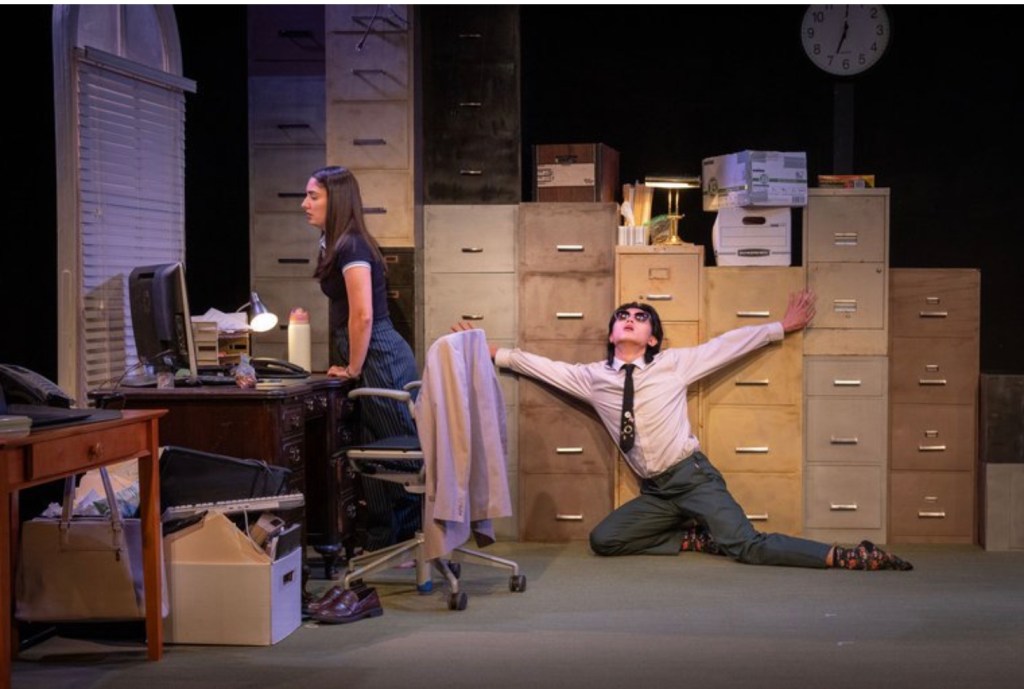
Kleo Mitrokostas and Charles Hsu in This is Government; photo by Burdette Parks

Much of the opening banter is character background and a the building of a familiar framework of government by bluster.  When Kaz surrenders to Tip’s plan, the plot takes on more elements of a detective procedural.  But Kissinger hasn’t so much dropped breadcrumbs as built a pullman loaf walkway.  There is less talk of fueling political change than there is of understanding the bomber’s motives.  The serious exploration of meaningful themes is obscured by broad comedy and near absurdism.  The fates of our would-be heroes feel underdeveloped and ultimately unearned.

Nina Kissinger is a distinguished voice in new generation of playwrights. But though it has been only three years since This is Government won the Agnes Nixon Playwriting Festival at Northwestern University, the political landscape has shifted sharply and is less supportive of her message.  At the performance I attended, nearly half the audience was under 30.  In her curator’s note, Artistic Director Val Day says she hopes these Gen Zers will hear this piece as a call to action.  I sincerely hope they do, even if it’s to gather for another shared experience at live theater.

This is Government is playing in Theater B at 59e59 Theaters, 59 East 59th Street in Manhattan.  Tickets are $44 and available at https://www.59e59.org/shows/show-detail/this-is-government/.  Running time is approximately 85 minutes without intermission.  Content is recommend for those 14 and up.

Appraisal (Preview)

Plato said, “One of the penalties for refusing to participate in politics is that you end up being governed by your inferiors.”  This sagacious line — quoted about halfway through the dark comedy Appraisal — summarizes Nicky’s worst fear as she enters the political minefield of her annual review. Her evaluation will be conducted by Jo, a man she’s privately told others is lazy among other shortcomings.  Nicky has admitted to making a few missteps in her ten years of supervising her team.  Like many office workers, she’s frustrated by the amount of paperwork and meetings that have chewed up her time.  But by traditional standards, she is a caring and dedicated employee who delivers measurable results.  Unfortunately for Nicky, Jo isn’t applying traditional standards.  His professional agenda — which falls somewhere below his desire for a better golf swing — is revealed turn by turn.  

As constructed by playwright Tim Marriott, who also portrays Jo, Appraisal travels some well-known pathways.  Having us settle into a rhythm of comfortably nodding our heads only serves to make the arrival at less familiar territory more jarring.  Director Margarett Perry has given the affable Marriott some wonderfully revealing staging.  He increasingly displays the physicality and emotional intelligence of a spider.  With a baring of his teeth that he hopes passes for a smile and some inappropriately chummy body language, Jo is off-putting even when he’s delivering something of a compliment.  Alex Sunderhaus’s Nicky is, engagingly, harder to peg.  The only questionable artistic decision is to dress her in a sleeveless yellow striped pantsuit (presumably from the actresses’s own closet since no costume design credit is given) topped off with messy hair held back by dime store barrettes.  It’s an incongruous look for an astute corporate player and an unnecessary distraction from a strong edgy performance.

Marriott and Sunderhaus in Appraisal; photo by Carol Rosegg

The power struggle between Jo and Nicky is relatable even to those who have never held an executive position.  There is a universality in the desire to be heard and valued and a general loathing of the dysfunctional hierarchies that seemingly weed out talent.  Another strength of Marriott’s lightly humorous script is the succinct yet vivid descriptions of characters we never get to see including Nicky’s child, Sam, and her co-workers, Cassie and Kat.  

With an peppy work-related soundtrack (Morning Train, Nine to Five, Manic Monday), 59e59 Street Theaters sets the tone for a pleasant and distracting hour of entertainment fitting for a hot summer evening.  Appraisal continues through June 30 in their Theater B as part of their Brits Off Broadway Season. Tim Marriott’s Smokescreen, a contemporary issues-based production company, co-produces with Twilight Theatre Company, a non-profit that supports the development of new works primarily by emerging UK artists.  Tickets are $30 for members and $44 for non-members.  Due to the intimacy of the space, there is no late seating and no reentry.  For more information visit https://www.59e59.org/shows/show-detail/appraisal/

Django In Pain – Streaming on Demand

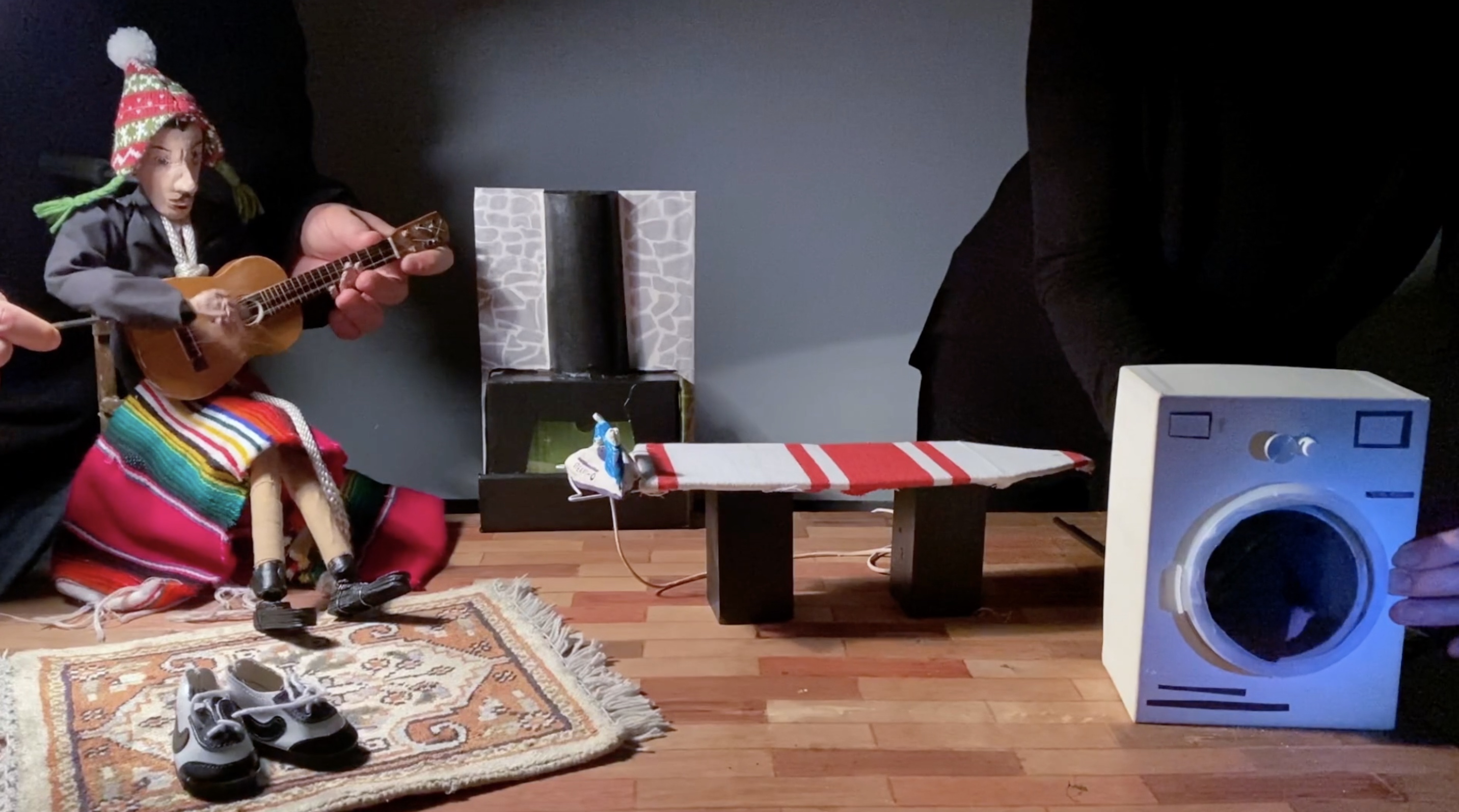
A play about a young man so depressed that he wants to kill himself may not sound like an appropriate match for our national state of mind.  But the journey Antonio Vega and Ana Graham invite us to take in Django in Pain is a beautifully rendered one.  Filmed by Graham mid-pandemic on a cellphone, it features handmade puppets, with props and scenery fashioned from found objects.  And just like in the parable made famous by The West Wing, Vega has been down there and he knows the way out.  The 2016 election kicked him in the soul and the earthquake in Mexico the following year affected him more than he could comprehend.  But the time he found himself in COVID lockdown, he could hardly function.  An invitation to be part of a creative project — the one that resulted in this innovative work — is what motivated him to push away the mental cobwebs and seek help.

Performed on a clear desk by Vega and two visible puppeteers, the piece follows Django on a series of adventures. His suicide attempt is interrupted by an overexcited dog with whom he slowly forms a bond.  The playwright often interacts with his inventions, his inner monologue taking the form of an astute vulture.  While the story has gloomy themes, there are also absurdist images such as Django eating breakfast with a noose still secured around his neck.  These farcical elements prevent Django’s anguish from becoming excruciating for the audience while still honoring the character’s feelings. 

A scene from Django in Pain

Vega’s dialogue isn’t distinctive nor is it a particularly important element for success.  The visuals are what is essential to the narrative and they are inventive and impactful.  Many types of puppets are employed including Indonesian style shadow puppets and traditional stringed puppets.  The shadows are often as prominent as the characters and set pieces, well-representing the dark and lighter moods battling for attention.  As Django’s outlook brightens, so too does the palette employed.  Music with a Spanish flavor written by Cristóbal MarYán heightens the mood.  Headphones may improve your streaming experience.

Django in Pain serves as an important reminder of the powers of connection and accountability.  Whatever our circumstances, there is always an opportunity to develop our own story.  Originally commissioned by PlayCo, the production is streaming from 59e59.org as part of their Plays in Place series.  Runtime is 56 minutes including Vega’s introduction: essential for comprehending the ending of the play.  Narration is available in both English and Spanish.  $15 tickets are available at https://www.59e59.org/shows/show-detail/django-in-pain-streaming/ and can be used on demand through October 19.  Due to the intensity of the content, there is a viewer advisory.

The Commons

The Commons attempts to explore the ways in which everyday moments can form a wider story.  The comedic drama is written by Lily Akerman and directed by Emma Miller backed by an almost exclusively female creative team.  For a piece that sprung from the mind of a young playwright known for telling stories filled with colorful and distinctive voices and further filtered through a sharply feminine lens, it is surprisingly lacking in warmth or depth.  

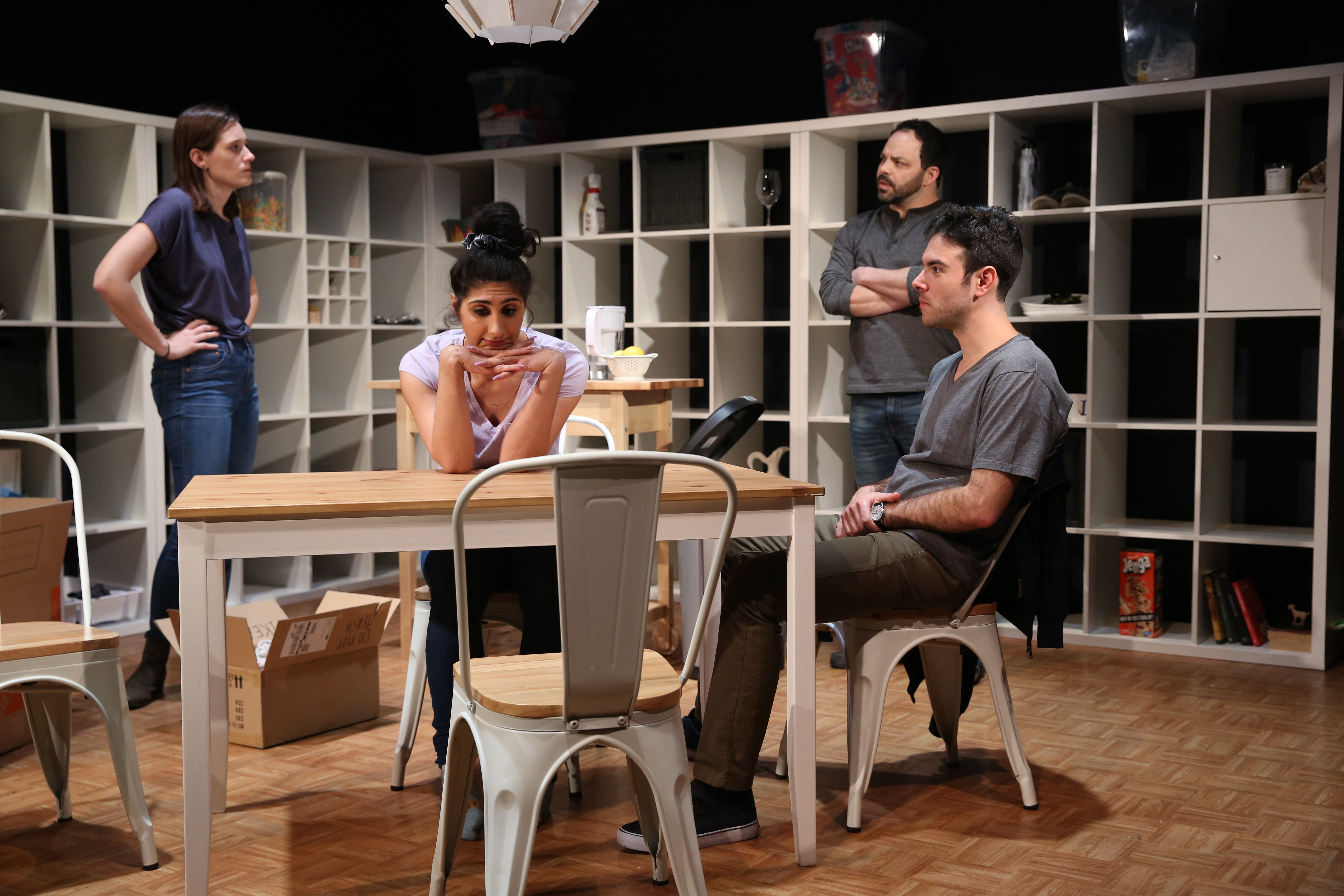
The script is composed of quick scenes depicting a series of conversations held in the kitchen shared by four New York City housemates.  Fastidious Robyn (Ben Newman) is a failed artists who has lived in the house for 20 years.  Jittery Dee (Julia Greer) is struggling to focus her thoughts about her all-important dissertation.  Homey Janira (Olivia Khoshatefeh) lovingly bakes bread while Marie Kondo-ing the heck out of the space.  And newcomer Cliff (Ben Katz) is stretching his meager web designer paycheck while filling the air with empty promises.  The topics they cover are everyday issues from who should wipe down the stove top to how long a guest should be able to stay.  Atypically, these discussions do not build on one another.  Each time an incident appears to be lifting the action to the next level, it deflates as quickly as Cliff’s vow to clean his beard hair from the sink.  In total, the characters live together for 9 months — the period it takes to create a new human life —  yet they have almost no impact on each other, an outcome that is as tedious as it is unrealistic.  

Ms. Miller’s staging in the black box Theater C at 59E59 is also ill-conceived.  In order to accommodate Emmie Finckel’s clean kitchen set, the performance area has the audience seated in an L-shape.  But the actors are mostly placed so that those on the shorter side are continually confronted by backs instead of faces.  The sharp cuts between episodes often make the passage of time difficult to gauge.  At least the clever sound designed by Caroline Eng fills the pauses with the “music” of kettles, microwaves, timers, and other kitchen noises.  

The cast members — most of whom have worked exclusively in festival and workshop productions — do what they can to bring variety to their roles.  The most successful is Olivia Abiassi, whose energetic arrival halfway through the play woke up the audience, in some cases literally.  Her portrayal of Cliff’s ex Anna, the most full blooded of the characters, is thoroughly engaging  For the short time she is in the shared apartment, the spunky straight shooter fills the void by providing everything the others have been lacking in their lives, be it a fresh salad or genuine honesty.   Unfortunately, none of her vitality survives her character’s exit.

Julia Greer, Olivia Khoshatefeh, Ben Newman, Ben Katz Photo by Carol Rosegg

Julia Greer, Olivia Khoshatefeh, Ben Newman, and Ben Katz; Photo by Carol Rosegg

A still-emerging work, The Commons might be better appreciated in a less established venue.  For a modern day kitchen sink drama, this production suffers from a lack of seasoning.  Though the situations portrayed may be increasingly… common, that does not automatically imbue them with meaning.  To build a real bridge between the viewers and the subjects requires more than an exploration of surface traits and eccentricities.  

Presented by The Hearth, The Commons is running at 59E59 (59th street between Madison and Park) through Sunday, February 23.  Tickets are $25 ($20 for members) and are available by calling the 59E59 Box Office at 646- 892-7999 or by visiting http://www.59e59.org. Seating is general admission.  Note that the second row on the shorter side of the L is not raked.  

Einstein’s Dreams

Alan Lightman’s novel, Einstein’s Dreams, follows a fictionalized Albert Einstein during the period he was developing his theory of relativity.  This literary exploration of time and our relationship to it has in turn inspired a number of artists including Joanne Sydney Lessner and Joshua Rosenblum.  Their musical version — also called Einstein’s Dreams — is currently making its off-Broadway debut at 59E59 Theaters, produced by Prospect Theater Company.

A theoretical physicist may seem odd subject matter for song and dance.  Indeed the numbers that are the most tuneful and consequently memorable — such as the spirited Relativity Rag — are those that portray universal feelings.  The all too human desire to hold onto a special moment or to feel stuck in an unpleasant one are sensations that are easily translated to a musical language.  It is when Lessner and Rosenblum move into storytelling mode that the quality of the lyrics suffers and the piece becomes problematic.

To convert the book — which centers on 30 varied dreams — to a manageable structure for performance, this retelling focuses on a relationship Einstein develops with Josette.  The tantalizing and intriguing woman only comes to him when he is asleep.  Their conversations supply him with fresh insight and inspiration.  Alexandra Silber gives soaring voice to this muse, set off from a sea of earth tone clad players by a fiery red outfit designed by Sidney Shannon.  Zal Owen counterbalances Silber’s flamboyance with his sensitive portrayal of a genius with no peers who is bored in his job and troubled by his deteriorating marriage.  

scenic design ISABEL MENGYUAN LEcostume design SIDNEY SHANNON

lighting design HERRICK GOLDMAN

sound design KEVIN HEARD

projection design DAVID BENGALI

props design SEAN FRANK

l-r- Zal Owen, Vishal Vaidya, Michael McCoy in EINSTEIN’S DREAMS at 59E59 Theater. Photo by Richard Termine

Even this central relationship isn’t given much spark by Cara Reichel’s clunky direction.  The biggest contributing factor to the unwieldiness of the work is the wideness of Isabel Mengyuan Le’s dramatic set.  While it is eye catching and brilliantly brought to life by David Bengali’s projections (the production element that makes the most of the theatrical medium and the dreamscape environment), it takes up so much of the stage that actors are sometimes forced to scoot awkwardly between sections.  Movement contributed by Dax Valdes is often limited to stunted waving of arms while the actors’ feet remain planted.

Of the supporting cast, Brennan Caldwell is a standout, providing comic relief and a blast of humanity as Einstein’s closest friend Besso.  Caldwell even manages to make physics sound conversational.  The rest of the company members (Talia Cosentino, Stacia Fernandez, Lisa Helmi Johanson, Michael McCoy, Tess Primack, and Vishal Vaidya) move mechanically from scene to scene.  Those who play multiple characters struggle to find meaningful differentiation.  Thankfully everyone in the cast has a pleasing voice and articulates clearly and the overall sound is comfortably modulated for the space.

The vast concepts that Einstein’s Dreams sets out to explore feel constrained by this production.  Yet those who love musicals as a means of expression will find enough here to keep them engaged for the swift 95 minutes of running time.  This limited engagement runs through December 15 at 59E59 Theaters (59 East 59th Street, between Park and Madison). Tickets are $25 – $70 ($49 for 59E59 Members) and can be purchased by calling the 59E59 Box Office at 646-892-7999 or
visiting http://www.59e59.org.