Tag Archives: Cathy Hammer

Puffs (On Demand)

Imagine being one of the likely terrified lesser-known students at Hogwarts during the time of Harry Potter’s attendance.  That is the delightful conceit of Matt Cox’s Puffs, or Seven Increasingly Eventful Years at a Certain School of Magic and Magic, which ended its very successful New York run in August of 2019.  Wonderfully captured on film by its stage director Kristin McCarthy Parker with support from VirtualArtsTV, the show is coming to BroadwayHD beginning August 15.  Though performed with farcical pace and style, like the Boy Who Lived, Puffs never loses its soul.  The sendups are executed with obvious love for the original world and characters, which makes them far more potent and enjoyable for the true fans that make up the target audience.  

We are guided through the 7-year journey by a narrator (a quick and snappy A.J. Ditty) whose identity will eventually be revealed.  Around the time of Mr. Potter’s birth, another boy, Wayne Hopkins (a warm and sweet Zac Moon) was born and orphaned in England and then whisked away to his Uncle Dave in New Mexico.  One day, a passing owl drops a letter into their living room inviting the nerdy child to a school in his home country.  He finds himself sitting under a famed hat which determines he is a Puff, a House of seeming misfits. They are led by a very polite Cedric (an amusingly servile James Fouhey) and live in the school’s basement somewhere near the kitchen.  Wayne and his new friends Oliver Rivers (adorkable Langston Belton) and Megan Jones (Julie Ann Earls on the right side of edgy) hope to distinguish themselves and contribute to Cedric’s goal of “third place or nothing”.

(Front row) Jessie Cannizzaro, Zac Moon, James Fouhey, Stephen Stout, (Back row) Madeleine Bundy, Langston Belton, Andy Miller, Eleanor Philips (L-R); photo by HUNTER CANNING

Their story plays out Rosencrantz and Guildenstern-like, with that of Harry (a pointedly irritating Madeleine Bundy), Hermione (a wig) and Ron (a mop) unspooling in the background.  Cast members take on over three dozen characters with admirable range and assurance.  A knowledge of the Harry Potter film series is essential for truly appreciating the hilarious and multilayered impressions from Stephen Stout’s spot-on Alan Rickman as a Certain Potions Teacher to Eleanor Philips as a squeamish Death Eater.  Familiarity with a certain 2008 rom-com will add laughs to Nick Carrillo’s wild about-last-night improv.  The ensemble is rounded out by Jessie Cannizzaro and Andy Miller playing opposite ends of the outcast spectrum among other roles.

Cox’s inventive script is a total triumph. The visual wizardry emanates from director Parker’s stagecraft along with the talents of her remarkable artistic team. Magical elements  — including a Dementor so smartly designed it should get its own standing-o — are made possible by sets, props and costumes all impressively conceived by Madeleine Bundy.  These clever and colorful elements are supported by lighting effects by Herrick Goldman and original music by Brian Hoes that recalls just enough of John William’s themes.

Shown in theaters for only two nights, Puffs, or Seven Increasingly Eventful Years at a Certain School of Magic and Magic will be available On Demand at BroadwayHD.  The production is recommended for those 13+ and runs just short of 2 hours.  The mid-credit outtakes add an extra sprinkle of joy to the fun-filled viewing.

The Half-God of Rainfall

At a time when the performing arts are struggling, it is fitting that the wonderful New York Theatre Workshop is hosting a theatrical event that takes much of its inspiration from the early Greeks.  Similar to the dramas of that time, The Half-God of Rainfall combines elements of religious mythology, social commentary, and contemporary politics.

The piece opens with a nod to the ancient tradition of oral storytelling as the players introduce themselves with their real names along with their god-selves.  Working together, the performers weave a tapestry of poetry and dance as they tell the tale of Demi, the product of a particularly violent rape by Zeus: one of many abuses perpetrated by the King of the Gods against human women.  Having won a wager with Sàngó, a fellow god of Thunder, Zeus took as his prize Modúpé, who almost instantly gives birth to a half-god child, Demi.  His despair can make rivers rise and his rage can make it rain.  But his real power manifests on the modern basketball court where every shot is a winner. Despite his many victories, his smoldering rage against his father always burns.

In this realm, the gods of all traditions know one another and many are no better than the mortals over whom they have dominion.  Encompassing so many deeply felt themes occasionally bends the narration out of shape, but the dazzling visuals and all encompassing soundscape keep you enraptured. The audience was invested enough that towards the end they elicited a loud gasp at a critical moment.  While some familiarity with the various pantheons would be helpful, playwright Inua Ellams includes enough background information that the plot can be followed without it.  Even the basketball reference are based on pop culture and never “inside baseball” as it were.

Taibi Magar’s direction is masterful, filling the scene with otherworldly energy enhanced by movement director Orlando Patoboy.  She also incorporates Orisha movement choreographed by Beatrice Capote.  The set by Riccardo Hernández with projections designed by Tal Yarden is in constant motion with swirling images of clouds, water, and the cosmos itself.  The stage continues the natural theme, covered in black sand that moves and lets out a soft crunch beneath the actors’ feet.  The physical experience is expanded with the sound design of Mikaal Sulaiman and lighting designed by Stacey Derosier.  Costume designer Linda Cho builds on basic black towards the shimmering waters of a fertility goddess.

The ensemble moves with fluidity throughout the work, their disparate voices adding variation to the verse.  Mister Fitzgerald gives Demi a radiant joy.  Jennifer Mogbock brings both strength and warmth to Modúpé, her body moving with the combined powers of grace and strength.  Jason Bowen as Sàngó and Patrice Johnson Chevannes as Osún make a fittingly splendid couple under whose protection Modúpé lives.  Kelley Curran’s Hera and Michael Laurence’s Zeus employ unnecessary Greek accents, but the two shine in their other supporting roles.  Only Lizan Mitchell over-modulates, consequently distorting her lines as the trickster Elegba and several other deities. 

Mister Fitzgerald as Demi, The Half-God of Rainfall; photo by Joan Marcus

As many Greek heroes learned, a great adventure often begins by being blown off course.  This production was disrupted by COVID only to wind up in just the right hands.  The result is an ambitious epic that draws a diverse audience much needed by today’s theater world.  Despite its themes, The Half-God of Rainfall is a human-level spectacle born of collaboration and heart.  (There is a trigger warning for a depictions of sexual violence and a use of flashing lights and haze for dramatic effect.)  Performances continue at the New York Theatre Workshop (79 East 4th Street) through August 20 and $65 tickets are available at https://www.nytw.org/show/the-half-god-of-rainfall/.  Runtime is about 90 minutes and mask-only performances are available.  A co-production of NYTW and Harvard’s American Repertory Theater, the show will be moving next to Cambridge, MA in September.

Primary Trust

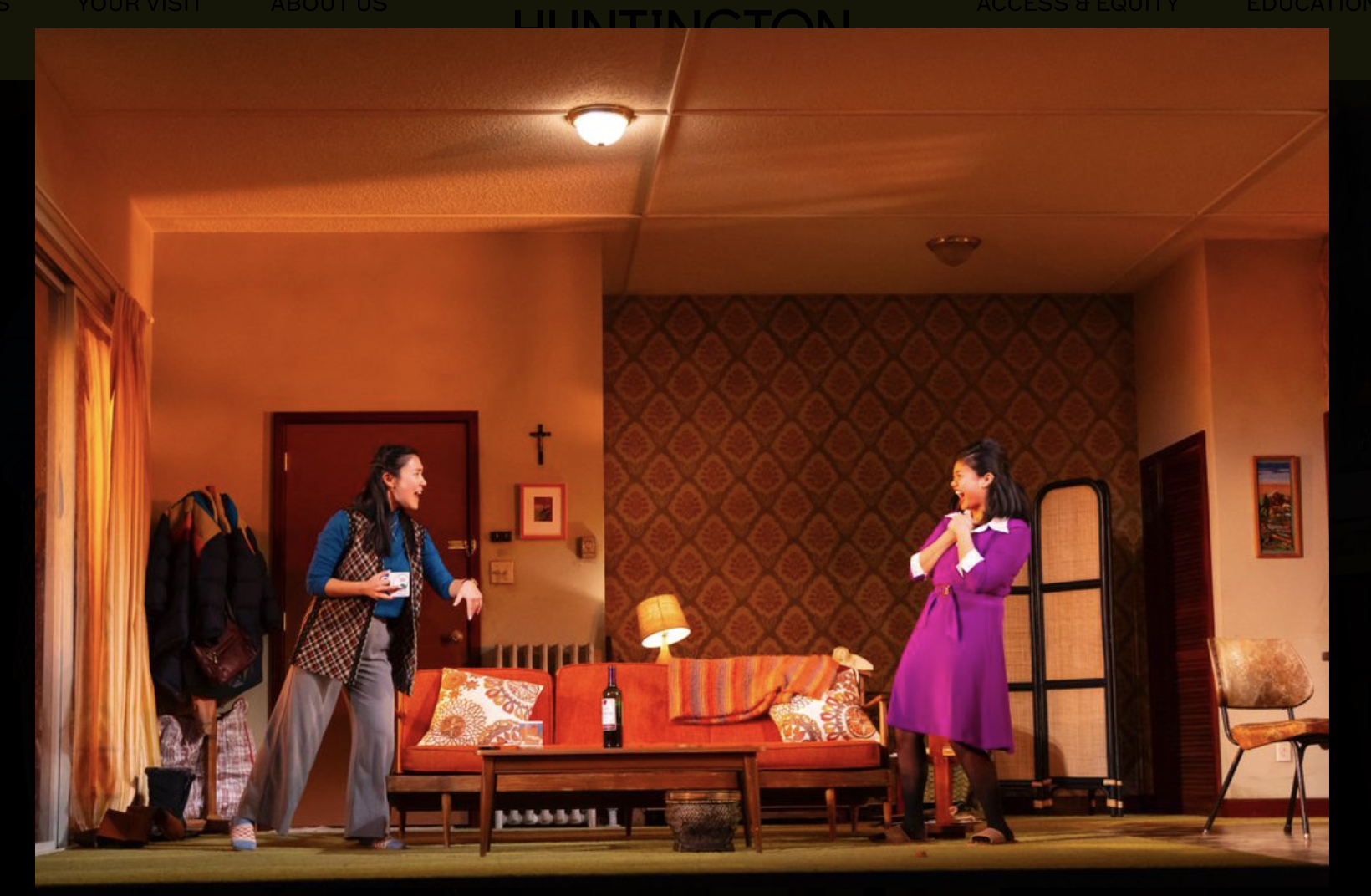
I usually don’t make my reviews personal, but my experience while watching Primary Trust and the themes within this gorgeously crafted play are inexorably intertwined.  With gentle brushstrokes, Eboni Booth introduces us to 38 year old Kenneth, one of the few Black people living in Cranberry, a suburb of Rochester, New York.  His ethnicity is only a minor contributor to Kenneth’s isolation.  Having lived an extremely restricted life since the death of his mother when he was only ten, Kenneth’s coping mechanisms are intricate and ritualized.  But somehow his idiosyncrasy has left him uniquely suited to meeting people at their own level.

There is a deliberate “let’s pretend” quality to the entire production.  From the opening moments, Kenneth speaks directly to us in his halting and self-reflecting style.  Long thoughtful pauses rest between effervescent bursts of storytelling.  All the activity comes with musical accompaniment composed by Luke Wygodny, punctuated by the ding of an “order up” bell.  Marsha Ginsberg’s whimsical scenic design takes the phrase “small town” and makes it literal, including a miniature church, bank, and big box store alongside Wally’s, the tiki bar that serves as Kenneth’s sanctuary.  Lighting by designer Isabella Byrd leaves long shadows on the ground well before winter sets in.  Costume designer Qween Jean employs a more muted color palate than her signature style until an essential jacket makes its appearance at a pivotal moment. Two actors play multiple roles, sometimes barely turning around before switching.  Yet the play is never anything less than genuine and heartfelt.  The entire audience was sufficiently swept up to respond emotionally to every turn.

William Jackson Harper is utterly perfect as Kenneth, balancing warmth, vulnerability, fear and heart.  It’s Harper’s first stage appearance since 2017 and it was my first live theater attendance since March of 2020.  Previously, theater played a major role in my life.  Many of my friends come from that world and it was often the way I entertained others.  Vacations have been planned around seeing a specific work or actor. The temporary loss of that pursuit was profound.  But Primary Trust is all about bringing people in.  At its core is the celebration of coming out of seclusion.  To have Kenneth welcome me as a member of the audience into his life could not have been more impactful. And though I don’t have much more in common with the character, I do share his deep belief in the power of one good friend.

Jay O. Sanders, William Jackson Harper, and Eric Berryman; photo by Joan Marcus

Director Knud Adams, who often works with new material, delicately mines Booth’s script, uncovering the layers of joy, sorrow and hope. Providing support and stability for Kenneth is his best friend Bert, played with sweet good nature by Eric Berryman.  Jay O. Sanders seems to be having the time of his life portraying (among other characters) Kenneth’s two very different bosses.  The first — the owner of a bookstore— has the difficult task of laying Kenneth off after twenty years of a comfortable relationship.  The loss of his job shatters the comfortable if confining structure of Kenneth’s life, and the chink of light shining through the holes is both frightening and filled with possibility.  Helping Kenneth step through the gap is April Matthis’s Corinna, the only one of a multitude of Wally Waiters who wants to see Kenneth as more than an eccentric customer.  Completing the ensemble is a Musician played by understudy Paul Lincoln in the performance I attended.  So essential is he in setting the beat and tone, that Mr. Lincoln received his own loud round of applause.

Roundabout has obviously worked to make this production inclusive.  The company offers clear and sensible guidelines to audience members and the staff makes themselves very available to help.  To get you in the mood for what is to come, the lobby has been decorated to resemble a tiki bar, complete with projected fish tank and artificial grass.  The ticket confirmation warns audience members not to arrive late.  I can only reemphasize their strong recommendation.  Missing any of the first few minutes of the show will leave you with quite the wrong impression of what is transpiring.

Primary Trust is a work of true beauty.  It was nurtured at the 2021 Ojai Playwrights Conference and is a recipient of an Edgerton Foundation New Play Award.  Running time is an absorbing 95 minutes with a realistic denouement.  It is playing at the Laura Pels Theater in the Harold and Miriam Steinberg Center for Theatre (111 West 46th Street) through Sunday, July 2.  (Note that Harper is out the weekend of June 9.)  Tickets start at $56.  $4.95 COVID cancelation insurance is available.  Visit www.roundabouttheatre.org for additional information including special performances.

College Fun

When I heard there was a theater troupe called the Frog & Peach, I simply had to see what they were up to.  Though they were founded in large part to make Shakespeare more accessible to a broad audience, their most recent production, College Fun, is a 35 minute long sharp-edged satire written by founding company member Ted Zurkowski.  With its setting at an elite university in Southern California and its relentless puncturing of a certain brand of authority figure, it reflects many of the qualities of Beyond the Fringe, the innovators of the routine about the world’s most revolting restaurant.

A lifetime member of The Actors Studio, Mr. Zurkowski has recently been focused on the musical portion of his career.  It would appear that for the creation of College Fun, he drew on his past experience as a teacher of theater history. The objects of his ire are those in the education community who employ the language of Diversity, Equity, and Inclusion without embracing or even understanding the movement.  Buzz words like “unpack,” “curate,” and “thought leader” are tossed around as if their mere use can take the place of their intended, beneficial goals.  

The cast features DazMann Still as the Everyman Teacher appropriately named Professor Jones, a black member of the theater department who who has somehow triggered one of his rich white students.  Alyssa Diamond’s wildly inappropriate Dr. Ram is the first to confront him, though she won’t even tell him the nature of the offense or who filed the complaint.  Filling in some of the blanks is Jonathan Reed Wexler as the over-the-top flamboyant Dr. Queeg.  It falls to the questionable power figure Dr. Pane, portrayed by Anuj Parikh, to complete the increasingly ridiculous picture. 

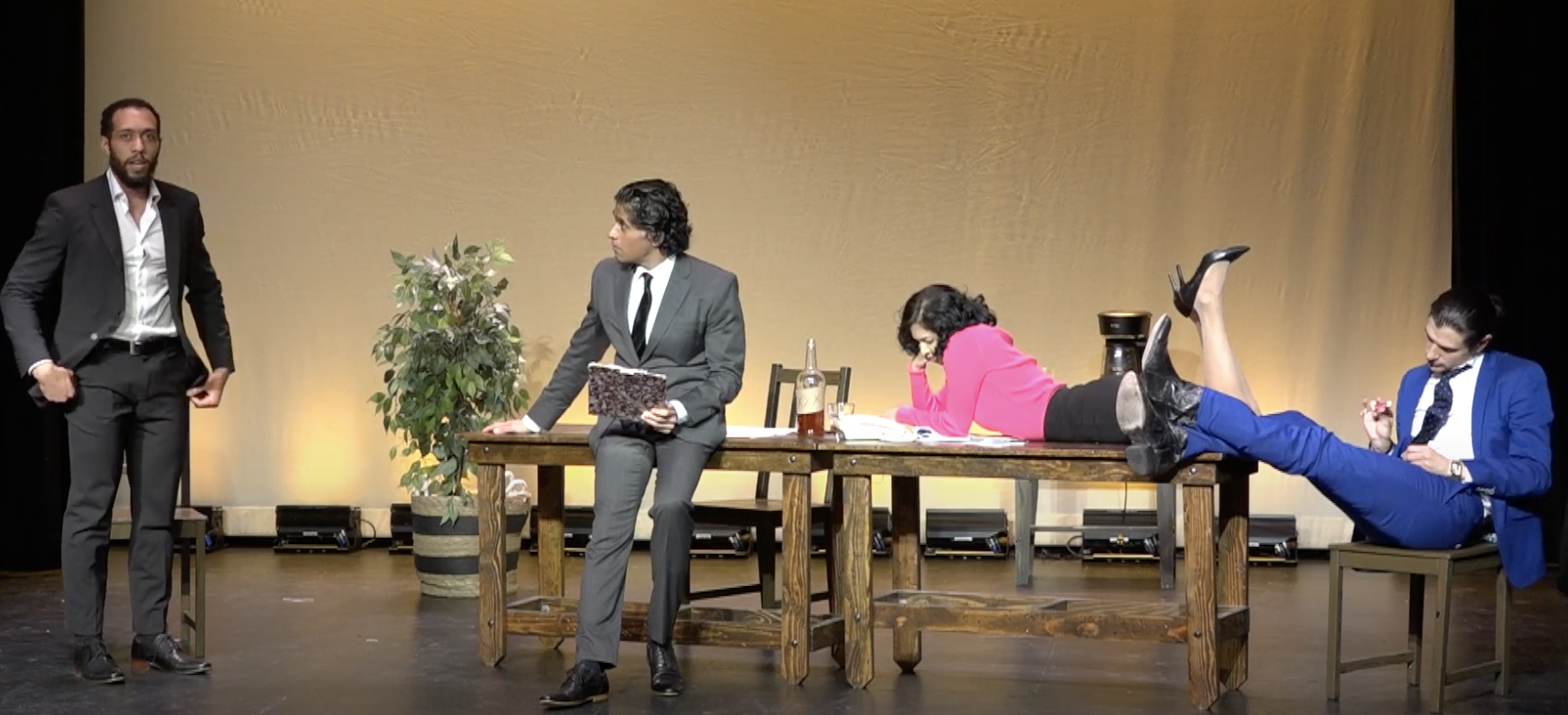
DazMann Still, Anuj Parikh, Alyssa Diamond and Jonathan Reed Wexler in College Fun

The one-night performance of College Fun was made possible in part by the NYC Department of Cultural Affairs. It was staged at the Marjorie S. Deane Little Theatre, a 145 seat house in the West Side YMCA near Lincoln Center.  As explained on the Frog & Peach Theatre’s website, the charming co-founder Lynnea Benson was chosen as the director because she’s the “least hammy and most wily” among them.  She made use of the physicality of her actors and a well-chosen wardrobe to give color to the simple set of a few wooden chairs, two tables, and a sad potted plant as background.  Diamond, Wexler, and Parikh previously worked together in the company’s production of As You Like It, giving them a familiarity that is useful to Still as his character navigates a progressively surreal landscape.  At key points, Professor Jones speaks directly to the audience as if to acknowledge that any discussion with his idiotic interrogators is pointless.

Zurkowski and Benson are now developing a new work, Verbatim, with Estelle Parsons and Austin Pendleton, so stay tuned.

Peter Pan Goes Wrong

Conceived in 2008 by students at the London Academy of Music and Dramatic Arts and nourished during an Edinburgh Fringe Festival, the Olivier Award winning Mischief Theatre has made being silly into a sincere mission.  Their Goes Wrong… series has won dedicated fans around the English-speaking world.  Fortunately for those who don’t have one of their creations nearby, several of their plays are available for streaming.  Just added to the line-up is Peter Pan Goes Wrong, the kind of crowd pleaser that gets nominated for three Broadway.com Audience Choice Awards.  

The performance on BroadwayHD originally aired on BBC1 on New Years Eve of 2016. It features David Suchet as the narrator, a role currently portrayed by Neil Patrick Harris in the Broadway production that was inspired by this special.  Using five cameras, the show was filmed in front of a very enthusiastic and in-the-know live audience. Director Dewi Humphreys made use of the television studio setting to add comedic elements. Close-ups that reinforce the physical gags are the trade-off for not being able to take in the entire stage.  The colorful staging earned a lighting award for designer Martin Kempton.  

A zesty example of Mischief’s body of work, Pan stars David Hearn, Henry Lewis, Charlie Russell, Jonathan Sayer, Henry Shield, and Nancy Zamit who are still with the company.  Current members in smaller roles are Harry Kershaw, Bryony Corrigan and Mike Brodie.  The ensemble is rounded out by Chris Leask, Ellie Morris, Adam Meegido (who directed the original stage version), Greg Tannahill.  It is hard to single out any one performer since they are so interdependent.  But my admiration is boundless for Zamit who flies through more than just Tinkerbell with the aid of break-away costumes by Roberto Surace.  Songs by Mischief’s Rob Falconer and Richard Baker remind us of the shear talent of this troupe.

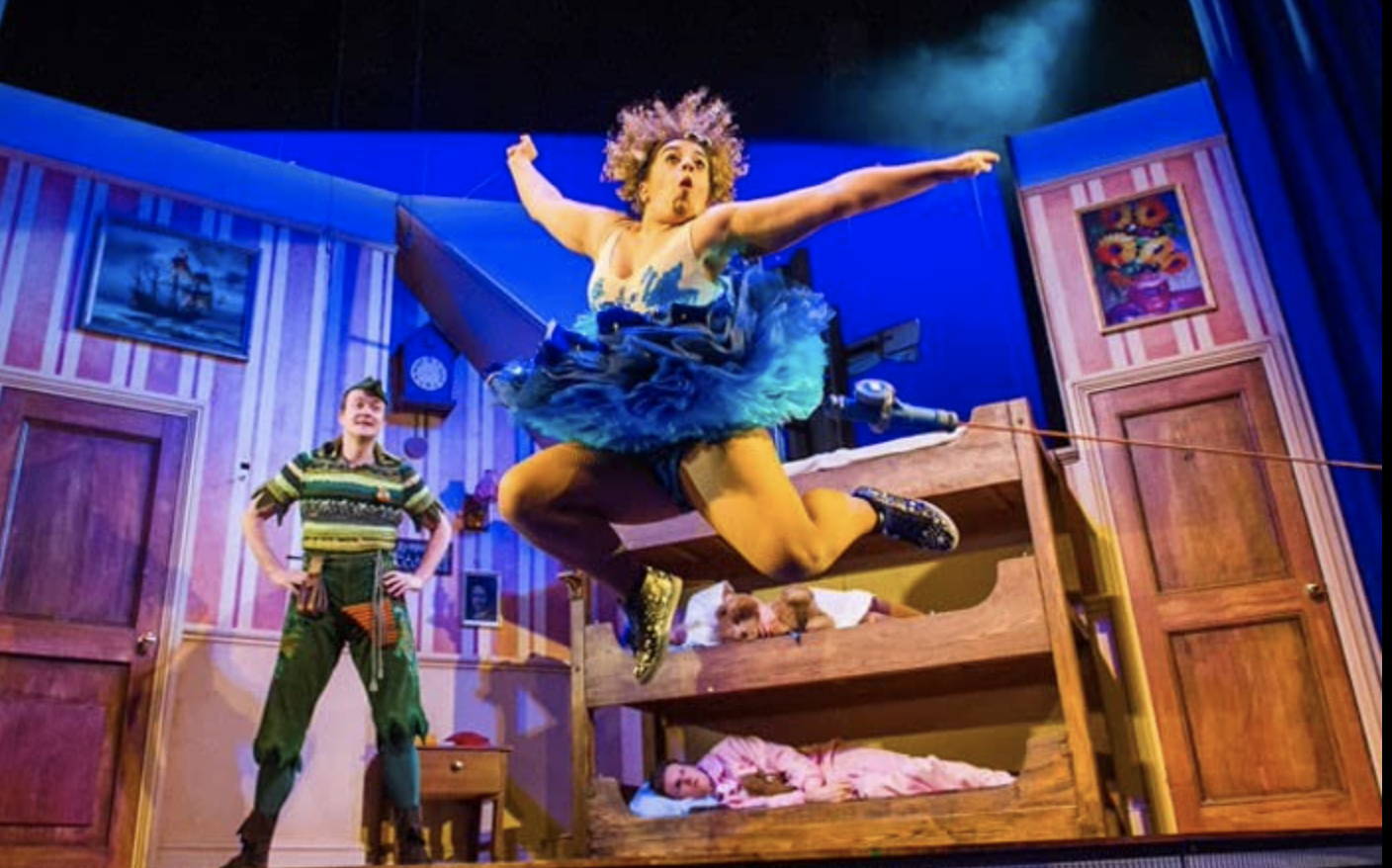
Nancy Zamit, Greg Tannahill, and Dave Hearn in Peter Pan Goes Wrong

Mischief members Henry Lewis, Jonathan Sayer, and Henry Shields liberally adapted J.M. Barrie’s story of the boy who wouldn’t grow up.  Their loose interpretation opens backstage where Suchet introduces us to the fictional Cornley Drama Society mockumentary style, providing background for jokes that will unfold over the course of the show.  Some of the well-known story elements remain: Peter Pan comes to the Darlings’ home to retrieve his shadow.  The children fly away with him to Neverland where the nasty Captain Hook seeks revenge for the loss of his hand to a crocodile.  But as the piece’s title would suggest, the production is plagued by issues from actors who forget their lines to designer Harry Banks’s fanciful sets that don’t work as intended.  It is quite a feat to pretend to be so terrible while being genuinely funny.  Even when you sense a set-up, the pay-off is always somewhere to the left of what you expected.  Several bits have their origins in “panto,” a comedic British theatrical form that uses well-known fairytales and encourages the audience to shout out to the players.  Some reactions were practiced, but one particularly witty off-the-cuff heckle was left in the final cut.

With a run-time of just over an hour and an emphasis on physical humor, Peter Pan Goes Wrong is a true family entertainment.  Also available on BroadwayHD are The Goes Wrong Show —12 half hour episodes — and A Christmas Carol Goes Wrong co-starring the magnificent Diana Rigg and Derek Jacobi.  You can learn more at https://www.broadwayhd.com/categories/recently-added.

Chicken & Biscuits

Theatre Squared continues to make their season available to a nationwide audience with a lively recording of their opening night of Douglas Lyons’ family dramedy Chicken & Biscuits.   It’s another cohesive and enjoyable ensemble production from the Fayetteville, AK based non-profit and winner of a special 2022 Obie Award. 

I saw a Zoom reading of the work in March of 2021.  As was typical of that time and medium, it was messy, but I enjoyed the interrelationships and the realistic tension between characters.  In its final form, the story unfolds almost entirely in one-on-one conversations, so it doesn’t flow so much as interconnect.  Many of the rough edges have been sanded down so that the understandable conflicts are aired and settled at an almost unnatural pace.   But the comedic exchanges and not-so-gentle ribbing remain in place.  Whether you will find this satisfying or frustrating depends on how much you value resolution over the journey to get there.

Baneatta and Beverly are two dramatically different sisters brought together by the death of their much-loved father.  It is clear from Baneatta’s opening prayer that the siblings are poles apart in style, attitude, and social position.  Quite simply, they drive each other crazy.  They even compete over who can feel more grief over the loss of a parent.  A gap between expectation and reality divide the other family members as well: mothers and children, sister and brother, partners and parents.  But the snipes stem more often from wanting the target to have the best life possible rather than deliberate viciousness.  As one character observes, “miscommunication ruins a lot of love.” 

Director Denise Chapman digs as deeply as she can to find the heart and humanity of each personality.  The vivacious cast brings a warm energy to the entire proceeding.  Robert Denzel Edwards is a stand out as Kenny, in part because his character is given the most vivid speech about his inner life.  With his sincere ability to listen, Edwards helps Justin Mackey as his white Jewish boyfriend Logan and Candace Jandel Thomas as Ken’s wounded sister Simone shine in their scenes togethers.  In another sequence, Maura Gale as Brianna covers 40 years of emotional history, providing a strong core to the plot and perhaps the toughest role.  She plays well against Kathy Tyree and Tameka Bob, respectively keeping Baneatta and Beverly in their defined lanes.  Michael A Jones lends solemnity as Baneatta’s husband Reggie, while Jordan Taylor sits on the other end of the spirit seesaw as Beverly’s Tik Tokking daughter La’Trice.

Photography at Theatre2 of Kathy Tyree and Tameka Bob in Chicken & Biscuits, Fayetteville, Arkansas on April 4, 2023.

As usual for T2, the artistic team supports the overall vision while keeping budget in mind.  Working almost entirely in black, costumer designer Devario D. Simmons gives us terrific textural queues about each character’s dominant qualities.  Marie Laster’s airy church set dominated by a rose window, illuminated cross and arched doorways creates a flexible space that is defined and refined by Athziri Morales’s soft lighting.  

According to American Theatre Magazine, Chicken & Biscuits was the 2nd most performed play across the USA in the 2022-23 season (right behind Clyde’s by Lynn Nottage).  The banter and relatability make for a pleasant viewing experience and sometimes that’s just what’s needed in these psychically exhausting times.  It runs though May 14 at TheatreSquared (477 W. Spring St., Fayetteville).  Live performances are at 7:30pm Tuesday through Saturday with 2pm matinees on Saturday and Sunday.  Digital streamers are available for 24 hours beginning at noon Central Time on the selected date.  Customer service is first rate.  Tickets run from $20-$54 and can be purchased by calling (479) 777-7477 or by visiting theatre2.org.

From The Mint Vault — Days To Come

“Lost Plays Found Here.”  So says The Mint Theater punningly about their mission.  Founded in 1992 by Artist Director Jonathan Bank, the company gives new life to neglected plays primarily from the 1930s.  Always polished, frequently charming, and often stunningly relevant, the line-up has included The Voysey Inheritance by Harley Granville-Barker, Rachel Crothers’ A Little Journey, and several works by the nearly forgotten Teresa Deevy.  They have made their home in several comfortable venues around Manhattan, most recently City Center and Theater Row.  

Financially slammed like every other small theater during COVID, The Mint occasionally opens their vault of recorded shows as a passive income stream.  Their current offering is the intense drama, Days to Come.  Written by Lillian Hellman between two better known plays — The Children’s Hour and Little Foxes — the plot unfolds over the course of a month in 1936 during a strike against a factory in a small Ohio town.  Hellman chose to focus on the social impact the strike has on the close community.   She conducted interviews with workers and management of the Wooster Brush Company to help her create characters of depth and conviction without the aim of solving their issues.  Andrew Rodman, the owner, and Thomas Firth,  the most vocal of the workers, are friends.  Their long-term relationship makes their conflict more complex, especially when outside forces intervene.  As events unfold it becomes clear that simply knowing a person over time doesn’t guarantee you can anticipate their actions. 

Director J.R. Sullivan builds the tension between various pairs of characters, each with a distinct style and agenda.  Larry Bull is the heart of the show, imbuing Andrew with surprising sensitivity and self-awareness.  In contrast, Chris Henry Coffey’s Tom is all gut reaction.  Coming between them is Ted Deasy’s Henry Elliot, a lawyer who’s wealth and style mask a grimy interior.  In arguably the most difficult role, Mary Bacon successfully balances the symptoms of Andrew’s sister, Cora’s, mental illness with genuine if misguided concern.  The rest of the cast includes Janie Brookshire, Dan Daily, Roderick Hill, Betsy Hogg, Geoffrey Allen, Kim Martin-Cotten, Wendy Rich Stetson and Evan Zes.

Larry Bull, Chris Henry Coffey, Ted Deasy, Roderick Hill, and Janie Brookshire in Days to Come; Photo by Todd Cerveris

Recorded in August of 2018, the stream is very stable and there’s no log in process, though a valid email address is required.  Audio quality is excellent and subtitles easy to read. It is shot from the audience viewpoint with straightforward camera work which never distracts.  Costume designer Andrea Varga sets the tone with wonderful fabrics, which can be seen with increased clarity.   And even on a small screen, the Rodman’s living room designed by Harry Feiner is lush with decorative detail. 

The original Broadway production of Days to Come was a disaster.  The influential William Randolph Hearst stormed out and the run lasted a mere seven days.  While the work isn’t the most relatable or smooth of The Mint’s productions, it is well worth the two hour investment.  It’s available On Demand at https://minttheater.org/ free of charge though April 2.  A request for support will appear in the upper right hand corner at the end, by which time I hope you, too, are a fan.

Elaine Stritch At Liberty – On Demand

Elaine Stritch At Liberty is available to stream just in time for Women’s History Month.  A true dame in all the best connotations of that word, Stritch adds song-and-dance sparkle to deeply personal storytelling in her one-woman show.  This performance was captured at London’s Old Vic, where it played after development at New York’s Public Theater and a Tony-winning run on Broadway.  It received two Emmys when it ran in prime time nearly 20 years ago and is a gift to her fans and anyone else with a love of show business.

Elaine Stritch at Liberty was recorded at The Old Vic in London

The intro is so stuffed with detail, it’s hard to believe there’s more to tell.  Costumed in a man’s dress shirt, dark tights, and dance shoes selected by designer Paul Tazewell, Ms. Stritch shares life stories from her sheltered Catholic upbringing in Michigan through her early acting classes in New York to her professional experiences on stage and in film and television.  New Yorker Magazine staff writer and theater critic John Lahr developed the script under Stritch’s watchful eye.  (The credits describe their collaboration as “Constructed by” and “Reconstructed by” respectively.)   Monologues are arranged to provide a constant shift in mood.  There’s a farcical account of a time she had a significant role in an out of town production concurrent with serving as understudy to the great Ethel Merman on the Great White Way.  But she is also brutally honest about her history with alcohol and less-than-wise choices of lovers.  Over her 50 years in the industry, she had brushes with many stars including Marlon Brando, Judy Garland, and Rock Hudson.  Though she is a clever mimic, many she mentions are not as well known to today’s audiences and those not immersed in theatrical lore might need to keep their IBDB page open.

Singing in more of a patter style, Stritch could still strut her stuff well into her 70s.  Jonathan Tunick mixes solo piano numbers reminiscent of Stritch’s sessions at the famed Carlyle Room with full orchestral pieces designed to bring down the house.  The expected songs from Ladies Who Lunch to Zip are all here, along with ones that played a role in her development into an unusual leading lady.  Some of the lyrics would not make the cut today and should be appreciated in context. 

Seasoned vet George C. Wolfe directed for the stage and gives life to the work even when Stritch is sitting still in a chair against a brick wall.  In an unusual agreement, five people have screen directing credit (documentary filmmaker Rick McKay along with Nick Doob, Chris Hegedus, D.A. Pennebaker, and Andy Picheta).  Certainly the visuals captured by a full complement of 11 cameras are varied given the intimate setting.  The differentiation of surroundings is further defined by the lighting design of Jules Fisher and Peggy Eisenhauer. 

At nearly 2 ½ hours long, Elaine Stritch At Liberty is a lot to take in, but so was the lady herself.  By turns funny, bitter, and vulnerable, she never wavers in her devotion to the path she chose.  The On Demand special is available beginning March 1, 2023 on BroadwayHD (https://www.broadwayhd.com/).

Pipeline – Streaming on Demand

Pipeline is one of those thrilling intimate dramas that pulls you into its core with genuine emotion and basic human truths.  Written by Dominique Morisseau and presented at Lincoln Center Theater one year after the completion of her famed trilogy, The Detroit Project, it won the Edgerton Foundation New Play Award.  Every one of the well-drawn characters has an arguable viewpoint, proving that the most provocative and intelligent questions rarely have straight answers.

The entire cast of six is perfectly calibrated to provide an affecting high-energy 90 minute ride.  Each character is under pressure, but despite their shared sense of oppression they simply can’t manage to give each other a break.  The story opens on an earnest Karen Pittman as Nya, a teacher in a typically underfunded public school.  Although she is fiercely dedicated to creating relatable materials for her inner-city students, she has agreed to send her only child Omari —  an appropriately grave Namir Smallwood — to a private boarding school.  He is clearly bright enough to compete academically, but privilege isn’t contagious and Omari has been undone by the environment.  His long-brewing rage has boiled over during a lesson on Richard Wright’s Native Son, a controversial book often criticized for bolstering a destructive stereotype of young black men.

As mother and son work along their distinct paths in search of conflict resolution, we also meet two of Nya’s co-workers: Tasha Lawrence as a frustrated and mouthy white fellow teacher, Laurie, and Jaime Lincoln Smith’s Dun, a caring security guard who has history with Nya.  Providing some lightness to the mood is a delightfully sincere Heather Velazquez as Omari’s girlfriend, Jasmine.  Perhaps most critical to setting all the events in motion is Morocco Omari’s Xavier, Nya’s ex-husband who is out of step with both her and their son.

Namir Smallwood as Omari and Karen Pittman as Nya in Lincoln Center Theater’s Pipeline.

Thanks to a partnership between LCT and BroadwayHD, the work is currently available to viewers nationwide with rewarding results.  Blending recordings from August 22 and 24 of 2017, Habib Azar’s direction for the screen(from stage direction by Lileana Blain-Cruz) draws the audience even deeper into the profound rage and passing joys of the characters.  Significant details from a bandaid to a tremor are more visible in closeup.  The short scenes are keep flowing by using film clips as bridges.   Presented in three-quarter round with the audience as a classroom, this production also serves as an introduction to the jewel box of a house that is the Mitzie Newhouse.

The creative team has supported the required fast pace.  Scenic designer Matt Saunders defines the space with a wall of white washed concrete masonry and simple set pieces.  Location is further established using projections by Hannah Wasileski.  Yi Zhao’s variations of light and shadow along with Justin Ellington’s sound work together to increase emphasis of key moments.  

At a time when public schools are increasingly lacking in financial and community support, Pipeline draws sharp lines from a personal story to the bigger picture.  The questions it raises are sure to linger in your heart and mind long after the last curtain call.  In honor of Black History Month, Pipeline is featured with a stellar line-up that also includes 2010 Tony Award-winner for Best Musical, Memphis; American masterpiece, Porgy and Bess recorded in San Francisco’s splendid War Memorial Opera House; and the incomparable Audra McDonald in Lady Day at Emerson’s Bar & Grill.  Learn more by visiting https://www.broadwayhd.com/categories/celebrating-black-artists.

The Tempest – Bethesda and Streaming

The Tempest, thought to be one of the last plays written by William Shakespeare, is one of his most often reinterpreted.  A new adaptation by wordsmith Aaron Posner and slight-of-hand master Teller (of Penn and Teller), who also co-direct, brings the themes of perception, manipulation, and illusion to the forefront.  It is the magic of theater fully visualized.

The story swirls around Prospero whose evil brother, Antonio, has usurped his position as Duke of Milan.  Now living on an enchanted island with his teenage daughter, Miranda, Prospero has become a powerful magician served by an able spirit, Ariel.  The only other inhabitant of the island is Caliban, the vengeful misshapen son of a witch who feels the island is rightfully his.  Fate has brought Antonio’s ship close by, and Prospero whips up a storm.  With Ariel’s help, Prospero grounds the vessel and scatters those aboard onto the shore.  This proves to be the first step in his plan to regain his position and give his child the life she deserves.  If Ariel performs his tasks well, Prospero promises to free him and bury the book of spells forever.

Playwright Posner has done a skillful job of trimming the sprawling plot and making visible some aspects of the text that are more often just implied.  In the beginning, he illustrates long narrative passages by bringing the relevant people on stage to act out the descriptions.  This technique not only makes the play even more engaging, it helps newcomers keep straight the myriad characters and their interconnections.  

The circus-like atmosphere of the island — complete with grotesques of all sorts— is also made bolder by the first-rate cast.  Prospero (Eric Hissom in tumbling waves of anger, love, and self-awareness) is presented as a cross between a magician and a carnival ringmaster, with a wand rather than his customary staff.  Several traditional magic tricks are woven into the production, with the most gasp-inducing being a transformation of Prospero’s own costume.  Teller’s influence is most notable in the rendering of Ariel (a uniquely suited Nate Dendy) as soft of tone and palette, with quick hands and a mischievous nature.  Caliban’s twisted essence is portrayed by two intertwined muscular actors (the awesome pair of Hassiem Muhammad and Ryan Sellers) whose menacing limbs and animistic movement were choreographed by Matt Kent and Renée Jaworsk of the revolutionary dance company Pilobolus.  Two roles — the compassionate counselor Gonzalo (a stately Naomi Jacobson) and the delusional drunkard Stephano (a winking Kate Eastwood Norris) — have been gender flipped which deepens certain aspects of their characters.

Eric Hissom (Prospero) and Nate Dendy (Ariel) in The Tempest at Round House Theatre. Photo by Scott Suchman.

Posner and Teller have surrounded themselves with a creative team that brilliantly supports their special take on this classic.  The scenic design by Daniel Conway inventively blends painted backdrops framed in old-fashioned footlights with elements of a ship’s rigging.  The bluesy music of Tom Waits has been substituted for the songs from Shakespeare’s time, supplying a moody soundtrack that is vibrantly interpreted by Kanysha Williams and Lizzie Hagstedt as “goddesses” Juno and Iris.  (A third god, Saturn, usually played by Ian Riggs, was absent from the performance I saw.)  Andre Pluess’s sound design also incorporates critical musical effects that emphasize the action.  In addition to the men’s dapper suits, costume designer Sarah Cubbage has given Miranda (an exuberant Megan Graves) practical loose fitting overalls and outfitted the crooning Iris with an eye popping red bustier.

It’s thrilling to see the dreamy and poetic aspects of The Tempest translated into spellbinding visual imagery.  The live production at Bethesda’s Round House Theatre (4545 East-West Highway) is sold out, but streaming tickets are still available making the play accessible to a wider audience.  The simple three camera production can only be streamed from the Round House site, but the Vimeo platform is stable on most browsers and the sound quality is high even on a laptop.  (Nice size captions are also available.)  Runtime of the recording is 2 hours and 10 minutes, which makes for clean storytelling.  Tickets must be purchased no later than January 29 by calling 240.644.1100, ordering online at RoundHouseTheatre.org, or visiting the Round House box office.  On Demand access will be available until February 12.