Tag Archives: Comedy

The Play That Goes Wrong

If celebrated farce Noises Off struck you as too controlled, then The Play that Goes Wrong will knock your socks off, most likely while doing a pratfall.  A more apt title would be The Play That Starts Wrong and Goes Even More Wrong from There.  The entire two hours is loopy silliness, which is either cathartic or annoying depending on your taste.

Even before the curtain rises, we are immersed in the whacky world of The Cornley University Drama Society, a ragtag company of well-meaning amateurs.  Outside the Lyceum, posters of celebrities boast that they haven’t attended or did so to their great regret.  Inside, the cast wanders throughout the theater making small talk, many encouraging audience members to leave and go elsewhere in order to attend a better show.  This practice sets expectations for the messiness that is to come.

As gracelessly explained at the opening by director/designer/customer/prop maker/ box office manager/ etc, etc, Chris Bean, The Murder at Haversham Manor — the play within the play —  was chosen primarily for the number of parts it provides for his tiny organization.  So it is no surprise that the drama they present is a painfully bad jumble of stock characters, tired plot, and melodramatic lines, all the better to fall apart at the hands of the hapless players.  Whether they are reading keywords from their palms or substituting a flower vase for a misplaced notebook, the entire team is well versed in physical comedy.  It also helps set the tone that they come across as likable and well-intentioned.  This is unsurprising since the actors have worked together on multiple “…Goes Wrong” productions from Mischief Theater.

As the multipurpose Mr. Bean, Henry Shields sets the giddy pace.  While he doesn’t wear as many hats as his fictional counterpart, Shields did also write the play with his co-stars Henry Lewis and Jonathan Sayer, for which they won the 2015 Olivier Award.  He is wonderfully supported by Dave Hearn as the self-conscious Max who somehow landed two parts.  Broad broads Charlie Russell  as Sandra and Nancy Zamit as Annie battle it out to play the female lead role of Florence Colleymoore in full view of their horrified fellow actors.  In the smaller but crucial role of Trevor the Duran Duran-loving sound engineer, Rob Falconer never loses his focus except of course when he’s suppose to.  It is amusing to note that he also provided the original music.

The Play That Goes WrongAn equally important character is the set by Nigel Hook.  Every piece has impeccable timing.  Not since Alan Ayckbourn’s Bedroom Farce have I seen furniture collapse so slowly and perfectly.  (I will not give away any of its more clever secrets.)  The purposeful fiasco is deftly staged by director Mark Bell.  His training at Ecole Internationale de Theatre and experience teaching at LAMDA likely influence the more overt style of this buffoonery.

If you enjoy seeing one joke played to the millionth degree by an experienced good-natured troupe, pop on over to the Lyceum Theater for The Play that Goes Wrong.  Tickets are available http://www.broadwaygoeswrong.com through the end of the year.

The Liar

Set Design ALEXANDER DODGECostume Design MURELL HORTON Lighting Design MARY LOUISE GEIGER Original Music ADAM WERNICK Sound Design MATT STINE

Kelly Hutchinson and Carson Elrod in The Liar Photo Credit: Richard Termine

Decidedly cute, The Liar, is currently brightening the Classic Stage Company just off Union Square.  This quick-paced farce is adapted by David Ives of Venus in Fur fame from a comedy written by Pierre Corneille, a man known better for his well-received tragedies.   The light-hearted (and one could say well-timed) story centers on Dorante, a man who tells lies as easily as he skewers his friend with an invisible sword.  Written in iambic pentameter — including a few lines purloined from mighty Shakespeare — the crafty script is dotted with modern references to personal ads, fraternity handshakes, and general self-awareness.  This keeps the 17th century spirit intact while making the work relevant and entertaining for a broad audience.

Director Michael Kahn commissioned the piece in his role as artistic director of the Shakespeare Theatre Company in Washington DC, where it received a world premiere in 2010.  A quick perusal of the Who’s Who reveals a seasoned cast well connected with both the director and the writer, as well as a number of quality Off Broadway houses.  The results are surefooted if not stunningly original or particularly generous to audience members seated on the sides of the 3/4 round.

As portrayed by Christian Conn, Dorante is smooth if somewhat lacking in the necessary magnetism to fully hold the center.  He keep things flowing as fluidly as the falsehoods roll off the rogue’s tongue.  As the object of his current fancy, Clarice, Ismenia Mendes delivers too many of her lines at a high pitch squeal, leaving her nowhere to go as her situation escalates in intensity.  Amelia Pedlow in the role of Lucrece has slight advantage as her character is silent for much of play’s first half, allowing her to step into her own power in Act Two.

These leading players are greatly upstaged by the stars of the subplot, starting with Carson Elrod as the loyal and eternally truthful Cliton.  His joyful performance perfectly balances physical and verbal humor to delightful effect.  Even better is Kelly Hutchinson who by all appearances is having the time of her life playing twin sisters Isabel and Sabine. Kudos to wig and hair designer J. Jared Janas for finding the perfect clip-on to aid Ms Hutchinson in her rapid changes between the two.

Scenic designer Alexander Dodge supports the lively pace, keeping settings simple with a few flown-in paintings and chandeliers and other set pieces pushed into place by the characters.  Award winning costumer, Murell Horton, decks the cast in easy to move in gowns and tunics with a nod to the proper period.  Original music, which adds a frothy layer, was developed by Adam Wernick in his CSC debut.

Great for a date and a safe bet for Mom, The Liar provides a carefree, low stakes two hours.  Tickets are available through February 26, 2017 at http://www.classicstage.org/season/the-liar/

The Illusionists ●Turn of the Century

illusionistsBefore reading on, you should know that I LOVE magic.  I have binged on Penn and Teller: Fool Us and have a serious crush on Ricky Jay.  I didn’t even hate Now You See Me 2 and it was spectacularly awful.  In short, The Illusionists Turn of the Century is my kind of crowd pleaser.  I am obviously not alone.  This is the third time this franchise has hit Broadway for the holidays and for the most part it delivers.

The usual magical acts are all here: a lady sawed in half, a floating ball that lights up a backdrop night sky, and birds out of handkerchiefs and in one case out of another bird.  While they are all skillfully executed it is not for them you should pay Broadway prices.  It is the more uncommon, and in some senses subtle performers, that are the bigger draw, starting with The Grand Carlini. This ingenious character — a magician marionette who performs his tricks through the hands of Spanish illusionist Justo Thaus — is not only the most original in the line-up, but also the most firmly planted in the “Turn of the Century” portion of the title.  The effect is captivating and a true marvel.  I have deliberately chosen not to include a photo of this section so that it can reveal itself to you in real time.

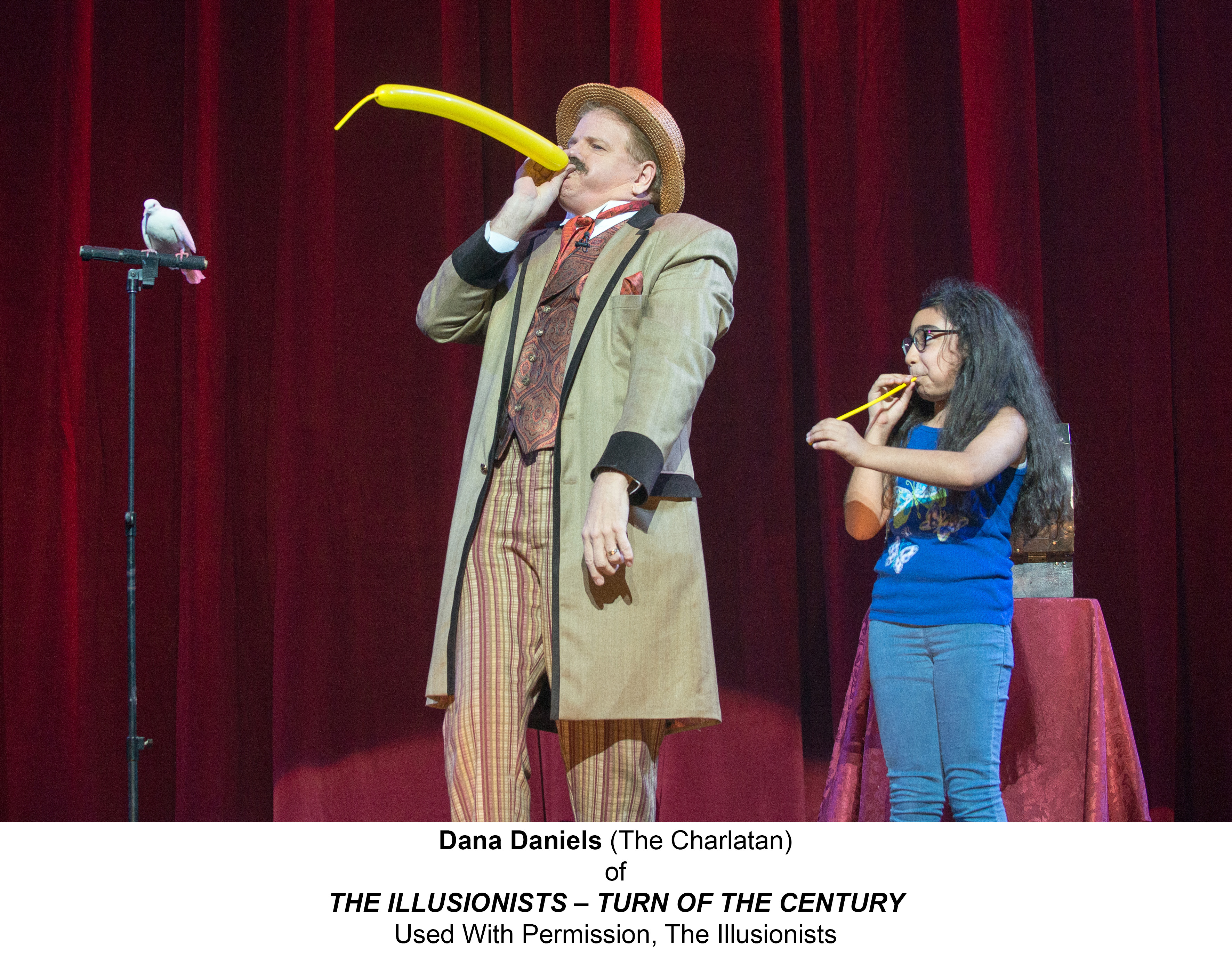
Another memorable duo is Dana Daniels (the Charlatan) and his psychic parrot Luigi.  Their family-friendly routines are so hilarious I was actually able to make someone laugh until they cried just by describing them.  A completely different kind of cute arrives in the form of Jonathan Goodwin, The Daredevil.  (Apparently there was at least one Equinox open in 1903.)  He is a returning character and audience favorite from The Illusionists’ last New York run.  As the only member of the cast who does not rely on slight on hand, he delivers the most gasp-inducing moments in the show with his Houdini-inspired stunts.  Among the more familiar acts, Austrians Thommy Ten and Amelie Van Tass (The Clairvoyants) stand out.  You may have seen these “what am I holding” theatrics before, but never with such a level of detail.  No wonder these partners were awarded the infrequently bestowed title World Champions of Mentalism.

Much of the suitably over-the-top atmosphere comes from the choice of The Palace Theater as home base.  The 1913 vaudeville house was renovated by the Nederlanders in the mid-sixties, but retains its somewhat gaudy features.  These have been enhanced by scenic designer Todd Ivins.  (A few of the parlor tricks are carried out in an actual parlor setting.)  At times, handheld cameras feed an ornate center screen in order to project smaller movements beyond the first few rows.  Angela Aaron’s period costumes add lovely flair as does the eerie music of Evan Jolly.

The quick pace and ever-changing mood of The Illusionists Turn of the Century make it an obvious choice for parents seeking special seasonal entertainment that everyone can enjoy.  With its good-natured spectacle, the show also seems like great date material.  Performances run through the first of the year at the Palace Theater.  For tickets and information visit http://www.theillusionistslive.com/turnofthecentury. Remember to dress well; about a dozen audience members wound up on stage.

Don’t You F**king Say a Word

We’ve all experienced being engrossed in a book only to have the plot fall apart in the final chapter.  Don’t You F**king Say a Word is the theatrical equivalent.  For the first hour the characters and conversation are suitably diverting, but when the inciting incident that provokes the title phrase finally occurs, it is a faint shadow of what we’re expecting.

Playwright Andy Bragen’s background is as a solo performer. In terms of its structure, phrasing and delivery, his script mostly plays out like another monologue only with the lines divided between two people. Interrupted by an occasional exchange, Kate and Leslie speak directly to the audience, taking us through the central relationships over the course of a few years.  Their fast patter creates momentum that is stronger than the described events ultimately achieve.

Sprinkled throughout the snappy script is some important if pat commentary about gender and different views towards competition. The collapse of the playwright’s case begins once the action moves from rapid scenes around New York City to a more traditional living room conversation.  The centrifugal force that has kept us spinning winds down and we along with it.  Breaking the fourth wall is an acceptable convention, but the same exposé doesn’t hold up when the characters are directly talking to one another.  We are confronted by a barrier comprised of false tone, unbelievable mechanics and a waning interest in the characters’ circumstances.

I appreciated and then blissfully forgot the colorblind casting. It was far more difficult to overlook the selection of Jennifer Lim and Jeanine Serralles as supposed college friends who nonetheless appear 10 years apart in age.  I also could not understand how two graduates of Yale’s MFA program didn’t manage to project past the third row.  It is one thing to address the audience and another to speak in the hushed tones you’d actually use if you were in public conversation.  As their romantic partners Russ and Brian, Bhavesh Patel and Michael Braun perfectly paint the landscape that lies between friendly rivalry and grudge match.  Their quivering body language and subtle changes in timbre were realistic and familiar.  (At least that’s the impression of this middle-aged female.)

The direction of Lee Sunday Evans is imaginative, defining several tough tennis matches with a series of frozen poses that work well for the constricted space and time.  Her creative vision is well supported by the simple and clever sets by Amy Rubin and the no-frills costumes designed by Asta Bennie Hostetter.

Don’t You F**king Say a Word is the first production of the writer-centric ABTP.  It is, therefore, doubly disappointing that it is not a fully realized piece, but rather a reflective soliloquy spread too thinly among four people and over 85 minutes.  It is playing at 59E59 through December 4.  For tickets and information visit https://www.ticketcentral.com/59e59/

Noises Off

This my third time seeing Michael Frayn’s Noises Off, considered by many to be the perfect comedy.  My first encounter with this piece of zaniness was in the early 1980s on London’s West End.  I laughed so much I couldn’t catch my breath.  Years later I could still quote lines.  Since then, the play has had an award winning run on Broadway with a cast headed up by the terrific Dorothy Louden.  It was also made into a considerably-less memorable movie with Carol Burnett.  Now it has returned to the Great White Way with an ensemble that includes Andrea Martin, Campbell Scott, Tracee Chimo, Daniel Davis, David Furr, Kate Jennings Grant, Megan Hilty, Rob McClure and (my cousin) Jeremy Shamos.  The script has been altered somewhat and it feels a little longer, but it remains a funny lighthearted event, perfect for these stressful times.

The story is structured as a farce within a farce.  The actors mentioned above star as the cast and crew of the touring company of Nothing On.  Audience members would do well to read the yellow program within a program for important backstory and a few additional giggles.  For example, it becomes clear that the reason Ms. Hilty’s Brooke Ashton as Vicki keeps mouthing all the words of her co-stars is that she’s never played a part with lines before.  We also learn that several of these people worked together in a long running television series, which explains their remarkable familiarity with one another.

But the joy of a first-rate physical comedy like this is that you don’t have to know anything in particular, except maybe the properties of gravity.  That’s why Act II — which of the three relies most on slight of hand, gestures and easily misinterpreted silhouettes — is by far the strongest.  The actors are astonishingly in tune throughout and provide hilarious points that a child could understand.  (In fact, three groups of school children had thoroughly enjoyed themselves at the matinee the day of my attendance.)  Credit should be given to director Jeremy Herrin and stunt coordinator Lorenzo Pisoni for the orchestration of these fabulous moments.

As Dotty Otley, the always-excellent Andrea Martin seems to be having a blast.  Her timing is impeccable and her shifts from hapless housekeeper to the frazzled leading actress who portrays her are brilliant.  David Furr manages to deliver his character’s many drifting lines with subtle difference that keeps him from being one-note.  (Ms. Hilty could take a lesson here.)  Kate Jennings Grant provides a centering influence as the closest thing to a straight man in this circus.  Jeremy Shamos is spot-on as usual.  (See you at Thanksgiving, Jer.)  The surprising weak link is Tracee Chimo as overwhelmed stage manager Poppy Norton-Taylor.  She tries to be farcical, which is one layer too many.  Like an improv that starts with an unbelievable premise, her performance quickly becomes forced and simply not funny.

The Roundabout Theatre Company’s Noises Off is playing at the American Airlines Theater through March 13, 2016.  Given the amount of energy required by the cast, it will remain a limited run.  If you are in the mood for some high-spirited fun, it’s the perfect choice.  Visit http://www.roundabouttheatre.org for tickets and information.

Women Are Crazy Because Men Are A**holes

Women Are Crazy Because Men Are A**holes has opened for ten days at The Cherry Lane, hoping for a longer New York stay after successful runs in Los Angeles and Chicago.  Recognizing that this well-trod material is better appreciated through shared experience, the producers wisely filled seats by offering discount tickets to active off-Broadway viewers.  Being nestled in a packed house turns what might otherwise be a forgettable show into a time of wicked laughter and knowing head-bobs.

The action begins with five young couples gathering for a brunch.  It is a celebration of the first face-to-face meeting between Nicole and Dylan, who have been courting on the internet.  While theirs may be the newest romance, there is plenty of awkwardness, codependency, and manipulation to go around.  Phoenix and Tim have just broken up, Mandy and Benny have just gotten back together, and Bella and Blake are in very different stages of life.

The banter is mostly realistic, likely because the events were inspired by writer/director Brad T. Gottfred’s own experiences with a girlfriend who — in his own words — brought out the asshole in him.   Much of the dialogue is witty and delivered at a brisk pace.  However, as in many relationships, the conversations are often circular.  This is particularly true of Hillary and Tim, who have the same unproductive argument for the entire play, never making it to the brunch as a result.  I avoid such people in real life and didn’t enjoy being exposed to them in my off-hours.  Judging from the fact that none of the characters express any concern for bickerer’s absence after the first five minutes, their friends don’t enjoy being around them much either.

Most of the ensemble — Mandy Henderson, JJ Nolan, Devlin Borra, Blake Boyd, Baxter Defy, and Tunisia Hardison — have been with the show since inception.  (Ms. Henderson, Mr. Boyd, and Ms. Nolan also serve as co-producers.) The remaining actors — Christine Donlon, Nikki McKenzie, Justin Sintic and John Weselcouch — joined two years ago.  This gives the entire cast a sense of ease with one another that provides depth and spontaneity to the somewhat predictable script.  To my no-longer-30-years-old ears, some of the dialogue was delivered in hard-to-interpret screeches, but generally the interaction had the right level of exuberance.  Gottfred’s staging is clever and makes use of every nook and cranny of the small theater.  This enables the focus to move swiftly among couples and lets them easily play off of one another’s exchanges.

Despite many uncomfortable moments for the characters, it all adds up to silly fun for spectators.  Best of all, as someone who supports keeping theater relevant and accessible to everyone, I was pleased to see so many younger people in the audience.  I have no doubt the irreverent title got them there.  I believe word of mouth will continue to bring them through the door.  If you’d like to be among their number, visit http://bleepingcrazy.com for tickets and information.

The Spoils

What if your best friend from third grade never stopped acting like an eight year old?  That is the dilemma faced by those closest to Ben, the central character of The Spoils.  As written and performed by playwright/actor Jesse Eisenberg, Ben can certainly be witty, but he is also cruel, directionless, and socially retarded.  It’s hard to imagine that these sweet people don’t have anything better to do with their time than hang out in this jerk’s apartment.

Therein lies the problem with this entire effort.  For a drawn-out 140 minutes we witness two relatively healthy couples — who clearly have enough on their plates — trying to help Ben get his life together and treat them with a modicum of respect. Puns are punned, recollections are recalled and banter is banted, all with a side of Nepalese beer.  Much of it is clever, but none of it leads to anything resembling a satisfying conclusion.

Eisenberg portrays the lead with much of the same disconnection and twitchiness that worked so well in The Social Network.  His oddness is magnified by Scott Elliott’s uneasy direction.  (Perhaps Mr. Elliott had some bizarre classmates when he was young and drew on these memories when he devised Ben’s peculiar physical conduct.)  The supporting cast (Erin Darke, Kunal Nayyar, Allapurna Sriram and Michael Zegen) all deliver their lines with appropriate zing.  Nayyar is particularly touching in the nearly-impossible role of Ben’s best friend, Kalyan.

Mr. Eisenberg is bright and talented.  It’s hard to believe he doesn’t have six other better scripts on his nightstand and superior writing examples on his hard drive.  Why he would chose to send eight weeks embodying a guy whose most cherished memory revolves around getting defecated on is my second unanswered question associated with this production.

The Spoils, presented by The New Group, is playing at the Pershing Square Signature Center through June 28, 2015.  For tickets and information, visit http://www.thenewgroup.org/the-spoils.html.

What I Did Last Summer

One of my goals for this blog is to introduce readers to theaters with reasonable ticket prices.  I have already mentioned the $20 seats at the Claire Tow and also recommend Theater C at 59E59 to those who don’t mind open seating.  A third incredible bargain is The Signature, which has secured enough funding to sell $25 tickets for every seat for every performance.  They also have a valuable residency program, which gives selected playwrights five years to create and produce new works as well as develop old ones.  It’s a terrific opportunity for participants to fully explore and expand their work.

This season, the Signature is featuring A.R. Gurney, best known for Love Letters, The Cocktail Hour, and Sylvia.  The current encore production, What I Did Last Summer, contains Gurney’s typical blend of lighthearted humor with a dash of poignancy.  It primarily follows the activities of teenager Charlie who is spending a few months at Lake Erie near the end of World War II.  His time and attention are divided between his Mother – who wishes him to study Latin – and free spirit Anna Trumbull – who believes he should explore his own creativity through art and play.

Having attended a very progressive school, I found the general discussion of book-learning versus life-learning an intriguing one and Gurney’s observations reasonable and well-argued.  The framework is very self-aware, with much of the action emphasized by having an unseen hand type key words of the dialogue and stage directions on the blank page that makes up the bulk of Michael Yeargan’s set.  All the characters directly address the audience and take every opportunity to make the story about themselves.  This highlights the playful side of the piece even when the action takes a more serious turn.

The cast is uniformly good, with a standout performance by Kristine Nielsen as Anna.  Noah Galvin’s Charlie makes a charming yet slightly bratty host and guide.  The ensemble’s high-energy is skillfully staged by Jim Simpson and backed by percussion provided live on stage by Dan Weiner.  The end results are enjoyable if slightly hazy, rather like summer vacation itself.

What I Did Last Summer is playing at The Pershing Square Signature Theater through June 7.  For tickets and information, visit http://www.signaturetheatre.org/tickets/production.aspx?pid=3776

Between Riverside and Crazy

Stephen Adly Guirgis has an almost unmatched talent for writing dialogue.  From the inept burglars in Den of Thieves to the titular Motherf**ker with the Hat, his casts sound completely authentic even when what they are doing isn’t completely familiar.  Guirgis’s skill creating deep believable characters allows the audience to take a little trip inside a world that is simultaneously commonplace and new.

This gift is in evidence in his latest theatrical work, Between Riverside and Crazy, now playing at 2second Stage Theater after a run at the Atlantic Theater Company.  In this dark comedy, we visit with Walter “Pops” Washington — a former cop living in a large rent controlled apartment on Manhattan’s west side — and his extended family.  Like many tenants of these highly desirable and marketable dwellings, the landlord wants them out.  But Pop’s is protective of his territory and that of his unusual brood.  They include Pop’s biological son, Junior, recent ex-con and recovering alcoholic, Oswaldo, and Junior’s girlfriend and perpetual student, Lulu.

It quickly becomes clear that of the three, it is strikingly Junior who feels the most distant from the well meaning yet gruff retiree.  Just how these relationships formed is made clear without banging the viewer over the head. Wonderful details and insight are shared in almost every line from the opening moments at the kitchen table.  (You will never think of breakfast food in the same way again.)

As with Guirgis’s other creations, the play isn’t all talk.  Events pick up speed when Pops is paid a visit by his former partner and her fiancee.  What unfolds is a highly enjoyable combination of clever laughs and tragic food for thought.  Each emotional turn is perfectly enhanced by Walt Spangler’s literally turning set, which moves the players through space and time.  The action is reinforced by Austin Pendelton’s astute direction.  He knows just when to leisurely play out a moment and when to jump ahead.  His artistry is supported by a practiced cast lead by Stephen McKinley Henderson, who wears the role of Pops like a tailored suit that’s been slept in.

Between Riverside and Crazy is playing through March 22, 2015, in the Tony Kiser theater, 2econd Stage Midtown.  For tickets and information, visit http://2st.com/shows/current-production/between-riverside-and-crazy.