Tag Archives: Cookie Jordan

The Receptionist

From the beginning, there is something off about the Northeast Office in Adam Bock’s The Receptionist.  There is a squishy sense of period and an even sparser sense of location beyond a workplace within a city with bagels, croissants, and public transportation. Most extraordinary, even with all the narrative phone calls and perpetual office gossip, it is more than halfway through this clipped play that we get any inkling of what these people do for a living.  It reflects well on the banter and incidentals that this revelation is so slow in dawning, effectively delaying our rising alarm.

Though the script has been around for nearly 20 years, its vibe fits all-too-comfortably into 2026 with only a few tweaks.  The construction hasn’t made the trip nearly as well.  Described by Second Stage as “a jet-black comedy,” the work is really more like a simple black and white cookie, with the gloom and the humor lying side by side.  By the end, much remains merely hinted at with mixed effect.  Post show chatter in the ladies room, where sometimes the most insightful criticism is shared, was split between those who felt sure they’d missed something and those who reveled in the murkiness.

The spiky dialogue is mostly between Katie Finneran’s good natured receptionist Beverly Wilkins and Mallori Johnson as a staff member, Lorraine Taylor.  Though further up the org. chart, the stunning but insecure Lorraine lacks Beverly’s assured hand.  With her consistent missing of her bus, inappropriately flirtatious manner and golf bag clearly in view inside her office door, her holding down of a job is yet another office mystery.  Their breezy day is disrupted by the dark cloud of Will Pullen’s Martin Dart from the Central Office.  He is seeking a chat with their head of office, Edward Raymond (an underutilized Nael Nacer).  We shouldn’t be surprised that someone so named would stay on target.
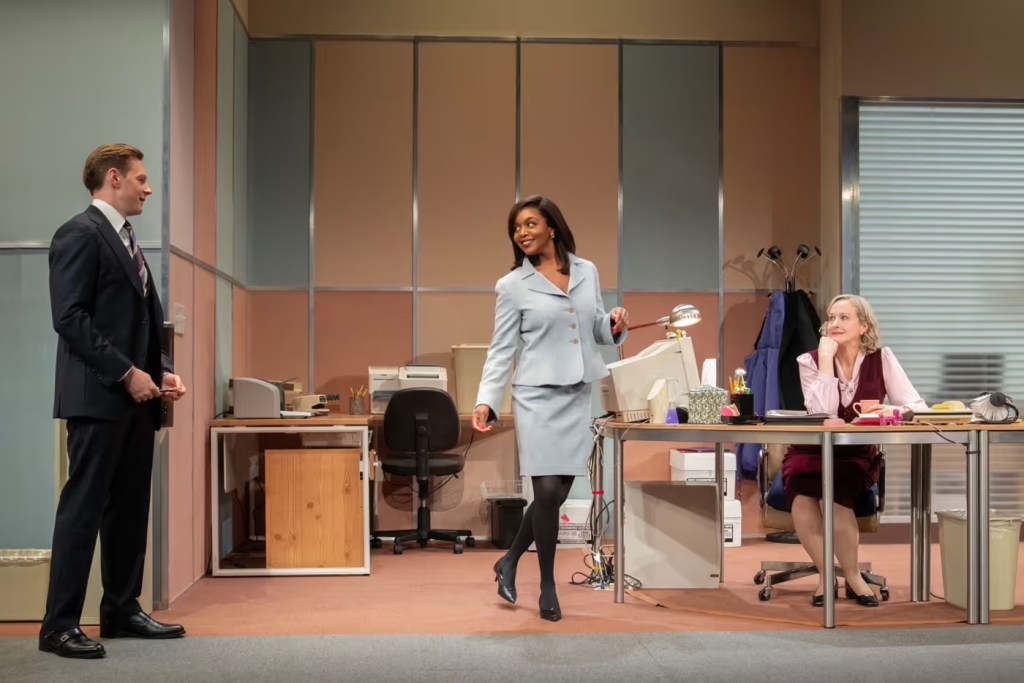
Will Pullen, Mallori Johnson and Katie Finneran in The Receptionist; photo by Joan Marcus

A skilled hand at refining sharp viewpoints, director Sarah Benson steers her cast through the ripples of normalcy and then oddness.  Encased within the earth-toned carpeting and padded walls by design collective “dots” and fashioned in part by Cookie Jordan’s wig design, the actors spark off one another, even though their characters lack the definition you’d expect to find in an expanded metaphor.  Like Jayne Houdyshell before her, the potential predictability of Beverly benefits from the performance precision of two-time Tony winner Finneran. She vivaciously transmits her character’s “in-the-know” regarding the finer details that flow through her.  Likewise Johnson finds a provocative note within Lorraine’s exhausting coquettishness.

The Receptionist is an amuse-bouche of a play: tasty, but not enough of anything — comedy, commentary, character development — to be fully satisfying.  (And yes, I am using another food metaphor.)  The intervening years have provided us with too many chilly worlds that are better and more distinctively built.  Part of Second Stage’s 47th season, performances are scheduled through May 24th at the Irene Diamond Stage in the Pershing Square Signature Center, 480 W 42nd Street near 10th Avenue.  Running time is 80 minutes without intermission.  Tickets begin at $66 up to $136 for premium seats.  The latter price range includes the entrance row G where there is extra legroom and space for wheelchairs.  Those in row H get a height boost, though there is a thin railing in front.  
Shakespeare in the Park: Merry Wives

The Merry Wives of Windsor — Shakespeare’s only play that centers around everyday working folk — is a wonderful selection for the Public Theater’s 2021 offering.  This production arrives after a difficult stretch which renewed awareness of our neighbors and neighborhoods.  For this rendition, the location has been dropped from the title and the spouses in question have been moved to South Harlem.  There, Farai Malianga engages with the audience as a congenial street drummer.   After a quick lesson in African diaspora, he ushers in the local residents who will share their story.  Layabout John Falstaff has grown weary of his VR light saber and nutrition-free snacking and is ready to get out and mingle.  He has his eye on Mmes Ekua Page and Nkechi Ford, two close friends with husbands of means. Even his wooing is lazy and he sends the exact same love letter to them both.  Thankfully they are clever bad ass women who know how to handle themselves.  Ekua has the additional responsibility of finding a suitable match for her beautiful daughter, Anne.  She has her heart set on the prestigious Doctor Caius, while Mr Ford has selected Slender, a sweet but rather simple young man.  But like her mother, Anne has a mind of her own and her lover of choice is not negotiable.  

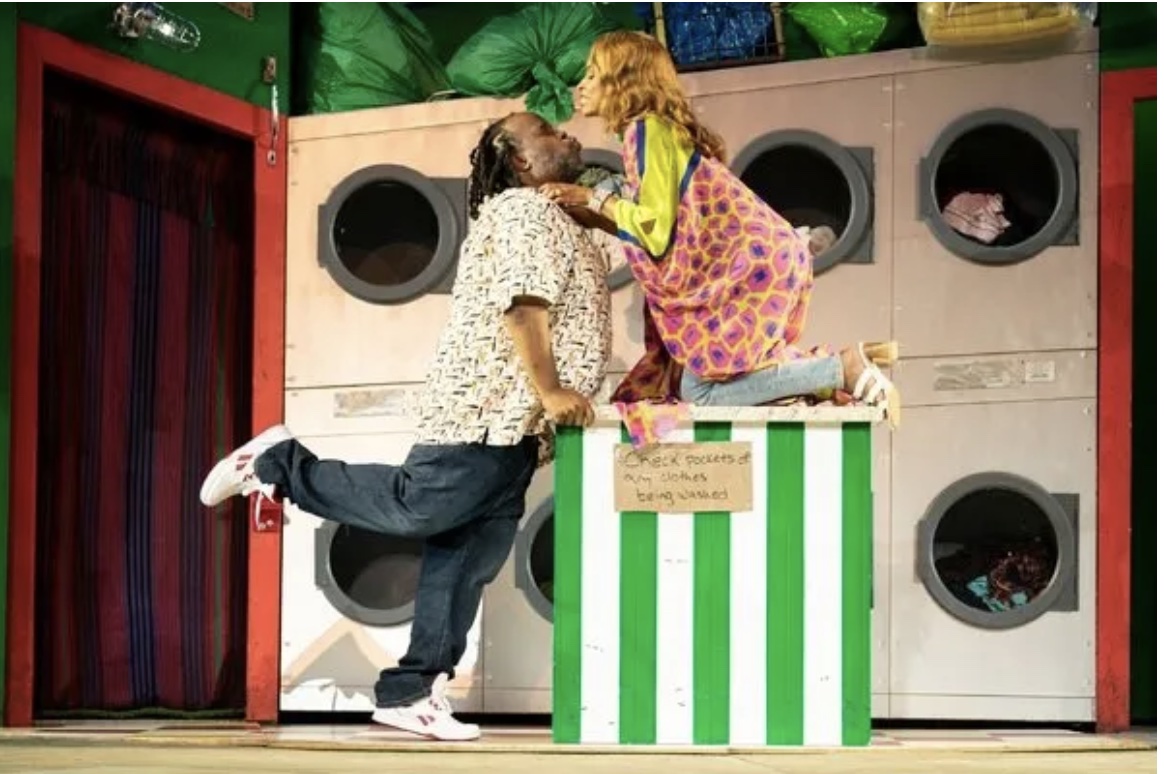
Jacob Ming-Trent as Falstaff and Susan Kelechi Watson as Madam Ford in Merry Wives

Saheem Ali’s staging takes advantage of the Delacorte’s airy space, filling it with the vibrant energy of his enthusiastic ensemble.  Jacob Ming-Trent is a total joy as a noisy, brash, and notorious-in-his-own-mind Falstaff.  His journey via laundry basket has never been funnier.  There is such warmth and charm in his performance, one feels a bit sorry about his treatment at the hands of far wittier Wives.  Susan Kelechi Watson’s Madam Ford grabs attention with her fabulous moves while Pascale Armand’s Madam Page is a commanding and calculating conspirator.  Both employ West African accents which add flavor though may present a challenge for unaccustomed ears.   Shola Adewusi as Mama Quickly and David Ryan Smith as the dapper doc make the most of their two dimensional characters with their impeccable timing.

Ghanaian-American writer Jocelyn Bioh has condensed Shakespeare’s comedy to a brisk 110 minutes and spiced up the language with modern slang and appropriate cultural references from jollof rice to Dreamgirls.  Upbeat musical cues by composer Michael Thurber as well as Dede Ayite’s brilliant outfits set off with hair and wigs by Cookie Jordan punch up the energy.  Stagehands outfitted as sanitation workers work speedily to redress the backgrounds.  The colorfully rendered settings by Broadway vet Beowulf Boritt  include a hair braiding salon, laundromat, family clinic and walkup apartment house, though nothing tops the natural beauty of the park itself, revealed in its natural splendor for the final scene.

The material is not the only part of the equation that is an appropriate match to this moment.  While much of the venue is seated at full capacity, sections are reserved for those who prefer to remain masked and distanced.  A fleet of volunteers help everyone find their place quickly and enforce protocols as needed.  The touchless program is accessed using a QR code on the seatback.  

The entirety of Merry Wives is a celebration of life, tolerance, and togetherness.  It is a love letter to New York and New Yorkers and a wonderful excuse to share a belly laugh in a crowd after a long stretch in isolation.  In particular, it is a fitting tribute to the residents of Seneca Village, the 19th Century Black community that lived on the land that is now occupied by Central Park.  Performances have been extended through September 20.  Visit https://publictheater.org/productions/season/2021/sitp/merry-wives/ for free ticketing information.