
It all comes down to gray areas according to Jared, the second debater on the undefeated team at the center of Emmanuelle Mattana’s Trophy Boys. The same could be said of the entire play, now in its American debut at MCC Theater. The most immediate and obvious dichotomy is that each of the four boys on stage is portrayed by an actor who is non-cis male. In truth, almost every aspect of the piece is non-conforming. It is a comedy permeated by devastation and a tragedy that contains plenty of laughs.
At opening, four seniors from an elite New York high school are preparing for the debate of their scholastic lives. Win, and they are all one giant step closer to achieving the lofty professional goals they’ve set for themselves. Lose, and all of their ambitious plans could be sidelined. In their favor is the well-honed collaborative technique they’ve developed over the year. Though they’ve just learned that they are to argue in the affirmative that feminism has failed women — against the team from an all-girls school no less — their brainstorming is exuberant. But when a catastrophic piece of information is introduced into their planning session, it throws everyone off balance.
Mattana has drawn from their own experience as a debater, a skill which often required them to argue for cases they didn’t believe. “It was no wonder,” they reflect in the program, “ that this ethos seeped so dangerously into other parts of these boys’ lives.” She has also given herself the juicy role of Owen, the socially awkward debate team closer who to his very roots believes he is the smartest person in the room.
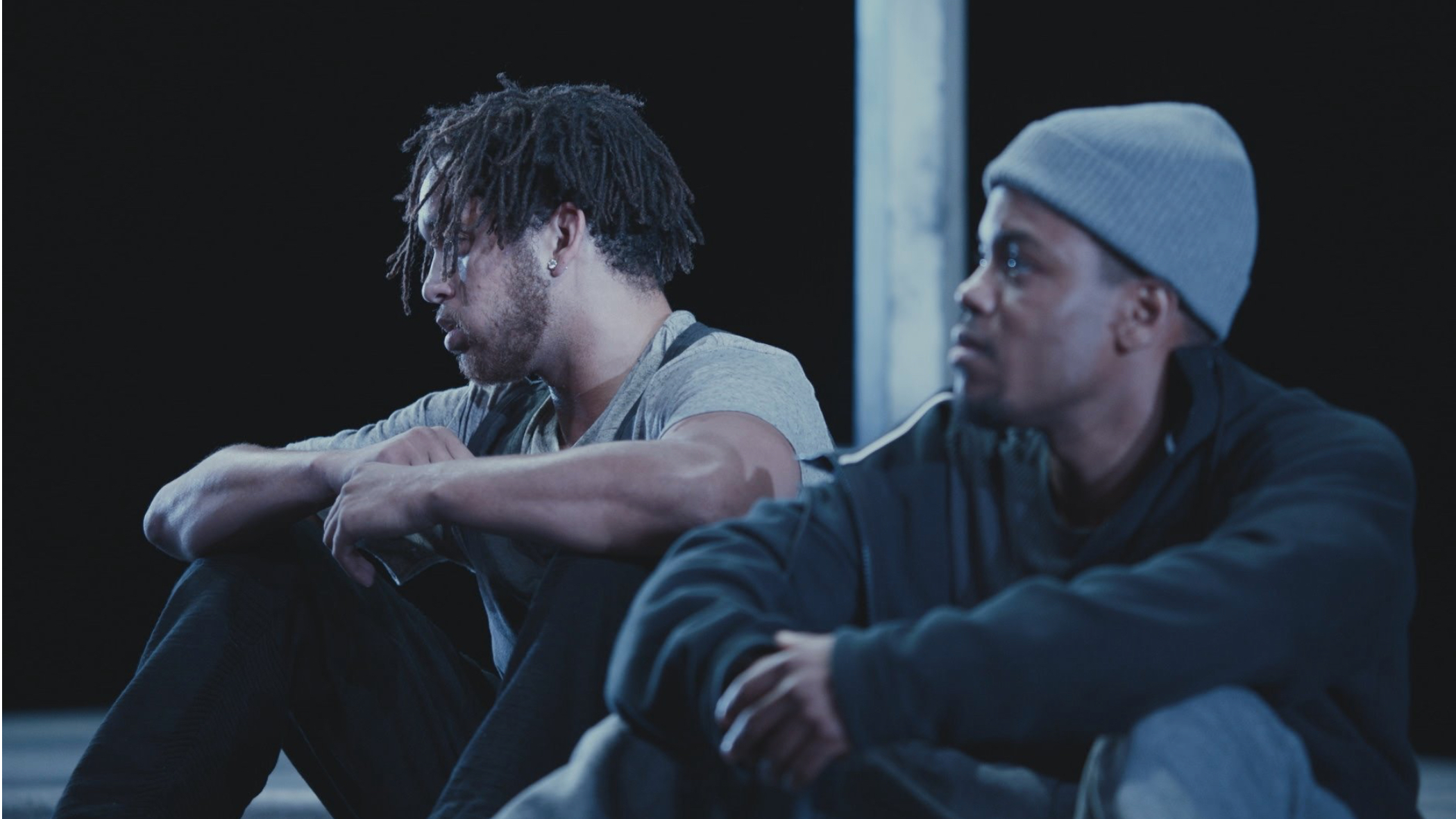
The other three teammates have their own reasons for seeing themselves as superior to the rest. In the first spot is the bi-curious physically dominant Scott, portrayed by the always magnetic Esco Jouléy. Backing him up is the creative lover-of-women Jared, an all-too-recognizable Louisa Jacobson. In forth place is Terry Hu’s David, the strict administrator. As an acting ensemble, they smoothly cede the spotlight to the next player even when their characters do not.

Director Danya Taymor has great familiarity with young males, having recently won the Tony Award for The Outsiders. She has injected that extreme physicality into her cast. The music pumps as the audience enters, preparing them for the energetic onslaught. At points the cast members literally bounce off the furniture, depicting what their nervous systems are experiencing. Vigorous dance moves include humping their notebooks to show their dominance over the material. Passions hot and cold run deep and lines are delivered at a barely digestible rate of speed. One can only imagine the sensitivity with which the more emotional exchanges were developed with a sensitivity specialist (Ann James) and DEI consultant (Nicole Johnson) working alongside Taymor to mold the scenes.
There is a through-line from the contradictions of ideas that runs across all the creative elements. It is far into the term, but Matt Saunders’ desks, chairs and whiteboard remain immaculate. Images of important women through history adorn the walls but appear cartoonish. The students are 17 years old and Márion Talán de la Rosa has dressed them in short pants usually reserved for under-classmates. Cha See’s lighting is natural and then morphs to profoundly exaggerated.
Ultimately, Trophy Boys is a sincere and thoughtful exploration of the non-binary nature of the world. No person represented is just one thing and neither is any aspect of the content. Most noticeable of all is our feelings which are completely adrift by the end of an increasingly taut 70 minutes. We are left in that all-important gray area. Performances continue through July 27 at MCC Theater, 511 West 52nd Street. Dynamically priced tickets start at $74 and are available at https://mcctheater.org/tix/trophy-boys/.
 The Unforgettable Line