Tag Archives: David Zinn

The Saviors

You can imagine a pitch meeting along these lines: “I’ve written a play that depicts the difference between being religious and acting godly.  Oh, and the lead roles are 13 and 14 year old boys.”  Fortunately for the prospective audience for The Saviors, the pitcher in question was Bubba Weiler who cemented his reputation as a playwright well worth backing with his acclaimed Well, I’ll Let You Go.  Fortunately for Weiler and his go-to director Jack Serio, the producer who picked up the challenge was the Atlantic Theater Company.  Their main-stage, The Linda Gross, is located in a converted church.  To paraphrase a line from The Saviors script, if that isn’t the hand of god, what is it?

A complaint I’ve sometimes made about The Linda Gross is that the performance space is often blocked to be wide and shallow.  This set by David Zinn is gorgeously expansive, with tall delicate stained glass windows and light colored steps leading up to humble statuary and a candle covered altar.  Director Serio also makes use of the aisles as an extension of the upfront interior (necessitating a strict no-late-seating; no-reentry policy).  Sound by Leah Gelpe that accompanies the cast member entrances lets us experience the chilly winter world just outside the heavy church doors.  Stacey Derosier’s shadowy lighting design of the sanctuary nearly qualifies as a fifth character.
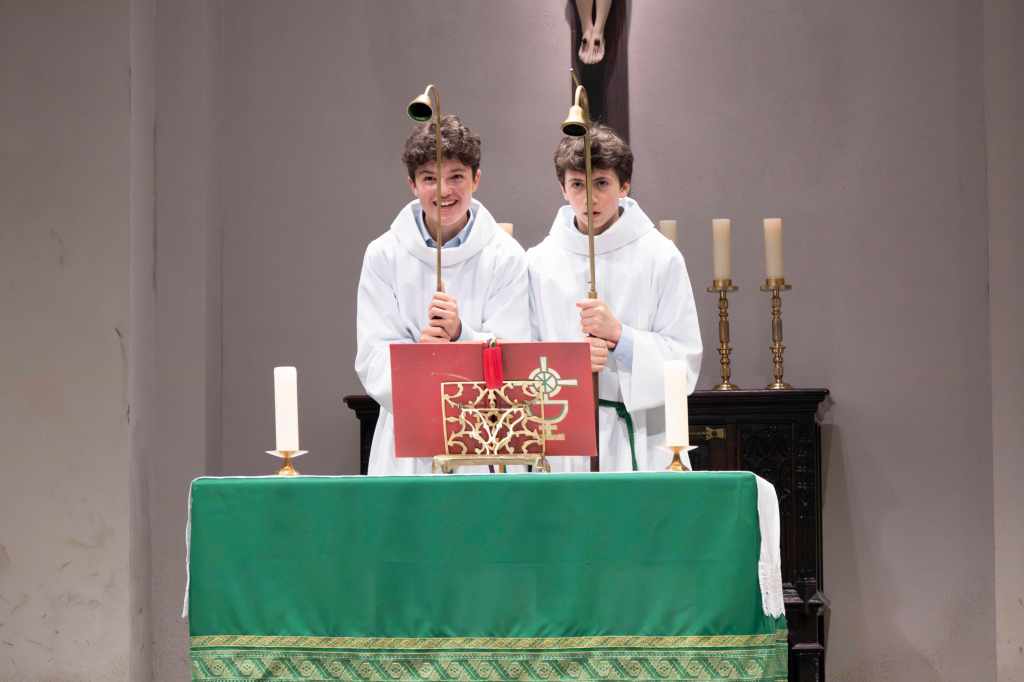
Ivan Howe and Julius Rinzel in The Saviors; production photos by Ahron R. Foster

Into this subdued scene of reverence tumble altar boys Michael and Paul.  The young teens are obviously close and have turned each assigned task into a lighthearted contest.  The differences between the two slowly unfold.  Michael has embraced the Catholic teachings with manic enthusiasm.  They give structure to a life that is otherwise filled with anxiety-inducing choices.  Paul is more questioning of the strict prescribed path that seems to lie ahead.  Two adults with disparate views on Christian faith become entwined in the boys’ bond.  Judy, a congregant whom Michael asks to be his Confirmation sponsor, is so devoted to the parish that Michael has come to regard her as a Mary figure. Concurrently, Paul befriends Julian, a homeless man with an unclear connection to the community who comes into the church seeking refuge and comfort.  

Much of the play consists of pairs in hypnotic conversation.  That Weiler began working on the script when he was not much older than the current stars is a factor in making the dialogue so genuine.  There is elegant world-building within the exchanges, with an underlying tension that rivals many psychological thrillers.  

It is nearly impossible not to feel protective of both Ivan Howe’s exuberant Michael or Julius Rinzel’s probing Paul.  Both actors are heartbreakingly brilliant (and neither has an understudy.)  Making his stage debut is an impassioned Stanley Simons as the older but equally vulnerable Julian.  Completing the first-rate company is Crystal Finn who expertly traverses Judy’s rough terrain.

The Saviors will undoubtedly have a different impact on practicing and lapsed Catholics than it did on me, but it doesn’t take a background in religious doctrine to feel its sting.  This World Premiere has been extended through August 15 at The Atlantic’s Linda Gross Theater, 336 West 20th Street.  Running time is a tight 90 minutes without intermission.  Tickets start at $56.50 for standing room and top out at $121 for premium seating at select performances.  To purchase, visit https://atlantictheater.org/production/the-saviors/
Liberation

Tony nominee Bess Wohl’s latest endeavor, Liberation, is a memory play in which the narrator describes events from someone else’s experiences.  She imagines what it was like for her own mother in the early days of the fight for women’s equality.  Through a series of talking circles with her mother’s friends, she attempts to shine a light on the connection between personal decisions and societal evolution and gain a better understanding of her own choices.

A zestful Suzannah Flood takes on future mom Lizzie, Lizzie’s daughter, our leading lady, and the voice of the playwright.  Flood has an endearing everywoman quality and relatability.  Her opening monologue weaving together all four women is a highlight of the evening.  She addresses the herd of elephants in the room, beginning with the political victories that are slipping away.  To better appreciate The Now, Lizzie’s daughter will role-play her own mother.  The path Lizzie chose in her twenties led to our host’s very existence and we should become deeply invested.  But the ensuing storytelling is like learning ballet by drawing the steps on a blackboard.  We grasp the ideas intellectually, but without experiencing any authentic movement.

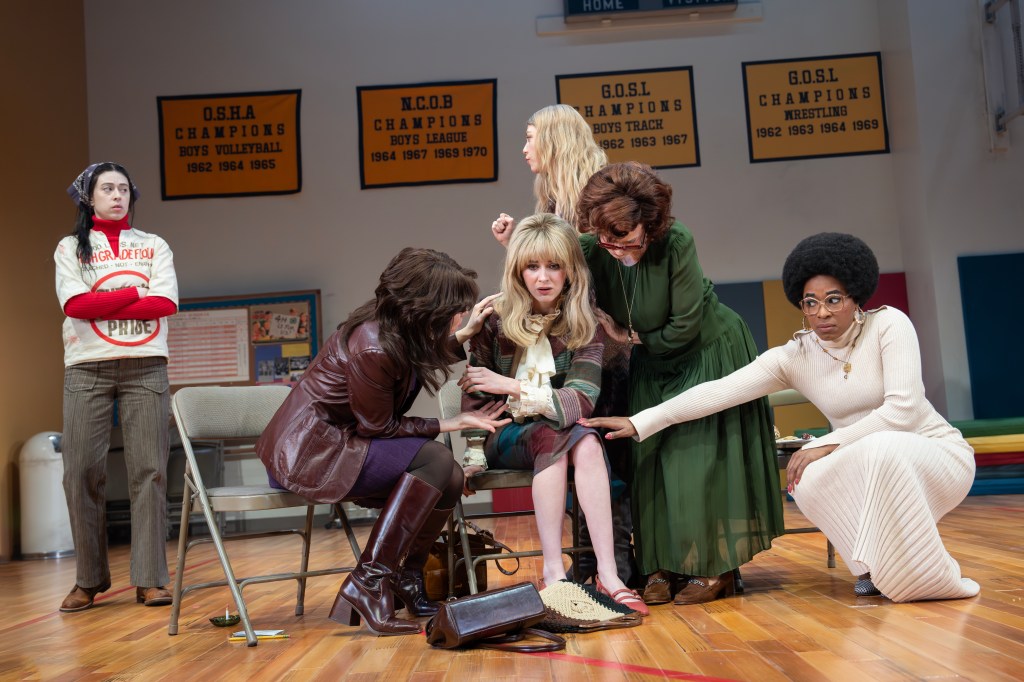
We are transported to Ohio in 1970 where budding journalist Lizzie is endeavoring to form a consciousness-raising group for women.  Five strangers have responded to her flyer and arrived at the local rec center.  Margie (Betsy Aidem) is a married woman with grown children whose entire life is consumed by caring for her family.  Dora (Audrey Corsa) is a young secretary whose intellect has been overlooked because she’s pretty.  Celeste (Kristolyn Lloyd)  — the lone woman of color — is an Ivy League graduate whose career has been blown off course by her ailing mother.  Isidora (Irene Sofia Lucio) is an Italian immigrant with creative ambitions who married for a green card and now wants out.  And Susi (Adina Verson) is living in her car and feeling completely exhausted by life.  Two others pass through the room.  Bill (Charlie Thurston) will eventually become the husband/father.  And Joanne (Kayla Davion) who arrives in search of her son’s lost backpack.  Her involvement in Act 2 provides one of the few exhilarating scenes in a series of otherwise predictable beats.

We are told these women are friends, but despite literally stripping themselves naked before one another, they do not truthfully reveal themselves.  Lizzie is too fearful of making a wrong move to be a leader or even anoint one.  We are reminded of the many limitations women faced in the days when they couldn’t open a bank account and no fault divorce was only legal in California.  But with only descriptions to go by, we experience a glancing blow rather than an enduring punch.  Stuck in chat mode, they all remain types from the era and never reach our hearts.

Adina Verson, Irene Sofia Lucio, Audrey Corsa, Susannah Flood, Betsy Aidem and Kristolyn Lloyd in Liberation; photo by Joan Marcus

The cast is up for the creative exercise, playing their counterparts in both past and present and occasionally stepping into the role of Lizzie when a situation would be awkward for her daughter to recreate.  Director Whitney White provides as much variation as she can, using the gym equipment to change the composition of bodies.  Set designer David Zinn adds some color with an unlikely rainbow of gym mats while costume designer Qween Jean seems to have had a blast at the local thrift shops to reconstruct that fabulous 70s look.

To protect the actresses from having nude images of themselves released by the public, all audience members must place their phones into a locked Yondr Pouch.  Unfortunately, no one at the venue was responsible for assuring that devices had been silenced or turned off, so the performance was punctuated by rings and pings.  The woman next to me could only kick her purse more deeply under her seat and smile sheepishly.

Liberation would be more successful in its mission if the characters generated the same level of support towards one another as the actresses seem to.  The message that even a little gesture can move a cause forward is an encouraging one, especially in a time when many of us feel like we are losing ground.  Instead, these characters inflict a concept of equality upon one another that feels more like another form of repression.  

An Off-Broadway entry to Roundabout’s season, Liberation continues through Sunday, March 30 at the Laura Pels (111 West 46th Street).  Tickets are available at https://www.roundabouttheatre.org/get-tickets/2024-2025/liberation and begin at $80 including fees.  Running time is 2 ½ hours including a 15 minute intermission.