Tag Archives: Dominique Morisseau

Sunset Baby

My first experience with Sunset Baby – Dominique Morisseau’s 2012 drama being revived at New York’s Signature Theatre – was a series of tweets from colleagues grumbling about the treatment of the playwright’s program insert. Indeed the tiny handout is a puzzling choice of physical manifestation for her enticing invitation to the audience to fully participate even vocally in her tale of a recently released social revolutionary, his traumatized daughter, and her loving thug of a boyfriend.  But it wasn’t so much that the “Permissions of Engagement” were on a 4×6 piece of paper in nine point font. The more disappointing aspect was that the production did not elicit so much as a peep from Sunday’s audience.
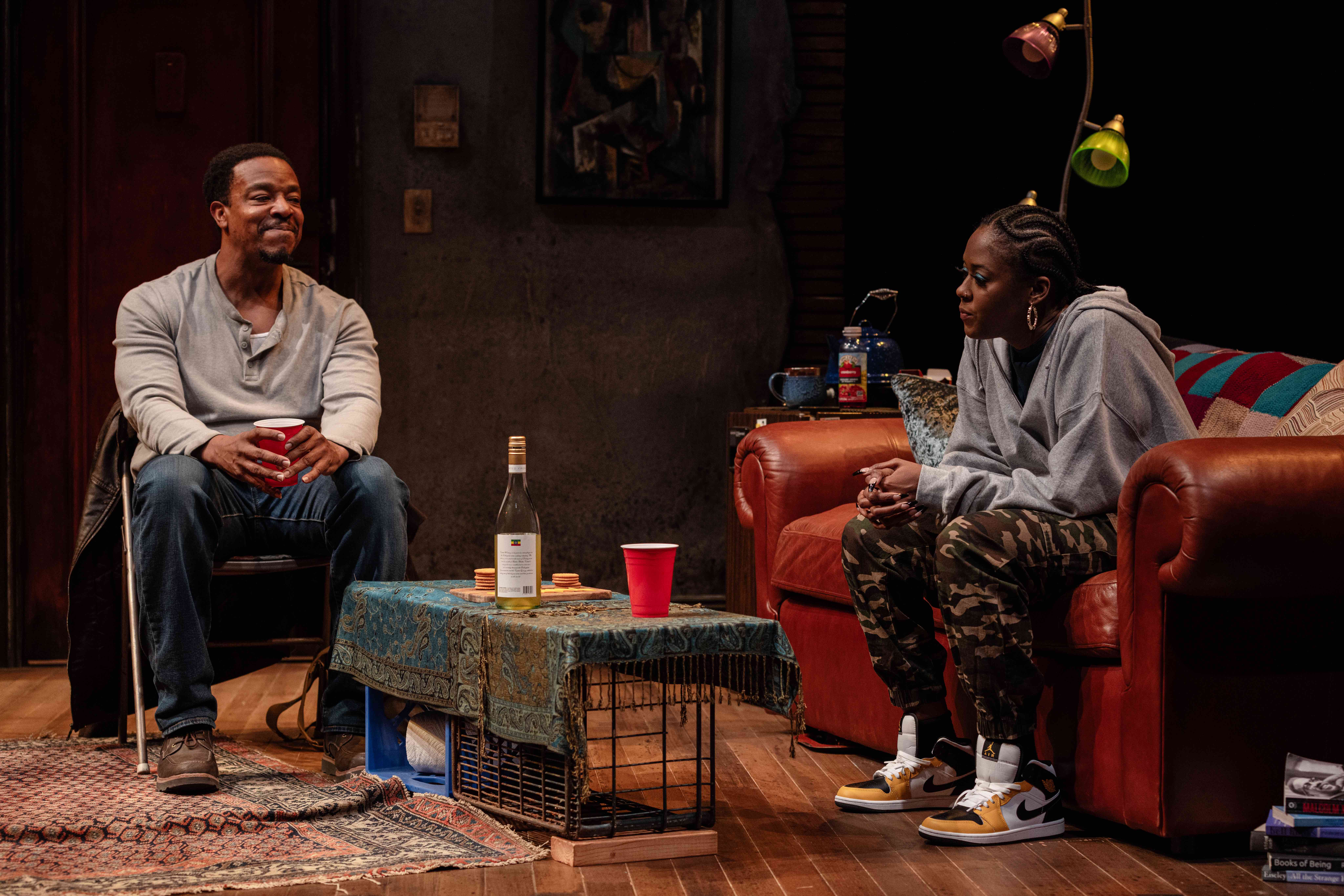
Russell Hornsby and Moses Ingram in Sunset Baby; Photo Credit, Marc J Franklin

The ability to fulfill Sunset Baby’s promise is boldly displayed in the concise history of the show’s world displayed on the wall outside the theater door. It is visible in Wilson Chin’s economical yet thoughtful scenic design with its peeling paint, well-used furniture, and intriguing choice of artwork.  The decision to move the proscenium forward and raise the rake between the rows increases the accessibility and brings the audience further into this room.  Small touches from a shower caddy (props by M. Picciuto) to the nearby train (sound by Curtis Craig & Jimmy Keys) bring the setting into clearer focus. The promise is most palpable in the emotive performance of Russell Hornsby as Kenyatta, who in warm and slightly trembling tones opens the show by vividly describing not only the struggles of his role in the Black liberation movement and resulting incarceration, but of the bigger challenge of trying to be a loving father. And it occasionally pokes its head out in Morisseau’s careful plotting such as the discovery that Kenyatta’s daughter Nina expands her world beyond her rundown room in East New York by watching the Travel Channel.  Indeed, Morisseau’s knowing and complex feelings about parenthood are strongly woven throughout the dialogue. But none of these sparks ever becomes flame in the frustratingly inert 90 minute runtime.

What seems to have put a dulled layer between the work and the experience of it are artistic choices by director Steven H. Broadnax III.   The pacing is slow and there are false notes along the way.  Nina comes home from her “job” as a fake hooker who helps her boyfriend, Damon, lure black men into dark alleys to rob them.  She slips off her shiny royal blue thigh-high boots — among the apt selections by costume designer Emilio Sosa — only to wrap her cozy pink bathrobe around her skin-tight leather mini. Is this a symbol for her constant discomfort or an inability to smoothly incorporate a wardrobe change?  The actress embodying Nina, Moses Ingram, has proven herself capable of deep emotional range.  But here she is stuck at the pitch of a petulant teen. Nina’s lack of full development is most notable in a pivotal scene between her and Kenyatta. It should play like a musical movement that shifts from minor to major.  Instead this sly turning point is tonally more like a repeated refrain.  As her literal partner in crime, J. Alphonse Nicholson is also wedged into a single groove when the character could be providing meaningful counterpoint. 

I deeply admire Signature Theatre as a surviving safe harbor of affordable, expansive community theater. The commitment to reexamine an older work by Dominique Morisseau that focuses on the personal impact of the socioeconomic divide is a timely one. But Sunset Baby 2024 misses an opportunity to more engagingly enlighten a new audience about the fallout from another period during which the Black community’s efforts to serve their own were villainized and politicized.  

The first of three offerings this season, Sunset Baby runs through March 10 in the Romulus Linney Courtyard Theatre at the Pershing Square Signature Center (480 W. 42nd Street).  Tickets are available at https://order.signaturetheatre.org/events and are $59/$79/$99/$119.

Pipeline – Streaming on Demand

Pipeline is one of those thrilling intimate dramas that pulls you into its core with genuine emotion and basic human truths.  Written by Dominique Morisseau and presented at Lincoln Center Theater one year after the completion of her famed trilogy, The Detroit Project, it won the Edgerton Foundation New Play Award.  Every one of the well-drawn characters has an arguable viewpoint, proving that the most provocative and intelligent questions rarely have straight answers.

The entire cast of six is perfectly calibrated to provide an affecting high-energy 90 minute ride.  Each character is under pressure, but despite their shared sense of oppression they simply can’t manage to give each other a break.  The story opens on an earnest Karen Pittman as Nya, a teacher in a typically underfunded public school.  Although she is fiercely dedicated to creating relatable materials for her inner-city students, she has agreed to send her only child Omari —  an appropriately grave Namir Smallwood — to a private boarding school.  He is clearly bright enough to compete academically, but privilege isn’t contagious and Omari has been undone by the environment.  His long-brewing rage has boiled over during a lesson on Richard Wright’s Native Son, a controversial book often criticized for bolstering a destructive stereotype of young black men.

As mother and son work along their distinct paths in search of conflict resolution, we also meet two of Nya’s co-workers: Tasha Lawrence as a frustrated and mouthy white fellow teacher, Laurie, and Jaime Lincoln Smith’s Dun, a caring security guard who has history with Nya.  Providing some lightness to the mood is a delightfully sincere Heather Velazquez as Omari’s girlfriend, Jasmine.  Perhaps most critical to setting all the events in motion is Morocco Omari’s Xavier, Nya’s ex-husband who is out of step with both her and their son.

Namir Smallwood as Omari and Karen Pittman as Nya in Lincoln Center Theater’s Pipeline.

Thanks to a partnership between LCT and BroadwayHD, the work is currently available to viewers nationwide with rewarding results.  Blending recordings from August 22 and 24 of 2017, Habib Azar’s direction for the screen(from stage direction by Lileana Blain-Cruz) draws the audience even deeper into the profound rage and passing joys of the characters.  Significant details from a bandaid to a tremor are more visible in closeup.  The short scenes are keep flowing by using film clips as bridges.   Presented in three-quarter round with the audience as a classroom, this production also serves as an introduction to the jewel box of a house that is the Mitzie Newhouse.

The creative team has supported the required fast pace.  Scenic designer Matt Saunders defines the space with a wall of white washed concrete masonry and simple set pieces.  Location is further established using projections by Hannah Wasileski.  Yi Zhao’s variations of light and shadow along with Justin Ellington’s sound work together to increase emphasis of key moments.  

At a time when public schools are increasingly lacking in financial and community support, Pipeline draws sharp lines from a personal story to the bigger picture.  The questions it raises are sure to linger in your heart and mind long after the last curtain call.  In honor of Black History Month, Pipeline is featured with a stellar line-up that also includes 2010 Tony Award-winner for Best Musical, Memphis; American masterpiece, Porgy and Bess recorded in San Francisco’s splendid War Memorial Opera House; and the incomparable Audra McDonald in Lady Day at Emerson’s Bar & Grill.  Learn more by visiting https://www.broadwayhd.com/categories/celebrating-black-artists.

Detroit 67 – Fayetteville, AR and Streaming

Playwright and MacArthur “Genius” Dominique Morisseau can weave a richer story with a handful of characters than most people can tell with a cast of dozens.  This makes her a great match for TheatreSquared in Fayetteville, Arkansas: a small space with a worldly audience.  Set against the backdrop of the historic bloody clash between the Detroit police and Black residents, their current production of Morisseau ’s Detroit 67 is all too current in its themes.  To bring in some extra cash, Lank and his sister Chelle are running an off-licensed after-hours bar in their basement.  It is similar to the one that was violently raided by police, sparking five days of rioting that ended in over 40 deaths and thousands of arrests.  As in the play, then-governor Romney had to call in the National Guard and President Johnson provided two army divisions to restore peace.  

Though Morisseau keeps the action confined to the siblings’ basement, she uses exposition sparingly and instead explores the social and emotional impact of the turmoil outside through well-drawn relationships.  We learn that though they are close, Chelle (a simmering Devereau Chumrau) and Lank (Tenisi Davis moving fluidly between tenderness and fury) have conflicting opinions about how to use their small inheritance.  Lank is encouraged in his riskier plan by his close friend Sly (smooth Christopher Alexander Chukwueke).  But his downgrading of the safety net provided by family and friends is challenged by Caroline (pixyish Jenna Krasowski), a young white woman who literally stumbles into his life.  The quintet is rounded out by Bunny (crowd favorite Na’Tosha De’Von), who relishes all  that life brings her way.  Through this battle between dreaming big and playing it safe, Morisseau tells a story that covers race, class, and the lies of the American Dream in a deeply personal and genuine way.  

Christopher Alexander Chukwueke, Devereau Chumrau, Na’Tosha De’Von and Tenisi Davis; photo by Wesley Hitt

Well-timed comebacks and the use of uplifting Motown tunes provide light around the shadows.  The songs of the Temptations, the Four Tops, the Vandellas, Smokey Robinson, Marvin Gaye and others form a bridge between the characters and the audience and momentarily erase all barriers.  It is the soundtrack of a particular time and place, but also a connector to our world.

The staging by director Dexter J. Singleton is somewhat constrained by Baron Pugh’s detail-oriented set.  Look closely at the walls, and Chelle’s and Lank’s childhoods envelop them.  The essential bar, worn furniture, and decor lend an appropriate hemmed-in vibe to the action.  Costume designer Azalea Fairley visually differentiates the characters, giving Bunny bold prints and highest heels, dressing Chelle in muted tones and flats, and displaying Caroline’s petite curves in Chelle’s cast-offs.  Sound design by Bill Toles expands on the wondrous playlist.

I deeply appreciate the considerate and inclusive opportunity TheatreSquare provides to participate in their varied season.  Their modest four-camera set-up always provides an engaging home experience complete with a warm welcome from their staff and volunteers.  Each streaming pass is good for 24 hours.  The instructions are easy to execute and the recording is of above-average quality. 

As the first piece in Morisseau’s Detroit Project, Detroit ’67 is a thrilling introduction to her potent work.  It is available on-stage and via streaming through Sunday, November 6.  Runtime is approximately 2 ½ hours including intermission.  Tickets are available at https://tix.theatre2.org/events and range from $37-$57 for the live show at TheatreSquared in Fayetteville and $25-$35 for individual and household streaming passes.