Tag Archives: dots

The Receptionist

From the beginning, there is something off about the Northeast Office in Adam Bock’s The Receptionist.  There is a squishy sense of period and an even sparser sense of location beyond a workplace within a city with bagels, croissants, and public transportation. Most extraordinary, even with all the narrative phone calls and perpetual office gossip, it is more than halfway through this clipped play that we get any inkling of what these people do for a living.  It reflects well on the banter and incidentals that this revelation is so slow in dawning, effectively delaying our rising alarm.

Though the script has been around for nearly 20 years, its vibe fits all-too-comfortably into 2026 with only a few tweaks.  The construction hasn’t made the trip nearly as well.  Described by Second Stage as “a jet-black comedy,” the work is really more like a simple black and white cookie, with the gloom and the humor lying side by side.  By the end, much remains merely hinted at with mixed effect.  Post show chatter in the ladies room, where sometimes the most insightful criticism is shared, was split between those who felt sure they’d missed something and those who reveled in the murkiness.

The spiky dialogue is mostly between Katie Finneran’s good natured receptionist Beverly Wilkins and Mallori Johnson as a staff member, Lorraine Taylor.  Though further up the org. chart, the stunning but insecure Lorraine lacks Beverly’s assured hand.  With her consistent missing of her bus, inappropriately flirtatious manner and golf bag clearly in view inside her office door, her holding down of a job is yet another office mystery.  Their breezy day is disrupted by the dark cloud of Will Pullen’s Martin Dart from the Central Office.  He is seeking a chat with their head of office, Edward Raymond (an underutilized Nael Nacer).  We shouldn’t be surprised that someone so named would stay on target.
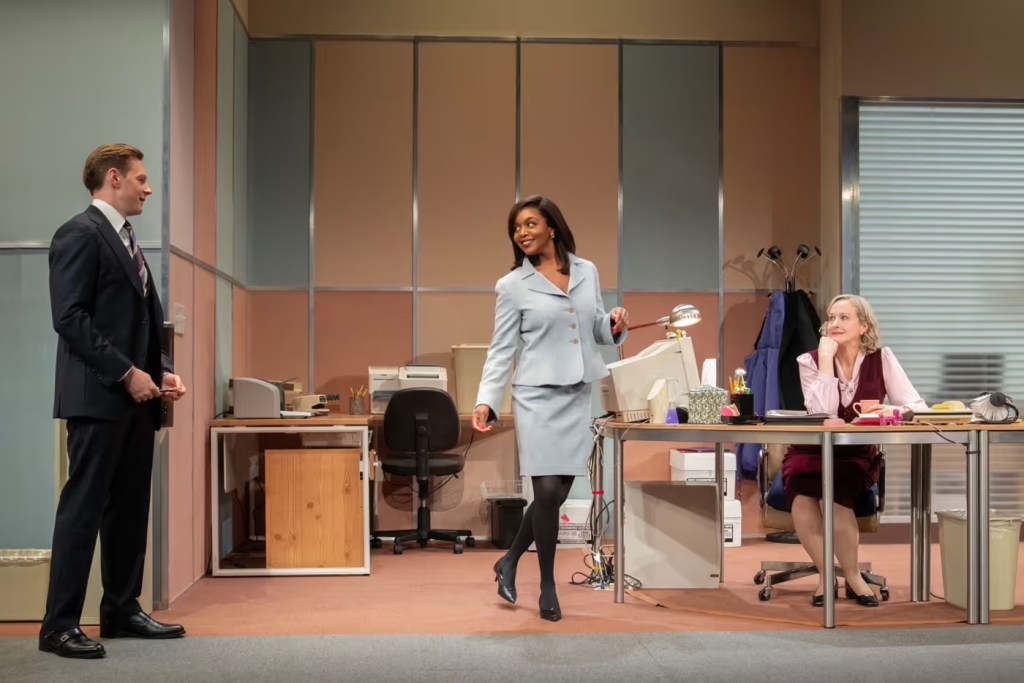
Will Pullen, Mallori Johnson and Katie Finneran in The Receptionist; photo by Joan Marcus

A skilled hand at refining sharp viewpoints, director Sarah Benson steers her cast through the ripples of normalcy and then oddness.  Encased within the earth-toned carpeting and padded walls by design collective “dots” and fashioned in part by Cookie Jordan’s wig design, the actors spark off one another, even though their characters lack the definition you’d expect to find in an expanded metaphor.  Like Jayne Houdyshell before her, the potential predictability of Beverly benefits from the performance precision of two-time Tony winner Finneran. She vivaciously transmits her character’s “in-the-know” regarding the finer details that flow through her.  Likewise Johnson finds a provocative note within Lorraine’s exhausting coquettishness.

The Receptionist is an amuse-bouche of a play: tasty, but not enough of anything — comedy, commentary, character development — to be fully satisfying.  (And yes, I am using another food metaphor.)  The intervening years have provided us with too many chilly worlds that are better and more distinctively built.  Part of Second Stage’s 47th season, performances are scheduled through May 24th at the Irene Diamond Stage in the Pershing Square Signature Center, 480 W 42nd Street near 10th Avenue.  Running time is 80 minutes without intermission.  Tickets begin at $66 up to $136 for premium seats.  The latter price range includes the entrance row G where there is extra legroom and space for wheelchairs.  Those in row H get a height boost, though there is a thin railing in front.  
Mother Russia

When I went to Russia as a child, my parents and I brought Skippy, Hanes, and Levis to a friend’s niece in Moscow.  All the best restaurants only took American dollars, which were unavailable to local residents, and we were constantly shadowed “for our safety.”  When I returned as an adult, all of my guides had their own Ikea-furnished apartments.  One of our destinations was a sprawling indoor mall in the center of Moscow and international fast-food chains were as plentiful as the family owned dumpling joints.  Between those two eras, the Soviet Union had been dissolved and the promise of social democracy hung in the air.  

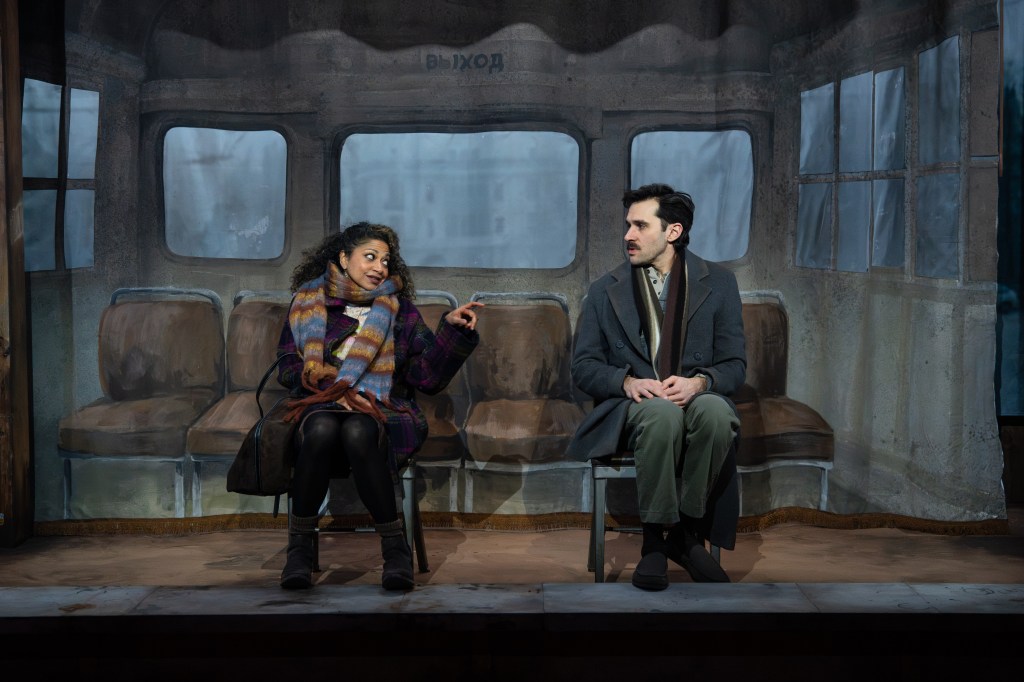
It is within that unsettled period of 1992 that Lauren Yee has set her new comedy, Mother Russia.  Erstwhile aspiring KGB agent Dmitri is operating a tiny general store in St. Petersburg while surveying former pop star Katya as a side gig.  His childhood friend Evgeny tries to shake him down for protection money.  The pathetic attempt at menace leads to an alternative job offer. A devoted fan of Katya, Evgeny will follow her when she is off mic and will take a shift monitoring her. The fourth character is an explosion of innovation.  David Turner portrays Mother Russia herself, an embodiment of Russian history, ideology and culture.  Dressed in bright tomato red from babushka to pointy shoe (costumes by Sophia Choi), she can see back to the “not so bad” Ivan the Terrible and forward to Pussy Riot and Navalny.  Within the whirl of broad and situational humor, she is the snide ballast, overseeing all that transpires.

Wildly praised prior to the pandemic — particularly for Cambodian Rock Band which inventively explored the terror of the Khmer Rouge using a father/daughter story with music — Lauren Yee is currently a playwright in residence at the SignatureTheatre.  Her pen and tongue are still sharp, though she seems in a more fun-loving mood this time around.  Lines are written in colloquial English but with Russian construction.  Teddy Bergman’s playful direction enriches the slender script.  The prolific and visionary scenic design team of dots plays up the conflicting worlds of artifice and factuality that run throughout its pages.  The central portion of the set has a detailed commercialized frame and a defaced rolling metal door that is often used for emphasis.  Fancifully painted curtains complete the look of a city bus and Evgeny’s family home.  This two-pronged motif is continued with Jon Knust cunning props.  Sound designer Mikhail Fiksel makes terrific use of a wide range of music

The part of Mother Russia is made riveting by Turner’s droll and pricelessly-timed thick-accented delivery.  He is not alone in mining the dialogue for every precious laugh.  Dmitri could easily be two dimensional, but Steven Boyer gives him heart and amiableness.  Adam Chanler-Berat elevates and varies Evgeny’s many feeble attempts at swagger.  The two play good-naturedly with one another, especially in a scene co-starring a Filet-O-Fish sandwich.  Rebecca Naomi Jones does the most she can as Katya, a surprisingly flat role given that the singer/revolutionary is the catalyst for the climactic scene. Ironically, we get a clearer image of Dmitri’s never-seen girlfriend, Masha. 

Genuinely unfunny is the current design of the black box space of The Romulus Linney Courtyard Theatre.  The narrow ceiling-high stadium seating is oppressive, leading many audience members to use their programs for air circulation.  Those in the back rows crouch like tennis fans in an impractical effort to take in the intimate scenes while those nearer the front must crane their neck to follow David Turner’s antics.  If the red house lights are intended to make us feel as disoriented as a typical Russian in the 1990s, then they work.

The ingredients for blistering social commentary are present.  But Mother Russia subverts a more serious conversation about economic and societal challenges in favor of punchy lines in absurdist packaging.  Given the current state of our own culture, one could do worse than spend 90 minutes laughing at and with these talented artists.  The New York Premiere continues through March 22 at the SignatureTheatre in Pershing Square, 480 West 42nd Street.  Tickets begin at $74.  Visit https://signaturetheatre.org/show/mother-russia/ for more information.

Rebecca Naomi Jones and Adam Chanler -Berat in Mother Russia; photo by HanJie Chow

Someone Spectacular

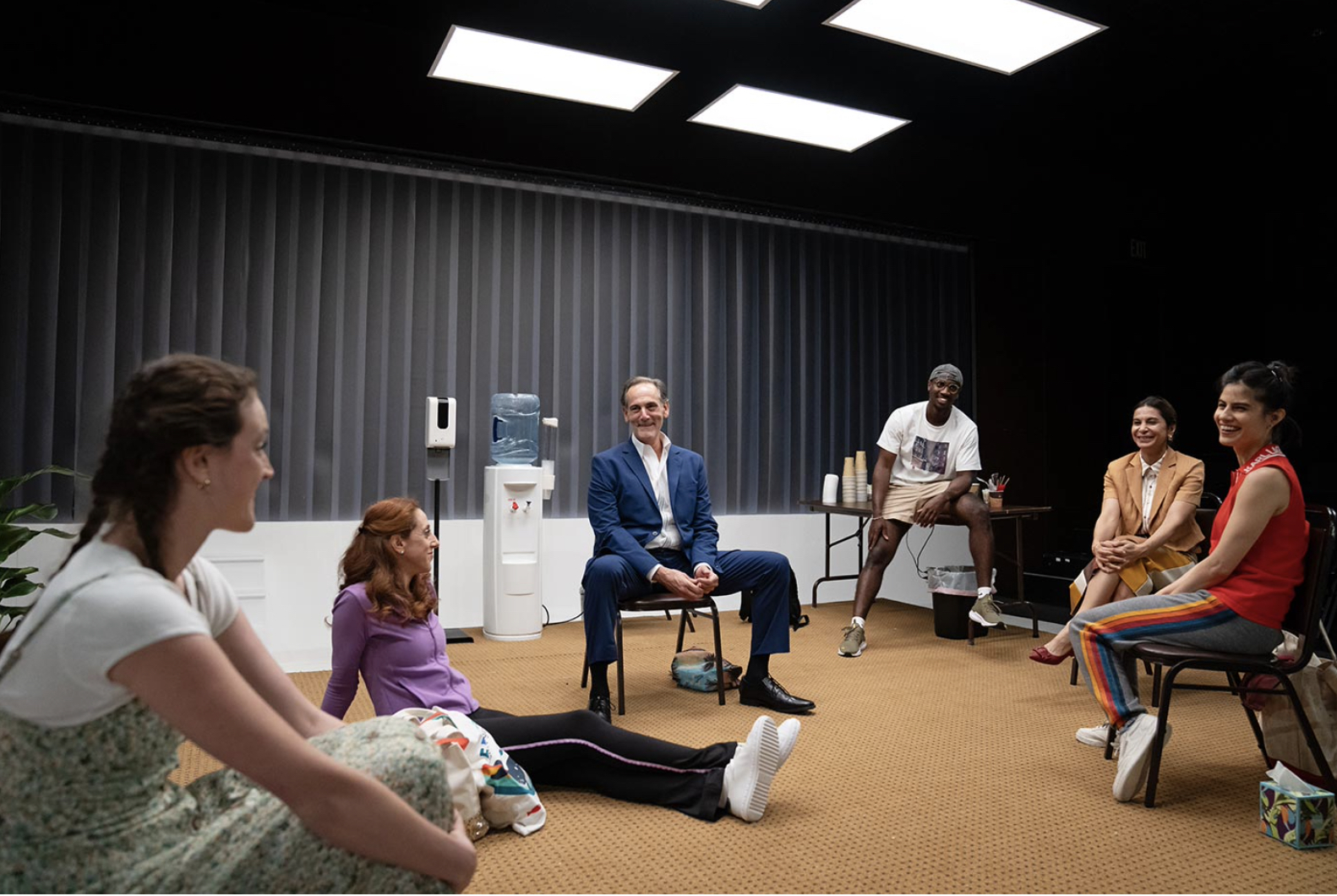
When their grief counselor, Beth, fails to show up for their group therapy session, the majority of her six clients vote to go on without her.  The revelation of their interaction is not in the manifestation of their grief.  Theirs is the expected cocktail of misplaced guilt, regret for things both said and unsaid, and the pain caused by the absence of “their person.”   Rather, the eye-opening moments of Someone Spectacular stem from each participant’s attempt to move the meeting — and the others in attendance— forward.  Do you keep your feelings to yourself?  Do you breathe, sleep or eat your way through?  Do you force yourself to take an obvious next step?  Can anyone just snap you out of it?

Playwright Doménica Feraud has dedicated this warm play to her mother, Nathalie Feraud-Salame, who had nurtured her through a crippling eating disorder.  It is Feraud-Salame’s whose passions and heart run through each of the characters.  Doménica’s deep understanding of Nathalie’s way of being has enabled her to use knowing shorthand to tell us much about each character in just 90 minutes.  Feraud’s genuine affection for each of her creations shines through even when she has to rely on a few tropes to find essential connections and get to her point.

The confident ensemble brings out the best in the material.  Delia Cunningham’s delicate Jude attracts attention even before the official start of the piece, dashing off stage as the audience is still finding their seats.  A moody Lily played by Ana Cruz Kayne makes herself known with a bang of her bag, a thump of her tiny rump, and a conspicuous costume adjustment. Next to catch our eyes and ears is Shakur Tolliver’s Julian, drumming on the back of his chair with a discomfort that has taken over every aspect of his life.  Dressed for business even on a Sunday afternoon, Damian Young’s Thom seems more invested in taking phone calls than in staying present.  It is Alison Cimmet’s crisp and impatient Nelle who pushes for action.  And Gamze Ceylan elegant and vulnerable Evelyn who brings the most skilled therapeutic elements to their time together.  Though Beth hasn’t arrived, her essence takes shape through their interpretation of her techniques and motivations.

Delia Cunningham, Alison Cimmet, Damian Young, Shakur Tolliver, Gamze Ceylan and Ana Cruz Kayne; Photo by Julieta Cervantes

With the exception of Thom, Director Tatiana Pandiani moves the restless mourners around the traditional talking circle of chairs.  Scenic design team dots provides them with plenty to work with from the children’s toys in the corner, the dying plant upstage, an unexplained helium balloon hugging the ceiling, and the sparse coffee set-up stage left.  This gives each audience section an opportunity to experience everyone as they literally jockey for their rightful place. 

Writing this play may have been cathartic for Feraud and it certainly is for the audience.  The more serious conversations are interspersed with understandable snark and amusing insight.  I saw friends and couples touching hands and heads in connection.  A young woman got as far as an exit door only to return to her seat and watch the remainder of the piece clutching her purse. The majority laughed and nodded in recognition.  There are plenty of moments for all present to breathe.

Grief is obviously not a problem that has a solution.  But Doménica Feraud has turned a discussion about this tough experience into an engaging and touching theatrical work.  The world premiere of Someone Spectacular has been extended at the Pershing Square Signature Center, 480 West 42nd Street,  through September 7.  (Note that it is not a Signature Theater production, but the first creation of B3-A12, a partnership which was founded in honor of Nathalie Feraud-Salame.)  The action starts promptly on the hour and there is no intermission.  Tickets range from $39 to $119.  For more information and to purchase tickets, visit https://someonespectacularplay.com/.  

Three Houses

For a play named after a family dwelling, Dave Malloy’s Three Houses has surprisingly little structure.  Set in a magical cocktail bar with an orchestra that can follow along in any key, three strangers share their experiences in a confessional open-mic night.  When the pandemic broke out, each one of them had just gone through a break-up with a partner and found themselves secluded and struggling mentally.  While there are similar strands within their tales, their ordeals only lightly touch, like their pinkies when they finally share a table.  Along the way, there are some wonderfully creative moments and beautiful melodies.  But like the current drive along the crumbling Highway 1 in Big Sur, a final point remains illusive.

In House #1, Susan (Margo Seibert) had been researching her next novel in Finland when COVID hit.  Unable to get back to the United States, she retreats to her grandmother’s abandoned house in the Latvian woods.  In a haze of red current wine, weed, and OCD, she uses the time to learn what she can about her ancestor.  House #2 is set to more uptempo tunes as we move from the deep woods to the sunny desert.  When her aunt returns to Korea leaving her New Mexico home unoccupied, Sadie (Mia Pak) takes refuge there.  Painfully missing her girlfriend, she further retreats into a SIM she has meticulously modeled on memories of her grandparents.  House #3 is actually a small basement apartment into which Beckett (J.D. Mollison) has moved after the end of his marriage.  On every level, it becomes the darkest of the dwellings, especially after he learns that his grandparents have just passed away in Ireland and paranoia sets in.  

Three Houses is the final piece of Malloy’s trilogy which includes Ghost Quartet and the memorable Octet.  Having written the music, lyrics, book and orchestrations, this work completely embraces his usual fascination with fables.  As they grapple with the effects of isolation and regret, each of our storytellers develops a relationship with a fictional being represented by puppets with tremendous personality designed by James Ortiz.  Elements of The Three Little Pigs play key roles and even show up in a sweater.  But when the inevitable wolf finally makes it to the door, he is dressed in grandma’s nightgown, which for fairytale purists will be perplexing.  

Mia Pak (with Pookie the Household Dragon) and Margo Seibert in Three Houses

All three soloists are terrific and support each other vocally and energetically.  Henry Stram and Ching Valdes-Aran appear as all of the mystical grandparents.  Scott Stangland rounds out the cast exuding something between command and menace as the bartender/MC Wolf.  However, Annie Tippe’s direction is both mystifying and maddening, especially given her assured hand with Octet.  The same black box space has been splendidly designed by the imaginative team of dots to feel warm and inclusive and a tad old-fashioned.  Fabric is draped all along the mezzanine, and the orchestra members sit in armchairs adorned with crocheted throws.  Center stage is an elaborate wooden bar, but even from the middle of the side section — normally a great spot in ¾ round — I could not make out what was on the changing backdrop behind it.  The vast majority of the staging is forward facing with the actors sometimes positioned side-by-side blocking each other from view.  Lighting designer Christopher Bowser has added some attention-getting effects and Haydee Zelideth costumes are a likewise literally colorful component that visually adds to the stories.  Nick Kourtides envelops the audience with his sound design, which appropriately alternates between feeling comforting and smothering.

Ultimately, Three Houses is more like a trio of discontinuous chapters of an unfinished novel than a fully fleshed out musical.  While the emotive songs and fanciful imagery of Octet have carried over, the clear interconnection of  those characters is missing here.  But there is some interesting terrain explored in finding discipline amid chaos and all the ways in which you can and can’t get to know someone else and — through them — yourself: vast themes to cover in a mere 100 minutes.  The production runs through June 9 at the Signature Theatre  (480 West 42nd Street) where Malloy is Premiere Resident.  Tickets ($49 – $124) and information are available at https://signaturetheatre.org/show/three-houses/