Tag Archives: Emma Kikue

My Man Kono

For nearly 20 years, Toraichi Kono worked for Charlie Chaplin during the period when the silent film star rose to prominence and notoriety.  Originally hired as a driver, Kono became one of Chaplin’s most trusted confidantes: acting as his a social secretary, assisting with film production, and even playing a valet in three of Chaplin’s pictures.  Serving as a role model for other Japanese immigrants, Kono’s starry life was eventually upended by tragedy on the home front and a fishy arrest by J. Edgar Hoover’s FBI for suspected espionage.  Los Angeles based Asian American playwright Philip W. Chung has now melded the world of Hollywood with the immigrant experience in his captivating new work, My Man Kono, highlighting this man’s fascinating story.

Kono is presented as a rich and well-rounded character.  We see his early days in Japan as a charming film flam man wooing and winning over the woman of his dreams against his parents wishes. We celebrate his rise in a flashy and influential California circle while regretting his time away from loved ones.  Dinh James Doan has replaced Brian Lee Huynh in this pivotal role for the remainder of the play’s run.  He was still not completely at ease with the broad demands during Saturday’s performance, but there were only a few scenes in which he didn’t fully connect with the fine ensemble bolstering him.  Conlan Ledwith pulls off the physicality, charm, and smugness of Chaplin on screen and off also portraying the judge who holds Kono’s future in his hands.  Robert Meksin imbues lawyer Wayne Collins with the right amounts of warmth and gravity and Cody Leroy Wilson gives the buffoonish Alva Blake much needed grounding.  Emma Kikue is clearly having fun playing all of Chaplin’s wives including Paulette Goddard who drove a wedge between Chaplin and Kono.  Kiyou Takami does what she can with the underwritten part of Kono’s suffering wife Isami, countering her husband’s thirst for fame and fortune with one driven by honor and family.  James Patrick Nelson plays a variety of almost clownish enforcement heavies, while Jae Woo rounds out the cast playing suspected spy Itaru Tachibana among others.
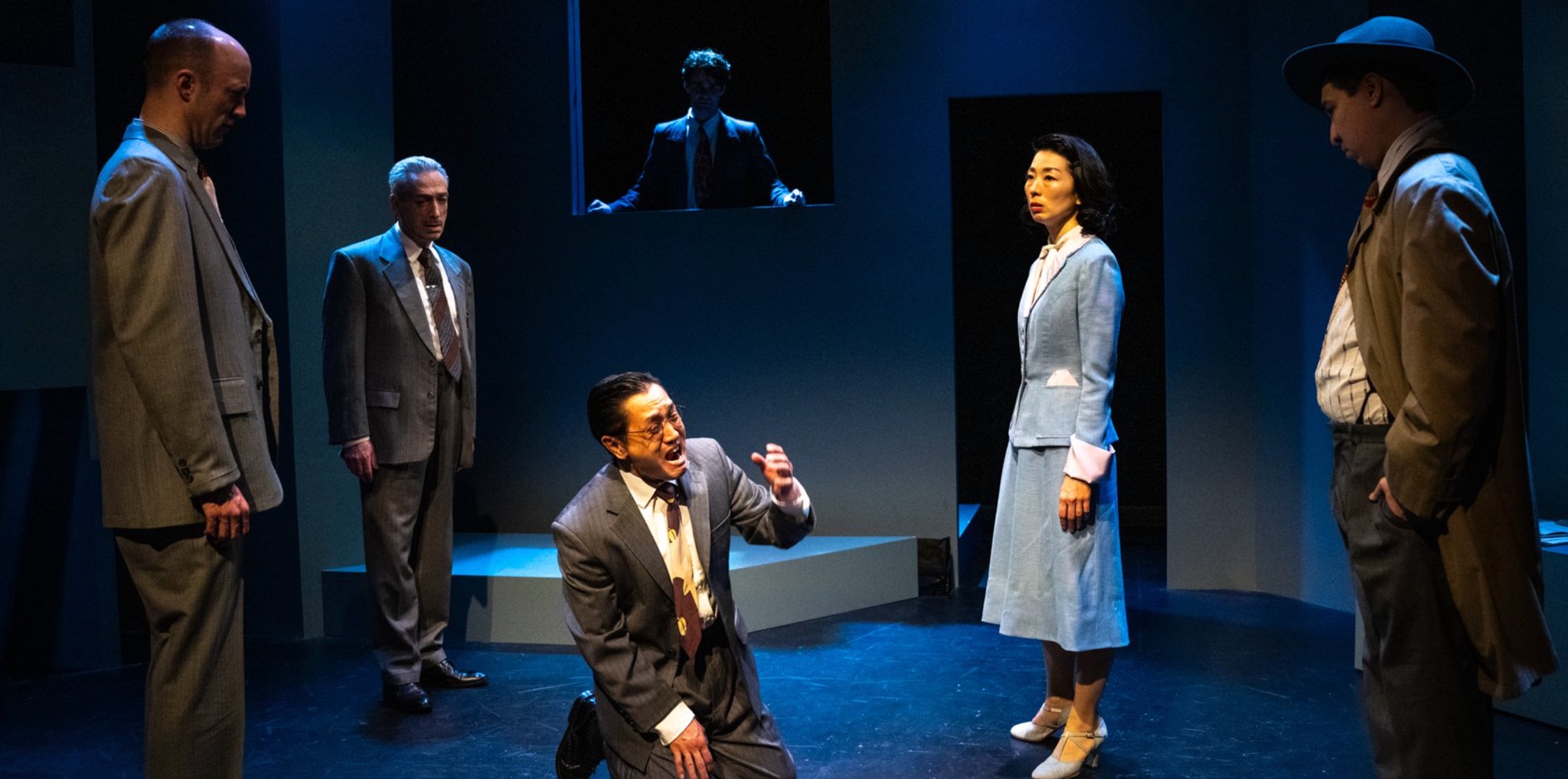
James Patrick Nelson, Robert Meksin, original cast member Brian Lee Huynh (kneeling), Conlan Ledwith (in window), Kiyo Takami, and Cody Leroy Wilson in My Man Kono; photo by Russ Rowland.

Director Jeff Liu has worked closely with set designer Sheryl Liu to make the most of the intentionally shallow configuration of the black box space.  Grey blocks with strategic cutouts are combined with Cinthia Chen’s projections to serve as everything from Chaplin’s elegant homes to a drab courtroom and represent geographically areas from across the US and Japan.  Sometimes the actors literally pop-up from the top or poke out through a window to grab attention.  Lighting designer Asami Morita supports this spirited concept.

Presented by Pan Asian Repertory as part of their 48th season, My Man Kono is a wildly engaging and informative piece of theater.  Sending American citizens — many of whom had offspring in our military — to internment camps because of their heritage is one of the most disgraceful chapters in our history.   Shameful questioning of what it means to be an American patriot reverberate in the present.  To see this period through the eyes of someone who was close to a Hollywood legend is an ingenious way to draw in a wider audience.  This World Premiere continues through March 9 at the A.R.T./NY Mezzanine Theatre on the second floor of 502 west 53rd Street.  Reserved seats are available at https://www.panasianrep.org/my-man-kono and are $35 for students, $60 for seniors and $70 for adults. 

Fruiting Bodies

The fog-bound woods of Bolinas are the setting for the Midsummer Night’s Dream-like meanderings of the characters at the center of Fruiting Bodies.  In reality, this town is as described by Asian-American playwright Sam Chanse: deliberately secluded from the rest of the Northern Bay Area by the townspeople who removed the highway signs that marked the exit.  Though there is no fairy Puck, there is a sprite of sorts: A Boy who by turns is the brother/son, an abandoned 10-year-old, and a giant talking mushroom.  All of them influence the actions of Ben and his daughters Mush and Vicky.  Their environment functions as a fifth player.  The bare trees that spin as the people are drawn deeper into the landscape are paired with soft welcoming rocks in the evocative set by Reid Thompson.  Lighting design by Jeanette Oi-Suk Yew brings out a magical quality and Kate Marvin provides nature’s moody background music.  Costume designer Sara Ryung Clement provides Vicky’s Instagram-ready outfit and the rest of the workhorse wardrobe.

In biology, the “fruit body” is the sexual phase in the lifecycle of fungi.  At their most literal, the mushrooms on the forest floor are the fruiting bodies of Chanse’s visionary world.  Each grows from a rotting tree, releasing spores into the air as it attempts to start new life.  The family members are also struggling to leave a mark on the world, one quite literally.  Yet each one has a passion that is met with disapproval.  They were at some point connected, but that body has been rotted by disagreement and negative judgment.  It’s a melancholy but recognizable sensation that Chanse evokes beautifully and poetically.  

As the piece opens, the sisters are in Vicky’s treasured Tesla on their way to Bolinas to pick up their father who has gotten lost in the woods. The third generation Japanese American has gone mushroom hunting, a pastime that according to his Japanese tradition can bind family members together.  But fittingly for the increasingly addled Ben, he has forgotten to bring younger daughter Vicky as promised.  Instead, he has meet up with a young boy whom he mistakes for his son Eddie, the first sign that Ben’s mind isn’t what it once was.  The sisters are also disconnected.  The gulf that started to form years ago when their Finnish mother left has deepened now that Vicky is proudly at work on a communication app and activist/artist Mush has the lofty goal of cleansing the world of preconceived notions of beauty and power.

Fruiting Bodies is still developing, having been fostered by the creative environment of  the Ma-Yi Writers’ Lab.  Along the way to opening night, the work shed about 35 minutes and an intermission, leaving a still leisurely 100 minute experience.  Like mushrooms in a pan, there are many concepts being tossed about. Big themes including homophobia, ethnicity, and the power of celebrity are introduced alongside more everyday family conflicts.  The play is as much about mood as it is about substance. Throwing morels, buttons, and chanterelles into his paper sack, Ben quite literally goes through the day with a mixed bag and in a fog.  For all his intentions to serve as model head of the household, he can’t seem to see his son and daughters clearly enough to genuinely bond with them.  Some may find the ending less a conclusion and more a stopping point on a longer path.  The playwright seems to have done this deliberately given that two of the most heated arguments are given simultaneously, sometimes blending, but just as often drowning each other out. 

Kimiya Corwin, Emma Kikue, Jeffrey Omura and Thom Sesma

Kimiya Corwin, Emma Kikue, Jeffrey Omura and Thom Sesma; Photo by Carol Rosegg

Director Shelley Butler knows how to get the most from her nimble cast and wonderland scene.  In Thom Sesma’s hands, Ben is both sympathetic and maddening, taking joy in some moments while completely oblivious to others.  Kimiye Corwin and Emma Kikue don’t yet have the chemistry of the sisters, though both are highly skilled and may find the right rhythm.  The role of The Boy and his many facets is the most challenging and Jeffrey Omura flits expertly among them.  His shifts from teenage exasperation to slightly menacing creature of the dark are executed with ease and limberness.  

Though a little thin on plotting, Fruiting Bodies make for an entrancing event.  For a brief time, you’ll be pulled away from your everyday experience and into these enchanted woods.  It is playing through May 19 in the Beckett Theater in Theatre Row (410 W. 42nd Street) in Manhattan  Tickets range in price from $32.25 to $42.25 and can be purchased by calling Telecharge at 212-239-6200 or online at www.telecharge.com.  More information is available on The Ma-Yi Theater Company website at www.ma-yitheatre.org.