Tag Archives: Emmie Finckel

Indian Princesses

YMCA’s Indian Princesses was originally established in the mid-1950s.  The objective was to nurture the bond between white fathers and daughters with Native American heritage.  The good intentions that were behind the launch of the project are evident in Eliana Theologides Rodriguez’s play Indian Princesses, alongside the residual anger she felt after participating in the culturally deaf program with her sister.  The financial stresses that emerged in the aftermath of the global market crisis of 2008 had forced her father to uproot his family just at a time when she needed stability and connection.  The summer’s activities only added to her pain; resentment over the organization’s false narrative followed.

Fortunately for theater-goers, Rodriguez’s approaches her complex feelings about the appropriation that passed for honoring traditions with humor and compassion.  A carefully composed Playbill insert provides helpful background to her simmering creative process.  She has drawn on the similar experiences of other women of color to round out the narrative and included a Mexican American and an adopted African American in her cast of characters.

Five immensely talented adult actresses — Anissa Marie Griego (Lily), Rebecca Jimenez (Andi), Serenity Mariana (Hazel), Lark White (Maisey), and Haley Wong (Samantha) —  portray girls ages 9 to 12.  The audience is with them from the moment of their initial meeting at a YMCA somewhere in the midwest.  So expressive and open are their faces that the constant fidgeting under the direction of Miranda Cornell is an irksome distraction from the authenticity that radiates from their interactions.  The actors playing the white fathers — Ben Beckley (Wayne, adoptive father of Maisey), Greg Keller (Chris, stepfather to Lily and Hazel), Pete Simpson (Mac, widowed father of Andi) and Frank Wood (Glen, Indian Princesses program leader and Samantha’s grandfather) — are given narrower paths to tread, but each does so with commitment and warmth.  
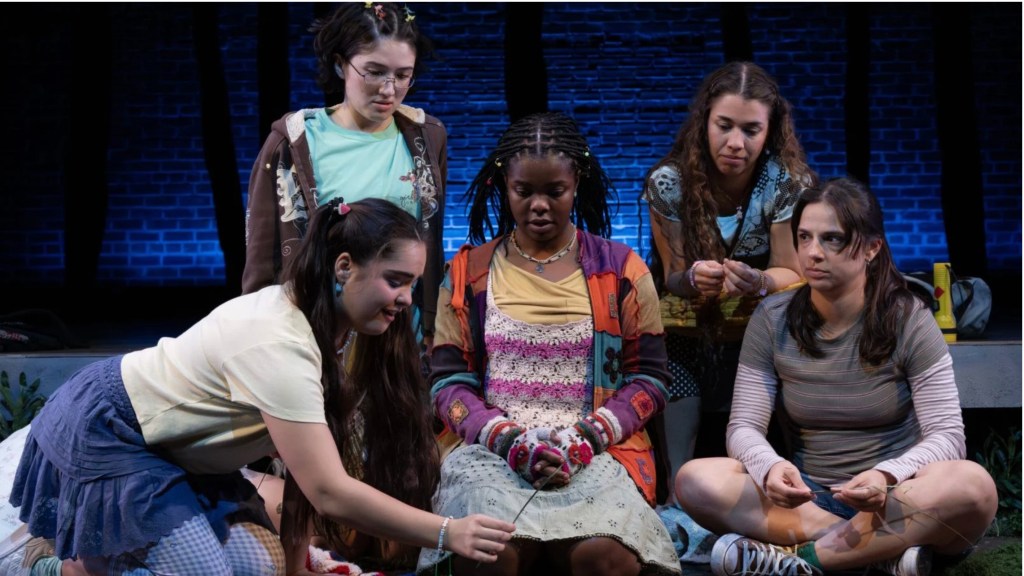
Serenity Mariana, Haley Wong, Lark White, Anissa Marie Griego, and Rebecca Jimenez in Indian Princesses;
Photo by Ahron R. Foster.

The naive and questioning viewpoint of kids about identify, racism and family relationships is critical to the success of the piece.  In absence of true insight, they’ve each designed their own personal mythology.  While the girls approach their camp assignments such as decorating mini canoe paddles with colored masking tape with glum obedience they also draw ever closer to each other with genuine curiosity.  

Co-produced by Rattlestick Theater and Atlantic Theater Company, this comedic social commentary is playing in the Linda Gross Theater.  A converted church — its arched windows and wide beams still in view — has more than its share of staging challenges.  The creative team has served this production well.  Set designer Emmie Finckel gets the muted in-need-of-a-paint-job colors and multi-purpose arrangement of a Y room just right and adds a wildflower strewn strip downstage to serve as the more magical outdoor clearing.  A car interior is among the areas of focus defined by Mextly Couzin’s shrewd lighting. Sound design by Salvador Zamora is beautifully woven into the dialogue.  

Currently scheduled to run through Sunday, June 7, Indian Princesses is a comedy derived from discomfort.  Though there are dark memories behind its creation, the story is rooted in love and empathy, resulting in both warm laughs and distressing cringes.  Performances are in the Linda Gross Theater at 336 West 20th Street between 8th and 9th Avenues.  There is an accessible entrance through the courtyard to the west of the main door.  The house is shallow with a decent rake and staggered seating.  Tickets range from $56.50 for standing room to $131.50 for “Tier 3”.  Running time is nearly two hours without an intermission.  In related news, the restrooms are downstairs and the elevator is very small.  Visit https://atlantictheater.org/production/indian-princesses/ for tickets and further information.

In the Amazon Warehouse Parking Lot 

Like the cruel corporation that manipulates Jen, Ani, Sara and their co-workers, for the most part In the Amazon Warehouse Parking Lot delivers the goods.  What this piece has in common with several of this year’s Off-Broadway productions is an over-stuffed plot that takes on too many critical issues to the detriment of them all.

Similar to Carol Churchill’s memorable Far Away, playwright Sarah Mantell begins by sketching oblique fine lines of a chilling future in a failing country and dramatically discloses details of the lives of an outrageously exploited underclass.  (Churchill twice won the Susan Smith Blackburn prize that Mantell was awarded for this work.)  Descriptions of an advanced climate crisis set to the “music” of Sinan Refik Zafa’s enveloping sound, are vivid, alarming, and all too possible.  The abusive work environment is also cleverly revealed and based just enough on reality to strike a chord.  The more publicized love story is not as well motivated and becomes a distraction.  It doesn’t help that Donnetta Lavinia Grays, who otherwise turns in a strong and steady performance, can’t conjure up any chemistry with Deirdre Lovejoy.   Ultimately, this thread may be essential to the playwright, but not to the play.

In her personal note, Mantell explains her intention to make this production “both art and a hiring document” particularly for women, trans, and nonbinary actors over 50.  The reward for her worthy goal is a memorable cast — Grays and Lovejoy are joined by Barsha, Sandra Caldwell, Ianne Fields Stewart, Tulis McCall, and Pooya Mohseni — so congenial and cohesive it is easy to believe they hang out at the (still open!) West Bank Cafe after every performance.  With no clear path forward, these people can only move “towards.”  Their palpable warmth is in stark contrast to Emmie Finckel set.  The characters are unmoored in a sea of cold conveyer belts and unwelcoming mountains awash in the purple hues of Cha See’s lighting.  

Ianne Fields Stewart, Pooya Mohseni, Tulis McCall; Photo credit: Valerie Terranova

Director Sivan Battat  draws on their background in ritual and diverse mythological storytelling to enrich the anchoring “around the campfire” scenes.  Even the most peculiar and futuristic banter feels organic.  (A lighter detail is Mantell’s selection of the social deduction party game Werewolf as the group’s preferred method of entertainment.)  The more mixed result stems from the monologues about how each of the workers spent their first night sleeping in a vehicle.  This often repetitive contrivance begins to bog down rather than deepen the unfolding of events.    

At its core, In the Amazon Warehouse Parking Lot  is a story of families lost, found, and made. The elements largely come together in a satisfying theatrical experience with a refreshing cast you will want to see more of.  While there are missteps in the dance between Mantell’s personal mission and broader audience appeal, if you give yourself over to her vision (as the mostly under-35 audience did at the performance I attended) the effects will linger.  Presented in association with Breaking the Binary Theatre, the world premiere continues on the MainStage theater at the Playwrights Horizons (416 West 42nd Street) through November 17.  Runtime is approximately an hour and half with no intermission.  Tickets begin at $62.50 and can be purchased at https://my.playwrightshorizons.org/events/amazon.  

The Commons

The Commons attempts to explore the ways in which everyday moments can form a wider story.  The comedic drama is written by Lily Akerman and directed by Emma Miller backed by an almost exclusively female creative team.  For a piece that sprung from the mind of a young playwright known for telling stories filled with colorful and distinctive voices and further filtered through a sharply feminine lens, it is surprisingly lacking in warmth or depth.  

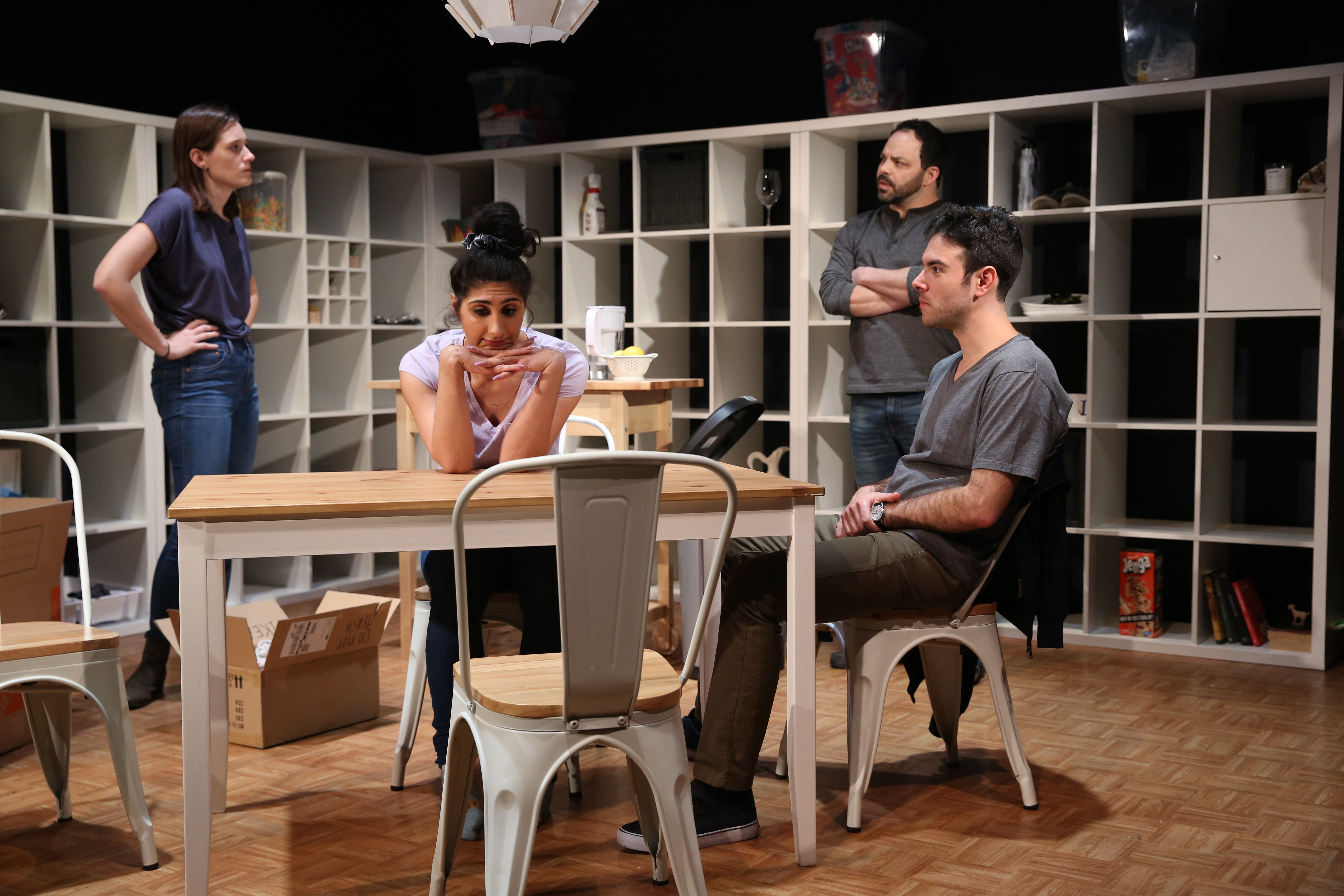
The script is composed of quick scenes depicting a series of conversations held in the kitchen shared by four New York City housemates.  Fastidious Robyn (Ben Newman) is a failed artists who has lived in the house for 20 years.  Jittery Dee (Julia Greer) is struggling to focus her thoughts about her all-important dissertation.  Homey Janira (Olivia Khoshatefeh) lovingly bakes bread while Marie Kondo-ing the heck out of the space.  And newcomer Cliff (Ben Katz) is stretching his meager web designer paycheck while filling the air with empty promises.  The topics they cover are everyday issues from who should wipe down the stove top to how long a guest should be able to stay.  Atypically, these discussions do not build on one another.  Each time an incident appears to be lifting the action to the next level, it deflates as quickly as Cliff’s vow to clean his beard hair from the sink.  In total, the characters live together for 9 months — the period it takes to create a new human life —  yet they have almost no impact on each other, an outcome that is as tedious as it is unrealistic.  

Ms. Miller’s staging in the black box Theater C at 59E59 is also ill-conceived.  In order to accommodate Emmie Finckel’s clean kitchen set, the performance area has the audience seated in an L-shape.  But the actors are mostly placed so that those on the shorter side are continually confronted by backs instead of faces.  The sharp cuts between episodes often make the passage of time difficult to gauge.  At least the clever sound designed by Caroline Eng fills the pauses with the “music” of kettles, microwaves, timers, and other kitchen noises.  

The cast members — most of whom have worked exclusively in festival and workshop productions — do what they can to bring variety to their roles.  The most successful is Olivia Abiassi, whose energetic arrival halfway through the play woke up the audience, in some cases literally.  Her portrayal of Cliff’s ex Anna, the most full blooded of the characters, is thoroughly engaging  For the short time she is in the shared apartment, the spunky straight shooter fills the void by providing everything the others have been lacking in their lives, be it a fresh salad or genuine honesty.   Unfortunately, none of her vitality survives her character’s exit.

Julia Greer, Olivia Khoshatefeh, Ben Newman, Ben Katz Photo by Carol Rosegg

Julia Greer, Olivia Khoshatefeh, Ben Newman, and Ben Katz; Photo by Carol Rosegg

A still-emerging work, The Commons might be better appreciated in a less established venue.  For a modern day kitchen sink drama, this production suffers from a lack of seasoning.  Though the situations portrayed may be increasingly… common, that does not automatically imbue them with meaning.  To build a real bridge between the viewers and the subjects requires more than an exploration of surface traits and eccentricities.  

Presented by The Hearth, The Commons is running at 59E59 (59th street between Madison and Park) through Sunday, February 23.  Tickets are $25 ($20 for members) and are available by calling the 59E59 Box Office at 646- 892-7999 or by visiting http://www.59e59.org. Seating is general admission.  Note that the second row on the shorter side of the L is not raked.