Tag Archives: Erin Bednarz

Dragon Lady

Sara Porkalob had received praise for playing a white Founding Father, Edward Rutledge, in the Broadway revival of 1776.  But she had never had the opportunity to represent someone with her Filipino background until she wrote a role for herself.  Her solo performance — Dragon Lady — tells the colorful story of Porkalob’s grandmother, Maria Porkalob Sr.  A karaoke-loving daughter of a gangster, Maria I moved from the Philippines to the Pacific Northwest as a pregnant newly wed wife of an American soldier.  (Senior made a cameo in the show until her death in 2022 and now appears in projection.)  The show premiered in 2017 and has been touring the country, now joined by Dragon Mama, another Porkalob creation told from Sara’s mother’s perspective.

The Pittsburg Public Theater recently shared Dragon Lady with a broader audience through the League of Live Stream Theater, a non-profit that works primarily with regional theaters to broadcast their productions in real time.  Built tenderly from a 9 minute senior year workshop assignment, the production runs 2:15 and spans over 40 years.  Designed in a framework of a cabaret act with a three piece band, Hot Damn Scandal (Pete Irving, Jimmy Austin, and Mickey Stylin), the performance is engaging and freeing.  On the night before her 60th birthday, Maria Sr. pulls her granddaughter aside in order to share some family secrets.  Sara’s mother, Maria Jr., is obviously not the matriarch’s biggest fan.  By revealing some less-than-flattering elements of her history, the elder Porkalob hopes to at least elicit understanding of if not forgiveness for her past actions from the newest generation.

Sasha Jin Schwartz’s set, bathed in blue with its raised rounded platforms and crisscross patterns, conveys the essence of a casino or nightclub.  Under the guiding hand of director Andrew Russell and leveraging the intimacy of this ¾ round space, Porkalob changes skins in a flash, portraying those closest to Maria Sr. including her father, lovers, and five children. Each relationship shines a little more light into the painful darker corners (physical lighting by Spense Matubang).  There is a particularly lovely and insightful exchange between Maria Sr’s two sons, Ron and Charlie, when they were younger.  Sara’s singing voice is remarkably strong and soaring as she delivers a range of musical numbers from torchlight to jukebox.  Mixed with atmospheric sound by Erin Bednarz, the selections help shift the mood and lighten the load.  
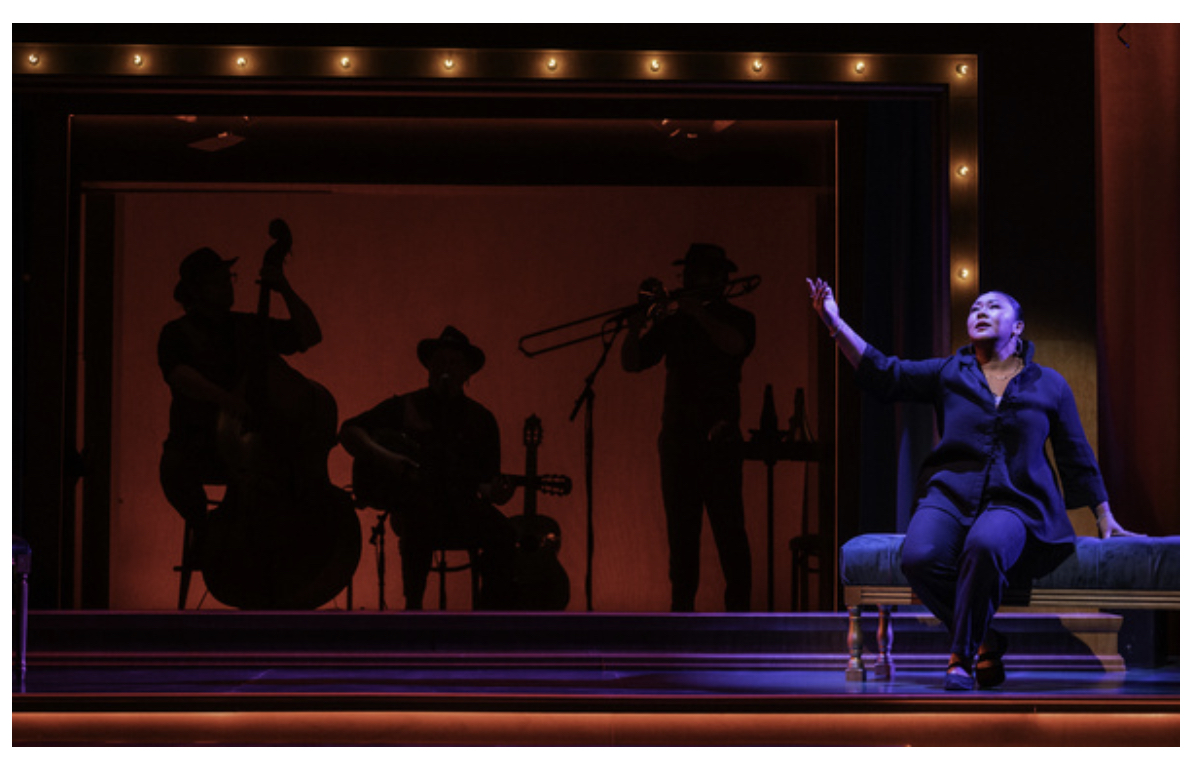
Sara Porkalob backed by the Hot Damn Scandal in Dragon Lady at Pittsburg Public Theater

Having broken away from the comfort of scene partners and backdrops, Porkalob has had to tap deeply into her own power as an artist.  By appreciating the value of a personal story and sharing a genuine human experience, Porkalob has given us a work that resonates far beyond her own family.  The language and themes are decidedly R-rated and intended for audiences over 18.  A third play, Dragon Baby, told from Sara’s vantage point, as well as a TV adaptation of the entire cycle are currently in development. 

For more information about Sara Porkalob and The Dragon Cycle, visit http://www.saraporkalob.com/.  To explore the rest of the Pittsburg Public Theater Season, visit https://ppt.org/.  To learn more about upcoming real-time simulcasts by the League of Live Stream, visit https://www.lolst.org/.  
Lavender Men – Los Angeles and Streaming

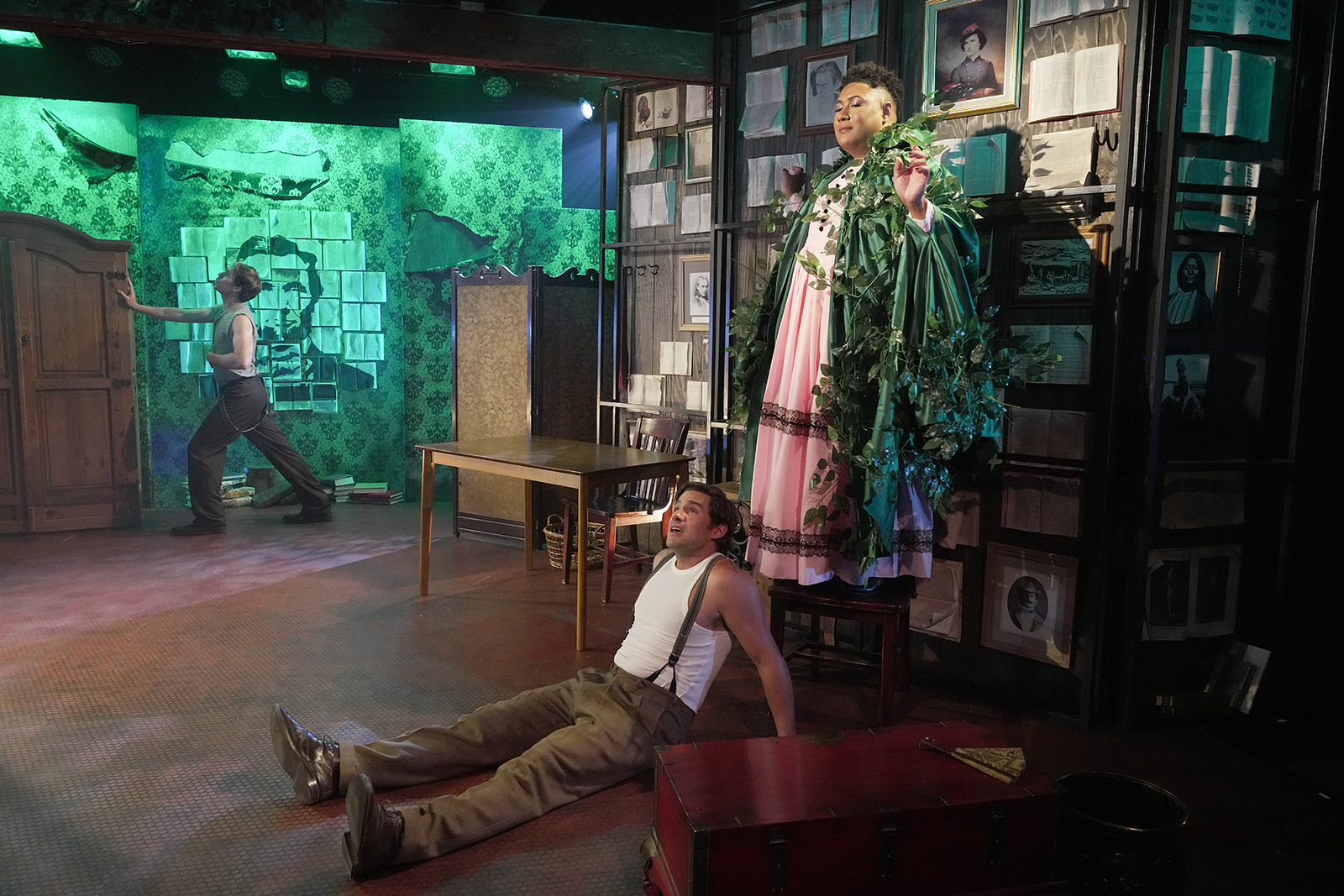
Taffeta, one of three characters in Lavender Men, describes what we are about to see as a “fantasia”.  The piece explores a personal chapter in the life of Abraham Lincoln as filtered through the mind — indeed the entire body — of playwright Roger Q. Mason.  In 1860, Lincoln mentored a young law clerk, Elmer Ellsworth.  Ellsworth went on to help Lincoln campaign for president.  He eventually made history of his own when he became the first Union casualty of the American Civil War, killed while removing a large Confederate flag from the rooftop of a Virginia inn.  That the men admired each other and became good friends is well documented.  In Lavender Men, Mason speculates that the two meant much more to one another.

The fast moving script, developed in Skylight Theater Company’s resident playwrights lab, covers many themes and styles.  Taffeta proposes that she take Abe and Elmer back in time to reexamine their relationship.  She will take on the role of “everyone else” including a young soldier, a cleaning woman, Mary Todd Lincoln and even a tree near a swimming hole.  Black, large, boisterous, and proudly queer, she is everything the two men are not, opening up plenty of space for conversation about oppressed voices throughout our history.  Themes of body image issues and social biases are explored, though the main plot always returns to a heartfelt love story.  

The play works best when it is self-aware such as when a character questions what is currently being taught in classrooms.  Mason seems to be using personal experience to deepen the emotions of the storytelling, which also makes the viewpoint very specific.  Their haunting voices literally make themselves heard in Taffeta’s ears.  The work does an admirable job of showing the imperfections of Lincoln’s legacy, but there are missed opportunities to connect those events more tightly to today’s political and social climate, particularly as that relates to Lincoln’s own party.  

Director Lovell Holder, who has been attached to the production since a reading at New York’s Circle in the Square, has brought out an intensity in all three actors.  His staging makes great use of a relatively small space and every speck of furniture.  The company has wisely hired Seth Dorcey to direct and edit the streaming version so that the flow translates for home viewers and harnesses the power of the enthusiastic live audience.  The set designed by Stephen Gifford uses a wardrobe as the main doorway so that Abe and Elmer literally go into and out of the closet throughout.  The backdrop includes some wonderful detail — a photo of Frederick Douglas, a paste-up of Lincoln — but nothing that distracts from the terrific performances.  Like a proper fantasia, there is original music by David Gonzalez which smooths the transitions ranging from burlesque to gravitas with cello played by John Swihart.  The shifts in mood are further supported by Dan Weingarten’s atmospheric lighting. Erin Bednarz’s sound design also incorporates some well-timed gun shots.  

Pete Ploszek, Alex Esola, and Roger Q. Mason; Photo credit Jenny Graham

Swirling in Wendell Carmichael’s glorious skirts and bonnets, playwright Mason portrays their unique creation, Taffeta, as bold yet self critical, wise, but with lessons to learn.  The chemistry between Pete Ploszek’s Abe and Alex Esola’s Elmer is electric.  The two maintain connection as they move through time — now, then and never — while manage Taffeta’s coaxing, interfering, and micromanagement.  This renders the tightly choreographed slo-mo love scene superfluous and, with Taffeta as a witness, cheapens what had felt genuine.  

Lavender Men is an engaging and emotionally charged look at pages from history you think you know.  It is currently playing at the Skylight Theater at 1816 1/2 North Vermont Ave in Los Angeles.  It is also available On Demand which is how I was able to enjoy it in New York City.  Run time is 95 minutes with no intermission.  Seats for the live show are $23 – $80.  Showtimes are Saturday 8:30pm, Sunday 3:00pm, and Monday 7:30pm.  The virtual experience is $28.75 for a secure link good for 72 hours.  Tickets through September 4 are available at https://skylighttheatre.org/program-lavender-men/.