Tag Archives: Fayetteville

twenty50

Oddly, one of the best distractions from the tumultuous election before us comes in the form of a drama about a political contest taking place 25 years from now.  In twenty50, playwright Tony Meneses sets his fresh and calculated thriller in an America in which the southern border is completely closed and Latinos — most of whom have fully assimilated — make up the majority of citizens.  Against this backdrop, farm owner Andres Salazar (who goes by Andy) is running for congress somewhere in the middle of the country.  With his campaign manager urging him to drop references to his background in order to appeal to a wider electorate, he finds himself torn between his traditional mother and his inquisitive daughter who doesn’t know a word of Spanish.  Though the bilingual dialogue sometimes blunts the pacing, it’s essential to the unfolding of the story.  Meneses is drawing on a deeply personal understanding of how much can change in a single generation.  His family moved from Guadalajara, Mexico, and he was raised in Albuquerque and Dallas.  The result of his honest excavation is a fair weighing of the many sides of culture, authenticity, and the desire to belong that are not exclusively LatinX.

In creative partnership with scenic designer Tanya Orellana, director Rebecca Rivas has reshaped T2’s intimate space to represent a house with a sloping roof that engulfs the audience placed on either side of a thrust stage. Lighting Designer Nita Mendoza adds emphasis to this metaphorical container.  The clever use of “farmhands” as stagehands, helps convert the landscape for the final scene.  Within the dwelling, the characters circle one another, trying to find their equilibrium.  Orlando Arriaga makes Salazar both approachable and questioning.  It is his genuine warmth that provides the production with a solid center.  He is particularly strong in exchanges with Isabel Quintero as the mother whose memories of the recent past wash in waves over the present.  Cary Hite as the farm’s manager presents an opportunity for another variation of Andy’s balancing act.  Yet a third foil is Gabriella Perez’s policewoman Lydia, the most obviously futuristic character.  As daughter Jenny, Alyssa Martinez is unnecessarily burdened with a childish wardrobe and mannerisms.  She is best when she leans into the role’s purity instead of relying on these distracting crutches.  Ricardo Pérez Dávila and Freddy Acevedo round out the cast.
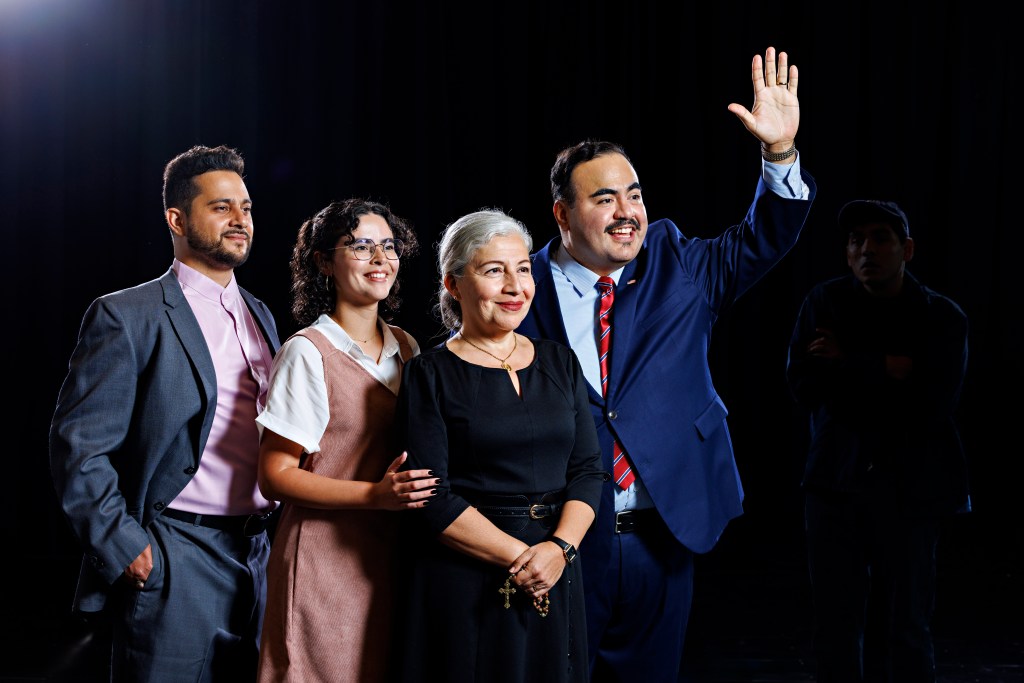
Ricardo Pérez Dávila (Sebastian), Alyssa Martinez (Jenny), Isabel Quintero (Irene) , Orlando Arriaga (Andres), Freddy Acevedo (Oscar) | Photo Credit: Wesley Hitt

In a brisk 90 minutes, twenty50 offers a buffet table ladened with food for thought. This is only the second time this play has been mounted and the rhetoric around immigrants has only grown louder and more destructive.  It’s a coup for TheatreSquared and their loyal audience. As the Executive and Artist Directors say, this insightful work “serves as both mirror and beacon.” Note that the content is written for adults, though there is nothing overtly “mature” in the action. 

The best way to see the performance is live for as little as $20, coming face to face with your fellow attendees at TheatreSquared’s Spring Theatre in Arkansas.  But those of us who cannot easily get to downtown Fayetteville should take advantage of the digital tickets to get in on the experience any way they can.  The camera switches house sides in an attempt to bring us fully into the thick of things.  Individual streams are $25 and household streams are $35.  Both types of links are good for 24 hours.  Tickets for performances through November 3 are available by calling (479) 777-7477 or visiting theatre2.org/twenty50.

Tiger Style – Arkansas and Streaming

In Mike Lew’s Tiger Style, Albert Chen is the congenial, underperforming younger brother of Jenny, a first rate doctor with a third rate love life.  The 30-something Chinese Americans share the burden of navigating the chasm between being born in Southern California yet being viewed as exotic in the case of Jenny or muted as Albert is. They vow to get out of their boxes even though they have no experience in out-of-the box thinking.  What they lack in rebellious nature, they make up for in their bond to one another.  But is “you and me against the world” enough of a force to create change? Certainly the characters swing for the fences, going all the way to another country in search of the right tools.  Act II takes place primarily in Shenzhen, China where they have familial roots.  While the tone expectantly shifts, the direction of that shift is surprising and the work veers towards farce.  

Director Chongren Fan expertly steers the action through the varying beats.  The stage is triangular, with two sides often hosting different scenes.  The set by Chika Shimizu incorporates multiple doors and revolving walls that help us move quickly to each location.  These pieces take on a mood elevating function in the more physical Act II.  Simple elements define each location: a Beyoncé quotation over Jennifer’s couch, a chaise in the therapist’s office, and a wooden bar and chairs in the parents’ home. Costume design by YuanYuan Liang is similarly stripped down, with an Oscar the Grouch T-shirt and matching plaid jackets helping to define characters.  Sparkling fabrics make their arrival in the second half of the play when the siblings’ outfits also undergo subtle changes.  While these likely began as budgetary requirements, the effect helps to draw parallels between Jenny’s and Albert’s American lives and their experiences in China.  They are essentially living in the same apartment with the same “baggage.”  Yi-Chung Chen’s light design includes chase lights around the floor tiles which cleverly add definition and sense of place.

Brandon Ruiter, Brian Kim McCormick, and Eileen Rivera perform well in multiple roles, but with little differentiation.  The impact of this creative decision puts the weight of success squarely on the shoulders of the two central characters.  The appealing Hyunmin Rhee plays Albert with warmth and charming bewilderment while the sharp Stephanie Shum finds heart at the center of the frustrated Jenny.  The dynamic between them has the perfect balance of friction and affection.  Making the most of Lew’s nicely crafted banter, the two actors bounce off each other in genuine rhythm that functions as a metronome holding the disparate tones of the work together.  

Stephanie Shum and Hyunmin Rhee in Tiger Style at TheatreSquared; Photo by Wesley Hitt

Tiger Style begins boldly as an exploration of cultural inheritance and racial profiling.  It’s a heavy lift for a generally light script that concludes with physical comedy and word play.  The experience is certainly enjoyable, but lacks some of the lasting impact of Lew’s Teenage Dick.  Performances run through April 10 in the West Theatre at TheatreSquared, 477 W. Spring Street in downtown Fayetteville, Arkansas.  Tickets range from $20-$54 and can be purchased at  theatre2.org.  As an alternative, a 24 hour digital pass starts at noon on your chosen day which is how I was able to enjoy the work all the way in New York City.  Live runtime is 2 hours and 15 minutes (1:54 when streamed without intermission.)