Tag Archives: Haley Wong

Indian Princesses

YMCA’s Indian Princesses was originally established in the mid-1950s.  The objective was to nurture the bond between white fathers and daughters with Native American heritage.  The good intentions that were behind the launch of the project are evident in Eliana Theologides Rodriguez’s play Indian Princesses, alongside the residual anger she felt after participating in the culturally deaf program with her sister.  The financial stresses that emerged in the aftermath of the global market crisis of 2008 had forced her father to uproot his family just at a time when she needed stability and connection.  The summer’s activities only added to her pain; resentment over the organization’s false narrative followed.

Fortunately for theater-goers, Rodriguez’s approaches her complex feelings about the appropriation that passed for honoring traditions with humor and compassion.  A carefully composed Playbill insert provides helpful background to her simmering creative process.  She has drawn on the similar experiences of other women of color to round out the narrative and included a Mexican American and an adopted African American in her cast of characters.

Five immensely talented adult actresses — Anissa Marie Griego (Lily), Rebecca Jimenez (Andi), Serenity Mariana (Hazel), Lark White (Maisey), and Haley Wong (Samantha) —  portray girls ages 9 to 12.  The audience is with them from the moment of their initial meeting at a YMCA somewhere in the midwest.  So expressive and open are their faces that the constant fidgeting under the direction of Miranda Cornell is an irksome distraction from the authenticity that radiates from their interactions.  The actors playing the white fathers — Ben Beckley (Wayne, adoptive father of Maisey), Greg Keller (Chris, stepfather to Lily and Hazel), Pete Simpson (Mac, widowed father of Andi) and Frank Wood (Glen, Indian Princesses program leader and Samantha’s grandfather) — are given narrower paths to tread, but each does so with commitment and warmth.  
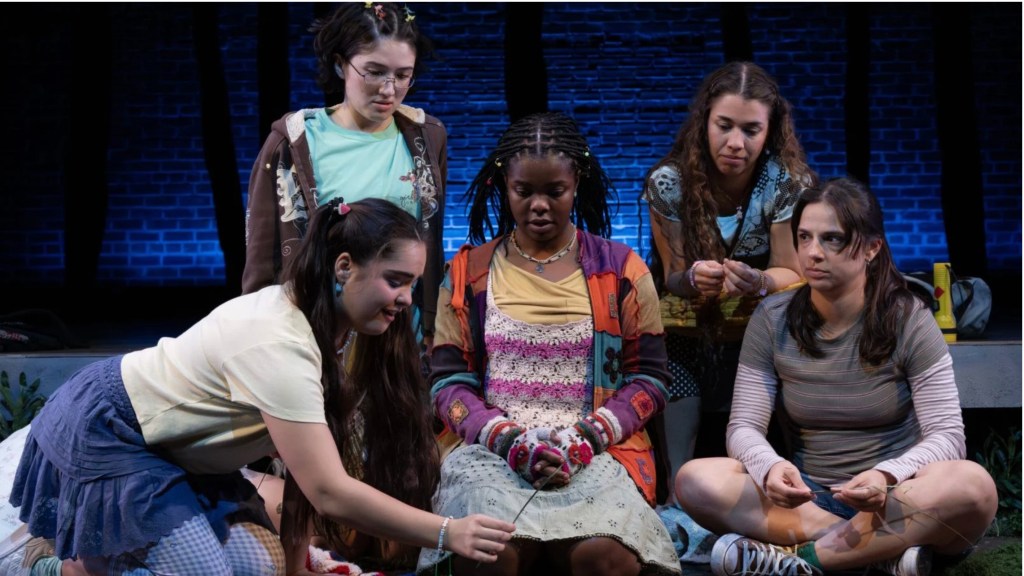
Serenity Mariana, Haley Wong, Lark White, Anissa Marie Griego, and Rebecca Jimenez in Indian Princesses;
Photo by Ahron R. Foster.

The naive and questioning viewpoint of kids about identify, racism and family relationships is critical to the success of the piece.  In absence of true insight, they’ve each designed their own personal mythology.  While the girls approach their camp assignments such as decorating mini canoe paddles with colored masking tape with glum obedience they also draw ever closer to each other with genuine curiosity.  

Co-produced by Rattlestick Theater and Atlantic Theater Company, this comedic social commentary is playing in the Linda Gross Theater.  A converted church — its arched windows and wide beams still in view — has more than its share of staging challenges.  The creative team has served this production well.  Set designer Emmie Finckel gets the muted in-need-of-a-paint-job colors and multi-purpose arrangement of a Y room just right and adds a wildflower strewn strip downstage to serve as the more magical outdoor clearing.  A car interior is among the areas of focus defined by Mextly Couzin’s shrewd lighting. Sound design by Salvador Zamora is beautifully woven into the dialogue.  

Currently scheduled to run through Sunday, June 7, Indian Princesses is a comedy derived from discomfort.  Though there are dark memories behind its creation, the story is rooted in love and empathy, resulting in both warm laughs and distressing cringes.  Performances are in the Linda Gross Theater at 336 West 20th Street between 8th and 9th Avenues.  There is an accessible entrance through the courtyard to the west of the main door.  The house is shallow with a decent rake and staggered seating.  Tickets range from $56.50 for standing room to $131.50 for “Tier 3”.  Running time is nearly two hours without an intermission.  In related news, the restrooms are downstairs and the elevator is very small.  Visit https://atlantictheater.org/production/indian-princesses/ for tickets and further information.
John Proctor is the Villain

Writers are often told to write what they know.  Playwright Kimberly Belflower has gone several steps further.  In John Proctor is the Villain she has boldly written from her very marrow, jangling the skeletons in our collective social-values closet.  Raised in Appalachian Georgia, Belflower sets her piece in a one stoplight town in her home state, using the locally accepted ways and belief systems to draw parallels between a circle of high school sophomore girlfriends and the characters in Arthur Miller’s The Crucible.  The year is 2018 and there is much in these young women’s lives that was not solved by Harvey Weinstein’s arrest.

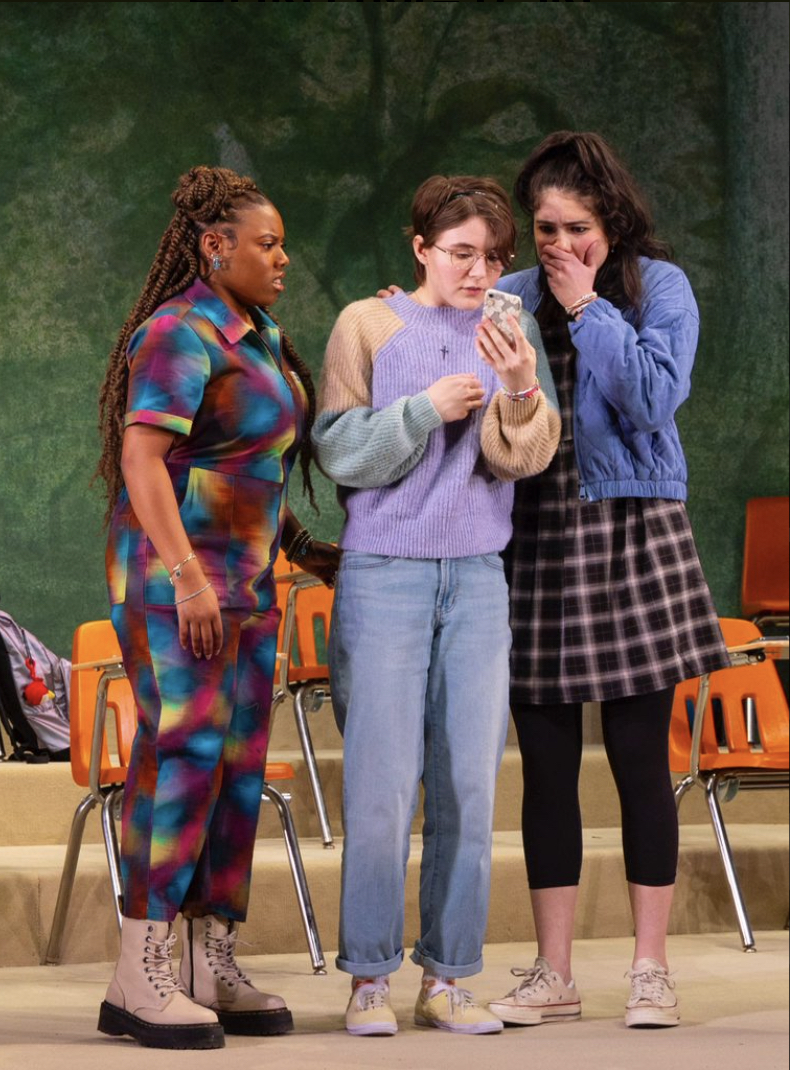
Victoria Omoregie, Jules Talbot, Haley Wong in John Proctor is the Villain; directed by Margot Bordelon; photo by T Charles Erickson

The dialogue is wicked-smart, filled with references from classic literature to song lyrics.  Though all are understandable because of clever context, only one is fully explained.  Belflower begins Act 1 in a classroom where sex education has been buried inside English-Lit, all the better to rush through the uneasy curriculum.  Along with getting a quick hit of each of “Villain’s” characters, this opening enables teacher Carter Smith (a  charmingly approachable Japhet Balaban) to also introduce any audience members not already familiar with Miller’s work to the major themes of The Crucible and the historical background of Witch Hunts.  It also becomes clear very quickly how much the study of the arts is giving meaning and purpose to the lives of these students

While serious issues of feminism, sexuality, body positivity and all varieties of belief run under the surface, front and center is a story of the power of female friendship.  The young ladies are created with some stereotypical DNA, but every one is layered with unique and endearing details.  Caught in a very personal #MeToo scandal through the actions of her father is Ivy Watkins (a warm Brianna Martinez).  Her former best friend Shelby Holcomb (a thorny Isabel Van Natta) has just returned to school after an unexplained “sabbatical” which might be connected.  Often speaking truth to power is Nell Shaw (a high-octane Victoria Omoregie) bringing “worldly wisdom” to the conversation from her upbringing in Atlanta.  At the other end of the confidence spectrum is Raelynn Nix (a fabulously wriggly Haley Wong) the local preacher’s daughter. The ultra serious Beth Powell (a ready-to-spring Jules Talbot) launches a feminist club in part to boost her college application but also to give them a container for discussing their feelings. They have a developing ally in Mason Adams (a sweetly awkward Maanav Aryan Goyal ) who experiences a particularly lovely character arc.   Filling out the attendance sheet is Raelynn’s ex-boyfriend Lee (Benjamin Izaak) and the class guidance councilor Bailey (Olivia Hebert) who are essential to the plot.

Seasoned director Margot Bordelon, who has a history of amplifying new voices, seems to have deep love for these characters, bringing out every delicate moment of discomfort and rage with authenticity.  The school room’s simple set by Kristen Robinson changes temperament with the help of Aja M. Jackson’s lighting.  Sound designer Sinan Refik mixes snippets of pop tunes with school bells and eery noises to further shift the tone of the room.  The girls also make themselves heard in their choice of wardrobe (Zoë Sundra) and in Raelynn’s case evolving eye make-up.

Whether it is exploring weighty matters (like why is “too much” simply parental shorthand for “a girl)” or making us laugh in solidarity, John Proctor is the Villain always keeps us entertained.  True enjoyment requires the ability to think big and a tolerance of of other points of view.  It is available as an On Demand stream from The Huntington Theatre in Boston through March 24.  Running time is about 100 minutes with no intermission. Digital tickets are available at four price points starting at $30 and can be purchased at https://bostontheatrescene.huntingtontheatre.org/28317/28319.