Tag Archives: Huntington Theater

Eureka Day — Boston, MA

I don’t remember the last time I attended a play at which everyone was laughing so loudly I couldn’t hear the dialogue… and I didn’t mind because I was laughing too.  That was the most unforgettable element of my visit to the Huntington Theater in Boston to see Jonathan Spector’s Eureka Day.  It was my first time experiencing one of their productions live after benefiting from their digital tickets to John Proctor is the Villain, The Heart Sellers, and Leopoldstadt among others.  The evening delivered the kind of communal experience I had anticipated based on the vibes that came through on the stream.

The play’s events take place during the 2018-19 school year at the type of Bay Area progressive educational institution whose website includes a weirdly specific drop-down menu of cultural identities.  Most of the plot revolves around the school’s board meetings overseen by consensus-enthusiast, Suzanne, and the easy-going Head of School, Don.  Equality and inclusion are cranked up so high that little is achieved beyond their customary reading of the mystic poet Rumi.  Their usual give-and-take is knocked askew by the arrival of a newcomer with a distinct perspective. They are then confronted with a different level of problem when some of the children come down with highly contagious mumps.  

I was living in San Francisco at that time and remember the outbreak of whooping cough that hit Marin that winter.  Notably, it was the year in which the now debunked study of a connection between MMR vaccines and autism risk was first published.  I know that vaccination has become a personal issue and that that there is nothing humorous about a sick child. But somehow Spector has found a way to serve up serious themes of medical disinformation and unproductive Zoom meetings with a spoonful of comedic sugar.  And though the script was written prior to the pandemic, given the current state of our Department of Health, Eureka Day’s arrival on stages couldn’t be more timely.
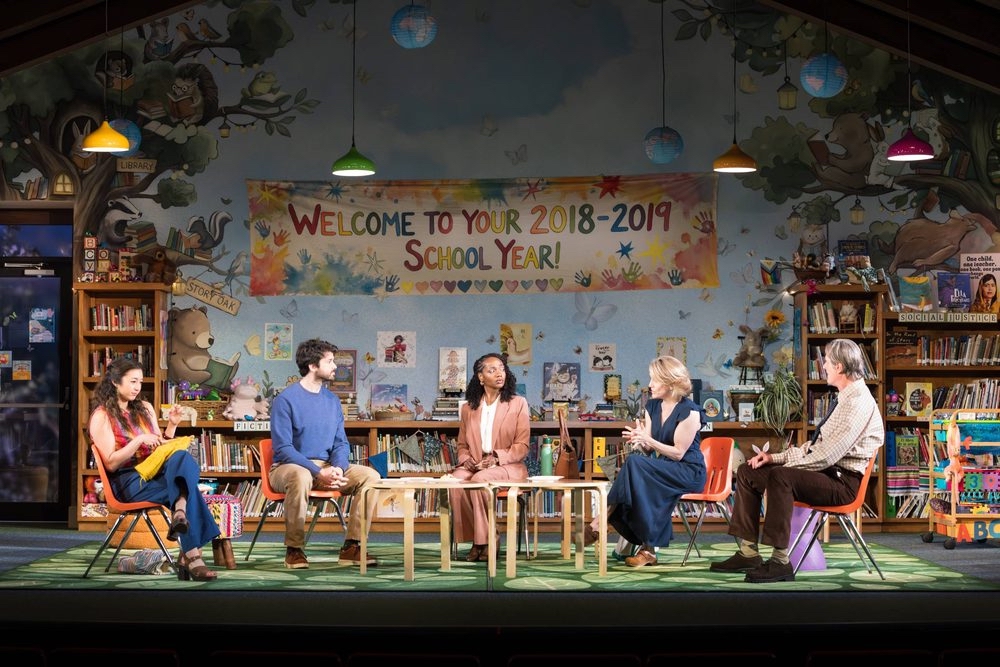
Sasha Diamond, Japhet Balaban, Eunice Woods, Nancy Lemenager and Ken Cheeseman in Eureka Day; photo by Liza Voll

Under the direction of Margot Bordelon, the cast members — Japhet Balaban, Ken Cheeseman, Sasha Diamond, Nancy Lemenager and Eunice Woods — are impressively in tune with one another.  Often their body language screams loudly when their voices are modulated.  Most impressively, they remain committed and connected even when the audience is losing its collective mind.  I imagine that the detailed, unspoken backstories provided in the printed script were useful for their robust character development.  Luciana Stecconi’s classroom set is charmingly detailed with projections by John Horzen & UptownWorks fulfilling a pivotal role.  Lighting fixtures hang beyond the proscenium making us part of the action. Yet, while I admire the level of talent brought to bear, I admit being disappointed that most of this production’s actors are from New York rather than local.  

Eureka Day is a first-rate example of why I go to theater.  I shared a stimulating, funny and happily memorable evening and formed a bond with a group of pleasant strangers.  The run continues through June 28 at the Huntington Theater, 264 Huntington Avenue in Boston, MA.  Running time is 100 minutes without an intermission.  Note that due to the subject matter there is discussion about childhood illness and infant mortality.  Patrons are offered the opportunity to read the script beforehand.  Tickets are available at https://www.huntingtontheatre.org/whats-on/eureka-day/.  Prices range from $29.00 – $185.00, so be sure to check the discount code page to see if you qualify for any of the generous concessions.
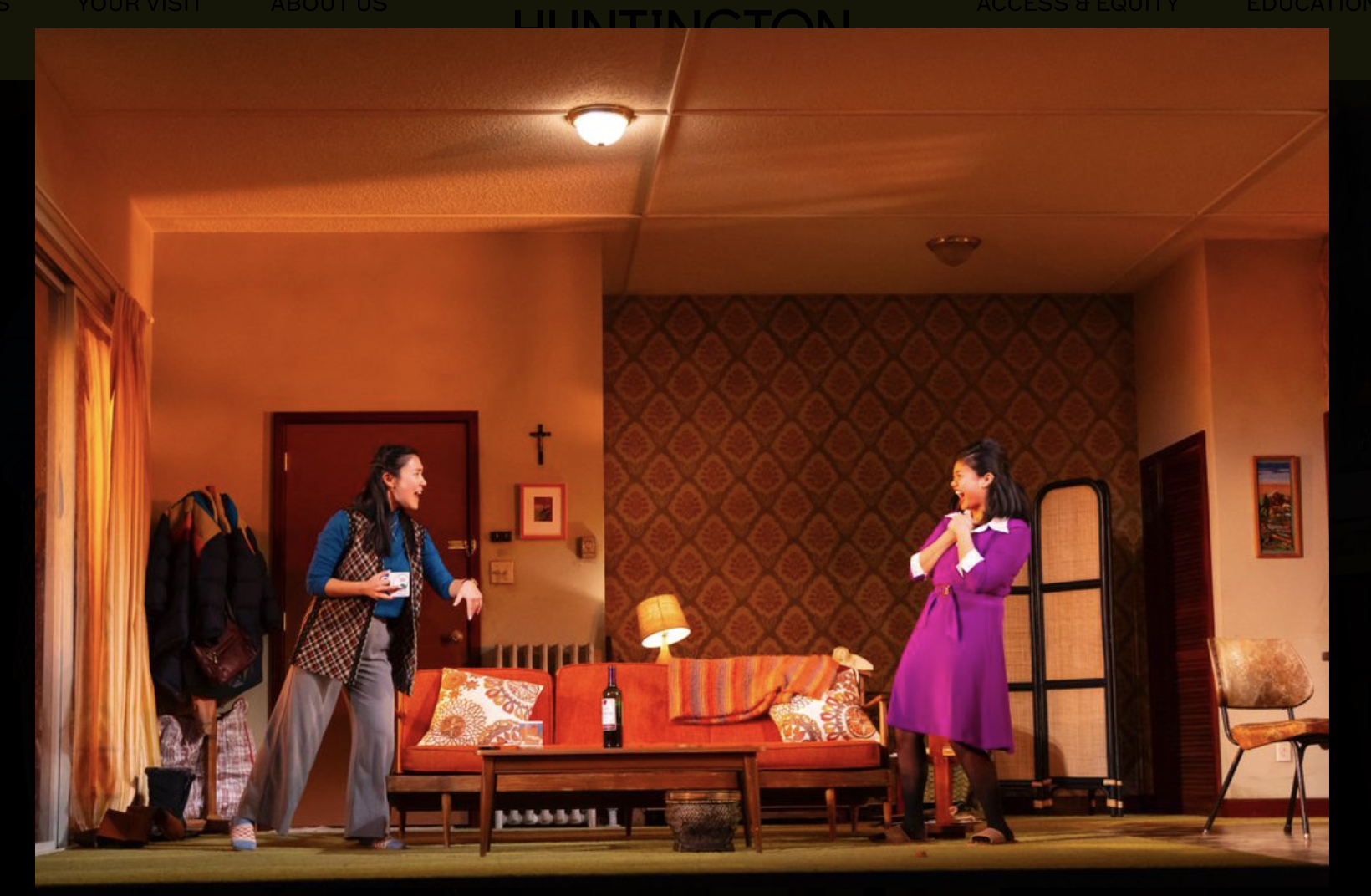
The Heart Sellers – Streaming

There are many recent plays and movies that investigate the immigrant experience.  Most scout the important but familiar terrain of fear and pain resulting from being in our country illegally.  The Heart Sellers takes on far less explored territory by rolling back to the early 1970s.  The two young women involved — one from the Philippines, the other from Korea — have been able to move to the United States under the provisions of the Hart-Celler Act.  This law made major changes to our immigration policy, making it easier for people from Asia and other areas previously discriminated against to come here for work.  In the case of Luna and Jane, their husbands are both in residential rotation at the local hospital.  But the wives have had to leave their dreams and most of what had given their lives meaning back in their home countries.  When fate brings them together in the supermarket on Thanksgiving, they make the most of the opportunity to find connection in what has been a very lonely world.

With an adept ear for dialogue, playwright Lloyd Suh treats us to a fabric of rich detail while keeping the conversation flowing.  His examination of the cultural norms of 1970s America is both funny and touching.  Luna and Jane’s exchange is at first realistically halting as they each employ their second language in search of common ground.  Scenic and costume designer Junghyun Georgia Lee sets the perfect tone, literally putting the two women in a tiny box that encloses the stage.  Luna’s apartment is dressed in wild and warm shades and the character herself appears in bright pink.  Matching that colorful energy, Jenna Agbayani’s Luna is buzzy and overly familiar, high on adrenaline from her daring step of inviting Jane into her home.  In contrast, Judy Song, making her North American stage debut, keeps Jane as fact-based as her earth and sky outfit would suggest.  Only when she changes into Luna’s flowered “house clothes” does her imagination soar.  

Judy Song, Jenna Agbayani; photo by T Charles Erickson

Echoing the characters’ testing of their lives’ constrictions, director May Adrales has created something of a dance for Luna and Jane within the small space.  The pacing of the piece is as zestful as the women’s search for friendship.  With its mixture of viewpoints and high level of intimacy, The Heart Sellers is a great choice for a hybrid production.  The On-Demand version was filmed at the Huntington’s Calderwood Pavilion in Boston on December 6 and is beautifully produced and edited by Kligerman Productions.

Though set during a November holiday, The Heart Sellers is a delightful treat for the end of a tough year and a hopeful start to the new one.  It is as warm and sweet as the yams the women devour with joy and gusto.  $30 digital tickets are still available at https://www.huntingtontheatre.org/whats-on/the-heart-sellers/  and can be used any time before January 6, 2024.  Playback is smooth and easy, with quality sound and image.  Runtime is 95 minutes.

Our Daughters, Like Pillars – Boston and Streaming

Playwright Kirsten Greenidge understands the impact of order: birth order, marriage order, and trying to keep order.  In her family drama Our Daughters, Like Pillars, she explores the significance of order in three full acts, allowing her characters to leisurely reveal their affecting histories and conflicting hopes for the future.  

This was my third viewing of a Huntington Theater play made possible by their digital insurance policy.  These offerings are not films, but rather live capture of a singular experience using 10-12 cameras.  While nothing can replicate the energy of sharing a performance with an in-person audience, The Huntington’s digital works offer quality productions to those who remain unable to sit in a venue with strangers.  All three had exceptionally clear audio. My first of these was the darkly funny Teenage Dick, energetically directed by Moritz von Stuelpnagel with a first rate cast.  This stream was later shared with the Pasadena Playhouse for an extended run.  Next was Toni Morrison’s devastating The Bluest Eye gorgeously adapted by Lydia R. Diamond.  Director Awoye Timpo’s swirling camerawork allowed home audiences to better view the characters’ movements around a stage poignantly shaped like a chopped tree stump.  With Kimberly Senior’s traditional proscenium staging, Our Daughters, Like Pillars uses more expressive close-ups than shifting angles, but it never loses pacing. 

The story revolves around the three Shaw sisters who are vacationing in a house rented by oldest sister Lavinia (Seldes-Kanin fellowship winner Nikkole Salter) and her husband.  What should be a celebratory time of togetherness turns increasingly tension-filled as Vinny becomes progressively more controlling of her siblings and their mother.  Having felt isolated during the first year of COVID, Vinny’s vision is to have the entire family under one roof on a permanent basis.  But though she tries tactical cajoling, needling guilt, and outright manipulation, that goal is not shared either by people-pleasing middle sister Octavia (Arie Thompson) or youngest Zelda (Lyndsay Allyn Cox) who has only just taken her first steps towards independence.  We gain a deeper understanding of the siblings through their mother Yvonne (Lizan Mitchell) and their stepmother Missy (Cheryl D. Singleton) who are each given profound fourth-wall breaking monologues.  Race and class play important but smaller roles in the script.

Lyndsay Allyn Cox, Arie Thompson and Nikkole Salter; Photo by T Charles Erickson

While the spotlight is clearly on the women — by turns strong and brittle — it is the two men who supply the softness.  Genuine light shines from Julian Parker’s Paul King, Zelda’s casual conquest living by his wits who gets caught up in the whirl of family conflict. And Postell Pringle portrays Vinny’s husband Morris with intensity as he tries to rein in his wife’s darker, more destructive instincts.  The set by Marion Williams includes several levels which provides a feeling of movement to the dialogue-heavy drama.  The family is tightly contained, with the outside world intruding only through the ringing of a telephone.  Costumes by Sarita Fellows add essential color and flow while Jane Shaw’s sound incorporates music from Prince to Sam Cooke.

At 3 ½ hours including two 15 minute intermissions, Our Daughters, Like Pillars, indulges in the kind of rolling storytelling rarely seen since March 2020.  It is playing at the Huntington’s Wimberly Theatre in Boston through May 8 and On Demand through May 22.  Prices range from $25 – $99.  For tickets and information visit https://www.huntingtontheatre.org/plays-and-events/.