Tag Archives: Huntington Theatre

Sojourners

Sojourners is part one of Nigerian-American writer Mfoniso Udofia ambitious interconnected nine play Ufot Cycle which intimately explores a multi-generational immigrant experience.  Over a dozen theaters including New York Theater Workshop, The Denver Center, and Berkeley Rep have introduced audiences across the United States to these deeply personal stories and unique characters.  Now the Huntington Theatre in Boston is bringing this special origin story directly into peoples’ homes with a live capture of a performance from their current season.  Directed by Dawn M. Simmons, this distinctive piece works well on a screen, within scenic frames designed by Jason Ardizzone-West.  

Woven into Udofia’s lines of dialogue are numerous details of the characters’ lives growing up in Etinan, an oil-rich area of Nigeria with its own local government.  Well educated and now residing in Houston, Texas on student visas, Ukpong and his pregnant wife Abasiama sit on a well worn couch in their small apartment reliving the days when they were first introduced for an arranged match.  Ama, as she is called, is following her superintendent father’s plan and studying hard to achieve the degree in biology that should assure her future. Her heart remains in her family’s compound as she cooks familiar foods and sings in her native language to her unborn child.  Ukpong, however, has been seduced away from his economic studies by the flash of rallies, Motown, and beer.  His lack of stick-to-itiveness is contrasted with goal-oriented Disciple, another Nigerian student who uses traditional African religious practices to focus his energies.  

Nomè SiDone brings charm and swagger to the role of husband, but while the couple is playful, their abode is “not home; it’s something else.” Ama’s night shift at the local Fiesta Mart and Gas Station has brought her in contact with Moxie, an illiterate streetwalker with ambitions of her own.  Despite her socioeconomic level, the native born Moxie initially looks down on the woman she simply calls “Africa.”  Abigail C. Onwunali is brilliantly expressive as Ama, a woman who knows her worth and can’t believe the many ways people have been careless with her.  So there is singular warmth that emanates from Ama’s scenes with Asha Basha Duniani’s vulnerable yet defiant Moxie.  Their unexpected relationship forms the true heartbeat of this story, along with inspiring a strong craving for Snickers.  Ama’s interaction’s with Joshua Olumide’s Disciple are more uneasy, though the discord adds an interesting flavor to the pot.
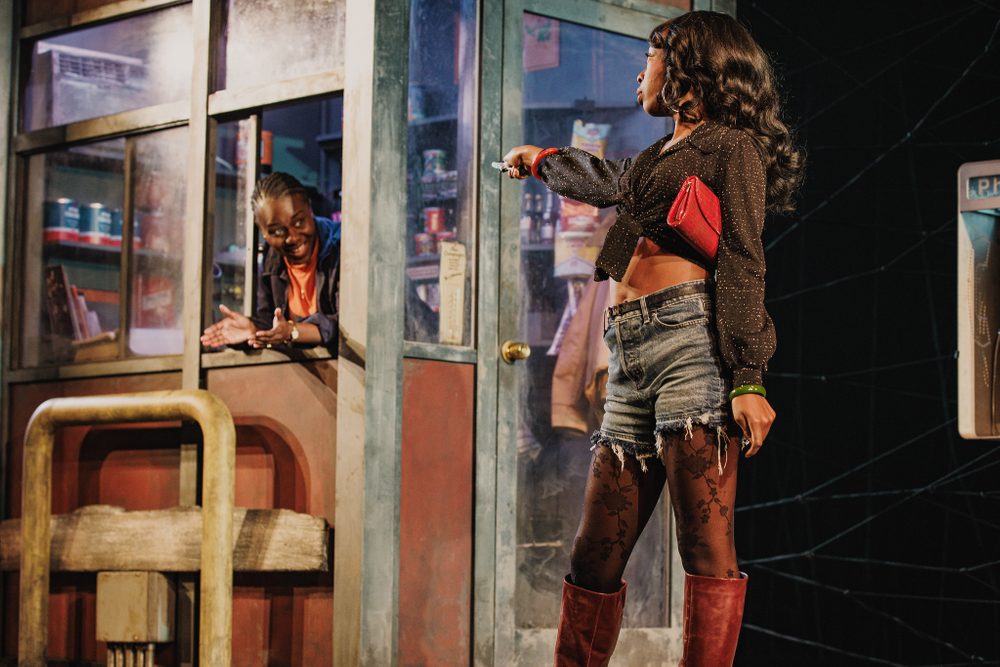
Abigail C. Onwunali and Asha Basha Duniani in Sojourners; photo by Marc J. Franklin

As a first chapter in a longer tale, the 1978-set Sojourners unsurprisingly draws to an end, but with an open-ended conclusion.  We are left wanting to know what possibilities await and what will have to be shed in order to reach the next target.  Fortunately, we won’t have long to wait.  The second play in the series, The Grove, begins performances at the Huntington Calderwood (527 Tremont St. Boston) on February 7, 2025.  Udofia completed that piece before Sojourners and its foundation should be set by this solid first layer. 

Digital tickets to Sojourners begin at $30 and can be used until midnight on December 29.  An introduction to the performance is delivered in two languages, perfectly setting up our 2:20 journey.  The platform is stable and the well-directed feed includes closed captioning.  Visit https://www.huntingtontheatre.org/whats-on/sojourners/ to purchase and read more information.
John Proctor is the Villain

Writers are often told to write what they know.  Playwright Kimberly Belflower has gone several steps further.  In John Proctor is the Villain she has boldly written from her very marrow, jangling the skeletons in our collective social-values closet.  Raised in Appalachian Georgia, Belflower sets her piece in a one stoplight town in her home state, using the locally accepted ways and belief systems to draw parallels between a circle of high school sophomore girlfriends and the characters in Arthur Miller’s The Crucible.  The year is 2018 and there is much in these young women’s lives that was not solved by Harvey Weinstein’s arrest.

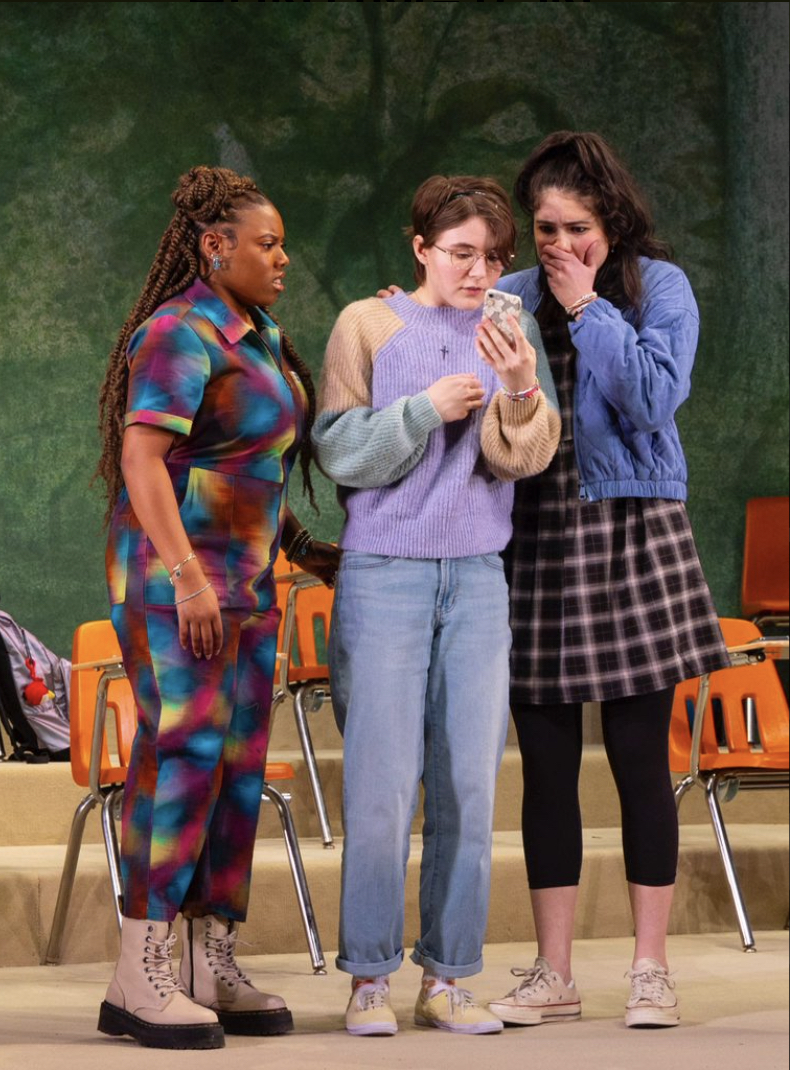
Victoria Omoregie, Jules Talbot, Haley Wong in John Proctor is the Villain; directed by Margot Bordelon; photo by T Charles Erickson

The dialogue is wicked-smart, filled with references from classic literature to song lyrics.  Though all are understandable because of clever context, only one is fully explained.  Belflower begins Act 1 in a classroom where sex education has been buried inside English-Lit, all the better to rush through the uneasy curriculum.  Along with getting a quick hit of each of “Villain’s” characters, this opening enables teacher Carter Smith (a  charmingly approachable Japhet Balaban) to also introduce any audience members not already familiar with Miller’s work to the major themes of The Crucible and the historical background of Witch Hunts.  It also becomes clear very quickly how much the study of the arts is giving meaning and purpose to the lives of these students

While serious issues of feminism, sexuality, body positivity and all varieties of belief run under the surface, front and center is a story of the power of female friendship.  The young ladies are created with some stereotypical DNA, but every one is layered with unique and endearing details.  Caught in a very personal #MeToo scandal through the actions of her father is Ivy Watkins (a warm Brianna Martinez).  Her former best friend Shelby Holcomb (a thorny Isabel Van Natta) has just returned to school after an unexplained “sabbatical” which might be connected.  Often speaking truth to power is Nell Shaw (a high-octane Victoria Omoregie) bringing “worldly wisdom” to the conversation from her upbringing in Atlanta.  At the other end of the confidence spectrum is Raelynn Nix (a fabulously wriggly Haley Wong) the local preacher’s daughter. The ultra serious Beth Powell (a ready-to-spring Jules Talbot) launches a feminist club in part to boost her college application but also to give them a container for discussing their feelings. They have a developing ally in Mason Adams (a sweetly awkward Maanav Aryan Goyal ) who experiences a particularly lovely character arc.   Filling out the attendance sheet is Raelynn’s ex-boyfriend Lee (Benjamin Izaak) and the class guidance councilor Bailey (Olivia Hebert) who are essential to the plot.

Seasoned director Margot Bordelon, who has a history of amplifying new voices, seems to have deep love for these characters, bringing out every delicate moment of discomfort and rage with authenticity.  The school room’s simple set by Kristen Robinson changes temperament with the help of Aja M. Jackson’s lighting.  Sound designer Sinan Refik mixes snippets of pop tunes with school bells and eery noises to further shift the tone of the room.  The girls also make themselves heard in their choice of wardrobe (Zoë Sundra) and in Raelynn’s case evolving eye make-up.

Whether it is exploring weighty matters (like why is “too much” simply parental shorthand for “a girl)” or making us laugh in solidarity, John Proctor is the Villain always keeps us entertained.  True enjoyment requires the ability to think big and a tolerance of of other points of view.  It is available as an On Demand stream from The Huntington Theatre in Boston through March 24.  Running time is about 100 minutes with no intermission. Digital tickets are available at four price points starting at $30 and can be purchased at https://bostontheatrescene.huntingtontheatre.org/28317/28319.