Tag Archives: Irene Diamond Stage

An American Daughter

A revered doctor and celebrated champion of women’s health is on track to be confirmed in a bipartisan vote as Surgeon General only to see her nomination derailed by an understandable personal oversight and a catty comment made by a conservative friend.  That storyline at the center of Wendy Wasserstein’s play An American Daughter seems ripe for reexamination amidst the hash political climate of Trump Two.  Tragically the bloated, charmless production that opened at the Irene Diamond Stage on Tuesday night will only serve as a lamentable introduction of an often witty and insightful playwright to a new generation.  

Originally presented in 1996, this script was never the strongest in the Wasserstein prize-winning oeuvre.  Despite a worthy cast, it only survived a handful of months on Broadway.  The updated version includes an unpublished Act 2, which does little to solve its structural issues.  Long talky speeches are in need of trimming and supporting characters including an aggressive former student Quincy Quince (Carmen Zilles) and an (inexplicable) family confident Morrow McCarthy (Ryan Spahn) could use more definition and purpose. 

That said, this rendition is singularly problematic.  Executive Director of La Femme Theatre Productions, Jean Lichty,  executes the lead role of Lyssa Dent Hughes with all the ease of The Tin Man prior to the application of oil.  There is no discernible chemistry between her and the rest of the cast.  Tony nominee Montego Glover plays best friend Judith with aplomb, but bafflingly delivers most of her lines directly to the audience rather than to her scene partner.  Tony winner Robert Sean Leonard as Lyssa’s husband Walter keeps shuffling uncomfortably as if he just wants to go home.  Portraying Lyssa’s father Senator Alan Hughes, veteran actor Dakin Matthews fairs better with characteristic wry delivery.  Likewise Mary Beth Peil ( his fourth wife, Charlotte “Chubby” Hughes) is unfaltering even when Spahn’s newly acquainted McCarthy creepily puts his arm around her.
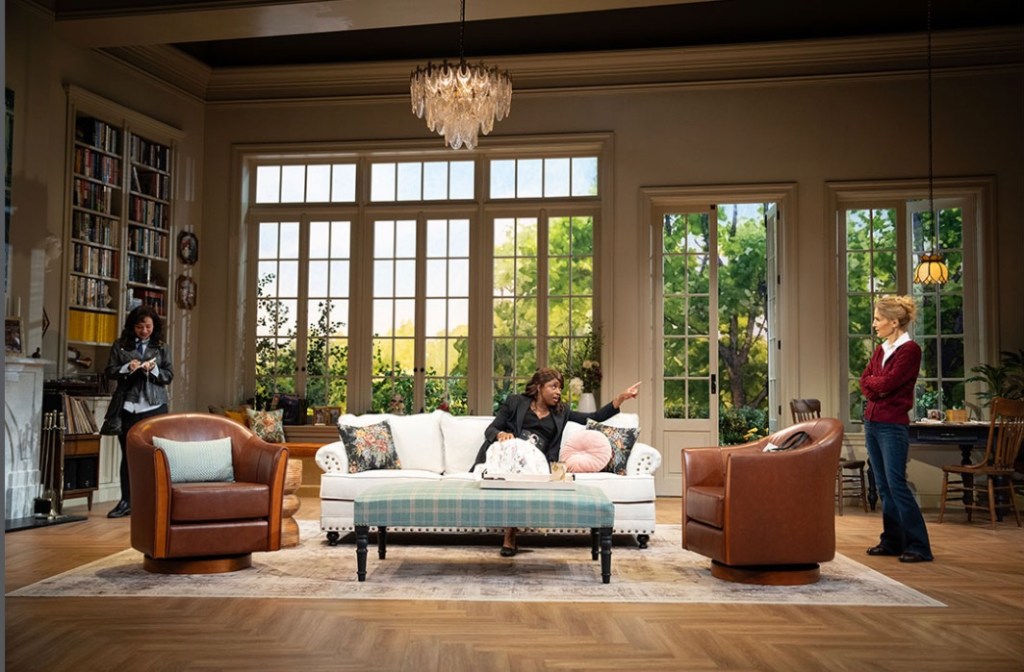
Carmen Zilles, Montego Glover and Jean Lichty in Wendy Wasserstein’s An American Daughter; photo by Joan Marcus

The spacious Georgetown living room set with glimpses of a garden beyond, designed by Mikiko Suzuki MacAdams, is the artistic highlight.  From there, the 1980s television sitcom style direction of Sarna Lapine dampens whatever stakes are present in the material.  The pacing and emphasis are so far off the mark that my friend thought they’d forgotten to insert the intermission.  The artificial nature of the sound design by Darron L. West often distracts from the dialogue in a “what the heck is that?” manner.  Alan C. Edwards’ lighting queues are poky and entrances consequently delayed causing the audience to clap sporadically in the pauses.  By the end they must have been exhausted.  This is the first time in memory that no one gave the cast a standing ovation.

Due to advanced sales prior to the official opening night, the run has been extended through September 20. It is a shame that the apparent enthusiasm to revisit Ms. Wasserstein’s traditionally snappy dialogue and entertainingly maddening situations is met with this dull and draggy revival.  Performances take place in the The Irene Diamond Stage at The Pershing Square Signature Center, 480 West 42 Street.   Presented by La Femme Theatre Productions, An American Daughter is not part of Signature Theatre’s season.  Run time is posted as 2 ½ hours, though the show ran 10 minutes longer when I attended.  Visit LaFemmeTheatreProductions.org for tickets and more information.
The Receptionist

From the beginning, there is something off about the Northeast Office in Adam Bock’s The Receptionist.  There is a squishy sense of period and an even sparser sense of location beyond a workplace within a city with bagels, croissants, and public transportation. Most extraordinary, even with all the narrative phone calls and perpetual office gossip, it is more than halfway through this clipped play that we get any inkling of what these people do for a living.  It reflects well on the banter and incidentals that this revelation is so slow in dawning, effectively delaying our rising alarm.

Though the script has been around for nearly 20 years, its vibe fits all-too-comfortably into 2026 with only a few tweaks.  The construction hasn’t made the trip nearly as well.  Described by Second Stage as “a jet-black comedy,” the work is really more like a simple black and white cookie, with the gloom and the humor lying side by side.  By the end, much remains merely hinted at with mixed effect.  Post show chatter in the ladies room, where sometimes the most insightful criticism is shared, was split between those who felt sure they’d missed something and those who reveled in the murkiness.

The spiky dialogue is mostly between Katie Finneran’s good natured receptionist Beverly Wilkins and Mallori Johnson as a staff member, Lorraine Taylor.  Though further up the org. chart, the stunning but insecure Lorraine lacks Beverly’s assured hand.  With her consistent missing of her bus, inappropriately flirtatious manner and golf bag clearly in view inside her office door, her holding down of a job is yet another office mystery.  Their breezy day is disrupted by the dark cloud of Will Pullen’s Martin Dart from the Central Office.  He is seeking a chat with their head of office, Edward Raymond (an underutilized Nael Nacer).  We shouldn’t be surprised that someone so named would stay on target.

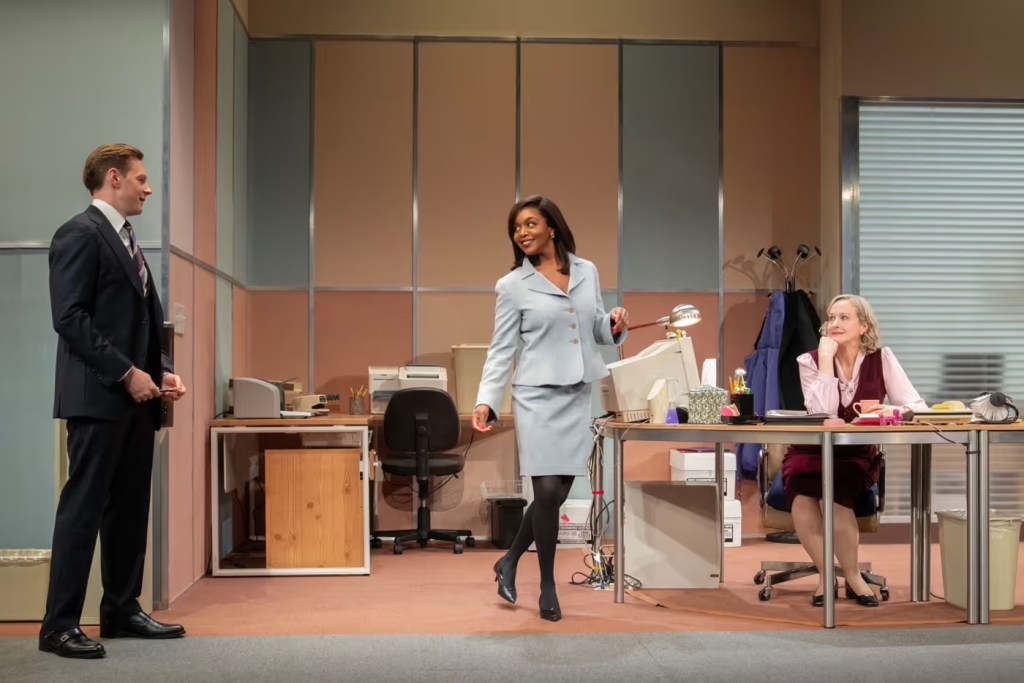
Will Pullen, Mallori Johnson and Katie Finneran in The Receptionist; photo by Joan Marcus

A skilled hand at refining sharp viewpoints, director Sarah Benson steers her cast through the ripples of normalcy and then oddness.  Encased within the earth-toned carpeting and padded walls by design collective “dots” and fashioned in part by Cookie Jordan’s wig design, the actors spark off one another, even though their characters lack the definition you’d expect to find in an expanded metaphor.  Like Jayne Houdyshell before her, the potential predictability of Beverly benefits from the performance precision of two-time Tony winner Finneran. She vivaciously transmits her character’s “in-the-know” regarding the finer details that flow through her.  Likewise Johnson finds a provocative note within Lorraine’s exhausting coquettishness.

The Receptionist is an amuse-bouche of a play: tasty, but not enough of anything — comedy, commentary, character development — to be fully satisfying.  (And yes, I am using another food metaphor.)  The intervening years have provided us with too many chilly worlds that are better and more distinctively built.  Part of Second Stage’s 47th season, performances are scheduled through May 24th at the Irene Diamond Stage in the Pershing Square Signature Center, 480 W 42nd Street near 10th Avenue.  Running time is 80 minutes without intermission.  Tickets begin at $66 up to $136 for premium seats.  The latter price range includes the entrance row G where there is extra legroom and space for wheelchairs.  Those in row H get a height boost, though there is a thin railing in front.  

Lunar Eclipse

When the earth, moon, and sun are in alignment, the moon moves into earth’s shadow blocking light from reaching the moon’s surface.  This lunar eclipse is the featured event of Donald Margulies play of that name.  It also serves as a somewhat strained symbol for the darkness that has engulfed the long marriage of 70-something George and Em.

The piece opens with George alone on stage crying in the vastness of night in a field on his Kentucky farm.  Soon Em arrives with a gigantic bag filled with items that might make him more comfortable, though he doesn’t show much interest in her offerings.  They talk as they wait for the moon to take on its eery red glow.  The phases of the astronomical phenomenon — umbra, penumbra, total — are projected behind them, inserting breaks in flow of their conversation.  It soon becomes clear that much as the moon’s shine is being swallowed up, so have they been swallowing their fears and sadness.

George is intellectual with a particular interest in the stars and a strong need to stop and appreciate his surroundings.  Em is more an instinctual “city girl” and her relative ignorance allows George to explain events to us as well.  As time elapses and the bourbon flows, their increasing levels of honesty and respect break chinks in the wall between them.  Despite all the disappointments they’ve had to face, they are reminded why they chose each other in the first place.

Lisa Emery and Reed Birney in Lunar Eclipse; Photo by Joan Marcus

Marital every day moments and eventual strain is not new territory for playwright Margulies, who previously won the Pulitzer Prize for Drama in 2000 for Dinner with Friends.  Much of the terrain here is as well-ploughed as George’s family farm.  But director Kate Whoriskey has been blessed with her cast.  Lisa Emery and Reed Birney — reprising his role from Shakespeare & Company’s 2023 production in Lenox, Massachusetts — remain two of the most reliable stage performers and watching their exchange is enthralling.  The dialogue may not be radical, but much is communicated in a touch, a look, or a pause. Their poetic descriptions of worry, loss, and grief ring true, though the fog doesn’t just roll across the skies.  

Scenic designer Walt Spangler has created a thick black box around the proscenium, restricting the space and cushioning the actors’ movements with earth (though what that does to the audience view from the first few rows is unwelcome.)  Just a few wild flowers add color to the landscape.  The tinkling of a piano lulls the audience upon entry to the theater.  Occasionally the soft sounds of the surrounding nature join Sinan Refik Zafar’s soundscape.  Lighting by Amith Chandrashaker provides metaphoric bright and shadow building to the crescendo of S. Katy Tucker’s video.

Unsurprisingly, though seeped in tragedy, Lunar Eclipse with its slow reveals and well-earned sorrow, is a master class in acting.  Performances take place on The Irene Diamond Stage in the Pershing Square Signature Center, 480 West 42nd Street. Runtime is approximately 90 minutes without an intermission.  Tickets are available through June 22 at https://2st.com/shows/lunareclipse