Tag Archives: Isabella Byrd

Glass. Kill. What If If Only. Imp.

The announcement of any performance of British playwright Caryl Churchill is cause for excitement.  She has long been a powerful and intriguing voice for gender equality, environmental protection, and sense of self while providing memorable entertainment.  On that score, the premiere program of four of her short works — Glass. Kill. What If If Only. Imp. — at The Public Theater is a disappointment.  Director James Macdonald and his artistic team have done a masterful job of making the production visually interesting.  But while moments gleam, it never comes together as a cohesive event.

Glass explores the melancholy lives of four decorative items (Japhet Balaban, Adelind Horan, Sathya Sridharan, and Ayana Workman) beyond the confines of their shared mantelpiece. Designer Miriam Buether’s first impactful set is a solid LED jutting out from the darkness and demanding attention.  Though a soulful Workman gives depth to the glass figurine who is the catalyst for the tragic events that unfold, Glass plays out more like an acting class exercise than a full fledged work of theater.
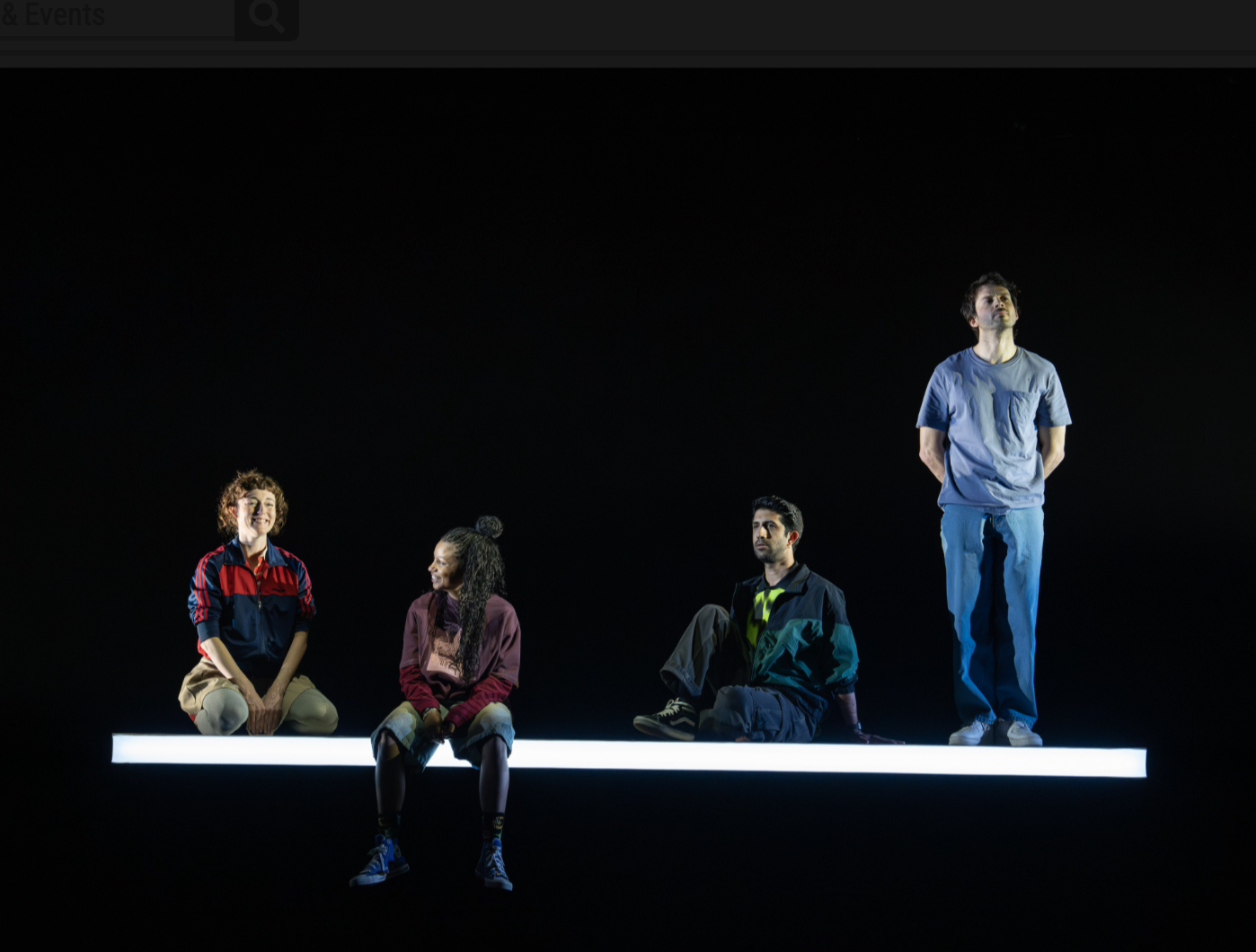
Adelind Horan, Ayana Workman, Sathya Sridharan, and Japhet Balaban; photo by Joan Marcus

Deirdre O’Connell, who won a Tony Award for her solo work in Dana H, pulls off the chillingly violent patter of Kill.  Sitting comfortably on a puffy cloud, a sparkling god of Olympus recounts many evil deeds performed by men — from the prideful Tantalus to the warrior Agamemnon — in the Pantheon’s name.  The repetition would sound like the narration of a five-year-old were the content less bloody.  A knowledge of Greek mythology is essential for following the rapid-fire references, though the essence is clear from O’Connell’s tone and manner.

The first half is closed out with What If If Only, a meditation on love, loss, and the risks of second chances.  For this solemn reflection, Buether provides a still life setting in stark black, white and red.  The sound design of Bray Poor also plays a key role by reinforcing the oppressive atmosphere.  The philosophical theater game is anchored by John Ellison Conlee, who makes the absurd sound completely natural.  

Breaks between these plays are filled by two talented acrobats.  The first is Junru Wang, who performs a balletic work while her hands balance on small stools at the foot of the stage.  For the second, we are treated to what I christened a “juggler-tease” performed with flirtatious glee by Maddox Morfit-Tighe.  Unfortunately some of his choreography was out of the sight lines of the back half of the audience.  Whether these two talented people provide unity, distraction, or a fleeting moment of joy is up to the beholder.

The second half of the program is fully occupied by the more plot-heavy Imp.  Conlee and O’Connell portray Jimmy and Dot, friends close enough to consider themselves brother and sister of different parents.  The affable Jimmy lifts his mood with running and chess.  Slumped in a nearby chair, Dot is ill-temperated and unwell.  She also believes herself to be in possession of a magical imp imprisoned in a wine bottle.  

The rhythm of their lives is altered by the arrival of two newcomers.  First their niece, Niamh, a recent transplant from Ireland stops by.  (Horan is wonderful at delivering Neve’s wildest fears in recognizable Churchill style.)  Then the couch surfing Rob enters their lives (Balaban again).  The younger pair is tossed about, though who’s to say whether their bumpy ride is caused by a supernatural being, the differing attitudes of their hosts, or just life.

It is fitting that the stage on which Glass. Kill. What If If Only. Imp. are performed is framed in chase lights with definite personality (Isabella Byrd lighting design).  With its bitesized ideas and high level of engagement, it’s Caryl Churchill for the TikTok generation.  Churchill’s signature poetic language and extraordinary themes are intact, but there is too little structure.  The Playbill notes encourage us to look beyond conventional narratives, but humans are storytellers with a need for an organizing rope to hold.  The feeling left behind by experiencing these four shorts is more akin to a stroll through a depressive art gallery than witnessing an emotionally fulfilling theatrical work.  Performances continue through May 11th at the Martinson Theater at The Public, 425 Lafayette Street.  Running time is 2:15 with one intermission.  Tickets are available at https://publictheater.org/productions/season/2425/caryl-churchill-plays/ and start at $89.

Primary Trust

I usually don’t make my reviews personal, but my experience while watching Primary Trust and the themes within this gorgeously crafted play are inexorably intertwined.  With gentle brushstrokes, Eboni Booth introduces us to 38 year old Kenneth, one of the few Black people living in Cranberry, a suburb of Rochester, New York.  His ethnicity is only a minor contributor to Kenneth’s isolation.  Having lived an extremely restricted life since the death of his mother when he was only ten, Kenneth’s coping mechanisms are intricate and ritualized.  But somehow his idiosyncrasy has left him uniquely suited to meeting people at their own level.

There is a deliberate “let’s pretend” quality to the entire production.  From the opening moments, Kenneth speaks directly to us in his halting and self-reflecting style.  Long thoughtful pauses rest between effervescent bursts of storytelling.  All the activity comes with musical accompaniment composed by Luke Wygodny, punctuated by the ding of an “order up” bell.  Marsha Ginsberg’s whimsical scenic design takes the phrase “small town” and makes it literal, including a miniature church, bank, and big box store alongside Wally’s, the tiki bar that serves as Kenneth’s sanctuary.  Lighting by designer Isabella Byrd leaves long shadows on the ground well before winter sets in.  Costume designer Qween Jean employs a more muted color palate than her signature style until an essential jacket makes its appearance at a pivotal moment. Two actors play multiple roles, sometimes barely turning around before switching.  Yet the play is never anything less than genuine and heartfelt.  The entire audience was sufficiently swept up to respond emotionally to every turn.

William Jackson Harper is utterly perfect as Kenneth, balancing warmth, vulnerability, fear and heart.  It’s Harper’s first stage appearance since 2017 and it was my first live theater attendance since March of 2020.  Previously, theater played a major role in my life.  Many of my friends come from that world and it was often the way I entertained others.  Vacations have been planned around seeing a specific work or actor. The temporary loss of that pursuit was profound.  But Primary Trust is all about bringing people in.  At its core is the celebration of coming out of seclusion.  To have Kenneth welcome me as a member of the audience into his life could not have been more impactful. And though I don’t have much more in common with the character, I do share his deep belief in the power of one good friend.

Jay O. Sanders, William Jackson Harper, and Eric Berryman; photo by Joan Marcus

Director Knud Adams, who often works with new material, delicately mines Booth’s script, uncovering the layers of joy, sorrow and hope. Providing support and stability for Kenneth is his best friend Bert, played with sweet good nature by Eric Berryman.  Jay O. Sanders seems to be having the time of his life portraying (among other characters) Kenneth’s two very different bosses.  The first — the owner of a bookstore— has the difficult task of laying Kenneth off after twenty years of a comfortable relationship.  The loss of his job shatters the comfortable if confining structure of Kenneth’s life, and the chink of light shining through the holes is both frightening and filled with possibility.  Helping Kenneth step through the gap is April Matthis’s Corinna, the only one of a multitude of Wally Waiters who wants to see Kenneth as more than an eccentric customer.  Completing the ensemble is a Musician played by understudy Paul Lincoln in the performance I attended.  So essential is he in setting the beat and tone, that Mr. Lincoln received his own loud round of applause.

Roundabout has obviously worked to make this production inclusive.  The company offers clear and sensible guidelines to audience members and the staff makes themselves very available to help.  To get you in the mood for what is to come, the lobby has been decorated to resemble a tiki bar, complete with projected fish tank and artificial grass.  The ticket confirmation warns audience members not to arrive late.  I can only reemphasize their strong recommendation.  Missing any of the first few minutes of the show will leave you with quite the wrong impression of what is transpiring.

Primary Trust is a work of true beauty.  It was nurtured at the 2021 Ojai Playwrights Conference and is a recipient of an Edgerton Foundation New Play Award.  Running time is an absorbing 95 minutes with a realistic denouement.  It is playing at the Laura Pels Theater in the Harold and Miriam Steinberg Center for Theatre (111 West 46th Street) through Sunday, July 2.  (Note that Harper is out the weekend of June 9.)  Tickets start at $56.  $4.95 COVID cancelation insurance is available.  Visit www.roundabouttheatre.org for additional information including special performances.