Tag Archives: Kenita Miller

Emma Duncan: In Praise of an Alternate

It is not unusual for a theatrical production to hire an alternate for a leading role.  Unlike an understudy, who is typically a member of the ensemble, an alternate is cast to play one specific part.  They can either be solely on stand-by or — particularly for a musical — contracted for set performances such as Wednesday and Saturday matinees.  

Animal Wisdom is a very personal piece written by Heather Christian in which she originally played  “Heather”.  It is more like a live performance of a concept album than a traditional musical, with the star singing the lead on every song.  For their revival, Signature Theatre at Pershing Square was lucky enough to find two very different women with powerhouse voices — Kenita Miller and Emma Duncan as the alternate —to take on the central character now known as “H”.  The company’s persistent focus on which performances either did or did not feature Miller struck me as disrespectful not just to Duncan, but to everyone else in the cast and to the work itself.  

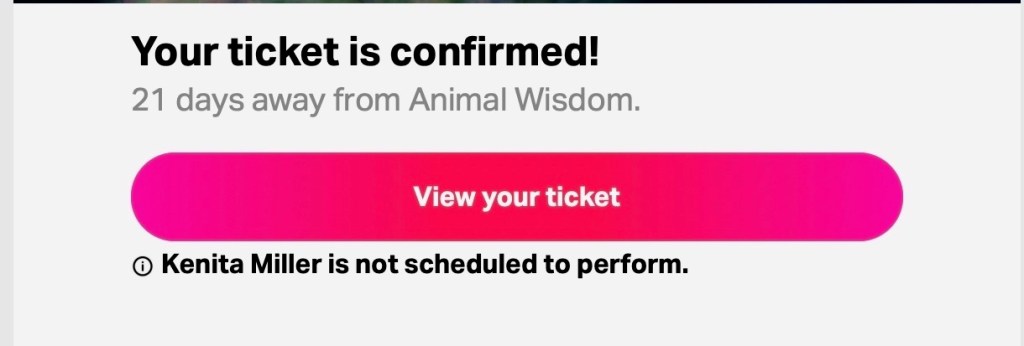
I have seen a number of fabulous alternates over the years.  (Hello, Javier Muñoz as Hamilton!)  What I had never seen is an alternate overtly treated like an also-ran.  So incensed was I, I spent over $100 on a ticket to see the “H Alternate”.  Ms. Duncan is a recipient of the prestigious Princess Grace Award which supports outstanding emerging artists.  (Some past winners whose names you may recognize are Leslie Odom Jr, Oscar Isaac, Paul Tazewell, and Patrick Page.)   But rather than saying that it was she fulfilling the role of “H” at the May 23rd matinee, my ticket only said Kenita Miller wasn’t.  Unsurprisingly, over 30% of the house was empty, even though it was a wet and unseasonably cold day.  
The part of H, the “cantor” of this musical ritual, is extremely demanding.  Composer Christian describes it as “an olympian feat of radical empathy.” Not only must whomever embodies H cover multiple song styles but do so at points while singing at a 45° angle, while being spun around a small circle, and for one song, while wringing tunefulness from a hanging condenser mic.  

Though similar in timbre to Christian’s, Duncan’s voice seemingly binds with your central nervous system.  Pouring from her waifish body comes a tone that is a little Joni, a little Janice, a little Xtina and a lot “oh, my goodness!”  If some Miller fans were waiting until the Tony nominee took the stage in the evening, at least they had background for their choice.  But if the clumsy marketing had anyone thinking they would get a lesser experience at 2PM than at 7PM, that’s a tragic loss of Signature’s own making.

This post is not a feature.  I did not interview the playwright about what she thought of the two takes on her persona, or the marketing director to ask why Ms. Miller was made the center of the Animal Wisdom promotional campaign rather than the substance, or Ms. Duncan to ascertain whether she was even a little bit ticked off by the consistent emphasis on her counterpart’s appearances.  This is a rant about an inequity that I can (for once) change. So, I encourage you to support a magical performance with your humming, your bell ringing, or just your sweet selves.  Find a seat on your favorite ticketing site for a Friday at 4PM or Saturday matinee of Animal Wisdom.  And don’t be put off when printed upon it are the words “Kenita Miller will not be performing.”  You are in radiant, nurturing, and capable hands, even if her name is in invisible ink.

Lights Out: Nat “King” Cole

In November of 1956, singer/pianist Nat “King” Cole became the first Black man to host a variety show on network television.  Though he eventually had multiple Billboard hits including Mona Lisa, L-O-V-E, and Nature Boy, he never secured a National sponsor for this groundbreaking program.  Major markets, especially those in the South, pressured advertisers to drop their support of the broadcast.  Despite an array of popular guest stars with household names, beaten down by the color barrier, NBC and Cole agreed to terminate the venture the following year after 53 episodes.

Lights Out: Nat “King” Cole, written by Colman Domingo and Patricia McGregor, uses the final taping of the Nat “King” Cole Show to explore not only this chapter in the life of the beloved crooner, but the systematic erasure of Black voices.  It’s an intriguing pick for a central character.  Though Cole participated in civil rights marches and avoided segregated venues, he felt his public role was one of an entertainer.  He sang ballads, not protest songs, even after a cross had been burned on the lawn of his home in a wealthy white Los Angeles neighborhood.  

The play is set in a television studio (scenic design by Clint Ramos) complete with an applause sign, clever lighting (Stacey Derosier), and a live “Nelson Riddle” band on the stage.  This enables the easy integration of music, live-feed camera work and audience reaction.  However, it quickly becomes obvious that this is not a recreation of one night.  Shortly before airtime someone (someTHING) causes the ghost light to flicker and briefly go out, allowing the spirit of Sammy Davis Jr. to explode onto the scene.  In an effort to inspire Cole to go out on a combative note, The Rat Packer takes him through a phantom version of events.  Classic song lyrics are incorporated into the spoken dialogue along with a mix of historical fact as seen through the lens of modern times and Cole’s personal reflection as imagined by Domingo and McGregor.

Dulé Hill in NYTW’s LIGHTS OUT; photo by Marc J. Franklin

Dulé Hill gives soothing voice and gravitas to Cole, a part he cultivated at the Peoples’ Light in Malvern, PA and further developed at the Geffen Playhouse in Los Angeles.  Daniel J. Watts, also reprising his role, grabs Davis by the lapels, practically ricocheting off the walls with intensity.  He is high octane gasoline to Hill’s humming battery pack.  Playwright McGregor directs, bouncing the two very different friends off one another, culminating in a dynamic dance number (choreography by Edgar Godineaux with tap by Jared Grimes). Though the plot line is choppy and likely to challenge those unfamiliar with the named celebrities and cultural touchstones, the songbook alone (arrangements and orchestrations by John McDaniel) makes for highly satisfying entertainment.  

Hill and Watts positively dazzle in the leads, capturing key qualities of their characters and steering clear of imitation.  The action is kicked off by Elliott Mattox’s convivial Stage Manager.  Cole’s white producer is portrayed in myriad forms by Christopher Ryan Grant.  Krystal Joy Brown makes an early impression as a purring Eartha Kitt, later embodying an enchanting daughter Natalie Cole. Also displaying range is another vet of the previous run, Ruby Lewis, who depicts both spunky Betty Hutton and sultry Peggy Lee.  Matriarch Perlina Coles, who first introduced Cole to the piano, is played with soulful sincerity by Kenita Miller with Mekhi Richardson performing as young Nat (and a younger Billy Preston) the afternoon I attended.  Adding a comedic touch is Kathy Fitzgerald as make-up artist Candy.  She is also featured in the highly creative live commercials that run throughout the program.   

You feel the ripples of connection move through different sectors of the audience depending on whether it is Cole performing his rendition of The Christmas Song, Lift Every Voice and Sing vocalized by mother Perlina, or young Natalie joining him for a duet of Unforgettable (something she created in the studio long after his death).  When you layer in the profound racism, disgraceful accepted stereotypes, and aggressions micro and macro, the entire experience becomes a social study as well as a piece of engaging theater.

Likely to fill you with a bubbling combination of elation and frustration, Lights Out: Nat “King” Cole provides a worthwhile conclusion to a bold season at New York Theatre Workshop.  Performances continue through June 29 on the main stage at 79 East 4th Street.  Runtime is 90 minutes without intermission.  The actors smoke heavily, making me grateful to remain a mask-wearer.  Tickets start at $49 and are available at https://www.nytw.org/show/lights-out-nat-king-cole/.