
Tony nominee Bess Wohl’s latest endeavor, Liberation, is a memory play in which the narrator describes events from someone else’s experiences. She imagines what it was like for her own mother in the early days of the fight for women’s equality. Through a series of talking circles with her mother’s friends, she attempts to shine a light on the connection between personal decisions and societal evolution and gain a better understanding of her own choices.
A zestful Suzannah Flood takes on future mom Lizzie, Lizzie’s daughter, our leading lady, and the voice of the playwright. Flood has an endearing everywoman quality and relatability. Her opening monologue weaving together all four women is a highlight of the evening. She addresses the herd of elephants in the room, beginning with the political victories that are slipping away. To better appreciate The Now, Lizzie’s daughter will role-play her own mother. The path Lizzie chose in her twenties led to our host’s very existence and we should become deeply invested. But the ensuing storytelling is like learning ballet by drawing the steps on a blackboard. We grasp the ideas intellectually, but without experiencing any authentic movement.
We are transported to Ohio in 1970 where budding journalist Lizzie is endeavoring to form a consciousness-raising group for women. Five strangers have responded to her flyer and arrived at the local rec center. Margie (Betsy Aidem) is a married woman with grown children whose entire life is consumed by caring for her family. Dora (Audrey Corsa) is a young secretary whose intellect has been overlooked because she’s pretty. Celeste (Kristolyn Lloyd) — the lone woman of color — is an Ivy League graduate whose career has been blown off course by her ailing mother. Isidora (Irene Sofia Lucio) is an Italian immigrant with creative ambitions who married for a green card and now wants out. And Susi (Adina Verson) is living in her car and feeling completely exhausted by life. Two others pass through the room. Bill (Charlie Thurston) will eventually become the husband/father. And Joanne (Kayla Davion) who arrives in search of her son’s lost backpack. Her involvement in Act 2 provides one of the few exhilarating scenes in a series of otherwise predictable beats.
We are told these women are friends, but despite literally stripping themselves naked before one another, they do not truthfully reveal themselves. Lizzie is too fearful of making a wrong move to be a leader or even anoint one. We are reminded of the many limitations women faced in the days when they couldn’t open a bank account and no fault divorce was only legal in California. But with only descriptions to go by, we experience a glancing blow rather than an enduring punch. Stuck in chat mode, they all remain types from the era and never reach our hearts.
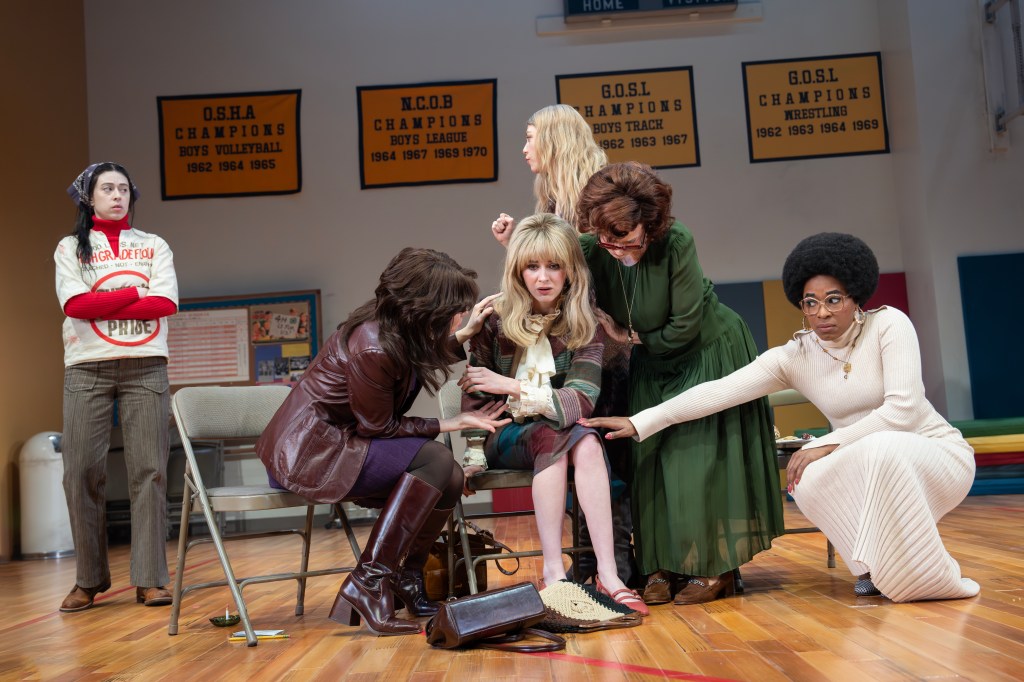
The cast is up for the creative exercise, playing their counterparts in both past and present and occasionally stepping into the role of Lizzie when a situation would be awkward for her daughter to recreate. Director Whitney White provides as much variation as she can, using the gym equipment to change the composition of bodies. Set designer David Zinn adds some color with an unlikely rainbow of gym mats while costume designer Qween Jean seems to have had a blast at the local thrift shops to reconstruct that fabulous 70s look.
To protect the actresses from having nude images of themselves released by the public, all audience members must place their phones into a locked Yondr Pouch. Unfortunately, no one at the venue was responsible for assuring that devices had been silenced or turned off, so the performance was punctuated by rings and pings. The woman next to me could only kick her purse more deeply under her seat and smile sheepishly.
Liberation would be more successful in its mission if the characters generated the same level of support towards one another as the actresses seem to. The message that even a little gesture can move a cause forward is an encouraging one, especially in a time when many of us feel like we are losing ground. Instead, these characters inflict a concept of equality upon one another that feels more like another form of repression.
An Off-Broadway entry to Roundabout’s season, Liberation continues through Sunday, March 30 at the Laura Pels (111 West 46th Street). Tickets are available at https://www.roundabouttheatre.org/get-tickets/2024-2025/liberation and begin at $80 including fees. Running time is 2 ½ hours including a 15 minute intermission.
 The Unforgettable Line
Blue Ridge
Alison only knows one way of being. All waving arms and defensive language, she’s a fast talker in all the meanings of that phrase. Having been incarcerated for taking a hatchet to her lover’s car, she’s been released into the loving care of a church-sponsored sober house in the Blue Ridge Mountains of Western North Carolina. We meet her at her very first group session where she recites Carrie Underwood lyrics instead of the bible passage she’s supposed to have prepared. Within minutes she’s telling the circle why she’s not really responsible for her crime and emphasizing that, having never done drugs, she doesn’t have need of any one of the twelve steps.
Anyone who has experience with someone in recovery will know exactly how this story is going to unfold. That’s the essential problem with Blue Ridge, now playing at the Atlantic Theater Company’s Linda Gross Theater. While Abby Rosebrock’s script is beautifully written with textured dialogue, it doesn’t have anything new to say about mental health, boundary issues, or the powers of addiction in its many forms. Only those who find a new path have a real prayer of moving on intact enough to survive in the outside world.
From lower left: Peter Mark Kendall, Chris Stack, Kyle Beltran, Kristolyn Lloyd, Nicole Lewis and Marin Ireland in Blue Ridge. Photo by Ahron R. Foster.
In the hands and body of stage steady Marin Ireland, Alison is particularly irksome. Her constant shrillness and twitching makes it hard to believe anyone in this substitute family would warm to her. This is especially true of her devoted roommate Cherie, played with deep sincerity by the excellent Kristolyn Lloyd. The male housemates’ reactions come from two diametrically opposed yet equally predictable directions. Peter Mark Kendall brings genuine vulnerability to the easily beguiled Cole while the endlessly watchable Kyle Beltran’s Wade creates friction in his struggle to find inner strength. The program’s co-founders are equally ill-equipped to lead everyone safely through a troubled journey. Pastor Hern (a smooth Chris Stack) weakly attempts to guide the housemates in a more mindful direction, and Nicole Lewis’s insufficiently defined Grace generally lives up to her name by simply finding the good in what comes naturally to each of her residents.
Director Taibi Magar successfully explores the shifting mood as the house moves from warm community to too close for comfort. Confrontations have a palpable and fiery emotional core. Her pacing is off, though, with the play running nearly 15 minutes over the prescribed two hours on Thursday night. Mikaal Sulaiman provides the intelligently curated soundtrack for both conflict and healing. Unfortunately, some of the other design choices are distracting. Why is the ten year old furniture of Adam Rigg’s set in a palate associated with the late 70s? Why does Amith Chandrashaker’s lighting incorporate an incongruous brilliant December sunshine streaming through the window and ugly fluorescent overheads that play a supporting role for just a few minutes? Why, while indicating the passage of time through Thanksgiving throws and a Rudolf mantlepiece, do we need to break the story’s flow and see each item put in place by the glow of a proscenium of LEDs?
Taken as a whole, this production of Blue Ridge is flawed and consequently frustrating. Writer Rosebrock has obvious talent, but her storytelling has not yet been brought into focus. However, if you are fascinated by the ways in which broken people can either fit together with or puncture those around them, you may find enough with which to engage. This limited run is scheduled through Sunday, January 27th. Regular tickets begin at $65 and can be purchased online at atlantictheater.org, by calling OvationTix at 866-811-4111, or in person at the Linda Gross Theater box office (336 West 20th Street between 8th and 9th Avenues).