Tag Archives: La MaMa

The Door Slams, A Glass Trembles

A Talking Band production is to a typical scripted play what an impressionist painting is to a photograph.  The plot lines are delineated, but the total picture is brought into focus through imagination and experience.  Their newest work, The Door Slams, A Glass Trembles, is being presented in association with the famed experimental La MaMa.  Judging from audience reaction, this is a match made in avant-guard theater heaven.

Written and directed by founding member Paul Zimet and partially inspired by Thomas Mann’s The Magic Mountain, The Door Slams… takes place in a modern day rural family home and a pre-WWI alpine sanatorium as well as in the memory of Marc (Jack Wetherall).  Over the course of multiple dinners, we learn that he and his wife Clara (Ellen Maddow) have retired to a house in the forest after having their research funding abruptly terminated.  Their family — son Norm (Patrick Dunning), game-loving daughter-in-law Jenny (Amara Granderson), and unseen granddaughter Abby — are visiting for the summer.  They have forged a new community of similarly frustrated neighbors (Lizzie Olesker, Steven Rattazzi and Tina Shepard). Not content with the present and with more time stretching out behind him than in front, Marc often reflects on his first love Anne (Delaney Feener) and the promising work he was forced to leave unfinished.  
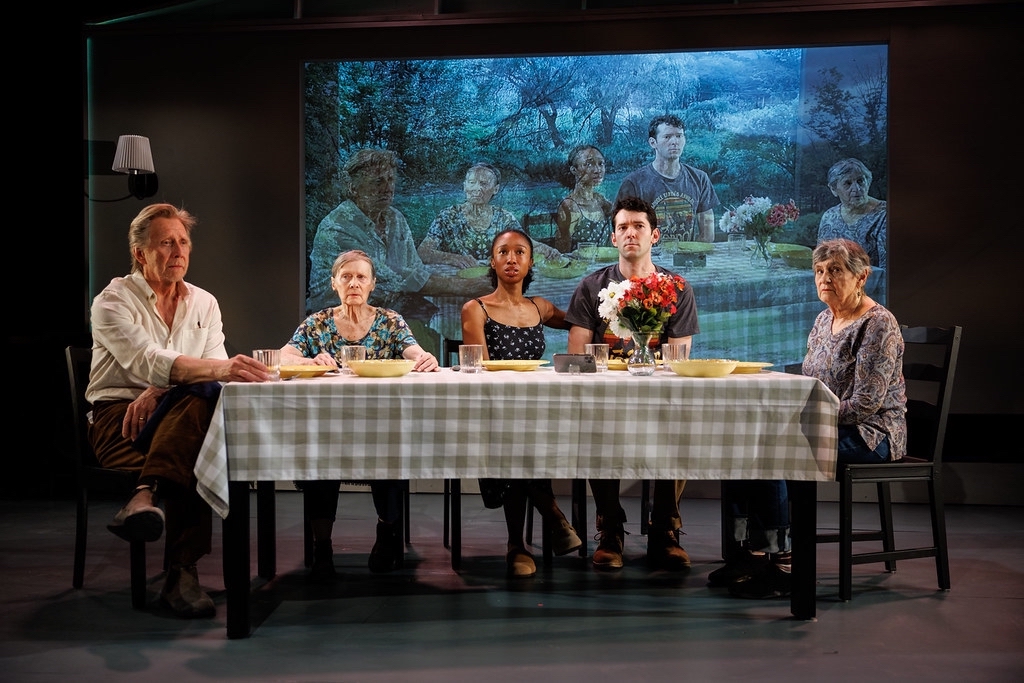
Left to Right: Jack Wetherall, Tina Shepard, Amara Granderson, Patrick Dunning, and Ellen Maddow; Photo by Maria Baranova

As with Talking Band’s previous collaborations, the story unfolds gently, with co-founder Maddow’s music, the choreography of Flannery Gregg, and lighting by Mary Ellen Stebbins playing as much of a role in the storytelling as the dialogue.  The ensemble — including third co-founder Shepard — is truly a band, with many of the players from previous shows making a return.  Actions are repeated but varied like a movement of a symphony.  Newcomers including Dunning and Feener pick up the rhythm.  Time with its patterns and alterations is central, especially as expressed by preternaturally forlorn-faced Wetherall.  There are well-placed moments of triumph and humor.  Politics is not the main course, but rather a scent wafting in from another room.

In Anna Kiraly’s set and video design, a few key pieces are all that is needed to convey time and space.  A slanted roof shape and window define the dwelling.  Rather than execute the scene changes under cover of darkness, the cast emphasizes the shifts with sound and gesture.  A well constructed family table easily converts to one appropriate for a large banqueting hall.  The front deck of the house is also the deck of a ship.  A window displays the actual woods outside and the murky waters of the mind.  Costume design by Olivera Gajic follows form with tees adorned with clever slogans swapped out for period formal attire and fancy dress.  

The Door Slams, A Glass Trembles has made a providential arrival, opening in a year when for many of us the nature of time feels like it is shifting.  The company’s comfort and understanding of the distinct Talking Band technique make the content flow like the waves and wind incorporated into the projections, even when the events are distressing. The World Premiere plays through May 10, 2026, at The Downstairs at La MaMa, 66 East 4th Street.  Tickets  ($40 General Admission, $35 students/seniors, $10 La MaMa members) can be purchased at https://lamama.org/the-door-slams-a-glass-trembles/ .  Running time is 70 minutes without intermission.  Due to the intimate nature of the piece, latecomers are offered stools to the side of the main seating area.  
The First Line of Dante’s Inferno

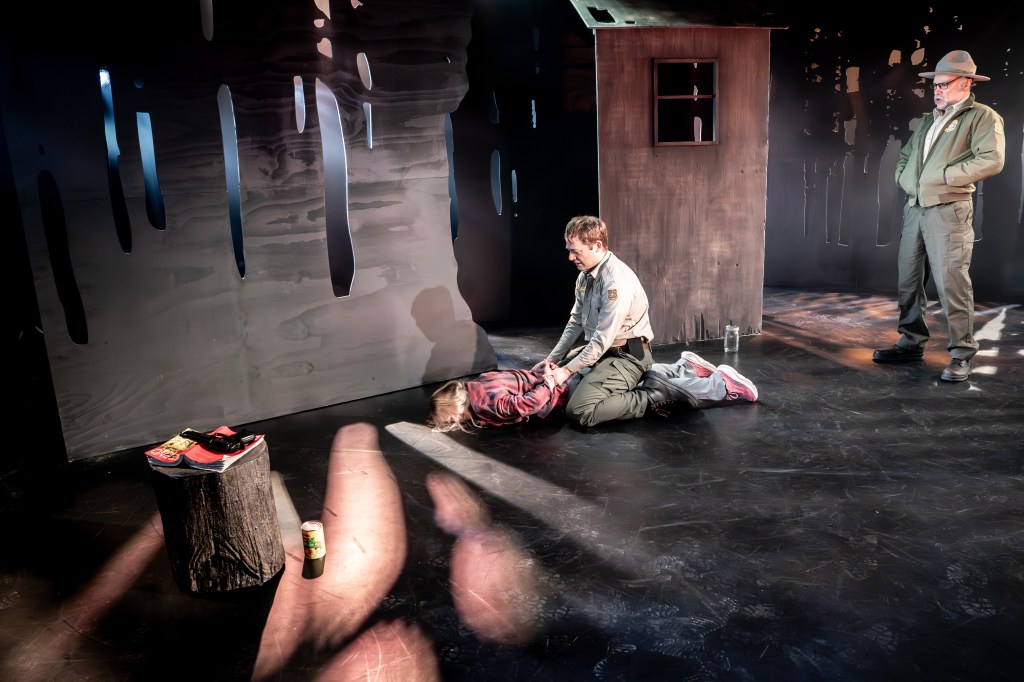
The presiding character in The First Line of Dante’s Inferno has no lines, but dominates and literally overhangs the dialogue.  It is the dark outlying woods represented by Lauren Helpern’s evocative set, with Jianzhi-esque  trees and a blackened canopy that flutters in the HVAC of La MaMa’s Downstairs Theatre.  This is where Ann (Kellie Overbey) has come, seeking her missing sister Carol.  As she shouts out to any creatures nearby, it becomes clear this is not her customary environment. Her tiny basecamp — a one room squatter’s cabin made of stolen plywood and containing a camping stove, a sleeping bag, a copy of Inferno, and some moonshine — has been under observation by a young ranger, Craig (Evan Sibley).  He has also been on Carol’s trail, though he is less optimistic about her being found.  With stunning speed, the two make an arrangement that will allow Ann to continue her search.  But the longer the duo stays within the forestland, the more feral they become, shedding social norms in favor of unfiltered instinct.  

Kellie Overbey, Evan Sibley and Greg Stuhr in The First Line of Dante’s Inferno; Photo credit Marina Levitskaya

Similar to the title’s narrative poem, Kirk Lynn’s emotionally gripping script is constructed in the style of Story Theater, with characters describing their actions.  First and third person are used interchangeably as if they too are fictionalized versions of themselves.  The shifting perspective often reveals more about the storytellers than the story.  The blending of facts, memories and psychological response is repeatedly illustrated by the telling phrase “As I remember…”  as if at heart they question whether their statements are 100% true.

Under Christian Parker’s direction, Overbey and Sibley truly play off each other, generating surprising wattage from an unlikely pairing.  Ann’s and Craig’s elevated honesty and rawness is refreshing and often funny.  So, too, is Craig’s older partner, Bill (Greg Stuhr) whose years of job experience have not necessarily made him wiser and certainly not a better shot.  He is more like an annoying big brother than a senior officer.

Carrying nearly as much weight as the scenic design is Bart Fasbender’s stirring soundscape of animal noises, vocalizations, and rustlings.  By contrast, lighting designer Zach Blane’s recreation of the shifting shadows and foliage sometimes pulls focus from the actors. Kanika Asavari Vaish designed the props, which include a suitably bright red copy of Inferno, that is used as a sort of divination tool. 

For 90 minutes, The First Line of Dante’s Inferno immerses the audience in its own musky world with a unique set of rules.  It is the debut production of Shadowed Forest, a multi-generational company that successfully elicited response from the broad swath of theater-goers who shared the space on a frigid Sunday.  Tickets are impressively priced at $30 for Adults, $25 for Students/Seniors and $10 for La MaMa Members and are available for advance purchase at https://lamama.org/the-first-line-of-dantes-inferno/.  Additionally, the first ten tickets for every performance are $10 each (limit 2 per person) and available first come, first served.  Performances of this World Premiere continue through February 22 at La MaMa’s Downstairs Theatre at 66 East 4th Street.  Recognized and rewarded for its support of experimental theater, this house offers comfortable seating, terrific sightlines, and even a few welcoming beverages for purchase.