Tag Archives: Laura Pels

Joy: A new True Musical

Tired of not being able to answer the simple query, “how are you?” without sighing? Ken Davenport and AnnMarie Milazzo may have an answer.  Their creation Joy: A New True Musical is a type of musical optimism that has audience members returning from intermission wearing the freshly-purchased official T-shirt.  Its message of resolve and imagination envelops people in a purple and yellow cloud that even has them warmly hugging the mops they’ve been handed by the ensemble.

You may be familiar with Joy Mangano from her book “Inventing Joy: Dare to Build a Brave & Creative Life,” from seeing the 2015 movie simply entitled “Joy,” or maybe even from buying her products through the QVC home shopping network.  She was a young mother with a house full of people depending on her when she was suddenly laid off from a steady if uninspiring job.  In other words, she had much in common with women around the country who are behind in their mortgage and anxious to fully provide for their families.  Using a combination of vivid imagination, determination, and a few lucky breaks, she turned her life around.  

The musical retelling of her tale stars the dynamic Betsy Wolfe, who gained a wide range of fans with her Broadway turns in Waitress and & Juliet.  She’s surrounded by an accomplished cast including Adam Grupper as her well intentioned father Rudy, Jill Abramovitz as her overly cautious mother Toots, and Honor Blue Savage as the daughter Christie who only wants Mom to be able to come to her games.  Along her road to success she has dealings with Paul Whitty’s underhanded Cowboy Eddie, and Charl Brown’s experienced network exec Dan, both of whom are given showy performance numbers.  
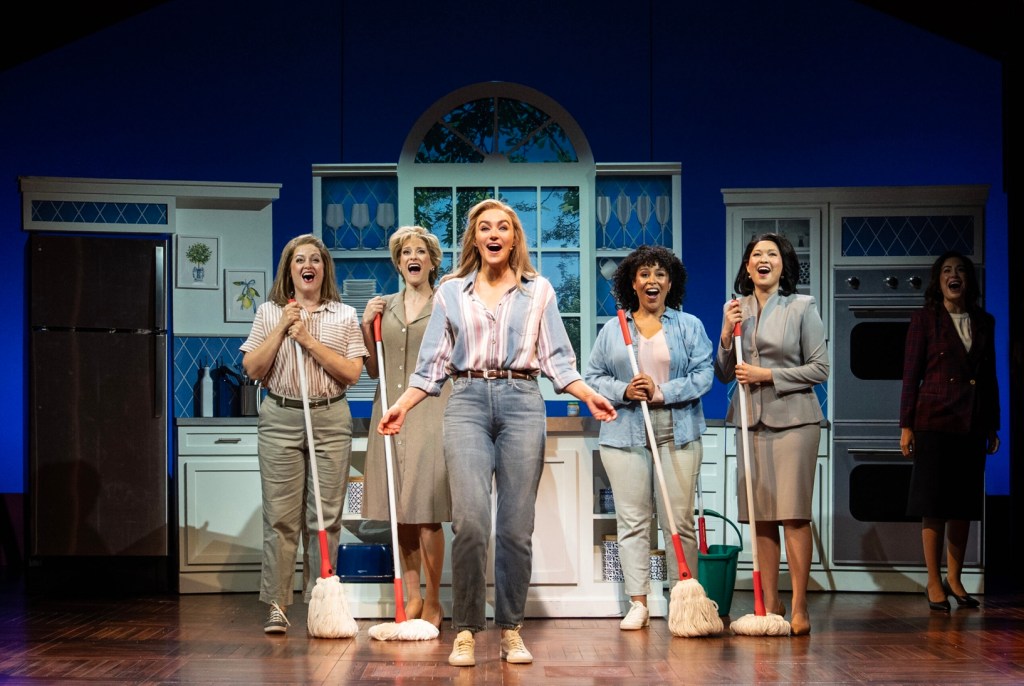
Betsy Wolfe (with ensemble members) in Joy: A New True Musical; Photo by Joan Marcus

It is easy to see why Wolfe is so popular that she gets a round of applause before she opens her mouth. Her very presence fills the house and she sings with much appreciated clarity and emotion.  Milazzo’s score isn’t the most varied and the refrains bleed into one another, but it is tuneful, carried along by Andy Einhorn’s arrangements.  The opening “Welcome to My World” does some heavy lifting, rapidly introducing us to a number of important characters and plot points.  The book by Davenport is considerably more assured than Hollywood’s interpretation of Mangano’s biography.  Filled with broad humor that makes a point, the plot gets bogged down in the second Act in part because it’s hard to top the momentum of Act I.  

Director Lorin Latarro uses her actors and limited space well, giving us glimpses of Bigger Show potential.  Likewise the choreography of Joshua Bergasse is muffled by shoulder shrugs and knee bends when it could eventually soar. The creative team has also delivered with vision but to scale.  Scenic designer Anna Louizos takes a lesson from the TV studios that brought Joy fame, filling a generic cityscape proscenium with small rolling set pieces.  Also taking a cue from television is David Bengali whose projections are critical to the storytelling.  Clever props including the co-staring Miracle Mop are designed by Andrew Diaz. Tina McCartney lets a few key outfits shine, and keeps the rest timely and simple. Liz Printz’s wigs and hair design age the lively Abramovitz and allow the ensemble to cover myriad roles.  Shout out to House Manager Dovber Dier and the incredible organization of the venue staff.

Who doesn’t welcome an upbeat story of success under trying circumstances?  Sure to be a crowd pleaser, the show is exactly what you’d expect from something called Joy: A New True Musical.  Performances are at the Laura Pels Theatre at the Harold and Miriam Steinberg Center for Theatre, 111 West 46th Street near 6th Avenue.  Running time is 2 hours including a 15 minute intermission.  The limited engagement is currently scheduled to end on August 17.  For more information and tickets starting at $72, visit https://joythemusical.com/.
Liberation

Tony nominee Bess Wohl’s latest endeavor, Liberation, is a memory play in which the narrator describes events from someone else’s experiences.  She imagines what it was like for her own mother in the early days of the fight for women’s equality.  Through a series of talking circles with her mother’s friends, she attempts to shine a light on the connection between personal decisions and societal evolution and gain a better understanding of her own choices.

A zestful Suzannah Flood takes on future mom Lizzie, Lizzie’s daughter, our leading lady, and the voice of the playwright.  Flood has an endearing everywoman quality and relatability.  Her opening monologue weaving together all four women is a highlight of the evening.  She addresses the herd of elephants in the room, beginning with the political victories that are slipping away.  To better appreciate The Now, Lizzie’s daughter will role-play her own mother.  The path Lizzie chose in her twenties led to our host’s very existence and we should become deeply invested.  But the ensuing storytelling is like learning ballet by drawing the steps on a blackboard.  We grasp the ideas intellectually, but without experiencing any authentic movement.

We are transported to Ohio in 1970 where budding journalist Lizzie is endeavoring to form a consciousness-raising group for women.  Five strangers have responded to her flyer and arrived at the local rec center.  Margie (Betsy Aidem) is a married woman with grown children whose entire life is consumed by caring for her family.  Dora (Audrey Corsa) is a young secretary whose intellect has been overlooked because she’s pretty.  Celeste (Kristolyn Lloyd)  — the lone woman of color — is an Ivy League graduate whose career has been blown off course by her ailing mother.  Isidora (Irene Sofia Lucio) is an Italian immigrant with creative ambitions who married for a green card and now wants out.  And Susi (Adina Verson) is living in her car and feeling completely exhausted by life.  Two others pass through the room.  Bill (Charlie Thurston) will eventually become the husband/father.  And Joanne (Kayla Davion) who arrives in search of her son’s lost backpack.  Her involvement in Act 2 provides one of the few exhilarating scenes in a series of otherwise predictable beats.

We are told these women are friends, but despite literally stripping themselves naked before one another, they do not truthfully reveal themselves.  Lizzie is too fearful of making a wrong move to be a leader or even anoint one.  We are reminded of the many limitations women faced in the days when they couldn’t open a bank account and no fault divorce was only legal in California.  But with only descriptions to go by, we experience a glancing blow rather than an enduring punch.  Stuck in chat mode, they all remain types from the era and never reach our hearts.

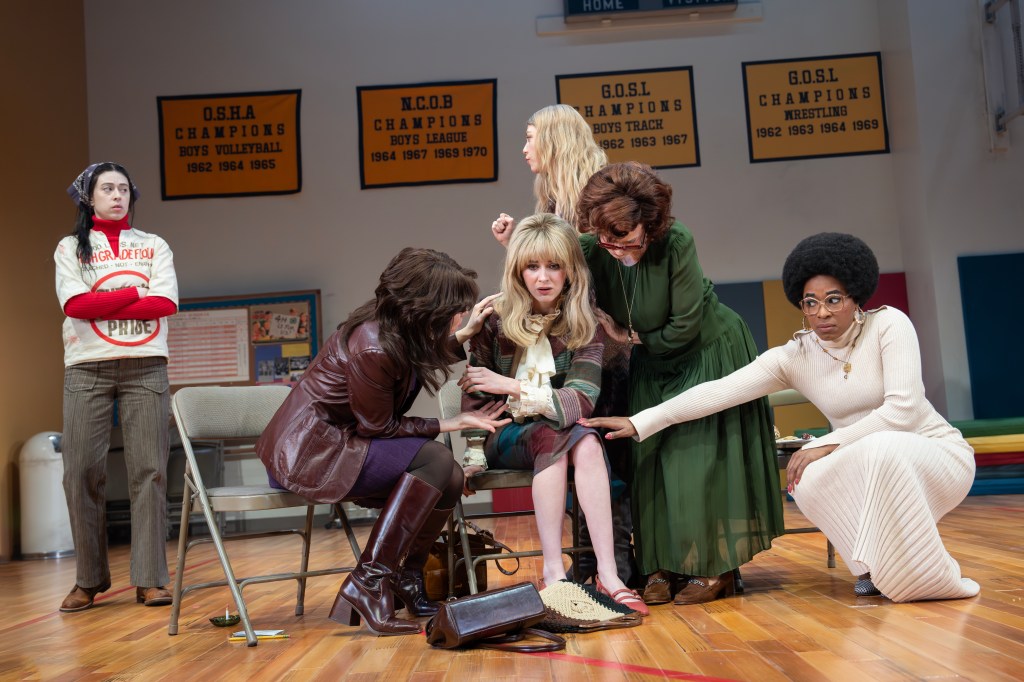
Adina Verson, Irene Sofia Lucio, Audrey Corsa, Susannah Flood, Betsy Aidem and Kristolyn Lloyd in Liberation; photo by Joan Marcus

The cast is up for the creative exercise, playing their counterparts in both past and present and occasionally stepping into the role of Lizzie when a situation would be awkward for her daughter to recreate.  Director Whitney White provides as much variation as she can, using the gym equipment to change the composition of bodies.  Set designer David Zinn adds some color with an unlikely rainbow of gym mats while costume designer Qween Jean seems to have had a blast at the local thrift shops to reconstruct that fabulous 70s look.

To protect the actresses from having nude images of themselves released by the public, all audience members must place their phones into a locked Yondr Pouch.  Unfortunately, no one at the venue was responsible for assuring that devices had been silenced or turned off, so the performance was punctuated by rings and pings.  The woman next to me could only kick her purse more deeply under her seat and smile sheepishly.

Liberation would be more successful in its mission if the characters generated the same level of support towards one another as the actresses seem to.  The message that even a little gesture can move a cause forward is an encouraging one, especially in a time when many of us feel like we are losing ground.  Instead, these characters inflict a concept of equality upon one another that feels more like another form of repression.  

An Off-Broadway entry to Roundabout’s season, Liberation continues through Sunday, March 30 at the Laura Pels (111 West 46th Street).  Tickets are available at https://www.roundabouttheatre.org/get-tickets/2024-2025/liberation and begin at $80 including fees.  Running time is 2 ½ hours including a 15 minute intermission.