
Balusters are the tiny pillars that support handrails on a deck or staircase. Not just an architectural flourish, these critical structures provide safety and support. In David Lindsay-Abaire’s The Balusters, they are among the items under review by the Neighborhood Association of the landmarked Vernon Point. They are also a metaphor for the shifting dynamics of the organization’s volunteer participants. But fear not. Tony Award and Pulitzer Prize winner Lindsay-Abaire is not taking us down another tragic Rabbit Hole (sublime as that experience was.) While this new work probes issues including racism, classism, and homophobia, its primary concern is giving the audience a rollicking good time.
We are initially confronted with an array of stock characters, but with novel “accessories.” This enables the playwright to communicate a familiar starting point for each one and then take him/her/them in a revealing — sometimes startling — direction. Director Kenny Leon and casting director Kelly Gillespie have composed a circle of actors with advanced degrees in timing and subtext. Even the expected becomes memorable and sweetly comical.
The battle for control at the plot’s center is between meeting chair Elliot Emerson (Richard Thomas) and new arrival Kyra Marshall (Anika Noni Rose). While Elliot leverages his long history with the community, Kyra’s fresh viewpoint appeals to some who recognize that not everything is rosy. The clash is set in motion by a proposal to install a stop sign. This seemingly sensible set-up expands so that each of the ten members of the talented cast is given time in the spotlight, delighting their distinct devotees in the audience. Duly awarded for “Sustained Excellence, ” Marylouise Burke lends her distinctive voice and just the right amount of eccentricity to HOA secretary Penny Buell. Ricardo Chavira’s Isaac Rosario and Margaret Colins’s Ruth Ackerman are given some of the best “burns.” Even housekeeper Luz Baccay, portrayed with grace by Maria-Christina Oliveras, has the opportunity to contribute more than freshly baked appetizers.
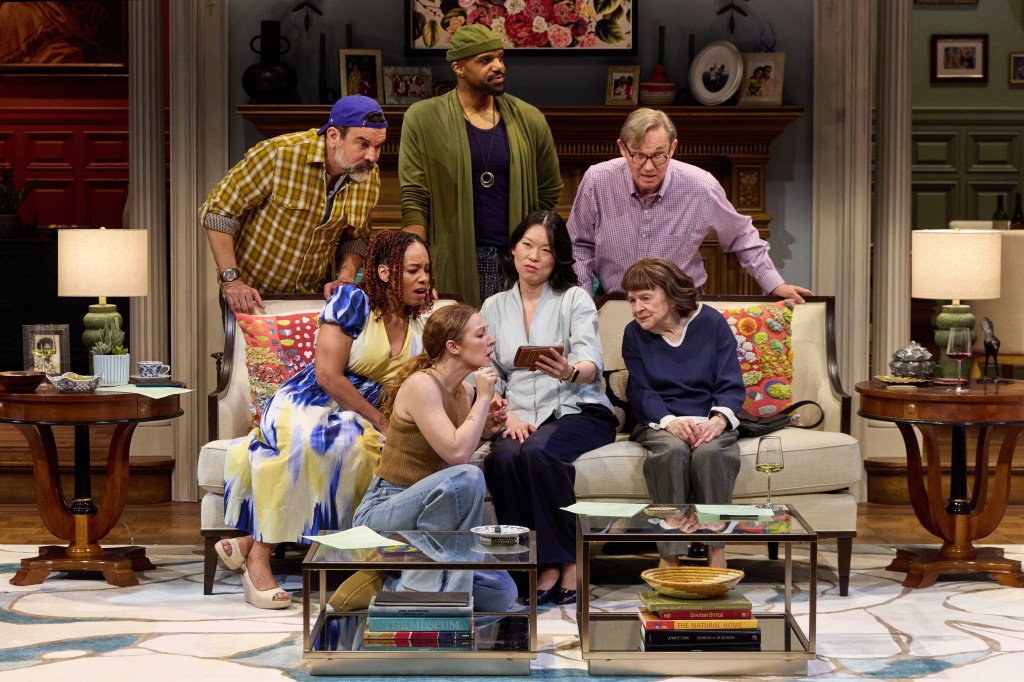
At its core, this is a drawing room comedy, and scenic designer Derek McLane has created a welcoming one with elegant pillars and elaborate throw pillow. There are views into a formal dining room and foyer with stairs leading to the unseen second floor. His artful variety of chairs plays a role in establishing personality traits. With transitions that resemble a night at a club (lighting by Allen Lee Hughes and original music and sound design by Dan Moses Schreier) , the characters often make wardrobe changes on the fly with separates by costume designer Emilio Sosa.
With both heart and brain, The Balusters is a welcome arrival. As proudly touted in the run-up to opening night, this Manhattan Theatre Club commission is the only original American play opening on Broadway this season, which says something about the well placed trust they had in playwright Lindsay-Abaire. Running time is a smooth and economical 100 minutes without intermission. Part of MTC’s spring season, performances are held at the Samuel J. Friedman Theatre, 261 West 47th Street. Tickets are currently available through June 7. Naturally, all of this talent doesn’t come cheaply. Orchestra seats on the official website run by the Telecharge top out at $347. The Mezzanine — which overhangs the orchestra mid-house — is less expensive and provides a great vantage point. Visit https://www.manhattantheatreclub.com/shows/2025-26-season/the-balusters/ for information and purchasing options.


The Cake
The Cake is like one of those imperfectly filled jelly donuts: a few sweet spot surrounded by too much bland. At a time when we could use serious conversation and considered insight into the critical issues that divide us as a nation, this comedy by This Is Us producer Bekah Brunstetter offers too little that is satisfying. Though it concludes with some timid steps towards a “love is love is love” message, it gets there via worn out arguments on both sides of the issue of gay marriage.
Fans of That 70s Show may delight in seeing Debra Jo Rupp as Della, the owner of a sweet shop in Winston-Salem North Carolina (Brunstetter’s home town) about to find fame on a national baking show. Her opening monologue cleverly lays the groundwork for the rigid discipline Della applies to all areas of her life. Soon after, she is reunited with Jen, her deceased best friend’s daughter, who is in town preparing for her October wedding. Initially Della is thrilled when asked to provide the wedding cake. But when she discovers Jen’s intended is another bride, she clumsily rescinds the offer. Their ensuing awkward discussion leaves both Della and Jen rattled and searching for the roots of their beliefs and accompanying feelings of shame.
Director Lynne Meadows does her best with a space that is too wide for a story this intimate. Rupp is her usual perky self, delivering most of the better lines with comic flair. To some ears, Della will simply come across as a bigot (though a chirpy petite one) who uses someone else’s pleasure and pain to mend her own relationship. But there are moments when Della’s turmoil feels genuine. Rupp is most grounded in her scenes with Dan Daily, who has the most joyful character arc in the role of her domineering husband, Tim. (Daily also provides the voice of the appropriately oily George, the host of the American Baking Show who functions as Della’s conscience.)
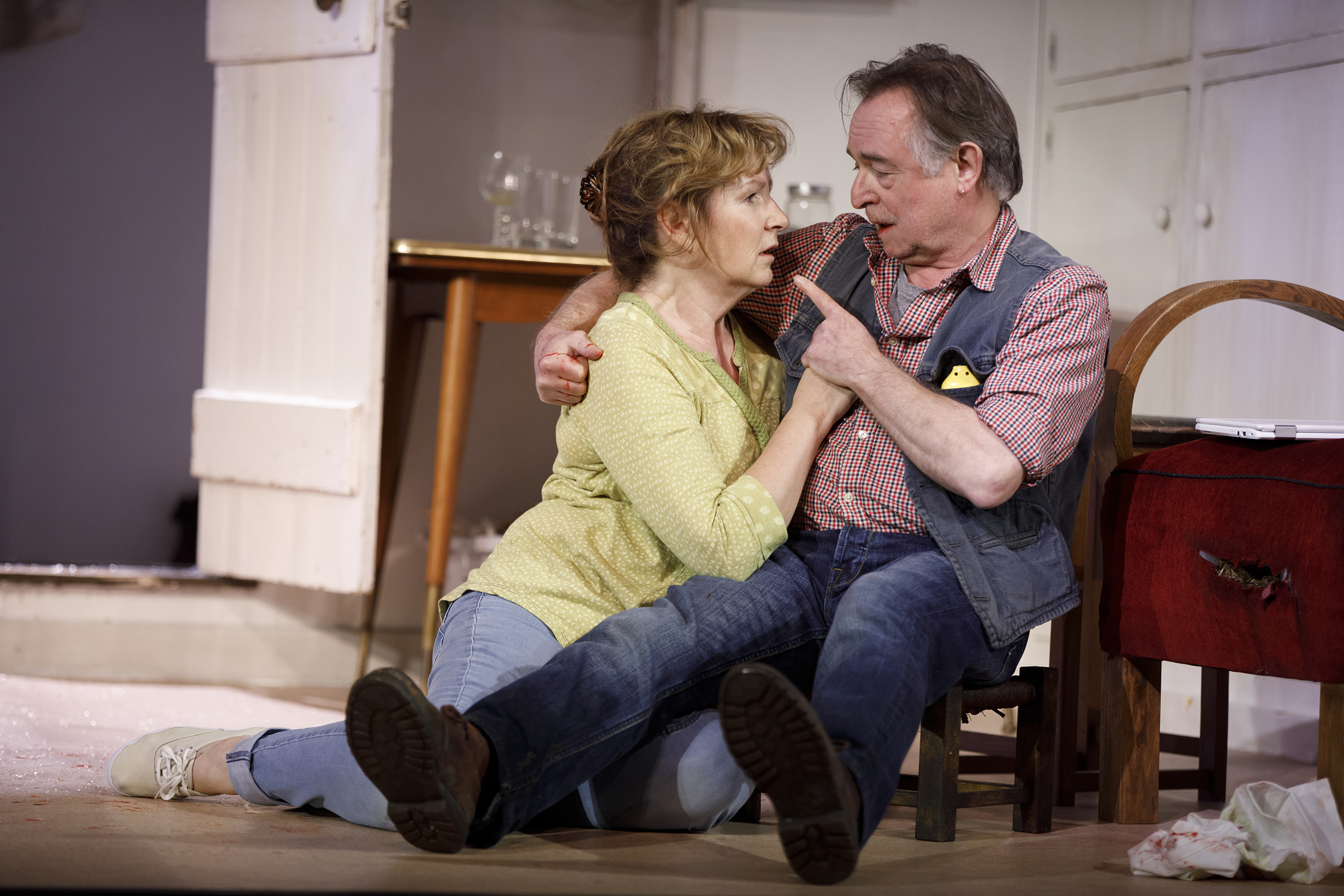
Rupp and Angelson in The Cake. Photo by Joan Marcus.
The relationship of the lesbian couple is more problematic. Disappointingly, though the words are often there — particularly in Jen’s vivid and horrifying description of her heterosexual encounters — there is no palpable connection between the two actresses. The fresh-faced Genevieve Angelson brings a sweet restlessness to Jen as she is tossed between the realms of her conservative childhood and newly found freedom discovered in New York. As her betrothed, Marinda Anderson gives Macy some well-earned rough edges, though the script occasionally requires her to speechify. But as a couple, they never seem to click.
The overall look of the piece is spot-on. Scenic designer John Lee Beatty has chosen candy colors to surround his baker, with mint green and strawberry cream pink swirling through her shop and home. In contrast, the engaged couple is staying in the only earth toned room on the set. Wardrobe by costume designer Tom Broecker follows a similar scheme, with Jen alternating palates. Philip S. Rosenberg’s ’s lighting sharpens the intensity of Della’s inner dialogue and softens the conversations between lovers.
With The Cake, Ms. Brunstetter has tried to make the point that recent cultural shifts have occurred too quickly for some goodhearted people to catch up. The irony is that since the time the play was first produced, those same shifts have given rise to a slate of superior projects with bolder things to say. From our current cultural vantage point, this work is a disappointing use of Rupp’s comedic talent as well as a waste of several delectable-looking cakes.
The Cake is playing through March 31 at MTC at New York City Center – Stage I. Theater-goers under 30 qualify for special $35 tickets. Full priced tickets begin at $89 and can be purchased online at www.nycitycenter.org, by calling CityTix at 212-581-1212, or by visiting the New York City Center box office (131 West 55th Street).