Tag Archives: Nael Nacer

The Receptionist

From the beginning, there is something off about the Northeast Office in Adam Bock’s The Receptionist.  There is a squishy sense of period and an even sparser sense of location beyond a workplace within a city with bagels, croissants, and public transportation. Most extraordinary, even with all the narrative phone calls and perpetual office gossip, it is more than halfway through this clipped play that we get any inkling of what these people do for a living.  It reflects well on the banter and incidentals that this revelation is so slow in dawning, effectively delaying our rising alarm.

Though the script has been around for nearly 20 years, its vibe fits all-too-comfortably into 2026 with only a few tweaks.  The construction hasn’t made the trip nearly as well.  Described by Second Stage as “a jet-black comedy,” the work is really more like a simple black and white cookie, with the gloom and the humor lying side by side.  By the end, much remains merely hinted at with mixed effect.  Post show chatter in the ladies room, where sometimes the most insightful criticism is shared, was split between those who felt sure they’d missed something and those who reveled in the murkiness.

The spiky dialogue is mostly between Katie Finneran’s good natured receptionist Beverly Wilkins and Mallori Johnson as a staff member, Lorraine Taylor.  Though further up the org. chart, the stunning but insecure Lorraine lacks Beverly’s assured hand.  With her consistent missing of her bus, inappropriately flirtatious manner and golf bag clearly in view inside her office door, her holding down of a job is yet another office mystery.  Their breezy day is disrupted by the dark cloud of Will Pullen’s Martin Dart from the Central Office.  He is seeking a chat with their head of office, Edward Raymond (an underutilized Nael Nacer).  We shouldn’t be surprised that someone so named would stay on target.
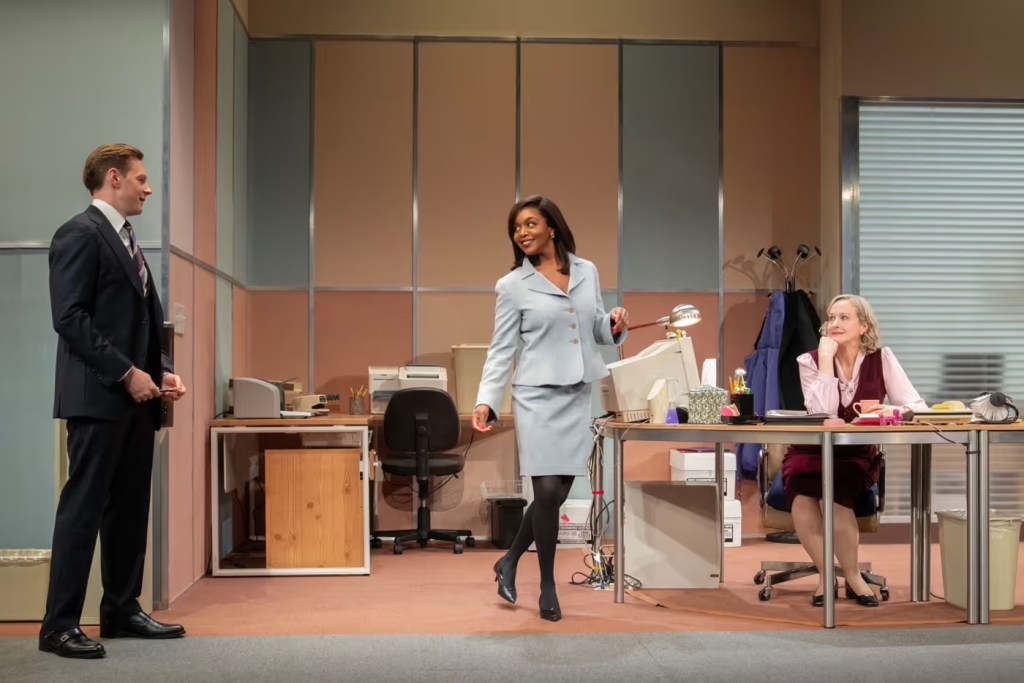
Will Pullen, Mallori Johnson and Katie Finneran in The Receptionist; photo by Joan Marcus

A skilled hand at refining sharp viewpoints, director Sarah Benson steers her cast through the ripples of normalcy and then oddness.  Encased within the earth-toned carpeting and padded walls by design collective “dots” and fashioned in part by Cookie Jordan’s wig design, the actors spark off one another, even though their characters lack the definition you’d expect to find in an expanded metaphor.  Like Jayne Houdyshell before her, the potential predictability of Beverly benefits from the performance precision of two-time Tony winner Finneran. She vivaciously transmits her character’s “in-the-know” regarding the finer details that flow through her.  Likewise Johnson finds a provocative note within Lorraine’s exhausting coquettishness.

The Receptionist is an amuse-bouche of a play: tasty, but not enough of anything — comedy, commentary, character development — to be fully satisfying.  (And yes, I am using another food metaphor.)  The intervening years have provided us with too many chilly worlds that are better and more distinctively built.  Part of Second Stage’s 47th season, performances are scheduled through May 24th at the Irene Diamond Stage in the Pershing Square Signature Center, 480 W 42nd Street near 10th Avenue.  Running time is 80 minutes without intermission.  Tickets begin at $66 up to $136 for premium seats.  The latter price range includes the entrance row G where there is extra legroom and space for wheelchairs.  Those in row H get a height boost, though there is a thin railing in front.  

Meet the Cartozians

What establishes our identity?  Skin color?  Language?  Scientific evidence?  In a country comprised primarily of immigrants, how do we balance our cultural heritage with our recognition as Americans?  In Meet the Cartozians, Talene Monahon, “a playwright of actor descent,” explores these weighty and often murky issues with keen insight and a knowing sense of humor using an Armenian family as her instruments.  With its complex history and even more complicated geography,  Armenia provides a wellspring of arguments about nationality, culture, and sense of self.  And if the play’s title brings to mind the most famous Armenian American of all, that, too, is very intentional.

In Act 1 we meet Tatos Cartozian, a character based on the man who was at the center of an Oregon court case in 1924.  As was true for the real Tatos, Monahon’s variation has been classified as a non-white Asian and on those grounds had his citizenship revoked.  It does not help his argument that his company makes Persian “oriental” rugs and employs “Islamics”.  To say more would detract from the delights of experiencing the reasoning of the family — Tatos’s mother Markrid, son Vahan, and daughter Hazel — along with their lawyer Wallace McCamant as he guides them in their preparation.  Monahon’s ear for dialogue and director David Cromer’s meticulous direction of each exchange should be freshly savored.

Act 2 takes place 100 years later in the Glendale, California home of Leslie Malconian. Several other Armenian Americans have been asked to gather with her to discuss and celebrate their ancestral heritage.  Their conversation will be featured in a special holiday episode of a wildly popular reality television show.  Despite the passage of time as well as that of many congressional bills, the subject of whiteness is no less thorny.  But it has taken on a very different hue.

The same six actors — Raffi Barsoumian, Will Brill, Andrea Martin, Nael Nacer, Susan Pourfar, and Tamara Sevunts — play parts in both acts.  Martin delivers her characters’ retorts with the wry “who me?” inflection we’ve come to expect from the seasoned comedian.  Fellow Tony winner Will Brill gets even bigger laughs with his quiet earnestness.  But a work this dialogue-heavy only succeeds because of the talent of the entire ensemble. The 2 ½ hour piece sails along at a satisfying clip.

Will Brill, Andrea Martin, Nael Nacer in MEET THE CARTOZIANS ; Photo by Julieta Cervantes.

The artistry behind the scenes is equally accomplished, particularly Enver Chakartash Act 2 costumes in relation to their Act 1 counterparts.  Scenic designer Tatiana Kahvegian creates the illusion of expansive depth in both living room settings.  Stacey Derosier’s lighting shifts from the muted tones of low watt bulbs and filtered sunlight to the intensive glare of actual spotlights.

Those who, like me, consider our country to be less of a melting pot and more of a stew — with distinct ingredients that complement each other — will find the brainy banter of Meet the Cartozians a sparking and engrossing entertainment.  The story also serves as eye-opening education as we witness a renewed struggle against those who wish to “preserve America’s white, Christian identity”.  It’s an auspicious opening for the 47th Season for celebrated 2nd Stage.  Performances continue through December 7 in the Irene Diamond at the Pershing Square Signature Center, 408 West 42nd near 10th Avenue.  The house is comfortable and well raked, but noticeably breezy.  Tickets begin at $86 and can be purchased at https://2st.com/shows/meet-the-cartozians#info.

The Orchard – NYC and Live Stream

Long before Joni Mitchell decried the paving of paradise to put up a parking lot, Anton Chekhov’s emotionally paralyzed Ranevskaya family auctioned off their cherished cherry orchard to make way for summer homes. His last play, The Cherry Orchard, centers on Madame Lyubov who is hopelessly in debt after years of living in Paris.  She and her daughters have returned to their estate for one last party and it is only then that they reflect on the once-prized fruit trees that will be chopped down to make way for modernization.  Like many of Chekhov’s works, there is a sense that happier alternatives have simply slipped out of reach.  

In Arlekin’s (zero-G) imaginative retelling, The Orchard, the work is simultaneously performed live and streamed to a global audience.  Typically, live streams have been made available because there was no audience permitted at the theater or it was presented in a way meant to simulate as closely as possible the live experience.  This is the first theatrical piece I’ve seen that deliberately gives those watching from home a different experience from those seated at the venue. 

While it is simply wonderful to make this production available worldwide and Ukrainian director Igor Golyak has unique experience using virtual reality to enhance traditional theater, it seems unnecessary to have augmented this particular work with an interactive component. The video-game-like curtain-raiser features various rooms of the house containing Mikhail Baryshnikov as Chekhov reading some the author’s more personal words in the original Russian.  Much of the interaction during the play involves being able to select something other than the main camera, though the few times I switched to another unit, it wasn’t revealing so much as disorienting.  And it was impossible to avoid FOMO when just before the auction of the property — during which the audience makes non-binding bids with proceeds going to support the company — the home audience was addressed directly by matriarch Lyubov Ranevskaya while a completely different scene was taking place on stage.

Furthermore, the production is straight-up terrific and needs no embellishment.  Golyak, whose homeland is currently undergoing life changing destruction and loss, has harnessed those feelings of disconnection and grief and made additions to the work that are engaging and meaningful.  The elegant script was translated by Carol Rocamora, who preserves the poetry while tightening the storyline and punching up the more farcical elements.  On scenic designer  Anna Fedorova’s all-blue stage, blossoms litter the floor and even the nursery room teddy bear and hobby horse appear melancholy.  The backdrop envelops the players in dramatic projections by Alex Basco Koch, including lines of dialogue, stars and planets, and the faces of the enraptured audience. The onstage robotics by Tom Sepe lend an eery futuristic and fatalistic feel to the tale.  

Denisova, Hecht, Brett and Nelson in The Orchard; photo by Maria Baranova

The cast is led by the sublime Jessica Hecht, who gives Ranevskaya’s delicacy meaning and tenderness.  Baryshnikov appears again as Firs, the faithful older servant.  His interpretation of an aging, submissive body practically collapses in on itself and he never stops being fully present, even providing a warm interaction with a mechanical dog.  The clowning of Arlekin Players regular Darya Denisova as Charlotta  the soon-to-be-displaced governess, adds appropriately discordant levity.  While Nael Nacer’s booming voice is just perfect for sounding the alarm as Lopakhin, the man best positioned to win the orchard his ancestors tended to as slaves.  John McGinty has been cast as Trofimov, though it’s unclear whether making the perpetual student deaf is a comment on communication between characters or Golyak just appreciates McGinty’s talent.  Juliet Brett, Elise Kibler, Mark Nelson, and Ilia Volok round out the company.

As a fresh take on a classic, The Orchard blossoms under Golyak’s knowing hand.  The themes of class division, misplaced materialism, and cultural loss are sadly timely and touching.  A quick read of The Cherry Orchard will only deepen your understanding of events.  Live performances run through Sunday, July 3, and take place at the Baryshnikov Arts Center at 450 West 37th Street (between 9th and 10th Avenues) .  Showtimes are Tuesday – Thursday at 7PM, Friday – Saturday at 8PM, with matinees on Saturday and Sunday at 2PM.  Proof of vaccination is required for entry and face masks must be worn throughout the two hour runtime.  Prices for the intimate live show run from $39 to $125.  The virtual experience — which requires a plugged-in laptop or desktop — is $29.  There are bundles to purchase both live and streaming together.  For tickets and additional information, visit www.TheOrchardOffBroadway.com.