Tag Archives: New York Theater Workshop

We Live in Cairo

In 2011, a number of Egyptian youth groups gathered together in Tahrir (Liberation) Square to protest the corrupt authoritarian rule of President Hosni Mubarak.  His 30 year stranglehold on power had led to economic stagnation, human rights violations, and media restrictions.  The young peoples’ acts of civil disobedience in concert with a series of labor strikes forced Mubarak’s resignation and brought about a democratic election.  Their victory was short lived, however, and Egypt now stands at a miserable 18 out of 100 on the Freedom House scale.  

Inspired by a photo of several of the activist artists, brothers Daniel and Patrick Lazour wrote We Live in Cairo, developing the score and book over ten years.  The results are inconsistent in their ability to sway the audience, primarily carried along on waves of tuneful music.  Most numbers combine instruments and musical themes from Egypt with traditional structures including love ballads and rock anthems.  Director Taibi Magar joined the collaboration to add depth and movement to song.  The voices of the all-Arab ensemble blend beautifully (vocal arrangements by Madeline Benson) even when their characters falter.  For the scene depicting the toughest days of uprising, the musicians join the actors center stage, enveloping them with melody.

Michael Khalid Karadsheh, Ali Louis Bourzgui, Rotana Tarabzouni, Nadina Hassan, Drew Elhamalawy and John El-Jor in WE LIVE IN CAIRO at New York Theatre Workshop; Photo by Joan Marcus

The atmosphere developed by the design team wraps the audience in the sights and sounds of the struggle for freedom.  Tilly Grimes’ set is kept simple with a collection of pillows, rugs, lamps and household items filling a few shelves. The visual emphasis is on the evocative projections designed by David Bengali, some of which appear overhead.  He and lighting designer Bradley King added their graphical layers to the look and feel when they joined the crew during the run at A.R.T. in Boston.

Unfortunately, the story, though it was restructured several times, lacks the same level of vibrancy.  While the idea of looking at this revolution through varying lenses of artistry, policy, and simple human compassion is an interesting concept, the issues are all frustratingly abbreviated and the actions poorly motivated. Initially apolitical and fearful, Layla (Nadina Hassan) suddenly turns her entire life inside out based on exposure to a single image.  The societal significance of her boyfriend, Amir (Ali Louis Bourzgui), and his brother Hany (Michael Khalid Karadsheh) living as Coptic Christians in the majority Muslim country is mentioned, but never meaningfully explored.  Fadwa (Rotana Tarabzouni) is so driven by her identity as the child of dissidents that her every opinion becomes a cause which muddies their significance.  The attraction between the majestic Karim (John El-Jor) and the tentative Hassan (Drew Elhamalawy) is covered over as quickly as one of Karim’s satiric murals.  The vagaries of this critical thread border on homophobic.  Even the impact from country’s former status as a British colony doesn’t receive more than a single line.

New York Theater Workshop, which has been helping to nourish this production for nearly 7 of the 10 development years, has done what they can to broaden the world of the play beyond the walls of the theater.  E-tickets include the promotion of local Egyptian restaurants, invitations to post-show topical talkbacks at their sister space, and lighter cultural fare like a hummus-making contest.   A brief historical timeline and the “origin story” of the production are inserted into the program.

Like the ending of the Arab Spring it depicts, We Live in Cairo ultimately fizzles.  But it leaves behind a feeling of purpose that makes the experience worthwhile at this delicate point in our own history.  The Off-Broadway premiere continues through November 24 at New York Theatre Workshop, 79 East 4th Street in Manhattan. The performance runs 2 ½ hours with one intermission and contains images and sounds of a violent nature.  Tickets begin at $49 and can be purchased at https://www.nytw.org/show/we-live-in-cairo/tickets/ or by calling the NYTW box office at 212-460-5475.  You will get a better sense of place seated further back from the stage.  This is the first play of four in the NYTW 2024-25 season and subscriptions are still available for as little as $230.
Bonnie’s Last Flight

Pack a bag full of whimsey and climb aboard Bonnie’s Last Flight.  This imaginative new play by the prolific Eliza Bent is taking off at Next Door at NYTW.  Your experience of the extended metaphor begins as soon as you receive your confirmation from the theater.  First class passengers are allowed to enter first and receive pre-performance wine and snacks.  (Though bibs on the back designate them as First Class, Comfort Plus or Economy, all the chairs are the same and there are no bad seats in the house.)  Upon entering, you are immersed in a representation of a cabin surrounded by oval windows and Virgin inspired overhead lighting.  Leg room is generous, though there is a limit of one carry-on per person.

Despite the title, the head of your crew is Jan. Thirty-one years ago during the rise of feminism, the then sexually naive teen found herself pregnant and alone.  She chose to carry the child to term.  Though she gave her daughter up for adoption, the chapter derailed her lifelong ambition to become a writer.  Taking a job as a “waitress of the skies” she continues to jot down ideas between trips down the aisle to serve brownies.  Her inspiration is a manic Mark Twain who is almost always by her side.  Recently accepted into a renowned Chicago based writing program, she’s finally hanging up her wings to follow her abandoned dream.

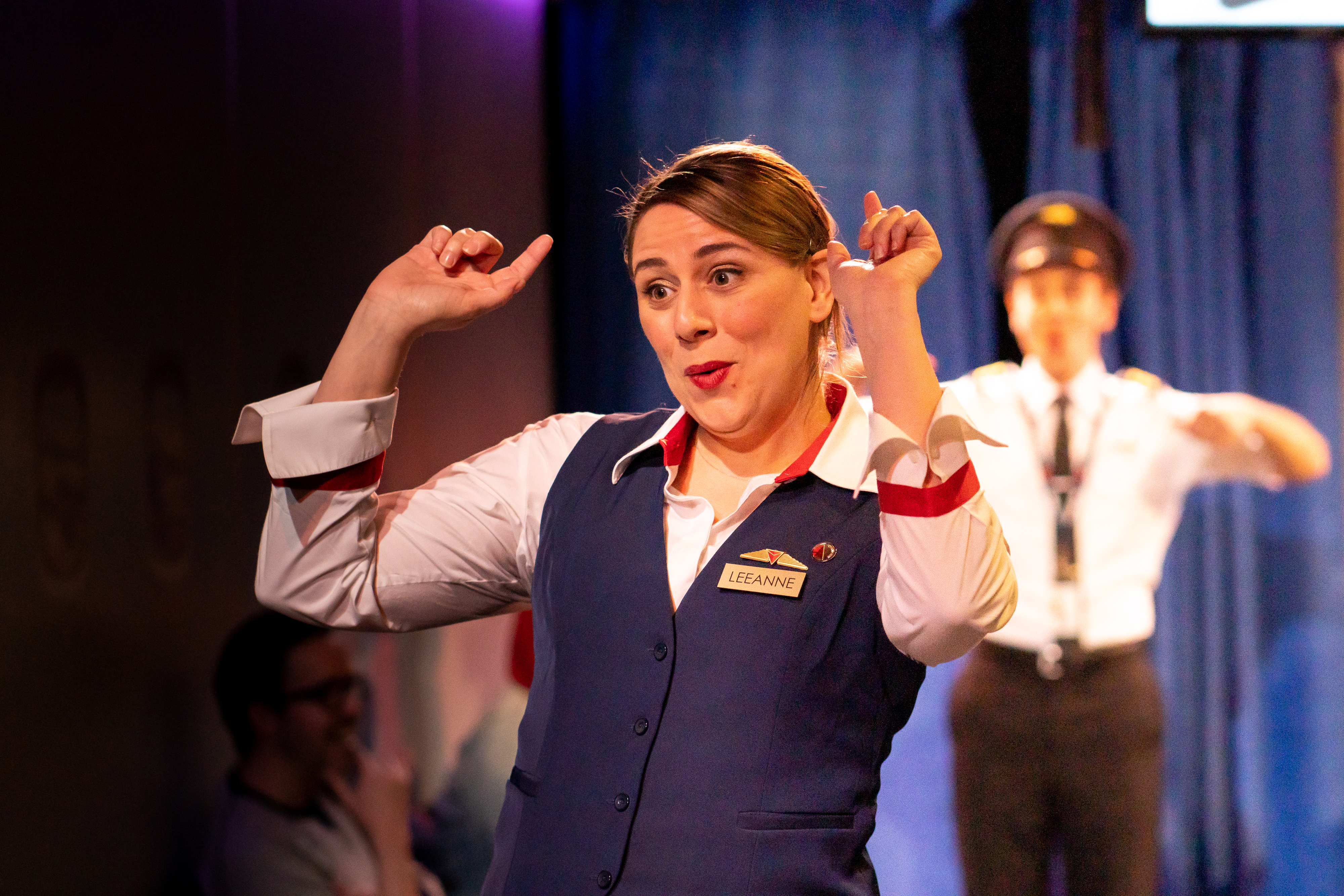
Jan’s story is one of many we learn during our fictional flight to Chicago and it is by far the most linear. The remainder of Ms. Bent’s script includes several personal episodes told by the rest of the crew as if glimpsed through cloud cover.  Jan’s counterpart is the well-meaning, high-energy and somewhat dimwitted LeeAnne who is also struggling to course-correct her life. Rounding out the cabin team is Jan’s devoted longtime colleague Greig, moved by items he finds left in seat back pockets and under seats.   Up in the cockpit is Tony, whose obviously lack of fitness to fly is one of the play’s plot holes.  His calling his co-pilot Erik “Jesus” is a running joke.  The troupe also portray other characters from the past.  To reveal more about the titular Bonnie would be a small spoiler, but she too is on board.

Ceci Fernandez in Bonnie's Last Flight. Photo by Shun_Takino

Ceci Fernandez in Bonnie’s Last Flight. Photo by Shun Takino.

In the elegant and graceful body of Barbara Walsh, Jan is a marvelous character, surprisingly well rounded and deeply sympathetic given the short amount of time we get to spend with her.  Greig Sargeant’s Greig isn’t given as much depth, but he acts as a sweet partner and balances Ceci Fernandez’s frantic and funny LeeAnne.  While those three are tonally in sync, the others seem to have stumbled in from a much more farcical piece.  The cockpit duo played by Sam Breslin Wright and Federico Rodriguez veers firmly into stock character territory.  Playwright Eliza Bent’s own clown-like Twain nearly pulls the piece over the slapstick edge, though this is apparently integral to her vision for the work.  

Director Annie Tippe cleverly choreographs the motion using the confined space defined by airplane body, aisles and jump-seats.  A good portion of the runtime is devoted to skits and business including clips of inflight movies.  This necessitates looking from side to side like a tennis match and occasionally completely turning around to see a curtained area behind you.  A few times, an unwitting “passenger” is included in the action.  Scenic design by Meredith Ries and costumes by Heather McDevitt Barton make the best of a small budget. Small overhead monitors expand the performance space and creative wigs and accessories make for quick changes.  The live action is supplemented by videos by David Pym and sound by John Gasper, which in previews had some technical glitches.  (For anyone who has tried to use Go-Go inflight wireless, this is not out of step with the rest of the gag.)

With tickets starting at $25, Bonnie’s Last Flight is a pleasant diversion, delivering some great fun and mild food for thought.  Can we lose our emotional baggage as easily as a major carrier sends the suitcase clearly marked for Rome to its hub in Abu Dhabi?  It is playing through March 2 as part of Next Door at NYTW, 83 4th Street near 2nd Avenue. Tickets are available online at NYTW.org, by phone at 212-460-5475, or in-person at the NYTW Box Office. Be warned that similar to a real flight, it will be impossible to leave before reaching the final destination.