Tag Archives: Pershing Square

Mother Russia

When I went to Russia as a child, my parents and I brought Skippy, Hanes, and Levis to a friend’s niece in Moscow.  All the best restaurants only took American dollars, which were unavailable to local residents, and we were constantly shadowed “for our safety.”  When I returned as an adult, all of my guides had their own Ikea-furnished apartments.  One of our destinations was a sprawling indoor mall in the center of Moscow and international fast-food chains were as plentiful as the family owned dumpling joints.  Between those two eras, the Soviet Union had been dissolved and the promise of social democracy hung in the air.  

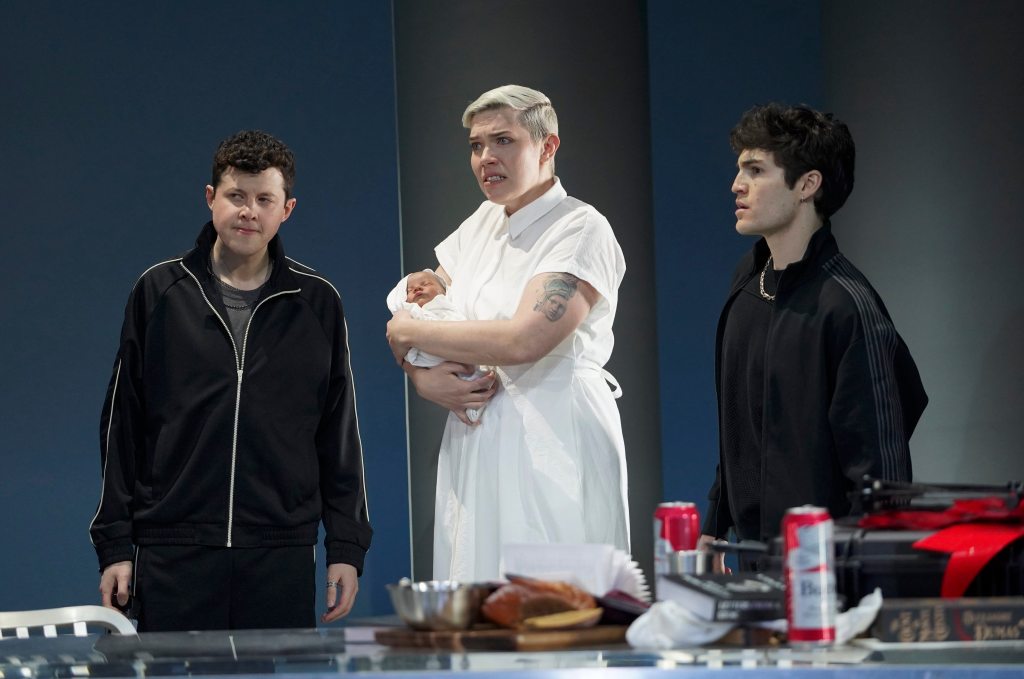
It is within that unsettled period of 1992 that Lauren Yee has set her new comedy, Mother Russia.  Erstwhile aspiring KGB agent Dmitri is operating a tiny general store in St. Petersburg while surveying former pop star Katya as a side gig.  His childhood friend Evgeny tries to shake him down for protection money.  The pathetic attempt at menace leads to an alternative job offer. A devoted fan of Katya, Evgeny will follow her when she is off mic and will take a shift monitoring her. The fourth character is an explosion of innovation.  David Turner portrays Mother Russia herself, an embodiment of Russian history, ideology and culture.  Dressed in bright tomato red from babushka to pointy shoe (costumes by Sophia Choi), she can see back to the “not so bad” Ivan the Terrible and forward to Pussy Riot and Navalny.  Within the whirl of broad and situational humor, she is the snide ballast, overseeing all that transpires.

Wildly praised prior to the pandemic — particularly for Cambodian Rock Band which inventively explored the terror of the Khmer Rouge using a father/daughter story with music — Lauren Yee is currently a playwright in residence at the SignatureTheatre.  Her pen and tongue are still sharp, though she seems in a more fun-loving mood this time around.  Lines are written in colloquial English but with Russian construction.  Teddy Bergman’s playful direction enriches the slender script.  The prolific and visionary scenic design team of dots plays up the conflicting worlds of artifice and factuality that run throughout its pages.  The central portion of the set has a detailed commercialized frame and a defaced rolling metal door that is often used for emphasis.  Fancifully painted curtains complete the look of a city bus and Evgeny’s family home.  This two-pronged motif is continued with Jon Knust cunning props.  Sound designer Mikhail Fiksel makes terrific use of a wide range of music

The part of Mother Russia is made riveting by Turner’s droll and pricelessly-timed thick-accented delivery.  He is not alone in mining the dialogue for every precious laugh.  Dmitri could easily be two dimensional, but Steven Boyer gives him heart and amiableness.  Adam Chanler-Berat elevates and varies Evgeny’s many feeble attempts at swagger.  The two play good-naturedly with one another, especially in a scene co-starring a Filet-O-Fish sandwich.  Rebecca Naomi Jones does the most she can as Katya, a surprisingly flat role given that the singer/revolutionary is the catalyst for the climactic scene. Ironically, we get a clearer image of Dmitri’s never-seen girlfriend, Masha. 

Genuinely unfunny is the current design of the black box space of The Romulus Linney Courtyard Theatre.  The narrow ceiling-high stadium seating is oppressive, leading many audience members to use their programs for air circulation.  Those in the back rows crouch like tennis fans in an impractical effort to take in the intimate scenes while those nearer the front must crane their neck to follow David Turner’s antics.  If the red house lights are intended to make us feel as disoriented as a typical Russian in the 1990s, then they work.

The ingredients for blistering social commentary are present.  But Mother Russia subverts a more serious conversation about economic and societal challenges in favor of punchy lines in absurdist packaging.  Given the current state of our own culture, one could do worse than spend 90 minutes laughing at and with these talented artists.  The New York Premiere continues through March 22 at the SignatureTheatre in Pershing Square, 480 West 42nd Street.  Tickets begin at $74.  Visit https://signaturetheatre.org/show/mother-russia/ for more information.

Rebecca Naomi Jones and Adam Chanler -Berat in Mother Russia; photo by HanJie Chow

Lunar Eclipse

When the earth, moon, and sun are in alignment, the moon moves into earth’s shadow blocking light from reaching the moon’s surface.  This lunar eclipse is the featured event of Donald Margulies play of that name.  It also serves as a somewhat strained symbol for the darkness that has engulfed the long marriage of 70-something George and Em.

The piece opens with George alone on stage crying in the vastness of night in a field on his Kentucky farm.  Soon Em arrives with a gigantic bag filled with items that might make him more comfortable, though he doesn’t show much interest in her offerings.  They talk as they wait for the moon to take on its eery red glow.  The phases of the astronomical phenomenon — umbra, penumbra, total — are projected behind them, inserting breaks in flow of their conversation.  It soon becomes clear that much as the moon’s shine is being swallowed up, so have they been swallowing their fears and sadness.

George is intellectual with a particular interest in the stars and a strong need to stop and appreciate his surroundings.  Em is more an instinctual “city girl” and her relative ignorance allows George to explain events to us as well.  As time elapses and the bourbon flows, their increasing levels of honesty and respect break chinks in the wall between them.  Despite all the disappointments they’ve had to face, they are reminded why they chose each other in the first place.

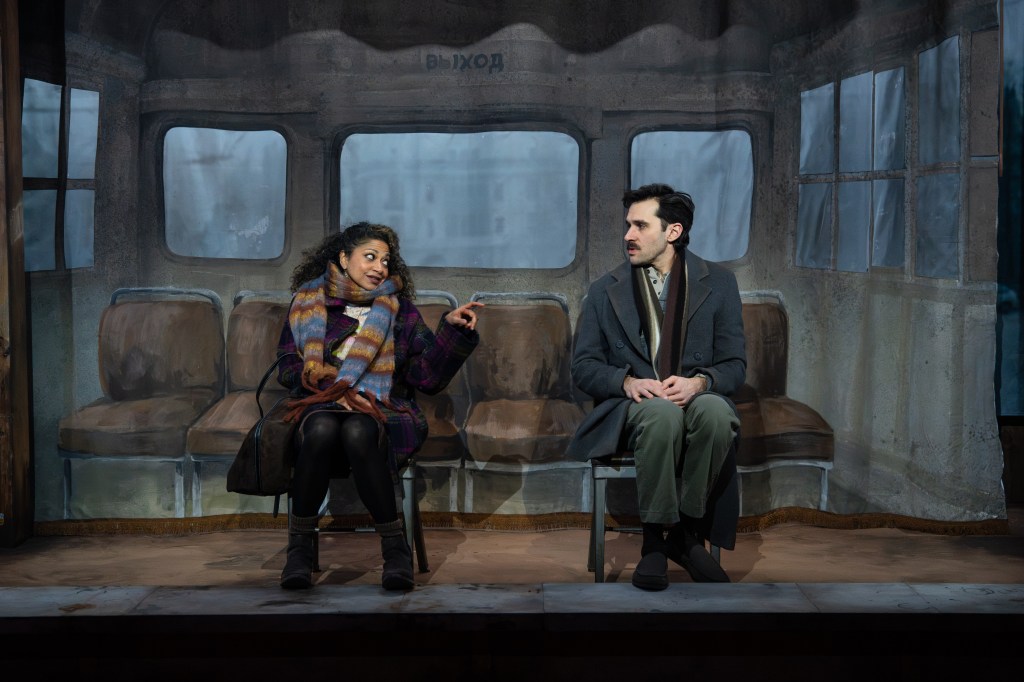
Lisa Emery and Reed Birney in Lunar Eclipse; Photo by Joan Marcus

Marital every day moments and eventual strain is not new territory for playwright Margulies, who previously won the Pulitzer Prize for Drama in 2000 for Dinner with Friends.  Much of the terrain here is as well-ploughed as George’s family farm.  But director Kate Whoriskey has been blessed with her cast.  Lisa Emery and Reed Birney — reprising his role from Shakespeare & Company’s 2023 production in Lenox, Massachusetts — remain two of the most reliable stage performers and watching their exchange is enthralling.  The dialogue may not be radical, but much is communicated in a touch, a look, or a pause. Their poetic descriptions of worry, loss, and grief ring true, though the fog doesn’t just roll across the skies.  

Scenic designer Walt Spangler has created a thick black box around the proscenium, restricting the space and cushioning the actors’ movements with earth (though what that does to the audience view from the first few rows is unwelcome.)  Just a few wild flowers add color to the landscape.  The tinkling of a piano lulls the audience upon entry to the theater.  Occasionally the soft sounds of the surrounding nature join Sinan Refik Zafar’s soundscape.  Lighting by Amith Chandrashaker provides metaphoric bright and shadow building to the crescendo of S. Katy Tucker’s video.

Unsurprisingly, though seeped in tragedy, Lunar Eclipse with its slow reveals and well-earned sorrow, is a master class in acting.  Performances take place on The Irene Diamond Stage in the Pershing Square Signature Center, 480 West 42nd Street. Runtime is approximately 90 minutes without an intermission.  Tickets are available through June 22 at https://2st.com/shows/lunareclipse

Lifeline

If you combined a biopic with a public service announcement and a Scottish jam session, you’d have Lifeline, the musical that opened Wednesday night at the Pershing Square Signature Theater.  Lifeline tells the story of Alexander Fleming, the Scottish microbiologist who stumbled upon Penicillin and introduced the world to the lifesaving power of antibiotics.  From the outset, Fleming recognized that if used incorrectly his discovery could lead to the formation of “superbugs,”: bacteria that becomes resistant to the drugs.  In tandem with Fleming’s history is the fictional tale of a rising musician, Aaron, and his childhood sweetheart now his attending physician, Jess.  While out on his first tour, Aaron had developed serious digestive issues and began taking antibiotics to relieve his symptoms.  Eventually seeking proper medical attention at Jess’s hospital, he underwent successful surgery, but developed a post-operative infection that won’t abate.  

With a book by Becky Hope-Palmer and music and lyrics by Robin Hiley and his songwriting partner James Ross, Lifeline was brought to New York by Hiley’s Charades Theatre Company, a charity that promotes community and social issues through their work.  The production started life at the Edinburgh Fringe as “The Man Behind the Mould,” and continued to evolve over six years as it toured London and D.C. among other stops.  The current rendition is described as “reinvented” and quotes from critics who reviewed the earlier two-time sell-out do not rightfully represent this run.

Drawing inspiration from practicing doctors and scientists who have engaged with the piece, the playwright does a splendid job of underlining the parallels between Fleming’s findings and current events.  Though the storyline is tough to witness and the outcome telegraphed from the outset, the first act of Hope-Palmer’s time-hopping script moves along briskly, buoyed by the musical talents of and chemistry between Scott McClure’s Aaron and Kirsty MacLaren’s Jess and the sincerity of Matthew Malthouse as the grounding Alexander Fleming.  (McClure doubles as Fleming’s war buddy, Clowes.) Alone, it would have been enough to amplify the threat that antimicrobial resistance (AMR) poses for the entire world.   Act II goes deeper into Fleming’s past and the aftermath of Aaron’s failed treatment.  But except for “I’ve Done All that I Can”, a song about the proliferation of antibiotics in our food and water delivered by Julian (Robbie Scott) a politician friend, there is little that adds to our understanding of the problem. And at a running time of 2:35, the endeavor becomes relentless — more likely to overwhelm than impress — and ends in a way that may be pure but is not satisfying.  The most thrilling twist, revealed in the last moments, concerns some of the cast members rather than the characters they portray.

In its current form, the production also seems better suited to a much larger space.  The leads are backed by five ensemble players and a rotating chorus of twelve.  A spirited band performs upstage throughout.  Alice McNicholas’s set is anchored by an illuminated turntable.  It so dominates the stage that Alex Howarth’s direction is primarily comprised of walking in circles and standing back to back while Wayne Parsons’ dance numbers featuring alter-egos and younger selves are forced to be nearly vertical.  The scenic arrangement also requires the cast to repeatedly hoist Aaron’s hospital bed on and off the platform.  Wonderfully creative visuals by Will Monks blend film, hand drawing, and helpful facts.  They are projected onto hospital privacy curtains to fill out the look, though some of Monks’ lighting is nearly blinding mid-house.

Aaron/Clowes (Scott McClure) is assisted by medical staff in Lifeline; photo by Andrew Patino

In light of a movement to have drug companies sell medications directly to patients, Lifeline provides palatable critical counsel about a rarely discussed healthcare crisis.  As a celebration of medical professionals, it’s superior to the beating of pots and pans.  As an introduction to Fleming and his achievements, it’s a shame that the whimsy of the original piece has been shed in favor of glum earnestness.  

It would be easier to recommend Lifeline as a daring artistic experiment if regular tickets were not $72 and premium seating $91, though that is understandable given the number of professionals involved who deserve to be making more than bus fare. The show continues through September 28 at the Alice Griffin Jewel Box at 480 West 42nd Street in New York.  Tickets are available at https://www.lifelinemusical.com/.   The current run is ironically sponsored in part by biopharma company GSK and pharmaceutical giant Merck.  Despite requests to turn off your phone in the lobby, don’t.  The only way to access the Playbill is with a QR code.  

Someone Spectacular

When their grief counselor, Beth, fails to show up for their group therapy session, the majority of her six clients vote to go on without her.  The revelation of their interaction is not in the manifestation of their grief.  Theirs is the expected cocktail of misplaced guilt, regret for things both said and unsaid, and the pain caused by the absence of “their person.”   Rather, the eye-opening moments of Someone Spectacular stem from each participant’s attempt to move the meeting — and the others in attendance— forward.  Do you keep your feelings to yourself?  Do you breathe, sleep or eat your way through?  Do you force yourself to take an obvious next step?  Can anyone just snap you out of it?

Playwright Doménica Feraud has dedicated this warm play to her mother, Nathalie Feraud-Salame, who had nurtured her through a crippling eating disorder.  It is Feraud-Salame’s whose passions and heart run through each of the characters.  Doménica’s deep understanding of Nathalie’s way of being has enabled her to use knowing shorthand to tell us much about each character in just 90 minutes.  Feraud’s genuine affection for each of her creations shines through even when she has to rely on a few tropes to find essential connections and get to her point.

The confident ensemble brings out the best in the material.  Delia Cunningham’s delicate Jude attracts attention even before the official start of the piece, dashing off stage as the audience is still finding their seats.  A moody Lily played by Ana Cruz Kayne makes herself known with a bang of her bag, a thump of her tiny rump, and a conspicuous costume adjustment. Next to catch our eyes and ears is Shakur Tolliver’s Julian, drumming on the back of his chair with a discomfort that has taken over every aspect of his life.  Dressed for business even on a Sunday afternoon, Damian Young’s Thom seems more invested in taking phone calls than in staying present.  It is Alison Cimmet’s crisp and impatient Nelle who pushes for action.  And Gamze Ceylan elegant and vulnerable Evelyn who brings the most skilled therapeutic elements to their time together.  Though Beth hasn’t arrived, her essence takes shape through their interpretation of her techniques and motivations.

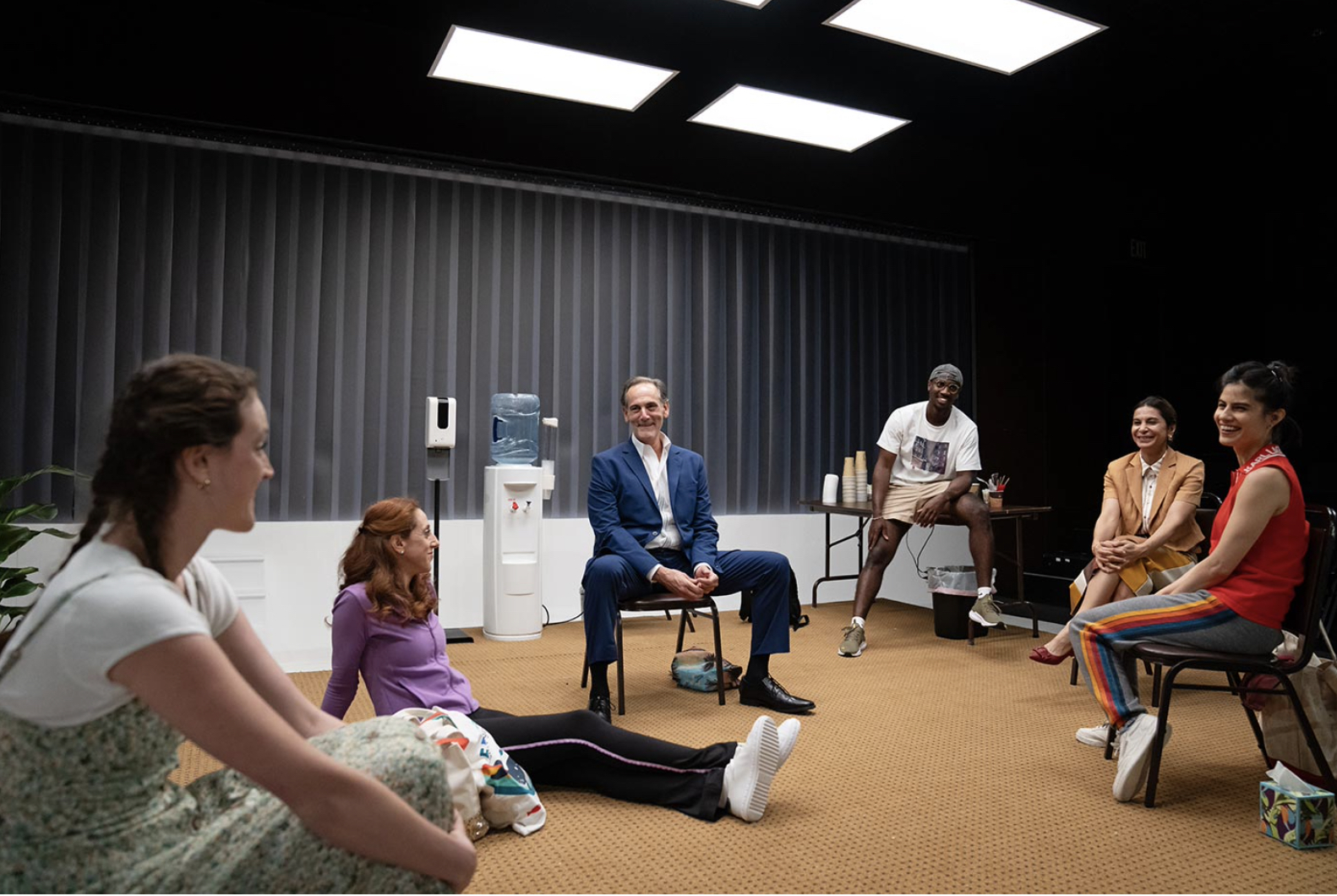
Delia Cunningham, Alison Cimmet, Damian Young, Shakur Tolliver, Gamze Ceylan and Ana Cruz Kayne; Photo by Julieta Cervantes

With the exception of Thom, Director Tatiana Pandiani moves the restless mourners around the traditional talking circle of chairs.  Scenic design team dots provides them with plenty to work with from the children’s toys in the corner, the dying plant upstage, an unexplained helium balloon hugging the ceiling, and the sparse coffee set-up stage left.  This gives each audience section an opportunity to experience everyone as they literally jockey for their rightful place. 

Writing this play may have been cathartic for Feraud and it certainly is for the audience.  The more serious conversations are interspersed with understandable snark and amusing insight.  I saw friends and couples touching hands and heads in connection.  A young woman got as far as an exit door only to return to her seat and watch the remainder of the piece clutching her purse. The majority laughed and nodded in recognition.  There are plenty of moments for all present to breathe.

Grief is obviously not a problem that has a solution.  But Doménica Feraud has turned a discussion about this tough experience into an engaging and touching theatrical work.  The world premiere of Someone Spectacular has been extended at the Pershing Square Signature Center, 480 West 42nd Street,  through September 7.  (Note that it is not a Signature Theater production, but the first creation of B3-A12, a partnership which was founded in honor of Nathalie Feraud-Salame.)  The action starts promptly on the hour and there is no intermission.  Tickets range from $39 to $119.  For more information and to purchase tickets, visit https://someonespectacularplay.com/.  

LadyShip at the New York Musical Festival

The 16th New York Musical Festival (NYMF) is underway.  This line-up of diverse and daring musical productions, concerts, and readings has given rise to 23 commercial Off-Broadway productions and catapulted four more (including the acclaimed Next to Normal and clever In Transit) all the way to the Great White Way.  It’s a specular opportunity for budding artists and audiences alike to experience fresh thinking in a nurturing environment.

This weekend’s offerings included the tuneful LadyShip, with book, music and lyrics by sisters Laura and Linda Good of The Twigs.  Inspired by true events that took place from the 1780s to the 1860s, it tells the tale of a sampling of the 25,000 women sentenced by London courts for petty crimes to serve out their time in Australia.  The concept was that the city could simultaneously reduce overcrowding of their prisons and accelerate the colonization process by sending females of marriageable age to the new land.  The journey was harrowing and many of these women found themselves forced into prostitution in order to afford housing and basic necessities in their new home.  

LadyShip does a good job of encompassing many of the grimmer facts.  All of the women depicted are victims of a male dominated culture and were reduced to stealing by drunken fathers, gambling husbands, or complete abandonment.  The focus is on the orphaned teenage Reed sisters, Alice and Mary, who were caught shoplifting in an effort to feed themselves.  As performed by Maddie Shea Baldwin and Caitlin Cohn, their soaring duets such as “No Matter Where We’re Bound” well-represent the tight and loving bond that keeps them moving forward under the most bleak of circumstances.  Unfortunately we learn less about the other four convicts.  Jennifer Blood’s educated Lady Jane Sharp biggest number is “I Need An Anchor” alongside Quentin Oliver Lee’s Captain, which seems a lost opportunity given her character’s potential for a superior life in an officer’s household.  Also sublimated is Lisa Karlin’s bold and witty Abigail Gainsborough, whose know-how might just help her escape traditional fate.  The potential for 11 year old Kitty MacDougal (an angelic voiced Noelle Hogan) comes into sharper view with her dreamlike solo “So Many Stars.”  Rounding out the group is Brandi Knox as the defeated Mrs. Pickering, who tells rather than sings most of what we learn of her backstory.

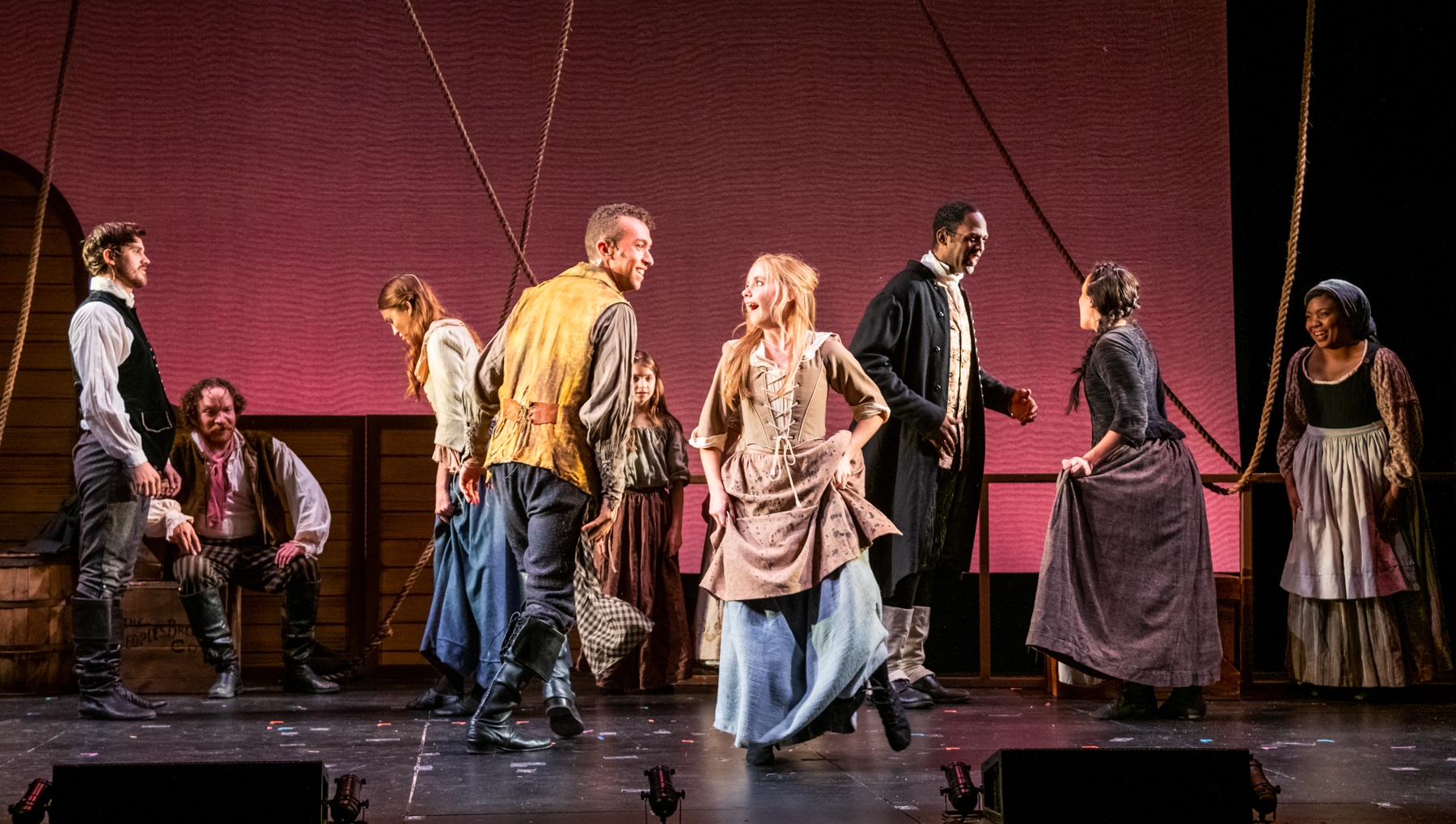
Ensemble Cast of LadyShip photo by Russ Rowland

Ensemble Cast of LadyShip; photo by Russ Rowland

All of the women develop variations of relationships with the male crew  — exemplified by Trevor St. John-Gilberts’s swaggering Lt. Adams and Justin R.G. Holcomb’s perpetually wasted Zeke Cropper — bargaining for writing paper or bribing them with rum.  One even establishes a true connection with Jordon Bolden’s charming and sweet Marcus “Finn” Findley, something which did often occur on these transportation voyages.  Clear ties are also made to current events including the notion that women and children will be separated upon arrival in their new land and that tougher levels of justice are meted out for the poor.  But there is little light shown on the few more hopeful stories of women who were permitted to marry emancipated men and lived more traditional married lives, much less any inclusion of the inspiring rebels such as entrepreneur Mary Reibey.  More emphasis on these story elements would have made the optimistic ending feel more earned than it currently does. 

The level of talent that went into this production is obvious.  Coming from the pens of an indie rock band, the music and lyrics are surprisingly subdued.  Under the direction of Simone Allen with Christopher Anselmo on guitar, Charlotte Morris on violin and herself on piano, most of the numbers are dulcet, easy to listen to and filled with luscious harmonies.  Karlin leading the women in the rollocking “Only the Strong Survive” is the closest we hear to the anticipated battle anthem.  Director Samantha Saltzman keeps the women realistically contained with scenic designer David Goldstein deftly providing the no-frills pieces that make up the dreary London jail, the dark bowels of the ship, and the sparse dockside.  Costumes by Whitney Locher appropriately telegraph class and rank, though they all stay a bit too clean throughout.  Sam Gordon’s lighting and Patrick Calhoun’s sound go a long way to completing the picture of life at sea.

NYMF continues through August 4 at Alice Griffin Jewel Box Theatre in Pershing Square  (480 W 42nd St, New York, NY 10036) and other nearby venues.  This is a not-to-be-missed affordable and rewarding chance for fans of musical theater to indulge their passion.  Passes for four or more tickets as well as individual tickets are available at http://www.nymf.org.