Tag Archives: Playwrights Horizons

The Antiquities – A First Look

When I heard that Playwrights Horizons, Vineyard Theatre and Goodman Theatre were co-producing a project, I jumped at a ticket to a late preview.  The Chicago-based Goodman — the oldest ongoing venue in the area — is a Regional Tony winner known for its community inclusiveness.  Vineyard Theater in Manhattan is renown for its support of new voices and unconventional works.  And the focus of Playwrights Horizons is to develop writers whose works promote conversation.  Recently they nurtured the seemingly impossible to stage Stereophonic which won a Tony for its Broadway transfer. 

Added to my incentive was that the playwright, Jordan Harrison, wrote two plays that have stayed with me over the years.  The characters in his Maple and Vine become so uncomfortable with the abundance provided by  modern technology that they move to a town filled with 1950s re-enactors.  In Marjorie Prime, which put Harrison on the short list for the Pulitzer Prize, a digitally generated companion assists an aging woman in recapturing her memories.  Both works are alternatively witty and chilling as they explore the relationship between technological advancement and what keeps us human.

While the performance I saw of Harrison’s latest occurred too early in the run for me to write an official review, I wanted to share a few thoughts.  In A Tour of the Permanent Collection in the Museum of Late Human Antiquities — or simply The Antiquities — two AI curators guide us through a museum built for preserving essential chapters in the human story.  The Playbill includes a quote by Oscar Wilde: “Every portrait that is painted with feeling is a portrait of the artist, not of the sitter.”  In this case, the artists are the systems into which we’ve fed everything from our grocery lists to sensitive photos and we are merely the byproduct of their process.

The trip forward begins in 1816 — when Mary Shelley concocted an original horror story that has since become a metaphor for many of man’s inventions —  and ends in 2240.  The journey is disjointed and abrupt, with some scenes lasting mere minutes.  The diverse cast, described only as Man/Woman 1-4 and Boy, moves with skill and comfort through roles and tone, though not all interactions land with the same level of impact.  For nearly an hour, Harrison relies on an intelligent and informed audiences to fill in blanks. The ride back to 1816 smashes the museum metaphor, but mostly succeeds in stitching together the incidents we’ve witnessed.  The conclusion leaves a stinging mark. 

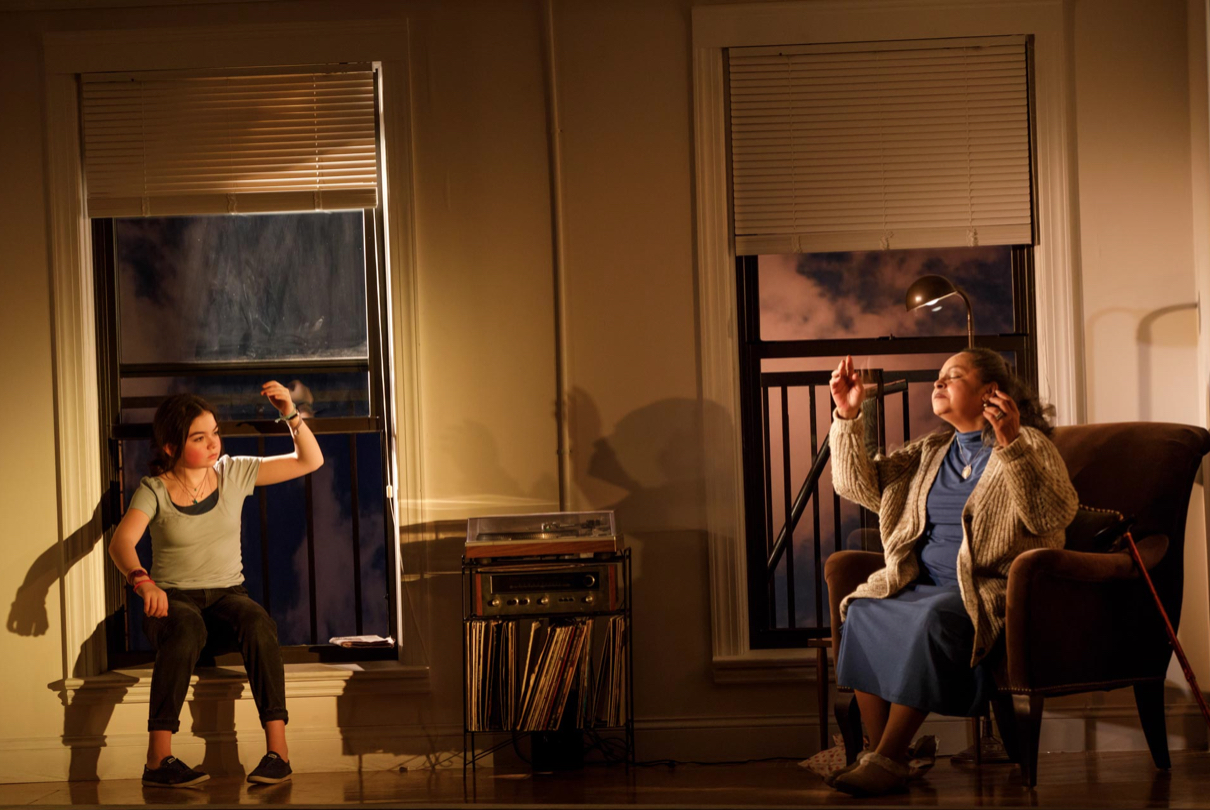
Kristen Sier and Julius Rinzel in The Antiquities, opening February 4, 2025 at Playwrights Horizons; Photo by Emilio Madrid

The co-directors are multiple award winner David Cromer and ascending star Caitlin Sullivan. This creative pairing may explain the wide range of flavors imparted by each bite-sized chunk.  It will be interesting to see what changes are made by the artistic team before the show is frozen.  The scenic design by Paul Steinberg is composed of metallic walls shiny enough to make us feel included by not clearly reflected. They move to constrict the characters, and are enhanced with a few set pieces.  Tyler Micoleau’s lighting is harsh and eery, blending well with the occasionally distorted sound design of Christopher Darbassie. 

The Antiquities is not an easy show, but it is an admirable offering for the subscriber base of the collaborating producers and others who don’t mind doing some cerebral heavy lifting.  After opening on February 4, the World Premiere runs through March 2 at Playwrights Horizons, 416 West 42nd Street.  Tickets begin at $52.50 and can be purchased at https://www.playwrightshorizons.org/about/production-history/2020s/2425-season/the-antiquities-jordan-harrison.  A second production begins on May 3 at Goodman’s Owen Theatre in Chicago.

In the Amazon Warehouse Parking Lot 

Like the cruel corporation that manipulates Jen, Ani, Sara and their co-workers, for the most part In the Amazon Warehouse Parking Lot delivers the goods.  What this piece has in common with several of this year’s Off-Broadway productions is an over-stuffed plot that takes on too many critical issues to the detriment of them all.

Similar to Carol Churchill’s memorable Far Away, playwright Sarah Mantell begins by sketching oblique fine lines of a chilling future in a failing country and dramatically discloses details of the lives of an outrageously exploited underclass.  (Churchill twice won the Susan Smith Blackburn prize that Mantell was awarded for this work.)  Descriptions of an advanced climate crisis set to the “music” of Sinan Refik Zafa’s enveloping sound, are vivid, alarming, and all too possible.  The abusive work environment is also cleverly revealed and based just enough on reality to strike a chord.  The more publicized love story is not as well motivated and becomes a distraction.  It doesn’t help that Donnetta Lavinia Grays, who otherwise turns in a strong and steady performance, can’t conjure up any chemistry with Deirdre Lovejoy.   Ultimately, this thread may be essential to the playwright, but not to the play.

In her personal note, Mantell explains her intention to make this production “both art and a hiring document” particularly for women, trans, and nonbinary actors over 50.  The reward for her worthy goal is a memorable cast — Grays and Lovejoy are joined by Barsha, Sandra Caldwell, Ianne Fields Stewart, Tulis McCall, and Pooya Mohseni — so congenial and cohesive it is easy to believe they hang out at the (still open!) West Bank Cafe after every performance.  With no clear path forward, these people can only move “towards.”  Their palpable warmth is in stark contrast to Emmie Finckel set.  The characters are unmoored in a sea of cold conveyer belts and unwelcoming mountains awash in the purple hues of Cha See’s lighting.  

Ianne Fields Stewart, Pooya Mohseni, Tulis McCall; Photo credit: Valerie Terranova

Director Sivan Battat  draws on their background in ritual and diverse mythological storytelling to enrich the anchoring “around the campfire” scenes.  Even the most peculiar and futuristic banter feels organic.  (A lighter detail is Mantell’s selection of the social deduction party game Werewolf as the group’s preferred method of entertainment.)  The more mixed result stems from the monologues about how each of the workers spent their first night sleeping in a vehicle.  This often repetitive contrivance begins to bog down rather than deepen the unfolding of events.    

At its core, In the Amazon Warehouse Parking Lot  is a story of families lost, found, and made. The elements largely come together in a satisfying theatrical experience with a refreshing cast you will want to see more of.  While there are missteps in the dance between Mantell’s personal mission and broader audience appeal, if you give yourself over to her vision (as the mostly under-35 audience did at the performance I attended) the effects will linger.  Presented in association with Breaking the Binary Theatre, the world premiere continues on the MainStage theater at the Playwrights Horizons (416 West 42nd Street) through November 17.  Runtime is approximately an hour and half with no intermission.  Tickets begin at $62.50 and can be purchased at https://my.playwrightshorizons.org/events/amazon.  

Staff Meal

A staff meal at a typical restaurant is an opportunity for the entire crew to be treated as equal members of a “family.”  However, in Abe Koogler’s Staff Meal currently being served up at Playwrights Horizons, there is something odd transpiring around the table.  While the enthralled servers moan in delight, what we see is unremarkable.   The true source of their reaction is imperceivable to outsiders.

At this same unnamed venue, Ben (Greg Keller) and Mina (Susannah Flood) are out on a what would strike most of us as a dreadful first date, though they seem quite comfortable with each other’s horror-tinged stories.  Their waiter (Hampton Fluker) is on a mesmerizing walk through the dark, deep, and disorganized wine cellar.  And the Servers (Jess Barbagallo and Carmen M. Herlihy) are just giddy to be employed by the elusive Gary Robinson (Erin Markey who is also — somehow — the chef and a vagrant) a man of wealth whose philosophy is what keeps them full.  Along the way, these characters don’t just break the fourth wall, they bulldoze it, build a fresh one, and then smash that one with a mallet as exemplified by Audience Member (Stephanie Berry).

Vagrant (Erin Markey) goes job hunting in Staff Meal; photo by Chelcie Parry

Similar to many artistic endeavors that were completed during the pandemic, Koogler’s piece is much more intent on capturing an unfamiliar mood than it is on telling a story.  The restaurant at its center is a unique universe with a distinct environment and even — it would seem — its own gravitation pull.  Individual scenes are like a Matryoshka Doll in reverse, with each character revealing a bigger, more colorful veneer without changing much of the plot’s shape.  Koogler imbues them all with astoundingly vivid and detailed memories and imaginations.  Poetic meditations on food, love, the past, and being of service are passionately delivered.  But while the people on stage search for common ground, you too might be casting about in hopes of feeling a connection. 

Under the hand of director Morgan Green, the artistic team functions in concert to support the absurdist tenor of the work.  Comparable to quarantine at COVID’s height, time spirals and sense of place becomes illusive.  Jian Jung’s papered walls are both elegant and nondescript.   The costumes by Kaye Voyce start off as commonplace and morph into outright bizarre.  As the players grow increasingly wary, Masha Tsimring’s lighting follows that tone.  Tei Bow’s sounds and music complete the vague and uneasy landscape.

Not unlike the restaurant that is Staff Meal’s home base, this play serves up some novel flavors. If you are willing to hover somewhere between drama and performance art, you might savor the experience without the need to define each morsel.  But also akin to dining in that central establishment, the undertaking might leave you feeling hungry for something more solid.

Staff Meal continues through May 19 at the Peter Jay Sharp Theater on the 4th floor of Playwrights Horizons at 416 West 42nd Street.  Running time is one hour and 35 minutes with no intermission.  Tickets are $51 – $91 and can be purchased at https://my.playwrightshorizons.org/events/staffmeal.

The Thanksgiving Play

In the right hands, satire can be a terrific educational tool.  This was clearly in the mind of award-winning playwright and activist Larissa FastHorse when she chose to go broad with The Thanksgiving Play.  Pained by the way the typical Thanksgiving story obliterates the voices of her people, the Sicangu Lakota uses laughter rather than lecture to take on all those insulting myths.  This is the award winner’s first New York production and it’s a worthy entrance. Through her four well-intentioned if off-base characters, she blows up those oft-repeated stories of pilgrims showering America’s indigenous peoples with respect and side dishes.  The results are uneven and she’s likely preaching to at large number of regular choir members, but a good time can still be had.

Thanksgiving Play

Greg Keller, Jennifer Bareilles, Jeffrey Bean, and Margo Seibert; photo by Joan Marcus

The economical cast of achingly progressive characters are developing a holiday performance that celebrates Native American Heritage month for a elementary school audience.  The director of this play within a play is Logan, an anxiety prone vegan who has pulled together an array of small niche grants in order to fund her vision of a more honest Thanksgiving story.  Her school play will co-star Disney-obsessed actress Alicia and Logan’s yoga-loving street performer boyfriend, Jaxton.  Rounding out the “creative team” is Caden, a playwright-wanna be and first grade teacher.  For the majority of the 90 minute runtime, these well-intentioned souls improvise and brainstorm their way towards an increasingly awkward outcome.  Their endeavors are occasionally interrupted by wildly off-kilter musical numbers covering all the cringe inducing story elements they are trying to leave behind.

Under the direction of Moritz Von Stuelpnagel, the dialogue starts out at such a high pitch it doesn’t have enough room to grow.  Jennifer Bareilles as Logan is a constant bundle of nerves.  Greg Keller’s Jaxton’s oozes PC doctrine from every pore.  Margo Seibert’s Alicia is such an airhead she’s perfected the art of looking at the ceiling.  And Jeffrey Bean’s Caden is like a Jack Russel terrier, excited just to be in their company.  All four quality actors do their best to add range and fair better with the piece’s physical humor.   These moments includes an uncoupling ritual and reading aloud from several fantastically illustrated textbooks.

The design team mostly strikes the right comedic notes.  The single set by Wilson Chin combines classic classroom elements with some of the most appropriately inappropriate theater posters.  Costume designer Tilly Grimes delivers equally well with liberal casual and tacky pageant wear.  Lighting created by Isabella Byrd highlights the action as it shifts from faux intense to intensely faux.

As both a comedy and a lesson plan, this production of The Thanksgiving Play would likely earn a B- for its insufficient build and variation.  But it has heart and successfully serves as a reminder that the upcoming family holiday is fraught with misunderstandings that go far down and way back.  Certainly if you’ve ever had a Caucasion friend who built a sweat lodge right next to his jacuzzi to honor “their heritage,” you will recognize FastHorse’s creations.  And even if you haven’t, you’ll be reminded that what you’ve learned about US history is not necessarily the full story. 

Performances are scheduled to run through November 25 at the Peter Jay Sharp theater at Playwrights Horizons.  For tickets and information visit https://www.playwrightshorizons.org/shows/plays/thanksgiving-play/.

This Flat Earth

“Are you there,” implores 13 year old Julie at both ends of This Flat Earth to anyone who’s listening Nine students were recently killed in a school shooting, disrupting her feelings of peace, safety, and normalcy.  This topic should be the springboard for compelling discussion.  Indeed there are some threads about socioeconomic conditions and adolescent turning points that click.  But for the most part, this is a ninety minute missed opportunity that ultimately promises that trauma will be all but lost beneath the unrelenting waves of everyday life.

This Flat Earth

Ella Kennedy Davis (Julie) and Lynda Gravátt (Cloris), Photo by Joan Marcus.

The piece is set in the recent past, and yet somehow Julie has no idea that hers is not the first school to have gone through such an experience.  She believes that her persistent jealousy of a talented and popular girl who died might have caused the tragedy. In her program notes, playwright Lindsey Ferrentino tells how she experienced a similar sense of misplaced power when the incidents of 9/11 occurred the day after she had written a diary entry about the joys of peacetime.  The transference of those feelings to sadly more common circumstance are diminishing to her main character.  The excuse provided for Julie’s ignorance is that her father is too poor to have purchased a laptop.  But even her best friend/would-be-boyfriend Zander seems to think the girl just hasn’t been paying attention.

The casting of Ella Kennedy Davis as Julie doesn’t do much to shore up the character as an interesting representative of her generation.  While speaking too quickly at a very high pitch and slurring key words is all too realistic, it also left many of the audience members trying to keep up as they attempted to fill in the missed dialogue. Faring much better is the gifted Ian Saint-Germain, who captures the natural flow of Zander’s assuredness and awkwardness.  Lucas Papaelias has trouble navigating the clumsy role of Julie’s father, Dan, but it is hard to tell how much of the difficulty is in the lines and  how much in his interpretation.  While no parent can protect a child from all dangers, widower Dan comes across as particularly ill-equipped and Papaelias often flails around in his skin.  In the role of Lisa, a mother who lost a child in the tragedy, Cassie Beck is also constrained by her character’s limited responses.  The only adult providing any constructive contribution is Lynda Gravátt’s upstairs neighbor Cloris.  Naturally she can’t answer the impossible, but she delivers sincere and often amusing descriptions of effective coping mechanisms.

The talented director Rebecca Taichman does her best to underscore the truer emotions in the script by matching it with genuinely motivated physicality.  Dane Laffrey’s two story set works wonderfully, though it could use a few more tonal touches.  Costume designer Paloma Young has put together a fitting wardrobe, particularly with a bag of clothes that plays a critical role.  Adding to the mood as well as forwarding the story is cellist Christine H. Kim under the musical direction of Christian Frederickson.

This Flat Earth is one of several recent productions that poses probing questions about the world we are leaving to the new generation.  The Artistic Director claims it was never conceived as a production about gun violence, but opening just a month after events at Parkland it’s impossible to view it separate from that issue.  Even when evaluated as an artistic expression, the play is wan when compared to similar offerings. While there are moments when the authentic psyches of the teens shine through, there are too many uninspiring stretches.  Performances of this world premiere continue through April 29 at Playwrights Horizons.  For tickets and information visit https://www.playwrightshorizons.org/shows/plays/flat-earth/.