
In Chinese Republicans, four women of Chinese heritage and spanning three generations are gathered for an Affinity Luncheon near their New York City office. As co-workers at a stressful international investment banking firm, they look forward to these supportive gatherings, not to mention the turnip cakes. Their stated purpose this time is to welcome their newest member — the pretty and giddy 24 year old Katie — and celebrate her recent promotion. Managing Director Ellen has been acting as Katie’s mentor, giving her encouragement and hints about how best to reach the next rung of the ladder. Corporate consultant Phyllis, who once held Ellen’s current job, plays healthy skeptic to Ellen’s cheerleader. The most conservative of the group, she punctuates many of her observations with a pointed “Thanks, Obama.” Also in attendance is Chinese citizen Iris. She is in the US on a Work Visa and hoping her contributions to the firm will allow her to stay. But from what we can see, her main responsibility is to get the lunch ordered correctly.
Over the course of numerous encounters and flashbacks, we watch the foursome jockey for position, sometimes in support of one another and more often in competition. All four are trying to cope with pressures both cultural and corporate; sometimes responding in anger and other times tactically. Their varying viewpoints on what it means to be Chinese add an intriguing element to their sparring.
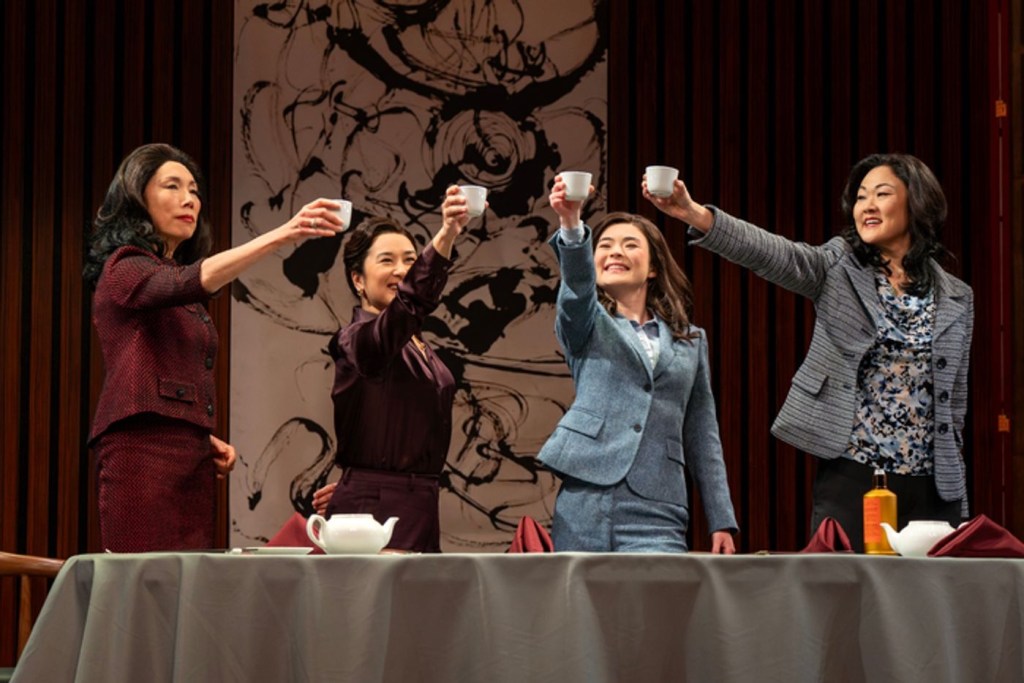
Quite a bit of obvious shorthand is used to backfill the women’s histories with the intention of clarifying their current motivations. Such narrow definition of character leaves Jennifer Ikeda (Ellen), Jully Lee (Iris), Jodi Long (Phyllis), and Anna Zavelson (Katie) without the ability to shine at full wattage. Some right leaning political views are mixed in with the abbreviated development (whoosh hate crime, whoosh abortion, whoosh “me too”) and the placement of the action in 2019 avoids the most thorny topics. Often director Chay Yew relies on elevated voices and manic gestures to take the place of more involving connection.
Playwright Alex Lin has generated enormous enthusiastic buzz, most recently for her Lear-inspired Laowang. In Chinese Republicans, what she sacrifices in keener character arcs, she makes up for in startling imagery. She demonstrates a flair for switching tones from heart attack-inducing conflict to door-slamming farce. Based on Lin’s obvious talent and genuine interest in her subject matter, there is a deeper, more distinctive, and less strident script just beyond our reach. While it certainly never gets boring, as the piece approaches its final 15 minutes the plot losses focus.
The play’s atmosphere is nicely detailed. Costume designer Anita Yavich provides a wardrobe made for code switching, mixing business attire with Asian-inspired accessories. The sound design by Fabian Obispo incorporates original music and big city hubbub. Impressive sets by Wilson Chin include an attractive modern restaurant and the imposing wall of the investment firm. To prepare for the varying degrees of fluency in Mandarin, Cantonese, and English, the company enlisted dialogue coach Ka-Ling Cheung.
With a great deal to say and an unconventional blending of styles, Chinese Republicans is both a thrilling and a frustrating ride. The World Premiere production, part of Roundabout’s 2025-26 season, continues through April 5. Performances are at the Harold and Miriam Steinberg Center for Theatre, Laura Pels Theatre, 111 West 46th Street. Running time is 95 minutes without an intermission. Seat prices range from very reasonable $69 – $102. The venue has superior sight lines and a small cafe on the lower level. Visit https://www.roundabouttheatre.org/get-tickets/2025-2026-season/chinese-republicans?url=/get-tickets/2025-2026-season/chinese-republicans for more information and to purchase tickets.



 The Unforgettable Line
Bobbie Clearly
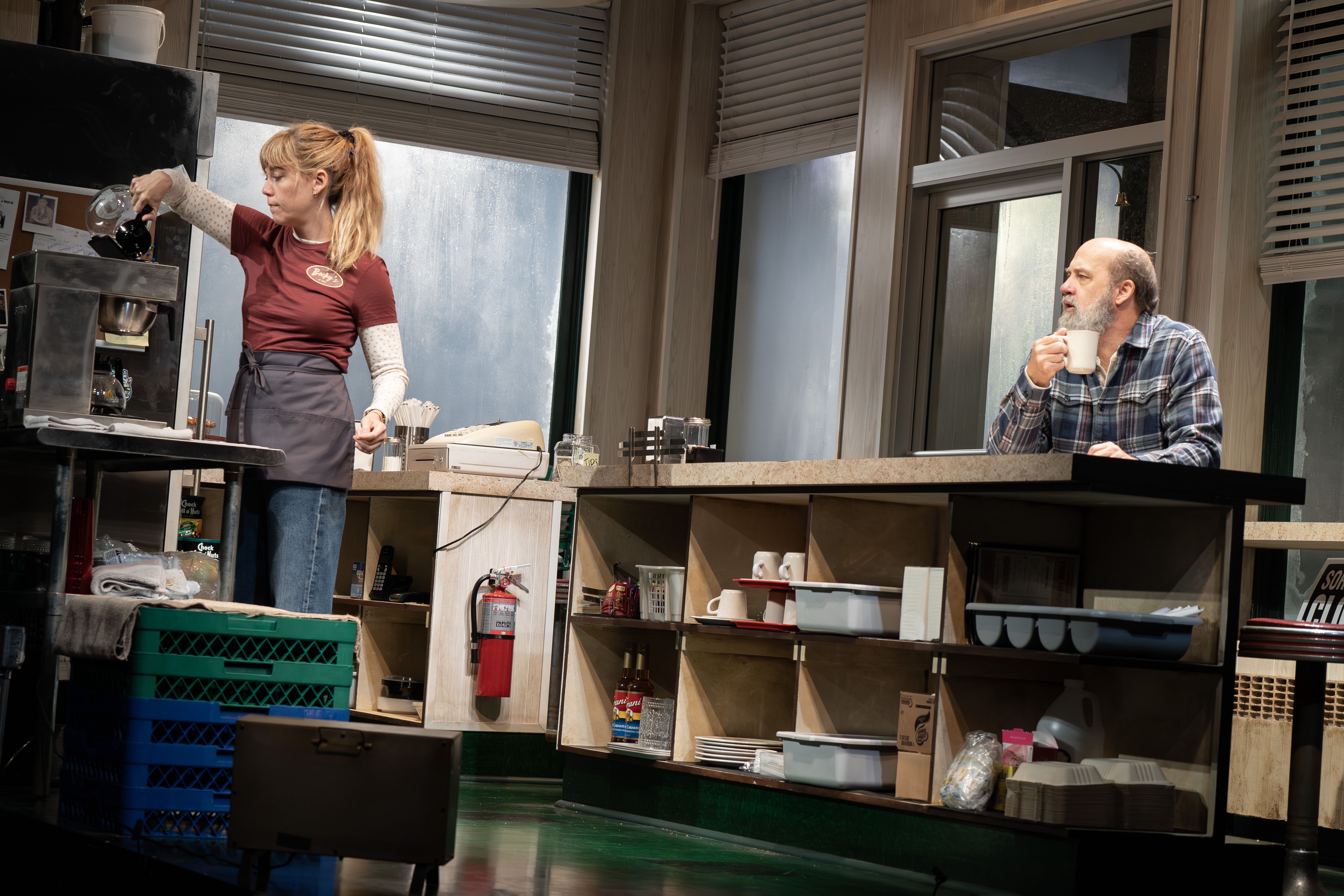
We are seated in the Milton Community Center witnessing the making of a documentary. Ten years ago, this small Nebraska town was rocked when the title character of Bobbie Clearly shot and killed Casey Welsh when she was 16 and he 14. For nearly 2 1/2 hours, we will hear from Bobbie and ten others about what led up to that horrific event and beyond it to present day. It will be as hard to see the next turn in their stories as it is to navigate the tall fields of corn where Casey’s body was found.
Avoiding the pitfalls of some of the seasons other issues-oriented productions, Bobbie Clearly focuses on the violent act’s human impact rather than on the shooting itself. Playwright Alex Lubischer has generously peppered his moving script with moments of humor, taking care to treat his characters with affection even when poking fun. Though primarily delivered in interview format (to an unseen host), the relationships sparkle. There are times when two people are telling separate segments using identical phrases, shining a light on the importance of context. Lubischer also captures a common progression of high school friendships, following four of Bobbie’s classmates from their summer jobs corn detasseling through their awkward fundraisers in Casey’s memory. Further, there is a profound exploration of the link between religion and forgiveness. Most importantly in this delicate time, Lubischer is careful not to take a stand on guns by making Casey’s father, Stanley, take delight in hunting as a distraction from his grief.
The entire cast is terrific, beginning with Ethan Dubin who — though used sparingly — manages to be both sweet and disturbing as Bobbie. Many will recognize the magnificent Constance Shulman from her equally wonderful ensemble work in television including Orange is the New Black. With her tiny wiry frame and high-pitched croak, she makes an unusual police officer, which is perfect given the unconventional bond she develops with Bobbie from the time he was the Sunday school bully to the day he makes his best attempt at repairing the huge hole he has ripped in his community. Her intensity is balanced by the performance of JD Taylor as Bobbie’s misguided and slightly goofy Big Brother Derek Nelson. As BF(F?)s and mismatched bookends Megan and Meghan, Talene Monahon and Sasha Diamond play off each other with great timing. And Tyler Lea taps into both vulnerability and inner strength as Casey’s younger brother, Eddie, the only witness to the murder.
The piece is performed in 3/4 round with what are essentially service doors to the space serving as entrances and exits. As directed by Will Davis, the energy flows consistently even through the silences. He may also be responsible for the brilliant choreography of two critical dance numbers, which call for very special talent. Kudos to Asta Bennie Hostetter for finding such great costumes-on-a-budget for those numbers as well as the more everyday items that fill in character details. Providing unsettling atmosphere are the smothering walls of dried corn that almost exclusively comprise the minimal set by Arnulfo Maldonado.
At $25 a ticket, Bobbie Clearly is superb bang for the theatrical experience buck. The play is presented as part of Roundabout Underground at The Black Box Theatre and is sure to keep developing its strengths. If you are looking for a who dunnit or even a why, look elsewhere. However, this slow-burn storytelling and honest examination of what is ultimately unknowable will leave you with your thoughts turning. For tickets, on sale through May 6, 2018, and information visit https://www.roundabouttheatre.org/Shows-Events/Bobbie-Clearly.aspx.