Tag Archives: Signature Theatre

Grangeville

Grangeville is the county seat of Idaho County and the setting for and title of Samuel D. Hunter’s latest play exploring life in his home state.  Older brother Jerry still lives in this town of slightly over 3000 people.  He is newly separated from his high school sweetheart Stacey, raising two kids, acting as healthcare proxy for his mother, and doing his best to support himself by selling RVs.  Younger half brother Arnold has distanced himself from all the bullying he received at the hands of his family and classmates.  Married for nearly 17 years to Bram, he lives and creates works of art in Rotterdam, the Netherlands.  The only thing these two seem to have in common is a little DNA.  But when it comes to light that their critically ill mother has made Arnold her Executor and granted him Power of Attorney, the siblings have no choice but to reconnect.

What follows is 90 minutes of stirring and often witty dialogue delivered by two versatile actors.  Similar to Arnold, Hunter has created a piece of art that both mocks and celebrates his birthplace.  This script is his usual blend of profound human insight and bookish humor.  If you’ve enjoyed my spoiler-free reviews, you should jump to the last paragraph.  There is simply no way to discuss this production without revealing something that is better experienced for the first time in the moment.  

Arnold and Jerry are so different they don’t even share similar memories from their past. Their search for and avoidance of common ground is enthralling.  In the meatier of the roles, Brian J. Smith portrays Arnold, the brighter and more settled of the brothers.  Smith’s ability to navigate Arnold’s swift transitions of emotional state is impressive and endearing.  Smith also plays Stacey just by adding a measure of softness to his tone and gestures.  Paul Sparks takes on Jerry, a man full of deep regret about his conduct as a younger man and consumed by unhappiness with his current circumstances.  At first, Jerry verbally tiptoes towards Arnold in their video chats.  As his need increases, so does the urgency in his language.  With a subtle change in posture and a waffling accent, Sparks then moves to the role of Bram.

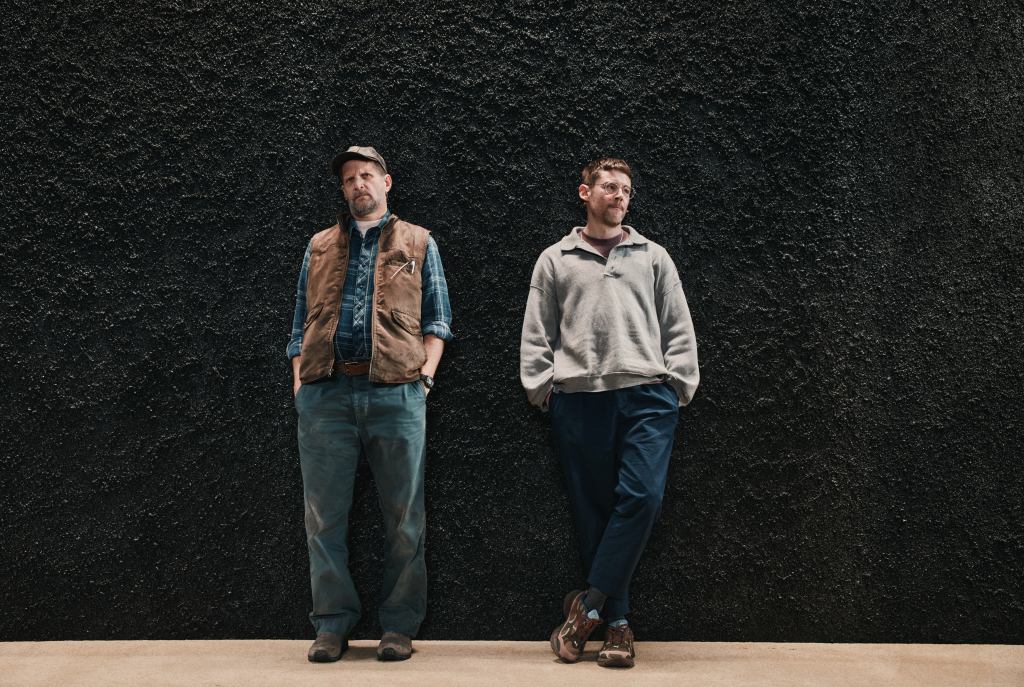
Paul Sparks and Brian J. Smith in Grangeville; Photo by Emilio Madrid

With the precision of an orchestra conductor, director Jack Serio enables his actors to delicately build towards an inevitable crescendo.  Initially we sit in darkness, fully tuned in to their choice of words and reflective pauses.  Movement is added as the exchanges increase in temperature and truthfulness.  Like Hunter’s characters, the black textured walls and dirty white door of the set by dots don’t fill out until far into the journey.  Stacey Derosier’s lighting and Chris Darbassie’s sound have similarly calculated arcs.  Props by Addison Heeren add the perfect punctuation.

Grangeville is a smartly written work that takes full advantage of live theater as a communication and entertainment vehicle.  The Signature-commissioned World Premiere continues through March 23 at The Alice Griffin Jewel Box Theatre, 480 West 42nd Street.  The house is shallow and well raked with the legroom of an economy seat on Spirit Airlines.  Run time is 90 minutes with no intermission and no re-entry permitted.  Tickets are available at https://signaturetheatre.org/show/grangeville/  and begin at $78 including fees.  Arrive early to take advantage of the pleasant cafe and small bookshop on the second floor.

Three Houses

For a play named after a family dwelling, Dave Malloy’s Three Houses has surprisingly little structure.  Set in a magical cocktail bar with an orchestra that can follow along in any key, three strangers share their experiences in a confessional open-mic night.  When the pandemic broke out, each one of them had just gone through a break-up with a partner and found themselves secluded and struggling mentally.  While there are similar strands within their tales, their ordeals only lightly touch, like their pinkies when they finally share a table.  Along the way, there are some wonderfully creative moments and beautiful melodies.  But like the current drive along the crumbling Highway 1 in Big Sur, a final point remains illusive.

In House #1, Susan (Margo Seibert) had been researching her next novel in Finland when COVID hit.  Unable to get back to the United States, she retreats to her grandmother’s abandoned house in the Latvian woods.  In a haze of red current wine, weed, and OCD, she uses the time to learn what she can about her ancestor.  House #2 is set to more uptempo tunes as we move from the deep woods to the sunny desert.  When her aunt returns to Korea leaving her New Mexico home unoccupied, Sadie (Mia Pak) takes refuge there.  Painfully missing her girlfriend, she further retreats into a SIM she has meticulously modeled on memories of her grandparents.  House #3 is actually a small basement apartment into which Beckett (J.D. Mollison) has moved after the end of his marriage.  On every level, it becomes the darkest of the dwellings, especially after he learns that his grandparents have just passed away in Ireland and paranoia sets in.  

Three Houses is the final piece of Malloy’s trilogy which includes Ghost Quartet and the memorable Octet.  Having written the music, lyrics, book and orchestrations, this work completely embraces his usual fascination with fables.  As they grapple with the effects of isolation and regret, each of our storytellers develops a relationship with a fictional being represented by puppets with tremendous personality designed by James Ortiz.  Elements of The Three Little Pigs play key roles and even show up in a sweater.  But when the inevitable wolf finally makes it to the door, he is dressed in grandma’s nightgown, which for fairytale purists will be perplexing.  

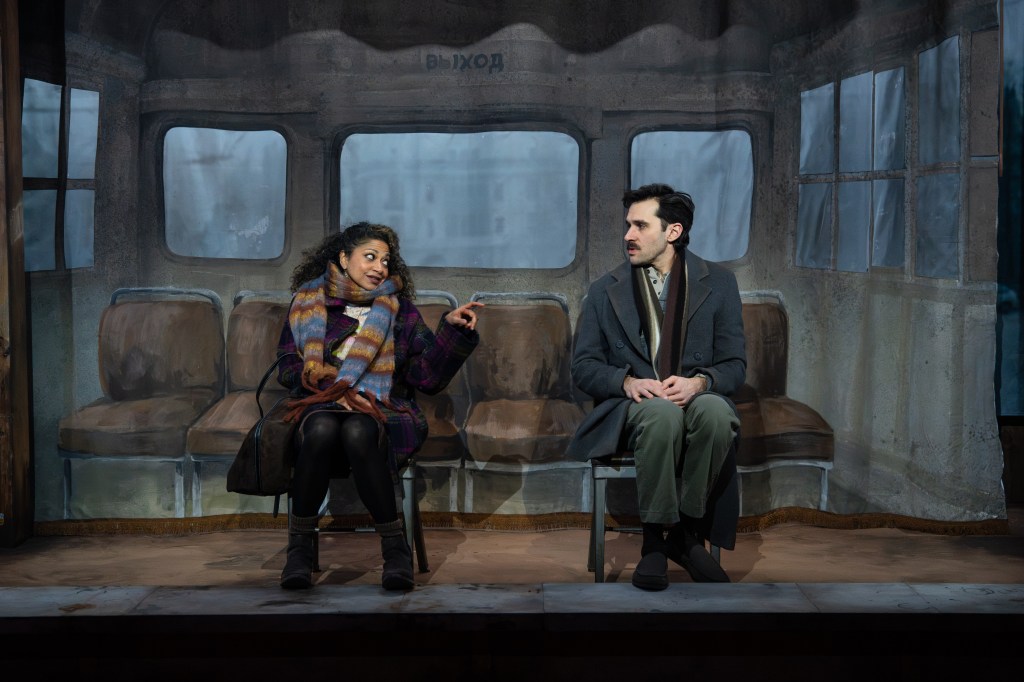
Mia Pak (with Pookie the Household Dragon) and Margo Seibert in Three Houses

All three soloists are terrific and support each other vocally and energetically.  Henry Stram and Ching Valdes-Aran appear as all of the mystical grandparents.  Scott Stangland rounds out the cast exuding something between command and menace as the bartender/MC Wolf.  However, Annie Tippe’s direction is both mystifying and maddening, especially given her assured hand with Octet.  The same black box space has been splendidly designed by the imaginative team of dots to feel warm and inclusive and a tad old-fashioned.  Fabric is draped all along the mezzanine, and the orchestra members sit in armchairs adorned with crocheted throws.  Center stage is an elaborate wooden bar, but even from the middle of the side section — normally a great spot in ¾ round — I could not make out what was on the changing backdrop behind it.  The vast majority of the staging is forward facing with the actors sometimes positioned side-by-side blocking each other from view.  Lighting designer Christopher Bowser has added some attention-getting effects and Haydee Zelideth costumes are a likewise literally colorful component that visually adds to the stories.  Nick Kourtides envelops the audience with his sound design, which appropriately alternates between feeling comforting and smothering.

Ultimately, Three Houses is more like a trio of discontinuous chapters of an unfinished novel than a fully fleshed out musical.  While the emotive songs and fanciful imagery of Octet have carried over, the clear interconnection of  those characters is missing here.  But there is some interesting terrain explored in finding discipline amid chaos and all the ways in which you can and can’t get to know someone else and — through them — yourself: vast themes to cover in a mere 100 minutes.  The production runs through June 9 at the Signature Theatre  (480 West 42nd Street) where Malloy is Premiere Resident.  Tickets ($49 – $124) and information are available at https://signaturetheatre.org/show/three-houses/

Sunset Baby

My first experience with Sunset Baby – Dominique Morisseau’s 2012 drama being revived at New York’s Signature Theatre – was a series of tweets from colleagues grumbling about the treatment of the playwright’s program insert. Indeed the tiny handout is a puzzling choice of physical manifestation for her enticing invitation to the audience to fully participate even vocally in her tale of a recently released social revolutionary, his traumatized daughter, and her loving thug of a boyfriend.  But it wasn’t so much that the “Permissions of Engagement” were on a 4×6 piece of paper in nine point font. The more disappointing aspect was that the production did not elicit so much as a peep from Sunday’s audience.

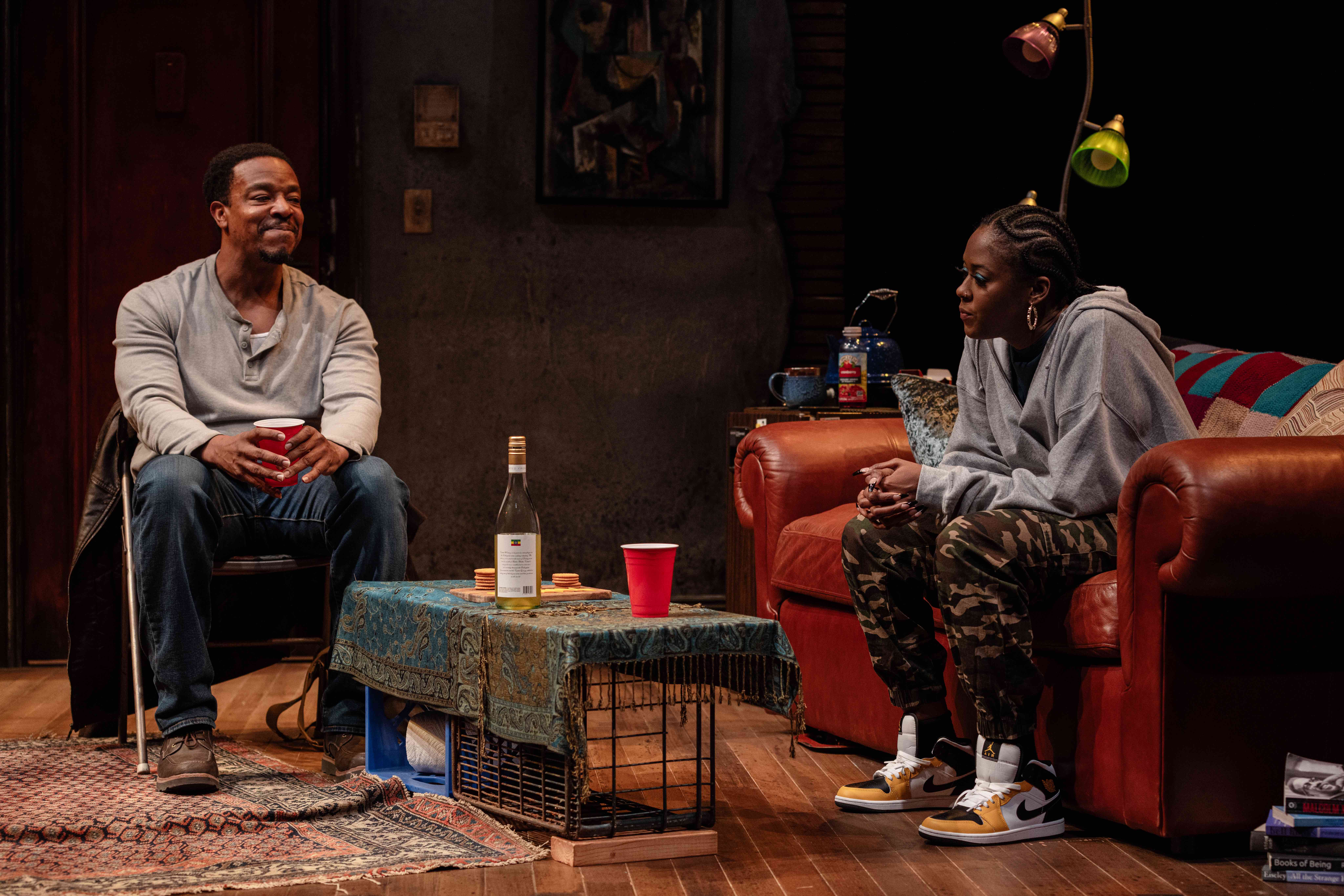
Russell Hornsby and Moses Ingram in Sunset Baby; Photo Credit, Marc J Franklin

The ability to fulfill Sunset Baby’s promise is boldly displayed in the concise history of the show’s world displayed on the wall outside the theater door. It is visible in Wilson Chin’s economical yet thoughtful scenic design with its peeling paint, well-used furniture, and intriguing choice of artwork.  The decision to move the proscenium forward and raise the rake between the rows increases the accessibility and brings the audience further into this room.  Small touches from a shower caddy (props by M. Picciuto) to the nearby train (sound by Curtis Craig & Jimmy Keys) bring the setting into clearer focus. The promise is most palpable in the emotive performance of Russell Hornsby as Kenyatta, who in warm and slightly trembling tones opens the show by vividly describing not only the struggles of his role in the Black liberation movement and resulting incarceration, but of the bigger challenge of trying to be a loving father. And it occasionally pokes its head out in Morisseau’s careful plotting such as the discovery that Kenyatta’s daughter Nina expands her world beyond her rundown room in East New York by watching the Travel Channel.  Indeed, Morisseau’s knowing and complex feelings about parenthood are strongly woven throughout the dialogue. But none of these sparks ever becomes flame in the frustratingly inert 90 minute runtime.

What seems to have put a dulled layer between the work and the experience of it are artistic choices by director Steven H. Broadnax III.   The pacing is slow and there are false notes along the way.  Nina comes home from her “job” as a fake hooker who helps her boyfriend, Damon, lure black men into dark alleys to rob them.  She slips off her shiny royal blue thigh-high boots — among the apt selections by costume designer Emilio Sosa — only to wrap her cozy pink bathrobe around her skin-tight leather mini. Is this a symbol for her constant discomfort or an inability to smoothly incorporate a wardrobe change?  The actress embodying Nina, Moses Ingram, has proven herself capable of deep emotional range.  But here she is stuck at the pitch of a petulant teen. Nina’s lack of full development is most notable in a pivotal scene between her and Kenyatta. It should play like a musical movement that shifts from minor to major.  Instead this sly turning point is tonally more like a repeated refrain.  As her literal partner in crime, J. Alphonse Nicholson is also wedged into a single groove when the character could be providing meaningful counterpoint. 

I deeply admire Signature Theatre as a surviving safe harbor of affordable, expansive community theater. The commitment to reexamine an older work by Dominique Morisseau that focuses on the personal impact of the socioeconomic divide is a timely one. But Sunset Baby 2024 misses an opportunity to more engagingly enlighten a new audience about the fallout from another period during which the Black community’s efforts to serve their own were villainized and politicized.  

The first of three offerings this season, Sunset Baby runs through March 10 in the Romulus Linney Courtyard Theatre at the Pershing Square Signature Center (480 W. 42nd Street).  Tickets are available at https://order.signaturetheatre.org/events and are $59/$79/$99/$119.