Tag Archives: Stacey Derosier

Meet the Cartozians

What establishes our identity?  Skin color?  Language?  Scientific evidence?  In a country comprised primarily of immigrants, how do we balance our cultural heritage with our recognition as Americans?  In Meet the Cartozians, Talene Monahon, “a playwright of actor descent,” explores these weighty and often murky issues with keen insight and a knowing sense of humor using an Armenian family as her instruments.  With its complex history and even more complicated geography,  Armenia provides a wellspring of arguments about nationality, culture, and sense of self.  And if the play’s title brings to mind the most famous Armenian American of all, that, too, is very intentional.

In Act 1 we meet Tatos Cartozian, a character based on the man who was at the center of an Oregon court case in 1924.  As was true for the real Tatos, Monahon’s variation has been classified as a non-white Asian and on those grounds had his citizenship revoked.  It does not help his argument that his company makes Persian “oriental” rugs and employs “Islamics”.  To say more would detract from the delights of experiencing the reasoning of the family — Tatos’s mother Markrid, son Vahan, and daughter Hazel — along with their lawyer Wallace McCamant as he guides them in their preparation.  Monahon’s ear for dialogue and director David Cromer’s meticulous direction of each exchange should be freshly savored.

Act 2 takes place 100 years later in the Glendale, California home of Leslie Malconian. Several other Armenian Americans have been asked to gather with her to discuss and celebrate their ancestral heritage.  Their conversation will be featured in a special holiday episode of a wildly popular reality television show.  Despite the passage of time as well as that of many congressional bills, the subject of whiteness is no less thorny.  But it has taken on a very different hue.

The same six actors — Raffi Barsoumian, Will Brill, Andrea Martin, Nael Nacer, Susan Pourfar, and Tamara Sevunts — play parts in both acts.  Martin delivers her characters’ retorts with the wry “who me?” inflection we’ve come to expect from the seasoned comedian.  Fellow Tony winner Will Brill gets even bigger laughs with his quiet earnestness.  But a work this dialogue-heavy only succeeds because of the talent of the entire ensemble. The 2 ½ hour piece sails along at a satisfying clip.

Will Brill, Andrea Martin, Nael Nacer in MEET THE CARTOZIANS ; Photo by Julieta Cervantes.

The artistry behind the scenes is equally accomplished, particularly Enver Chakartash Act 2 costumes in relation to their Act 1 counterparts.  Scenic designer Tatiana Kahvegian creates the illusion of expansive depth in both living room settings.  Stacey Derosier’s lighting shifts from the muted tones of low watt bulbs and filtered sunlight to the intensive glare of actual spotlights.

Those who, like me, consider our country to be less of a melting pot and more of a stew — with distinct ingredients that complement each other — will find the brainy banter of Meet the Cartozians a sparking and engrossing entertainment.  The story also serves as eye-opening education as we witness a renewed struggle against those who wish to “preserve America’s white, Christian identity”.  It’s an auspicious opening for the 47th Season for celebrated 2nd Stage.  Performances continue through December 7 in the Irene Diamond at the Pershing Square Signature Center, 408 West 42nd near 10th Avenue.  The house is comfortable and well raked, but noticeably breezy.  Tickets begin at $86 and can be purchased at https://2st.com/shows/meet-the-cartozians#info.

Lights Out: Nat “King” Cole

In November of 1956, singer/pianist Nat “King” Cole became the first Black man to host a variety show on network television.  Though he eventually had multiple Billboard hits including Mona Lisa, L-O-V-E, and Nature Boy, he never secured a National sponsor for this groundbreaking program.  Major markets, especially those in the South, pressured advertisers to drop their support of the broadcast.  Despite an array of popular guest stars with household names, beaten down by the color barrier, NBC and Cole agreed to terminate the venture the following year after 53 episodes.

Lights Out: Nat “King” Cole, written by Colman Domingo and Patricia McGregor, uses the final taping of the Nat “King” Cole Show to explore not only this chapter in the life of the beloved crooner, but the systematic erasure of Black voices.  It’s an intriguing pick for a central character.  Though Cole participated in civil rights marches and avoided segregated venues, he felt his public role was one of an entertainer.  He sang ballads, not protest songs, even after a cross had been burned on the lawn of his home in a wealthy white Los Angeles neighborhood.  

The play is set in a television studio (scenic design by Clint Ramos) complete with an applause sign, clever lighting (Stacey Derosier), and a live “Nelson Riddle” band on the stage.  This enables the easy integration of music, live-feed camera work and audience reaction.  However, it quickly becomes obvious that this is not a recreation of one night.  Shortly before airtime someone (someTHING) causes the ghost light to flicker and briefly go out, allowing the spirit of Sammy Davis Jr. to explode onto the scene.  In an effort to inspire Cole to go out on a combative note, The Rat Packer takes him through a phantom version of events.  Classic song lyrics are incorporated into the spoken dialogue along with a mix of historical fact as seen through the lens of modern times and Cole’s personal reflection as imagined by Domingo and McGregor.

Dulé Hill in NYTW’s LIGHTS OUT; photo by Marc J. Franklin

Dulé Hill gives soothing voice and gravitas to Cole, a part he cultivated at the Peoples’ Light in Malvern, PA and further developed at the Geffen Playhouse in Los Angeles.  Daniel J. Watts, also reprising his role, grabs Davis by the lapels, practically ricocheting off the walls with intensity.  He is high octane gasoline to Hill’s humming battery pack.  Playwright McGregor directs, bouncing the two very different friends off one another, culminating in a dynamic dance number (choreography by Edgar Godineaux with tap by Jared Grimes). Though the plot line is choppy and likely to challenge those unfamiliar with the named celebrities and cultural touchstones, the songbook alone (arrangements and orchestrations by John McDaniel) makes for highly satisfying entertainment.  

Hill and Watts positively dazzle in the leads, capturing key qualities of their characters and steering clear of imitation.  The action is kicked off by Elliott Mattox’s convivial Stage Manager.  Cole’s white producer is portrayed in myriad forms by Christopher Ryan Grant.  Krystal Joy Brown makes an early impression as a purring Eartha Kitt, later embodying an enchanting daughter Natalie Cole. Also displaying range is another vet of the previous run, Ruby Lewis, who depicts both spunky Betty Hutton and sultry Peggy Lee.  Matriarch Perlina Coles, who first introduced Cole to the piano, is played with soulful sincerity by Kenita Miller with Mekhi Richardson performing as young Nat (and a younger Billy Preston) the afternoon I attended.  Adding a comedic touch is Kathy Fitzgerald as make-up artist Candy.  She is also featured in the highly creative live commercials that run throughout the program.   

You feel the ripples of connection move through different sectors of the audience depending on whether it is Cole performing his rendition of The Christmas Song, Lift Every Voice and Sing vocalized by mother Perlina, or young Natalie joining him for a duet of Unforgettable (something she created in the studio long after his death).  When you layer in the profound racism, disgraceful accepted stereotypes, and aggressions micro and macro, the entire experience becomes a social study as well as a piece of engaging theater.

Likely to fill you with a bubbling combination of elation and frustration, Lights Out: Nat “King” Cole provides a worthwhile conclusion to a bold season at New York Theatre Workshop.  Performances continue through June 29 on the main stage at 79 East 4th Street.  Runtime is 90 minutes without intermission.  The actors smoke heavily, making me grateful to remain a mask-wearer.  Tickets start at $49 and are available at https://www.nytw.org/show/lights-out-nat-king-cole/.

Grangeville

Grangeville is the county seat of Idaho County and the setting for and title of Samuel D. Hunter’s latest play exploring life in his home state.  Older brother Jerry still lives in this town of slightly over 3000 people.  He is newly separated from his high school sweetheart Stacey, raising two kids, acting as healthcare proxy for his mother, and doing his best to support himself by selling RVs.  Younger half brother Arnold has distanced himself from all the bullying he received at the hands of his family and classmates.  Married for nearly 17 years to Bram, he lives and creates works of art in Rotterdam, the Netherlands.  The only thing these two seem to have in common is a little DNA.  But when it comes to light that their critically ill mother has made Arnold her Executor and granted him Power of Attorney, the siblings have no choice but to reconnect.

What follows is 90 minutes of stirring and often witty dialogue delivered by two versatile actors.  Similar to Arnold, Hunter has created a piece of art that both mocks and celebrates his birthplace.  This script is his usual blend of profound human insight and bookish humor.  If you’ve enjoyed my spoiler-free reviews, you should jump to the last paragraph.  There is simply no way to discuss this production without revealing something that is better experienced for the first time in the moment.  

Arnold and Jerry are so different they don’t even share similar memories from their past. Their search for and avoidance of common ground is enthralling.  In the meatier of the roles, Brian J. Smith portrays Arnold, the brighter and more settled of the brothers.  Smith’s ability to navigate Arnold’s swift transitions of emotional state is impressive and endearing.  Smith also plays Stacey just by adding a measure of softness to his tone and gestures.  Paul Sparks takes on Jerry, a man full of deep regret about his conduct as a younger man and consumed by unhappiness with his current circumstances.  At first, Jerry verbally tiptoes towards Arnold in their video chats.  As his need increases, so does the urgency in his language.  With a subtle change in posture and a waffling accent, Sparks then moves to the role of Bram.

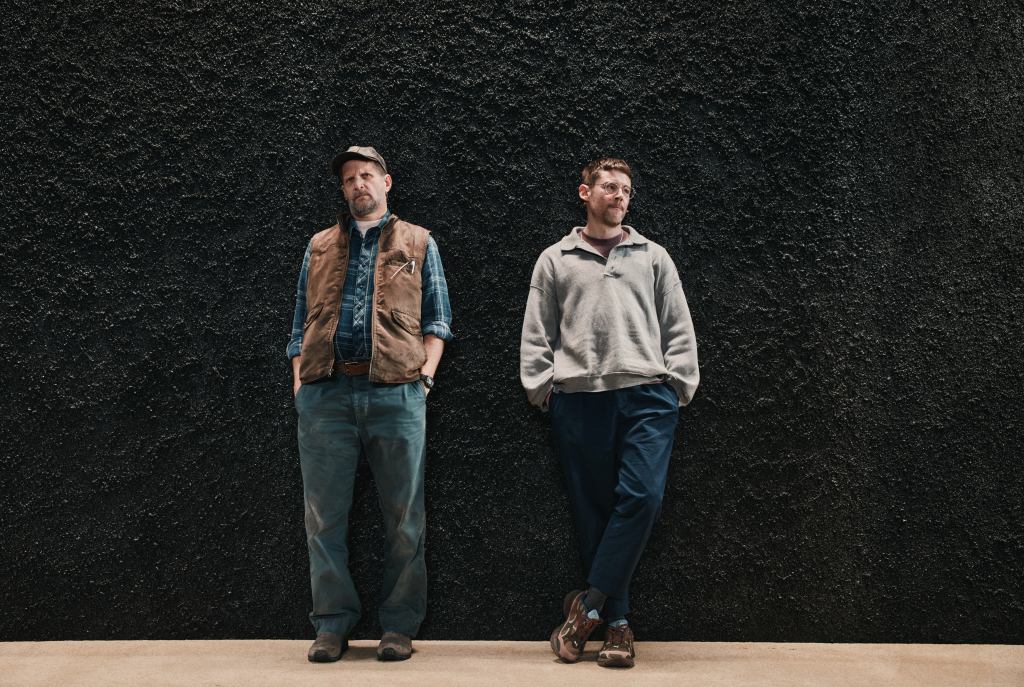
Paul Sparks and Brian J. Smith in Grangeville; Photo by Emilio Madrid

With the precision of an orchestra conductor, director Jack Serio enables his actors to delicately build towards an inevitable crescendo.  Initially we sit in darkness, fully tuned in to their choice of words and reflective pauses.  Movement is added as the exchanges increase in temperature and truthfulness.  Like Hunter’s characters, the black textured walls and dirty white door of the set by dots don’t fill out until far into the journey.  Stacey Derosier’s lighting and Chris Darbassie’s sound have similarly calculated arcs.  Props by Addison Heeren add the perfect punctuation.

Grangeville is a smartly written work that takes full advantage of live theater as a communication and entertainment vehicle.  The Signature-commissioned World Premiere continues through March 23 at The Alice Griffin Jewel Box Theatre, 480 West 42nd Street.  The house is shallow and well raked with the legroom of an economy seat on Spirit Airlines.  Run time is 90 minutes with no intermission and no re-entry permitted.  Tickets are available at https://signaturetheatre.org/show/grangeville/  and begin at $78 including fees.  Arrive early to take advantage of the pleasant cafe and small bookshop on the second floor.

The Counter

Your ability to feel liberated by the story that unfolds in The Counter will depend greatly and how well the aftermath of the COVID pandemic and the current political climate have treated you.  The Playbill makes clear that the actions take place a few years ago, seemingly before we were all cut off from one another while living under extreme conditions.  If you have maintained or regained the muscle memory of a singular connection with someone in your life, Meghan Kennedy’s newest work will leave you with an increased sense of appreciation.  If, however, you remain in the grip of isolation and anxiety, the honesty with which the playwright confronts those feelings may overwhelm the more pleasant sensations of watching skillful actors drawing generously from sincere emotional wells.

Susannah Flood and Anthony Edwards in
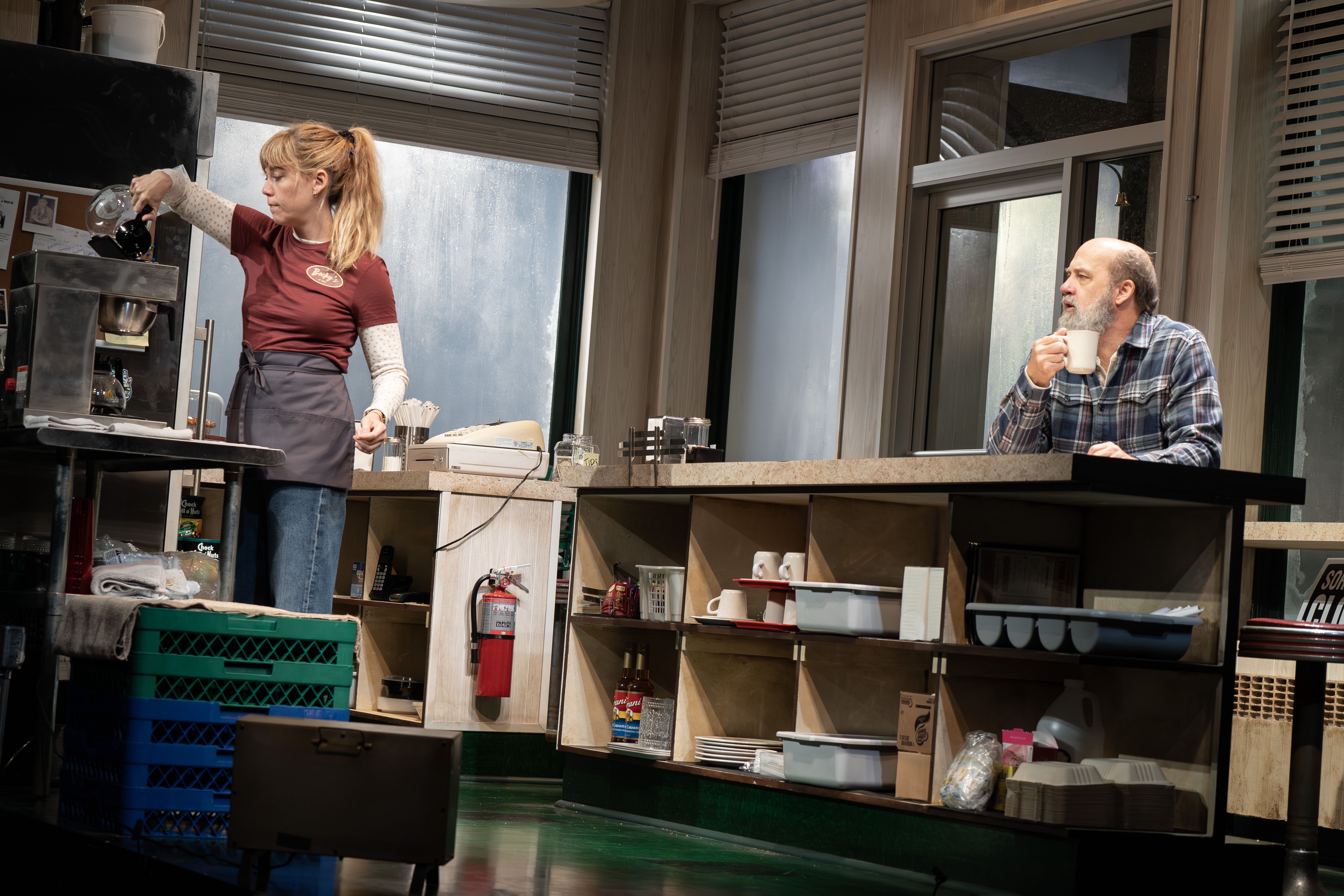
Roundabout Theatre Company’s The Counter; Photo by Joan Marcus

In an economic 75 minutes, Kennedy explores universal themes of grief and opportunities lost and found in a much more successful way than most of the COVID-panic-inspired plays I’ve reviewed this year (see Three Houses, Staff Meal and Six Characters).  Paul (a wholehearted Anthony Edwards nearly unrecognizable under a bushy beard) is a retired firefighter in small town New York close to the Canadian border.  He has an endearing ability to perceive, remember, and value the tiny gestures that make those around him special.  For reasons that come increasingly into focus, his life never fully launched.  Katie (Susannah Flood spreading her gloriously skittish wings) owns the cafe where Paul eats breakfast six mornings a week.  Unlike Paul, she has chosen this quiet and contained life.  With his frank urging, the two begin to form a friendship.   Amy Warren portrays third character, Peg, in a scene made pivotal by all we hear about her character before her entrance. 

Kennedy takes many shortcuts that some may find manipulative in order to move her story along to the key moments that propel each of them down their destined paths.  But in playing out their stories at 1 ½ speed, she accelerates our emotional investment in them both.  With increasing trust, they share “tough talk” with each other and us.  The balance of power shifts frequently, offering us fresh perspective with each twirl.

The scene is laid out in realistic detail by designer Walt Spangler, whose museum-worthy sets always provide an evocative sense of place.  The cafe is set on a angle, coming to a point audience center so everyone gets a pure view of every exchange.  Award-winning director David Cromer gives the central couple just enough business to heighten the small yet critical variation in the day-to-day.  Stacey Derosier’s lightening and Christopher Darbassie’s sound move the emphasis from exterior to interior dialogue and practically allow the windy world outside to swirl around our knees.  

We often hear about the importance of meeting people where they are.  The Counter illustrates exactly how powerful this connection point can be.  The underlying notes around self-care could also not come at a more appropriate time.  This limited engagement — part of Roundabout’s 2024-25 season — runs through November 17 at the Laura Pels Theatre (111 W 46th St).  Full priced tickets start at $58 and are available by calling 212.719.1300, or online at roundabouttheatre.org.

The Half-God of Rainfall

At a time when the performing arts are struggling, it is fitting that the wonderful New York Theatre Workshop is hosting a theatrical event that takes much of its inspiration from the early Greeks.  Similar to the dramas of that time, The Half-God of Rainfall combines elements of religious mythology, social commentary, and contemporary politics.

The piece opens with a nod to the ancient tradition of oral storytelling as the players introduce themselves with their real names along with their god-selves.  Working together, the performers weave a tapestry of poetry and dance as they tell the tale of Demi, the product of a particularly violent rape by Zeus: one of many abuses perpetrated by the King of the Gods against human women.  Having won a wager with Sàngó, a fellow god of Thunder, Zeus took as his prize Modúpé, who almost instantly gives birth to a half-god child, Demi.  His despair can make rivers rise and his rage can make it rain.  But his real power manifests on the modern basketball court where every shot is a winner. Despite his many victories, his smoldering rage against his father always burns.

In this realm, the gods of all traditions know one another and many are no better than the mortals over whom they have dominion.  Encompassing so many deeply felt themes occasionally bends the narration out of shape, but the dazzling visuals and all encompassing soundscape keep you enraptured. The audience was invested enough that towards the end they elicited a loud gasp at a critical moment.  While some familiarity with the various pantheons would be helpful, playwright Inua Ellams includes enough background information that the plot can be followed without it.  Even the basketball reference are based on pop culture and never “inside baseball” as it were.

Taibi Magar’s direction is masterful, filling the scene with otherworldly energy enhanced by movement director Orlando Patoboy.  She also incorporates Orisha movement choreographed by Beatrice Capote.  The set by Riccardo Hernández with projections designed by Tal Yarden is in constant motion with swirling images of clouds, water, and the cosmos itself.  The stage continues the natural theme, covered in black sand that moves and lets out a soft crunch beneath the actors’ feet.  The physical experience is expanded with the sound design of Mikaal Sulaiman and lighting designed by Stacey Derosier.  Costume designer Linda Cho builds on basic black towards the shimmering waters of a fertility goddess.

The ensemble moves with fluidity throughout the work, their disparate voices adding variation to the verse.  Mister Fitzgerald gives Demi a radiant joy.  Jennifer Mogbock brings both strength and warmth to Modúpé, her body moving with the combined powers of grace and strength.  Jason Bowen as Sàngó and Patrice Johnson Chevannes as Osún make a fittingly splendid couple under whose protection Modúpé lives.  Kelley Curran’s Hera and Michael Laurence’s Zeus employ unnecessary Greek accents, but the two shine in their other supporting roles.  Only Lizan Mitchell over-modulates, consequently distorting her lines as the trickster Elegba and several other deities. 

Mister Fitzgerald as Demi, The Half-God of Rainfall; photo by Joan Marcus

As many Greek heroes learned, a great adventure often begins by being blown off course.  This production was disrupted by COVID only to wind up in just the right hands.  The result is an ambitious epic that draws a diverse audience much needed by today’s theater world.  Despite its themes, The Half-God of Rainfall is a human-level spectacle born of collaboration and heart.  (There is a trigger warning for a depictions of sexual violence and a use of flashing lights and haze for dramatic effect.)  Performances continue at the New York Theatre Workshop (79 East 4th Street) through August 20 and $65 tickets are available at https://www.nytw.org/show/the-half-god-of-rainfall/.  Runtime is about 90 minutes and mask-only performances are available.  A co-production of NYTW and Harvard’s American Repertory Theater, the show will be moving next to Cambridge, MA in September.