Tag Archives: The Theater Center

Perfect Crime

In a secluded stately home in the Connecticut woods, a married team of well-educated psychiatrists uses psychodrama to help their troubled patients work through trauma.  One night, their cook witnesses a young redhead murdering the husband.  A handsome police detective is called to the scene.  The therapists claim it was merely a client acting out a dream.  A series of clues to the truth are dropped over seven scenes representing a single week.  This is the set-up of Perfect Crime, an Off-Broadway mystery with a record-breaking run.  So why is this production still so unsure of its storytelling capabilities that each audience member is handed a 17 point solution sheet upon exit?

The viewing experience begins cleverly enough.  The comfortable lobby centers on a massive mugshot board with a bucket of props beside it for taking selfies.  Tips for committing the perfect crime are hung on the the pillars around a welcoming bar offering an array of theme cocktails.  The producers have thoughtfully paid for Wordly, a translation and caption service that can provide the play’s dialogue in a number of languages.  

Upon entry to the 194 seat house, one sees an authoritative set designed by Jay Stone dressed with Neo-Gothic furniture and leather bound books.  Other creative elements could use an update.  An intricate brick mural that provides a critical plot point has become dull with time.  A talk show clip obviously filmed years ago no longer fits the time frame.  Musical cues, though significant to the plot, are loud enough to intrude on conversation and an important recorded message has become garbled.  

Playwright Warren Manzi, a Yale School of Drama graduate, wrote the original script for Perfect Crime when he was only in his mid 20s.  Reviews at the time indicated it was too complex to absorb, so he continually refined it.  Mr. Manzi’s legal counsel is executive producing the current run.  The piece still begins with a stereotypical phone call in a storm, but this is quickly revealed to be part of a therapeutic reenactment.  Along the way, there are several of these unusual, even sophisticated elements.  

It is the performance of Guinness Book of World Records holder Catherine Russell as famed therapist Dr. Margaret Thorne Brent that makes this playful mystery descend into rubbish.  Lines are ejected from her mouth without any differentiation, as if written as a single run-on sentence.  She never genuinely reacts to any of her scene partners, a basic tenet of the craft.  Her physicality is equally hasty.  For example, when her character juggles multiple phone calls, she often forgets to press the hold button on the phone until she has spoken several sentences to the incorrect person.  I found references to Ms. Russell’s somnambulism dating back at least three years.  The Show Score — usually an enthusiastic measurement — stands at equal parts positive and negative.  She may pride herself on only missing four performances over the years, but in all the important ways she has stopped showing up.

The rest of the cast, most of whom are making their Off-Broadway debuts, struggle along with what they are handed.  David Butler is the most successful as the multi-layered W. Harrison Brent.  Taking on the role of the bored and probably alcoholic Inspector James Ascher is a charming Adam Bradley.  I had the pleasure of seeing Mark Epperson — understudy for all the male roles — as Lionel McAuley, a particularly unhinged yet clever patient of Margaret’s. Seen only on video, Patrick Robustelli plays talk show host David Breuer.  

Catherine Russell was a treasured member of the theatrical community.  Her image was captured by famed illustrator Al Hirschfeld. She was a lead producer of the legendary revival of The Fantastics.  Her proceeds were used in part to build The Theater Center which houses Perfect Crime and several other stages that can be rented out for daring works in development and entertaining parody musicals.  Why, in a time when theater is under threat and yet remains filled with energetic talent, has she chosen to turn in a thoroughly careless performance devoid of heart? That, my dear readers, is perfectly criminal.

Perfect Crime is playing at the Anne L. Bernstein Theater at The Theater Center, 120 West 50th Street. Seats purchased through numerous discounted services are assigned by the box office, which stuffs the first few rows of the low raked house.  Performances are evenings Thursday – Tuesday with matinees on Saturday and Sunday. Running time is about two hours with the intermission.  A detailed plot is available on Wikipedia, which would add greatly to your ability to follow along with the curveballs. For more information, visit https://www.perfect-crime.com.
The Glitch

In a world in which AI has seemingly infiltrated every aspect of life, it is not hard to imagine a lab like the one featured in Kipp Koenig’s The Glitch.  “Future Child” allows want-to-be parents to interact with DNA-based projections of their teenage offspring.  The technology orchestrated by Aurora — an AI combination therapist and diagnostic program — is still a work in progress.  The simulation developed for their ninth client hit a raw nerve and resulted in an unanticipated traumatic reaction.  After a great deal of upgrading and testing, company founder Wyatt and his more cautious second in command Wendy feel prepared for client #10.  But when she turns out to be a woman from Wyatt’s past, the outcome of If/Else commands becomes even less predictable.  

Though the question of whether AI is capable of improving our quality of life drifts along in the background, front and center are more approachable and relatable topics.  What parent isn’t terrified of giving birth to someone who might not be “good” in the way they envision?  What child doesn’t say something hurtful in haste or engage in a rash act of rebellion?  And who hasn’t experienced that moment of horror when the sound of their parents comes flying out of their own mouths?  

Koenig has clearly drawn from his years working in technology to concoct the plausible atmosphere of a visionary and delicate start-up.  Scenic design by Josh Oberlander featuring hospital-white blocks and levered doors gleaming under Zack Lobel’s bright florescent lighting accompanied by Philip Glass-y music brings us right into the scene.  Director Mark Koenig (no relation) makes clever use of the aisles to expand the movement of the highly conversational script. Though there are a few too many short cuts in the plotting, they are necessary for squeezing all the required thought and sentiment into a tight 100 minute package.

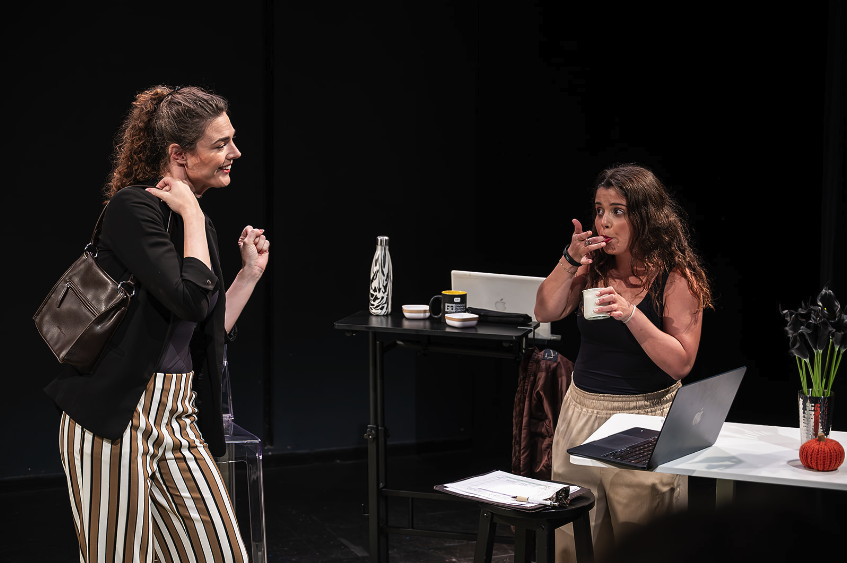
Danielle Augustine and Jacquie Bonnet in The Glitch; photo by Thomas Mundell

As Hailey the holographic daughter, Hannah Rose Doherty is a revelation, striking the perfect vocal tone of a tween at once loving and frustrated.  At times she was little more than 3’ from me.  Covered in silvery sparkles, she remained engaged and reactive: physically exploring her “projected” body, flipping her hair before she was given arms, and quivering with excitement as she was allowed to develop.  The comic relief lands primarily in the feet of Jacquie Bonnet’s Wendy.  Both the actress and the character deserve a more meaningful domain given the story arc.  A grounded Sunny Makwana brings warmth and the right touch of neurosis to the Omar Sharif-loving Wyatt, providing sufficient credibility to the string of coincidences in the story.  This makes for a less persuasive connection with Danielle Augustine whose Amy sounds forced.  To be fair, the actress is challenged by prolonged interaction with a disembodied voice and having to express a complex emotional life based on falsehoods.  The commanding presence of Aurora is given breadth and wit by Amilia Shaw, who takes a well deserved bow with the rest of the three dimensional cast.  

At a time when so many playwrights are exploring current events with fear and loathing, it’s refreshing to see playwright Koenig take a different path.  The Glitch proposes that with kindness and compassion tempered by a dose of healthy skepticism we are still capable of doing good for one another.  You can experience this for $50 ( $70 if you’d like to increase your support to premium level).  Performances are 2PM Wednesdays, 4PM Fridays and 6PM Sundays.  The limited engagement at The Theater Center, 210 West 50th near Broadway, ends November 2nd.  Visit https://theglitchplay.com/ for a sneak peek and purchasing information.

The Lights Are Bright Off Broadway

The New York theater scene is most often associated with Broadway, but there is a diverse audience that actually prefers to head Off-Broadway.  (I count myself among them.)  The descriptor has nothing to do with location, but rather the number of seats — between 100-499 — making for a more intimate shared experience.  Not needing to attract as large a crowd or pay sky high production costs allows tickets to be offered at relatively budget-friendly prices. Additionally, themes are often more daring: speaking to the issues of our time with an unexpected voice.  Many works are brand new, possibly even still evolving.  However, most runs are just a few weeks long, so here are a few to keep on your radar.

The six performances spaces of Theatre Row have welcomed a number of smaller companies from Pan Asian Rep to the community minded Keen Company as well as played host to the country’s largest celebration of monologues, United Solo. Now playing through September 29 is Sober Songs. With a score comprised of a range of musical styles, this dark comedy by Michael Levin tells the story of six young adults who meet at a local AA group.  Emotions flow from carefree and charming to raw and deep, much like the recovery process itself.

Housed in the Theatre at St. Jean down a flight of stairs on an Upper East Side side street is The York Theater.  Founded by three theater professionals over fifty years ago, their focus is on new musicals and lost gems.  This fall season begins on Tuesday, September 9, with the World Premiere of This is Not a Drill.  The script was inspired by the experience of Holly Doubet in 2018 when a false alert went out to residents and visitors that there was an missile attack headed for Hawaii.  The book is by Doubet and Joseph McDonough with music and lyrics by Doubet, Kathy Babylon and John Vester. 

Also calling a church home is the Theatre at St. Clements.  Nestled in the heart of Hells Kitchen, this steep venue has launched new works by David Mamet, Terrence McNally, Sam Shepherd, and Julie Taymor among others.  Beginning September 5th, the storied tradition continues with False Steps, a ballroom comedy written by dance champion Candace H. Caplin and Kim St. Leon, with original music and lyrics by Jesse Corbin.  Starring Caplin, this farcefollows a floundering playwright whose life takes an unpredictable turn when her recently widowed mother falls for a much younger ballroom dance instructor. 

Positioned firmly on your funny bone is Asylum NYC which offers stand-up comedians, sketch and improv troupes and musical reviews.  Beginning on Wednesday, September 17, performances of Exorcist: The Rock Musical will be followed by the Slam Frank.  With a score by Andrew Fox and a book by Joel Sinensky, this satire is perfect for those who think South Park doesn’t go nearly far enough.  Inspired by a truly bonkers provocative tweet, the Afro-Latin hip-hop musical puts the story of Anne Frank through a pan-gender, feminist, multiethnic lens to create a work that has already sparked spirited conversation.  

Long before finding household fame in Law & Order, Jerry Orbach starred in the long-running Fantasticks.  Now the black box where the revival played on the third floor of  The Theater Center bears his name.  (A smaller space honoring his wife sits across from it.)  The chairs in the Orbach feel like the sectional you should have replaced last year and the A/C is cranked to an 11, but the staff is welcoming and there are no bad seats.  Recently, it’s been home to both The Office and Friends parody shows.  But more progressive works are scheduled in between the comfort food.  Starting on September 24 on Wednesdays at 2 pm, Fridays at 4 pm and Sundays at 6 pm is Kipp Koenig’s The Glitch. This timely sci-fi dramedy uses a woman’s visit to an AI simulator lab to explore life decisions, emotional connection, and the interdependence of love and forgiveness.  

These are just some of the spaces offering risk-taking, thought-provoking, conversation- stimulating theater… and that’s just September!  So consider enlivening your entertainment line-up with something brand-new and uniquely theatrical.