Tag Archives: Zack Lobel

Spare Parts

In Spare Parts, a well-meaning Columbia University Assistant Professor and a dedicated graduate student are studying the aging process; experimenting with possibilities for slowing or reversing it.  As with many such studies, they have received a government grant and had success with lower organisms.  But a potential billionaire investor is ready to skip all the usual precautions and move straight on to a human subject: HIM.  He’s 64 with high blood pressure and simply doesn’t have the patience or the NEED to wait.  Along with his younger and more emotionally intelligent assistant, he has summoned the academics in hopes that his money will move them along.

The concept is sadly timely, with Peter Thiel, Jeff Bezos, and Sam Altman among those eagerly backing anti-aging ventures.  Playwright David J. Glass is a medical professional and has drawn on his first-hand experience at both a biotech company and Playwrights Horizons to forge a unique narrative path.  The result is a wild blend of life questions.  While the probing of ethics is enticing — especially during our period of deception — it is the exploration of the purely human realm that gives this play heart.  There are a few places in the script where the storytelling is a touch inelegant, but for the most part it’s impressively paced given that this is a 95 minute play and not a three-part mini.  

While the content vibrates with originality and intrigue, the direction by Michael Herwitz erodes the impact.  Actors are sometimes stretched out across the long, shallow space, diminishing the electricity between characters.  Worse is in the unimaginative and downright confusing set by designer Scott Penner.  Various locations slosh around on top of one another without so much as a color shift in Zack Lobel’s serviceable lighting to differentiate the location.  My I-Give-Up moment with the staging occurred when the the walls became doors thanks to PVC strips that flap upstage.  The thumping original synth music by Ryan Gamblin overwhelms his futuristic soundscape.
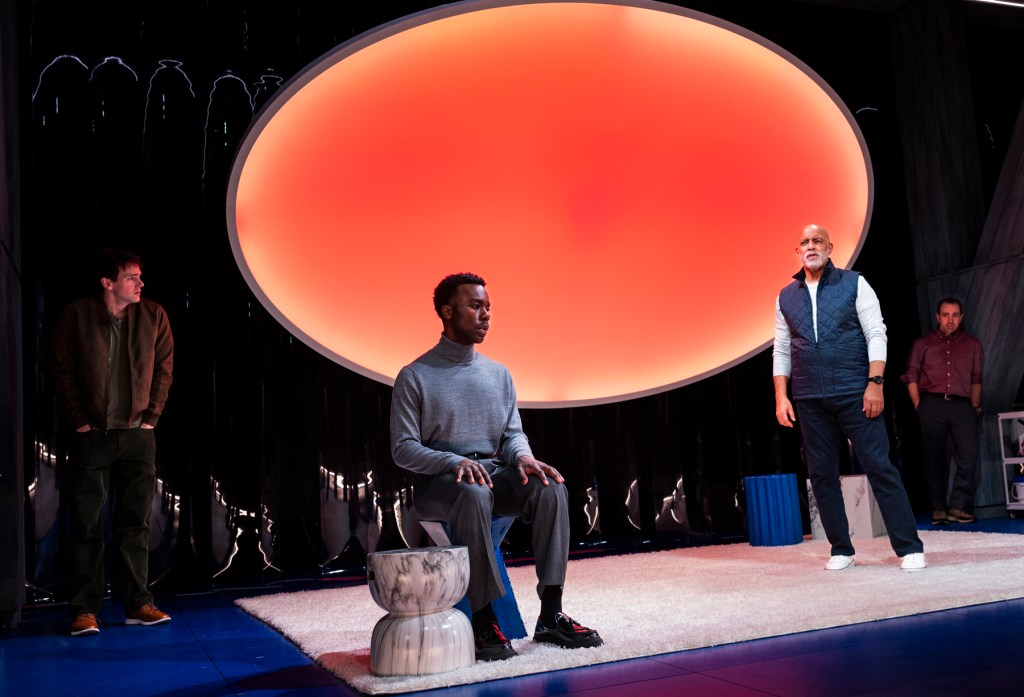
Matt Walker, Jonny-James Kajoba, Michael Genet and Rob McClure in Spare Parts; Photo by Russ Rowland

Fortunately the cast more than holds up their end of selling the story.  While the draw is frequent award nominee Rob McClure, his talent outweighs the needs of Professor Coffey.  Similar to their characters’ dynamics, he is outshone by Matt Walker in a delicious layer cake of a performance as assistant Jeffrey Jordan.  Perhaps it is Walker’s actual Ph.D. in genetics from Columbia University that makes him appear so comfortable while embodying such an awkward personage.  As billionaire Zeit Smith, Michael Genet understands how to portray a character with troubling intentions without stepping over the line into melodrama.  Most admirable is Jonny-James Kajoba’s turn as Ivan Shelley, Zeit’s faithful protégé.  (How I wish I’d seen his Lady Bracknell!)

Spare Parts is certainly not easy to peg, which makes it exciting even for frequent theater attendees.  Whatever discomposure is brought on by the indecent proposal is more than offset by the satisfaction of an unexpected journey.  The limited engagement of this comedy/drama/mystery/horror show has been extended through April 30 in Theatre Three in Theatre Row, 410 West 42nd Street.  Prices range from $39 “cheap seats” to $129 for the premium section.  There is little rake in the first four rows followed by sufficient rise, along with better than average leg room throughout the house.  Visit https://www.sparepartsplay.com/ for more information.
The Glitch

In a world in which AI has seemingly infiltrated every aspect of life, it is not hard to imagine a lab like the one featured in Kipp Koenig’s The Glitch.  “Future Child” allows want-to-be parents to interact with DNA-based projections of their teenage offspring.  The technology orchestrated by Aurora — an AI combination therapist and diagnostic program — is still a work in progress.  The simulation developed for their ninth client hit a raw nerve and resulted in an unanticipated traumatic reaction.  After a great deal of upgrading and testing, company founder Wyatt and his more cautious second in command Wendy feel prepared for client #10.  But when she turns out to be a woman from Wyatt’s past, the outcome of If/Else commands becomes even less predictable.  

Though the question of whether AI is capable of improving our quality of life drifts along in the background, front and center are more approachable and relatable topics.  What parent isn’t terrified of giving birth to someone who might not be “good” in the way they envision?  What child doesn’t say something hurtful in haste or engage in a rash act of rebellion?  And who hasn’t experienced that moment of horror when the sound of their parents comes flying out of their own mouths?  

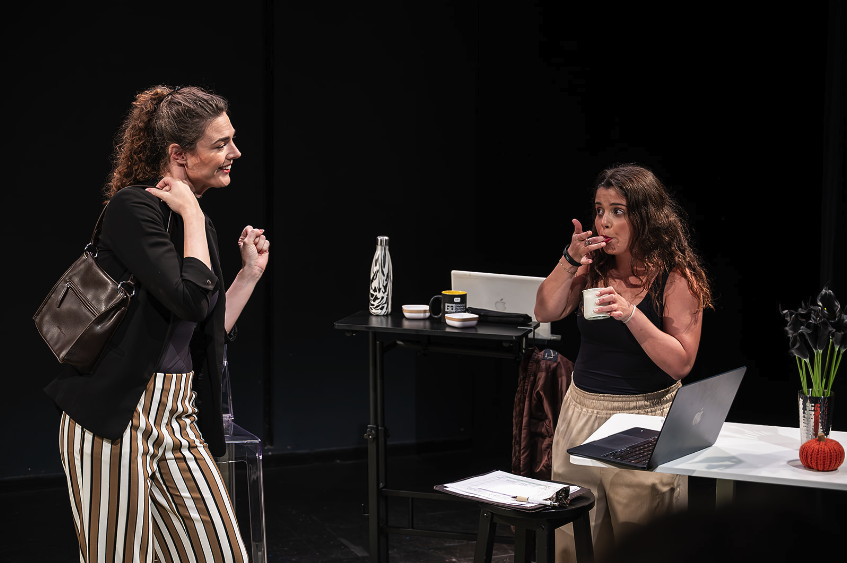
Koenig has clearly drawn from his years working in technology to concoct the plausible atmosphere of a visionary and delicate start-up.  Scenic design by Josh Oberlander featuring hospital-white blocks and levered doors gleaming under Zack Lobel’s bright florescent lighting accompanied by Philip Glass-y music brings us right into the scene.  Director Mark Koenig (no relation) makes clever use of the aisles to expand the movement of the highly conversational script. Though there are a few too many short cuts in the plotting, they are necessary for squeezing all the required thought and sentiment into a tight 100 minute package.

Danielle Augustine and Jacquie Bonnet in The Glitch; photo by Thomas Mundell

As Hailey the holographic daughter, Hannah Rose Doherty is a revelation, striking the perfect vocal tone of a tween at once loving and frustrated.  At times she was little more than 3’ from me.  Covered in silvery sparkles, she remained engaged and reactive: physically exploring her “projected” body, flipping her hair before she was given arms, and quivering with excitement as she was allowed to develop.  The comic relief lands primarily in the feet of Jacquie Bonnet’s Wendy.  Both the actress and the character deserve a more meaningful domain given the story arc.  A grounded Sunny Makwana brings warmth and the right touch of neurosis to the Omar Sharif-loving Wyatt, providing sufficient credibility to the string of coincidences in the story.  This makes for a less persuasive connection with Danielle Augustine whose Amy sounds forced.  To be fair, the actress is challenged by prolonged interaction with a disembodied voice and having to express a complex emotional life based on falsehoods.  The commanding presence of Aurora is given breadth and wit by Amilia Shaw, who takes a well deserved bow with the rest of the three dimensional cast.  

At a time when so many playwrights are exploring current events with fear and loathing, it’s refreshing to see playwright Koenig take a different path.  The Glitch proposes that with kindness and compassion tempered by a dose of healthy skepticism we are still capable of doing good for one another.  You can experience this for $50 ( $70 if you’d like to increase your support to premium level).  Performances are 2PM Wednesdays, 4PM Fridays and 6PM Sundays.  The limited engagement at The Theater Center, 210 West 50th near Broadway, ends November 2nd.  Visit https://theglitchplay.com/ for a sneak peek and purchasing information.