Monthly Archives: May 2025

The United States vs Ulysses

In 1933, the landmark trial of “United States v. One Book Called Ulysses” cleared the way for the publication of many significant works of literature that include sexual content and adult language.  Though James Joyce’s seminal novel was readily available in Europe at the time, it had twice been deemed obscene by a New York court. Random House founder, Bennett Cerf, determined that being the first in America to print the book in its entirety would launch them into the big leagues.  To that end, his company attorney, Morris Ernst, strategized what became a test case for freedom of expression.  Judge Woolsey’s deeply considered decision is practically a literary work in itself.

The events of the trial — its echos reverberating off the walls of today’s public libraries and scholastic institutions — form the foundation of The United States vs Ulysses currently running at the Irish Arts Center.  Playwright Colin Murphy takes the name of the actual case to heart, positioning sections of the book in the role of defendant.  He also fuses the courtroom drama with a rather unrefined behind the scenes look at the live reenactment produced by CBS’s The March of Time.  

This multilayered investigation is executed by a skillful cast of six under the adept hand of director Conall Morrison.  The send-up of the radio broadcast gives way to a serious lesson in interpretive performance.  The ensemble moves through characters historic and fictional, often brushing one against the other.  Jonathan White provides cohesion even while portraying a number of different narrator types.  Clare Barrett is an utter delight as Molly Bloom, especially in her interactions with Morgan C. Jones’s cerebral Judge Woolsey.  Ali White serves as a counterbalance to Barrett’s wild abandon, taking on the sterner female roles.  Ross Gaynor pulls off playing Bennett Cerf and the prosecuting lawyer as well as Molly’s oily lover.  Ernst is rendered by Mark Lambert, personifying this production’s blend of honest reflection and sharp-edged humor.  

The Cast of The United States vs Ulysses; Photo by Nir Arieli

The entire design team facilitates the slide between modes of storytelling. The actors are able to switch roles with the rapid exchange of a hat, the wrapping of a scarf or the removal of glasses (costumes by Catherine Fay).  Liam Doona’s set is like a gift box, with sound proofed radio studio opening to reveal Paris, Dublin, and the Southern District of New York.  Each state of the narrative is given its own tonal palette thanks in large part to John Comiskey’s lighting.  Music and sound by Simon Kenny enhance the atmosphere.

Combining elements of history, literature, law, society and culture, The United States vs Ulysses reminds us of the fight which won us the right to read whatever we choose.  Along the way, it pokes fun at the powerful men who tried to silence a fictional woman for being a sexual being.  Performances continue through Sunday, June 1, at The JL Greene Theatre in the Irish Arts Center,  726 11th Avenue.  There is a lovely cafe in the lobby that is open before and after the show.  Runtime is a sleek 85 minutes.  Tickets start at $25 and are available at https://irishartscenter.org/event/the-united-states-vs-ulysses.
Bowl EP

I am not young, black, gay, or well acquainted with club drugs. What I am is a fierce advocate for theater as an art and communication form. Being in a performance space filled with 20-somethings who are stomping, clapping, hooting, and laughing, even while relating strongly to Morales trying to feel like an ice cream cone, was thrilling. That was my recent experience at a matinee of Nazareth Hassan’s Bowl EP, a joint production of Vineyard Theatre and National Black Theatre in association with The New Group.

If you are a fossil like me, you remember Extended Plays or EPs as the record albums comprised of a few songs. These days they are used by artists to stay on the charts while they are working on larger musical projects.  Bowl EP begins with short “tracks,” the titles of which are projected around the sides of the “bowl,” an empty swimming pool that Quentavius da Quitter (Oghenero Gbaje) and Kelly K Klarkson  (Essence Lotus) use for skateboarding… and other activities.  Similar to that short form, the scenes are performed by the same pair, but don’t firmly connect in style or content.

Also like an EP, much of what the two say to each other has more of the quality of song lyrics than naturalistic dialogue: abstract and disconnected, yet deeply emotional. They never call each other by name and there are no characters listed in the program.  They talk very little about their lives away from this space as if there is no meaningful world away from the bowl.   It’s even hard to tell how long they’ve known each other.  The exchanges do produce a recurring cycle: flirtation, overt sexuality, and comic relief as they try come up with a name for their nascent rap duo.  Their “yums” are quite different, but each one is greeted with acceptance.

At a turning point Kelly — bedecked in wrap skirt over jeans and a sparkling baby-T (costumes by DeShon Elem) — mentions a cathartic therapy session during which she was able to vomit up her demon and become her.  Then during an intensely intimate act she is able to do the same for Quint.  The demon expelled into the pool is the high energy Lemon Pepper Wings (Felicia Curry).  From here, this pan-gender all-knowing character with oversized anime head, pink and purple frills, beat up teddybear backpack and a heart shaped tailed, takes over.  The rapid “tunes” are replaced by a relentless tirade akin to a drum solo as he/she/they shares Quint and Kelly’s relationship past and future in gory detail, personally involving the audience as well.  (Shout out to the stage managers who facilitate the magic.)

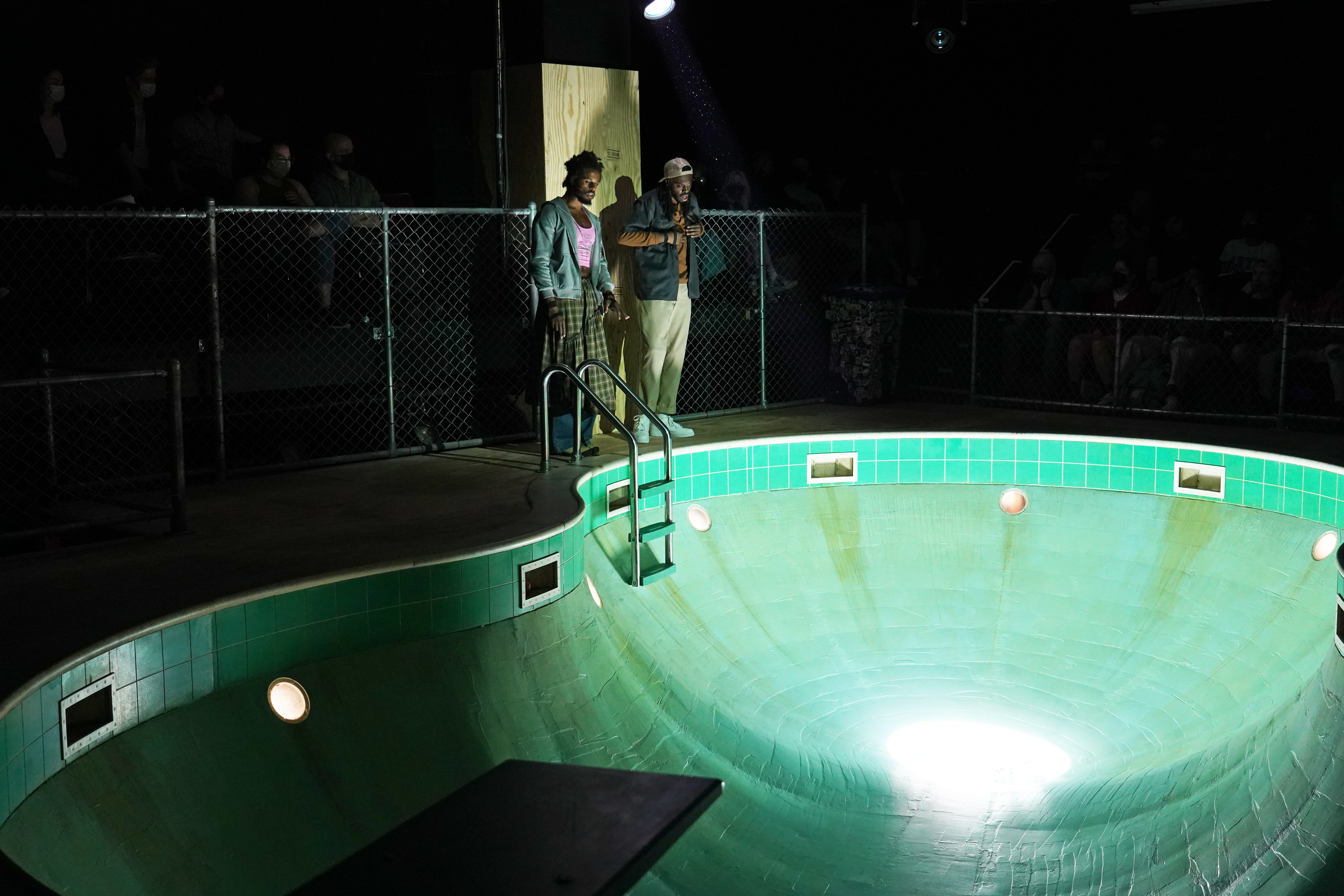
Essence Lotus and Oghenero Gbaje in Bowl EP; Photo by Carol Rosegg

Much thought has gone into transforming the venue for this unusual work.  Seating is in the round and blocked off from the stage with chain link fencing.  Playwright Hassan follows the flow of his words in the actors’ movement accented by Teniece Divya Johnson’s fight and intimacy choreography.  Scenic design team Adam Rigg & Anton Volovsek have created a gorgeous curvaceous pool in peaceful sea-foam complete with useful ladders and a diving board to contain the ferocity of the action.  Kate McGee’s lighting simulates street lamps and headlights until the colorful shift to the unconscious.  The projections as designed by Zavier Augustus Lee Taylor telegraph the intensity and vibe of each beat with the formation of the lettering.  Music by Judah “Free Fool” Girvan caps the undertaking, even effectively incorporating some of the lyrics devised in earlier chapters.

Intentionally and undeniably different, Bowl EP continues through June 22 at the Vineyard Theatre, 108 East 15th near Union Square.  Runtime is 80 minutes without intermission. Tickets are available at https://vineyardtheatre.org/shows/bowl/  beginning at $37.80.  Seating is unique and a look at the chart is helpful in selecting your preferred location.  ADA seating is available in the North section.  A joint fundraising initiative is striving to provide tickets to first-time theatergoers, though if this production was on film the content would likely be rated M for violence and sexuality. The venue continues to offer two masked performances per run, honoring their commitment to make theater accessible to everyone.

Lights Out: Nat “King” Cole

In November of 1956, singer/pianist Nat “King” Cole became the first Black man to host a variety show on network television.  Though he eventually had multiple Billboard hits including Mona Lisa, L-O-V-E, and Nature Boy, he never secured a National sponsor for this groundbreaking program.  Major markets, especially those in the South, pressured advertisers to drop their support of the broadcast.  Despite an array of popular guest stars with household names, beaten down by the color barrier, NBC and Cole agreed to terminate the venture the following year after 53 episodes.

Lights Out: Nat “King” Cole, written by Colman Domingo and Patricia McGregor, uses the final taping of the Nat “King” Cole Show to explore not only this chapter in the life of the beloved crooner, but the systematic erasure of Black voices.  It’s an intriguing pick for a central character.  Though Cole participated in civil rights marches and avoided segregated venues, he felt his public role was one of an entertainer.  He sang ballads, not protest songs, even after a cross had been burned on the lawn of his home in a wealthy white Los Angeles neighborhood.  

The play is set in a television studio (scenic design by Clint Ramos) complete with an applause sign, clever lighting (Stacey Derosier), and a live “Nelson Riddle” band on the stage.  This enables the easy integration of music, live-feed camera work and audience reaction.  However, it quickly becomes obvious that this is not a recreation of one night.  Shortly before airtime someone (someTHING) causes the ghost light to flicker and briefly go out, allowing the spirit of Sammy Davis Jr. to explode onto the scene.  In an effort to inspire Cole to go out on a combative note, The Rat Packer takes him through a phantom version of events.  Classic song lyrics are incorporated into the spoken dialogue along with a mix of historical fact as seen through the lens of modern times and Cole’s personal reflection as imagined by Domingo and McGregor.

Dulé Hill in NYTW’s LIGHTS OUT; photo by Marc J. Franklin

Dulé Hill gives soothing voice and gravitas to Cole, a part he cultivated at the Peoples’ Light in Malvern, PA and further developed at the Geffen Playhouse in Los Angeles.  Daniel J. Watts, also reprising his role, grabs Davis by the lapels, practically ricocheting off the walls with intensity.  He is high octane gasoline to Hill’s humming battery pack.  Playwright McGregor directs, bouncing the two very different friends off one another, culminating in a dynamic dance number (choreography by Edgar Godineaux with tap by Jared Grimes). Though the plot line is choppy and likely to challenge those unfamiliar with the named celebrities and cultural touchstones, the songbook alone (arrangements and orchestrations by John McDaniel) makes for highly satisfying entertainment.  

Hill and Watts positively dazzle in the leads, capturing key qualities of their characters and steering clear of imitation.  The action is kicked off by Elliott Mattox’s convivial Stage Manager.  Cole’s white producer is portrayed in myriad forms by Christopher Ryan Grant.  Krystal Joy Brown makes an early impression as a purring Eartha Kitt, later embodying an enchanting daughter Natalie Cole. Also displaying range is another vet of the previous run, Ruby Lewis, who depicts both spunky Betty Hutton and sultry Peggy Lee.  Matriarch Perlina Coles, who first introduced Cole to the piano, is played with soulful sincerity by Kenita Miller with Mekhi Richardson performing as young Nat (and a younger Billy Preston) the afternoon I attended.  Adding a comedic touch is Kathy Fitzgerald as make-up artist Candy.  She is also featured in the highly creative live commercials that run throughout the program.   

You feel the ripples of connection move through different sectors of the audience depending on whether it is Cole performing his rendition of The Christmas Song, Lift Every Voice and Sing vocalized by mother Perlina, or young Natalie joining him for a duet of Unforgettable (something she created in the studio long after his death).  When you layer in the profound racism, disgraceful accepted stereotypes, and aggressions micro and macro, the entire experience becomes a social study as well as a piece of engaging theater.

Likely to fill you with a bubbling combination of elation and frustration, Lights Out: Nat “King” Cole provides a worthwhile conclusion to a bold season at New York Theatre Workshop.  Performances continue through June 29 on the main stage at 79 East 4th Street.  Runtime is 90 minutes without intermission.  The actors smoke heavily, making me grateful to remain a mask-wearer.  Tickets start at $49 and are available at https://www.nytw.org/show/lights-out-nat-king-cole/.

EPIC’s Seussical the Musical

Seussical the Musical was not exactly a hit with the critics when it ran on Broadway about 25 years ago.  Nonetheless, the familiarity of the characters and its themes, including the consequences of cronyism and the importance of staying true to yourself, resonated with audiences.  It continues to be performed regionally with its “junior” version popular in schools throughout the country.  These messages also make it a fitting selection for EPIC’s diverse troupe.  The cast’s palpable joy in performing a work that embraces such a delightful and distinctive population makes for an easy-to-love experience for the whole family.

Horton the Elephant (Gianluca Cirafici) surrounded by the Wickersham Brothers

For those unfamiliar with the script, it is adapted from several children’s books written and illustrated by Theodor Geisel aka Dr. Seuss.  Music is by Stephen Flaherty with lyrics by Lynn Ahrens.  Two of the plots feature a compassionate elephant portrayed by an endearing Gianluca Cirafici sporting soft floppy ears.  The third story line moves the focus to his love-struck neighbor, Gertrude McFuzz, depicted with pizzazz and warmth by Natalie Kaiser, accompanying herself on kazoo.  To attract Horton’s attention, the self-conscious bird grows an impressive tail with the help of Dr Dake (Ethan Jones).  Other Seuss inventions that make appearances large and small are the famous trickster The Cat in the Hat (Shoshanna Gleich), a bluesy Sour Kangaroo (Emily DeMaio) and her Baby (Anjel Bell), a judicious Yertle the Turtle (Prince Hurst), and the Wickersham Brothers (Miles Butler, Ethan Homan, Nick Moscato, Sven W) who never get tired of literally monkeying around.

Gertrude McFuzz (Natalie Kaiser, center) growing a tail with the help of Dr Dake (Ethan Jones) and encouragement from The Cat in the Hat (Shoshanna Gleich).

The opening is primarily based on Horton Hears a Who. Finding an entire populated planet on a clover, Horton appoints himself protector aided by the Smallest Who of All, Jojo embodied in the tiny but mighty Christine Newberry.  It is she who calls forth a universe of Seussian creations with her unbridled imagination.  Standout Matt Tierney has a wonderful time soliciting both laughs and donations from the audience as her father the Mayor.  Sandy Gladstone Karpe is Mrs. Mayor rendered with overflowing glass of chardonnay in hand.

Jojo (Christine Newberry) with her disapproving parents, Mrs. Mayor (Sandy Gladstone Karpe) and Mr. Mayor (Matt Tierney)

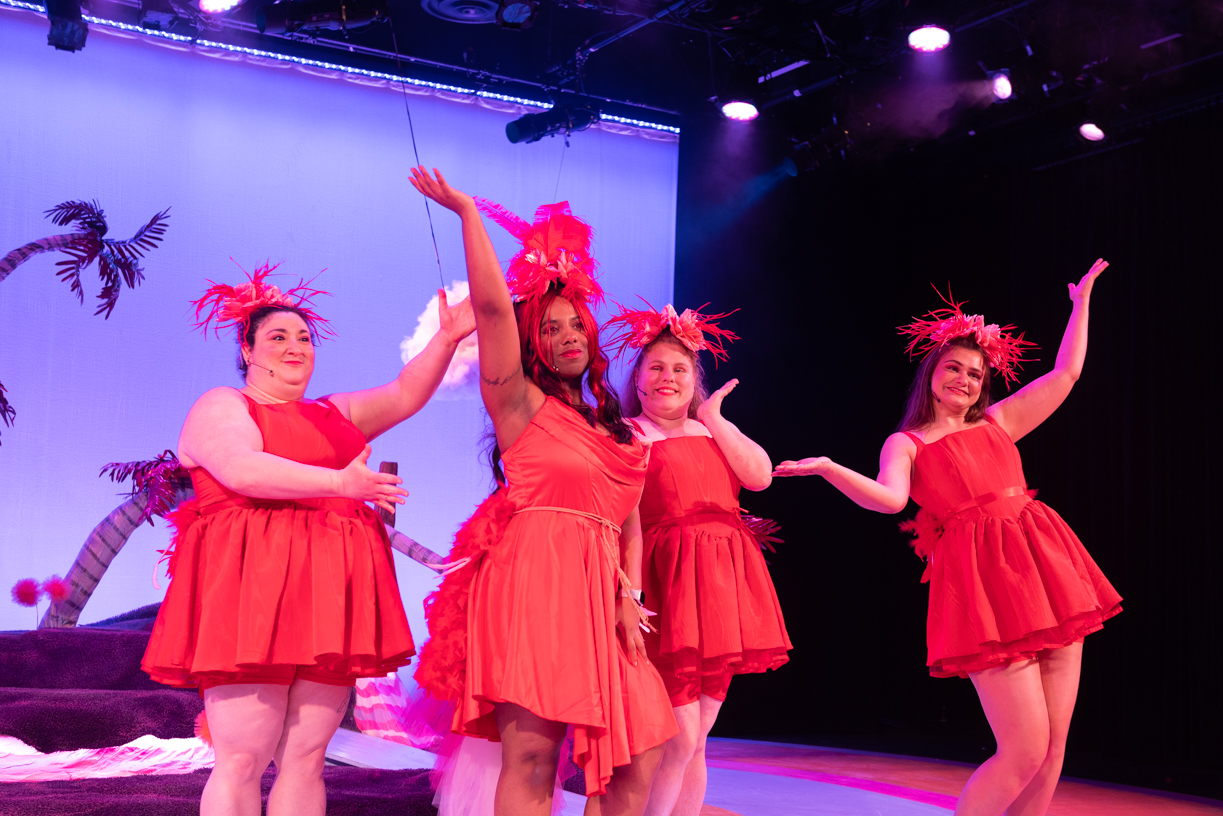
As if the Whos of Whoville and their speck of dust world (Bre Baron, Sami Binder, Miles Butler, Tess Carvelli, Shafer Gootkind, Prince Hurst, Ethan Jones, Genesis Solivan) weren’t responsibility enough, Horton then falls for the manipulations of Mayzie Labird, taken on with sass a-plenty by Kayla Robinson, who tricks him into sitting on her egg.  As is appropriate, all the birds, including Kaiser and Robinson plus the powerhouse “Bad Girls” trio of Alice Frannsen, Rachel Paine, and Elisa Weiss, bring vocal purity to all of their songs. 

Mayzie Labird (Kayla Robinson, second from the left) with the Bad Girls: Alice Frannsen, Rachel Paine, and Elisa Weiss

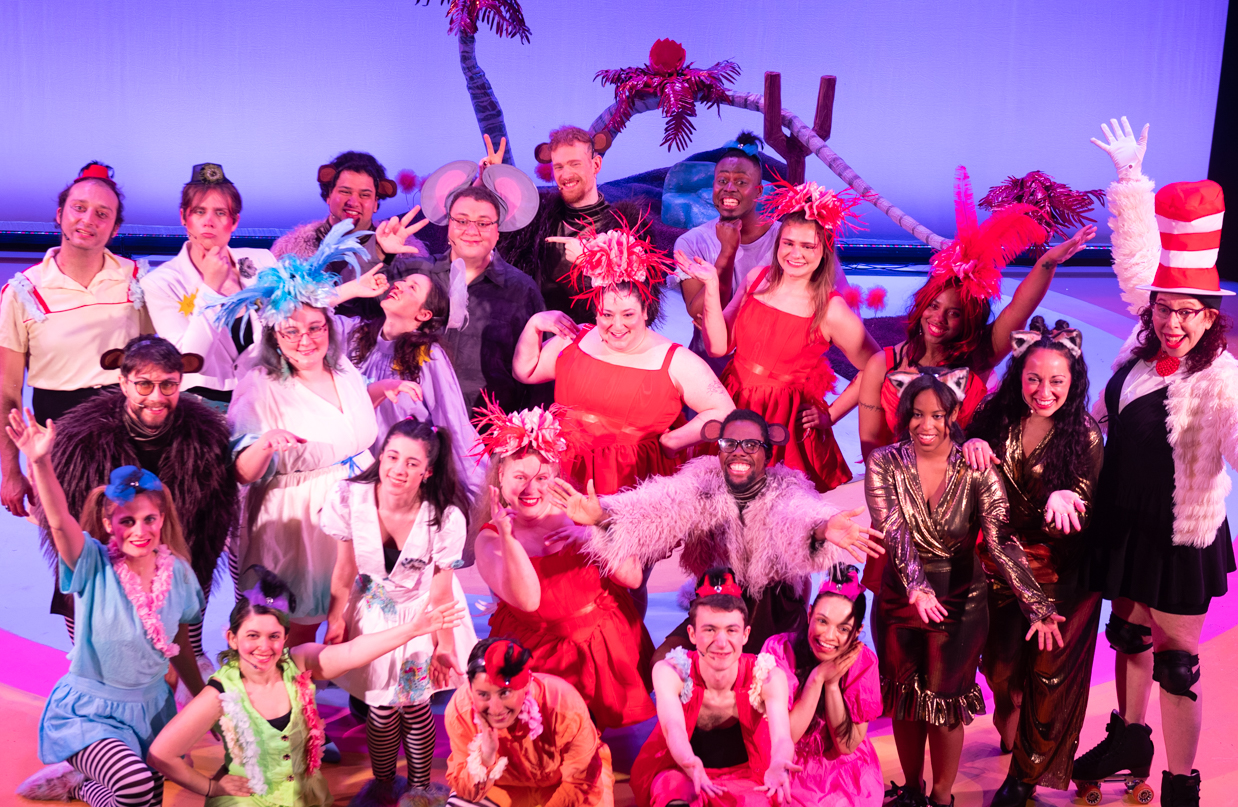
Scenic designer Christian Flemming has done an admirable job capturing Seuss’s drawing style in three dimensions encircled by an “Oh, the Places You’ll Go” rainbow sidewalk.  Likewise Izzy Kitch’s whimsical costumes and elaborate headgear.  Props by Dana Weintraub include miniature everyday items for the Whos and of course a Red Fish and a Blue Fish.  Against this background, Artistic Director Aubrie Therrien and her Co-Director Meggan Dodd have added their usual high-energy interaction.  Choreographer Travis Burbee provides several effervescent dance numbers. 

The Cast of EPIC Players’ Seussical the Musical

Since 2016, EPIC Players (Empower, Perform, Include, Create) has been dedicated to creating professional performing arts opportunities and a supportive social environment for Neurodivergent and Disabled artists.  With its wonderful range of colorful characters, Seussical the Musical is a perfect match for their talents and mission.  As a Mother’s Day “gift,” on Sunday May 11th their performance will be relaxed with ASL interpretation.  There couldn’t be a better time to deliver the message that “a person’s a person’s no matter how small.”  So if you could use a reminder of How Lucky You Are, head to ART/NY The Mezzanine Theatre, 502 W 53rd St. now through May 18.  Tickets are $35-$65 and can be purchased online at https://epicplayers.ticketspice.com/epic-players-presents-seussical.  

Photos by Zui Gomez