Monthly Archives: October 2025

Malcolm X & Redd Foxx Washing Dishes at Jimmy’s Chicken Shack in Harlem

In June of 1943, Malcolm Little and John Elroy Sanford crossed paths as dishwashers in the same Harlem fried chicken joint.  At ages 19 and 20 respectively, they were still finding their footing as Black men at a time when they were encouraged to give their lives for the country, but not being given societal or economic opportunity.  His father having died early and his mother hospitalized after a breakdown, Little was a petty criminal, frustrated to keep finding himself on that path.  Foxy was an aspiring comic who already handled his finances so poorly he was living on a rooftop.  The engaging Malcolm X & Redd Foxx Washing Dishes at Jimmy’s Chicken Shack in Harlem opens an imaginative window into the relationship between these two men long before fame found them.  

Though familiarity with the raunchy comedian and the inspirational Muslim leader is helpful, at heart Jonathan Norton — who won the American Theatre Critics/Journalists’ M. Elizabeth Osborn New Play Award  for Mississippi Godddamn — has here written a thoughtful exploration of friendship.  Though Foxy and Little share concerns, they have divergent approaches for overcoming them.  By turns, they build each other up and tear each other down, eventually bringing out something special in one another that perhaps no one else would unearth.  Always running in the background is the pre-civil-rights society that literally and metaphorically deprives the two of the music in life.  

Squat and expressive, with an ability to swing from insecurity to dominance, Trey Smith-Mills plays Foxy.  The long and suave Edwin Green — who has been with the production since its 2024 Off-Broadway reading — makes a terrific counterpart as Little.  Director Dexter J. Singleton heightens the required physicality and timing in both performances.

Trey Smith-Mills and Edwin Green as Foxy and Little; Photo by Wesley Hitt

Costume designer Claudia Brownlee provides the right style-on-a budget wardrobe, particularly with a red and white suit and outrageous hat for Foxy.  Jennifer McClory’s wigs mimic the chemically treated reddish hair that was popular in that period.  The shabby back-kitchen set with its stained walls and gurgling drain is designed by Kimberly Powers.  Blackouts and hot spots (lighting by Levi J. Wilkins) along with jazz standards and order-up bells (sound by Howard Patterson) work cleverly together to illustrate the passage of long summer days.

Malcolm X & Redd Foxx Washing Dishes at Jimmy’s Chicken Shack in Harlem is a captivating two hander about people you think you know in an era you think you understand.  Above all, it is the evolution of a friendship that reverberated throughout two meaningful lives.  This World Premiere was commissioned by TheatreSquared, and is a co-production of T2, City Theatre Company, Virginia Stage Company and Dallas Theater Center.  The run has been extended until November 2nd.  Live performances take place at Spring Theatre (477 W. Spring St., Fayetteville, AR).  The streaming version is shot casually (odd angles, heads in the way, uneven audio) but is a wonderful option for those with mobility or childcare issues and those of us who live at too great a distance from the the venue.  Content is for mature audiences, with simulated drug use and adult language.  Runtime is an hour and forty minutes with no intermission.  Both live tickets ($$25-$71) and streaming tickets ($25-$35) are available at theatre2.org/jimmys-chicken or by calling (479) 777-7477.

Perfect Crime

In a secluded stately home in the Connecticut woods, a married team of well-educated psychiatrists uses psychodrama to help their troubled patients work through trauma.  One night, their cook witnesses a young redhead murdering the husband.  A handsome police detective is called to the scene.  The therapists claim it was merely a client acting out a dream.  A series of clues to the truth are dropped over seven scenes representing a single week.  This is the set-up of Perfect Crime, an Off-Broadway mystery with a record-breaking run.  So why is this production still so unsure of its storytelling capabilities that each audience member is handed a 17 point solution sheet upon exit?

The viewing experience begins cleverly enough.  The comfortable lobby centers on a massive mugshot board with a bucket of props beside it for taking selfies.  Tips for committing the perfect crime are hung on the the pillars around a welcoming bar offering an array of theme cocktails.  The producers have thoughtfully paid for Wordly, a translation and caption service that can provide the play’s dialogue in a number of languages.  

Upon entry to the 194 seat house, one sees an authoritative set designed by Jay Stone dressed with Neo-Gothic furniture and leather bound books.  Other creative elements could use an update.  An intricate brick mural that provides a critical plot point has become dull with time.  A talk show clip obviously filmed years ago no longer fits the time frame.  Musical cues, though significant to the plot, are loud enough to intrude on conversation and an important recorded message has become garbled.  

Playwright Warren Manzi, a Yale School of Drama graduate, wrote the original script for Perfect Crime when he was only in his mid 20s.  Reviews at the time indicated it was too complex to absorb, so he continually refined it.  Mr. Manzi’s legal counsel is executive producing the current run.  The piece still begins with a stereotypical phone call in a storm, but this is quickly revealed to be part of a therapeutic reenactment.  Along the way, there are several of these unusual, even sophisticated elements.  

It is the performance of Guinness Book of World Records holder Catherine Russell as famed therapist Dr. Margaret Thorne Brent that makes this playful mystery descend into rubbish.  Lines are ejected from her mouth without any differentiation, as if written as a single run-on sentence.  She never genuinely reacts to any of her scene partners, a basic tenet of the craft.  Her physicality is equally hasty.  For example, when her character juggles multiple phone calls, she often forgets to press the hold button on the phone until she has spoken several sentences to the incorrect person.  I found references to Ms. Russell’s somnambulism dating back at least three years.  The Show Score — usually an enthusiastic measurement — stands at equal parts positive and negative.  She may pride herself on only missing four performances over the years, but in all the important ways she has stopped showing up.

The rest of the cast, most of whom are making their Off-Broadway debuts, struggle along with what they are handed.  David Butler is the most successful as the multi-layered W. Harrison Brent.  Taking on the role of the bored and probably alcoholic Inspector James Ascher is a charming Adam Bradley.  I had the pleasure of seeing Mark Epperson — understudy for all the male roles — as Lionel McAuley, a particularly unhinged yet clever patient of Margaret’s. Seen only on video, Patrick Robustelli plays talk show host David Breuer.  

Catherine Russell was a treasured member of the theatrical community.  Her image was captured by famed illustrator Al Hirschfeld. She was a lead producer of the legendary revival of The Fantastics.  Her proceeds were used in part to build The Theater Center which houses Perfect Crime and several other stages that can be rented out for daring works in development and entertaining parody musicals.  Why, in a time when theater is under threat and yet remains filled with energetic talent, has she chosen to turn in a thoroughly careless performance devoid of heart? That, my dear readers, is perfectly criminal.

Perfect Crime is playing at the Anne L. Bernstein Theater at The Theater Center, 120 West 50th Street. Seats purchased through numerous discounted services are assigned by the box office, which stuffs the first few rows of the low raked house.  Performances are evenings Thursday – Tuesday with matinees on Saturday and Sunday. Running time is about two hours with the intermission.  A detailed plot is available on Wikipedia, which would add greatly to your ability to follow along with the curveballs. For more information, visit https://www.perfect-crime.com.

Triplicity

Talking Band has been generating their unique brand of performance art for more than 50 years.  Last year, they received a Lifetime Achievement Obie Award for their whimsical thought provoking body of work, which includes Painted Snake in a Painted Chair (2003), Panic! Euphoria! Blackout (2010), and Shimmer and Herringbone (2024).  Their latest creation, Triplicity (rhymes with simplicity), fills their singular mold with its poetic storytelling, musical interludes and distinctive movement. Written and composed by founding member Ellen Maddow, it follows three people whose lives fleetingly touch as New Yorkers often do.  Adding a score to their communion is an attuned street performer stationed near the West Village Path train.

Anna Kiraly’s staggered set is suggestive of distinct yet related households, with welcoming doorways and windows that are more light display than light admitting.  A small projection screen stage right provides a musical title for each scene.  The only pop of color is behind the musician who is aptly named  Calliope after the muse of epic poetry.  The character is brought to blazing life by the one-of-a-kind El Beh, a performer with too many hyphens to list.  Costume designer Olivera Gajic has likewise saved her most vivid selections for this unique goddess, at one point reminding us they are the key by dressing them in keys.  The lighting design by Mary Ellen Stebbins by turns unites and divides the characters with cool pools.  

Though small, the cast well-represents the broad range of generations, appearances, and sensibilities of a New York City neighborhood.  The first resident we meet is Frankie, a retired bookkeeper played by Talking Band regular Lizzie Olesker.  At first she shrugs off her days as repetitive and grey, but they take on definition with each recounting.  Next we are introduced to an empathic budding non-fiction writer, an exuberant Amara Granderson.  Rounding out the unlikely trio is an exterminator from Bay Ridge with a soft spot for bee hives.  Steven Rattazzi’s rendering is so genuine, one could reasonably expect him to change into work overalls and grab a bag of sticky traps post-show.  The triad is doing its best to give each day a purpose and act responsibly.  With choreography by Sean Donovan and Brandon Washington augmenting Artistic Director Paul Zimet’s stage direction, the stories flow one to the other with phrases and key words echoed by Calliope’s dramatic accompaniment and wardrobe.  As Frankie often says, “That’s all; that’s it.”  But often that’s more than enough.

Steven Rattazzi and Amara Granderson in Triplicity; photo by John David West

Triplicity is a quieter piece than some of the Talking Band’s more overtly political work.  But it’s as diverting as a warm afternoon in Christopher Park.  The plot’s interlacing threads work as a reminder that ultimately we are in this life together.  The limited run is at Mabou Mines, a comfortable six row house at 122CC, 150 First Avenue between 9th and 10th Streets.  The performance schedule is Mondays and Wednesdays – Saturdays at 7pm with matinees Sundays at 2pm and an additional 2pm performance on Saturday, October 25. Running time is 70 minutes without intermission.  Tickets are $30/$40 and available for purchase at www.talkingband.org/triplicity.

The Glitch

In a world in which AI has seemingly infiltrated every aspect of life, it is not hard to imagine a lab like the one featured in Kipp Koenig’s The Glitch.  “Future Child” allows want-to-be parents to interact with DNA-based projections of their teenage offspring.  The technology orchestrated by Aurora — an AI combination therapist and diagnostic program — is still a work in progress.  The simulation developed for their ninth client hit a raw nerve and resulted in an unanticipated traumatic reaction.  After a great deal of upgrading and testing, company founder Wyatt and his more cautious second in command Wendy feel prepared for client #10.  But when she turns out to be a woman from Wyatt’s past, the outcome of If/Else commands becomes even less predictable.  

Though the question of whether AI is capable of improving our quality of life drifts along in the background, front and center are more approachable and relatable topics.  What parent isn’t terrified of giving birth to someone who might not be “good” in the way they envision?  What child doesn’t say something hurtful in haste or engage in a rash act of rebellion?  And who hasn’t experienced that moment of horror when the sound of their parents comes flying out of their own mouths?  

Koenig has clearly drawn from his years working in technology to concoct the plausible atmosphere of a visionary and delicate start-up.  Scenic design by Josh Oberlander featuring hospital-white blocks and levered doors gleaming under Zack Lobel’s bright florescent lighting accompanied by Philip Glass-y music brings us right into the scene.  Director Mark Koenig (no relation) makes clever use of the aisles to expand the movement of the highly conversational script. Though there are a few too many short cuts in the plotting, they are necessary for squeezing all the required thought and sentiment into a tight 100 minute package.

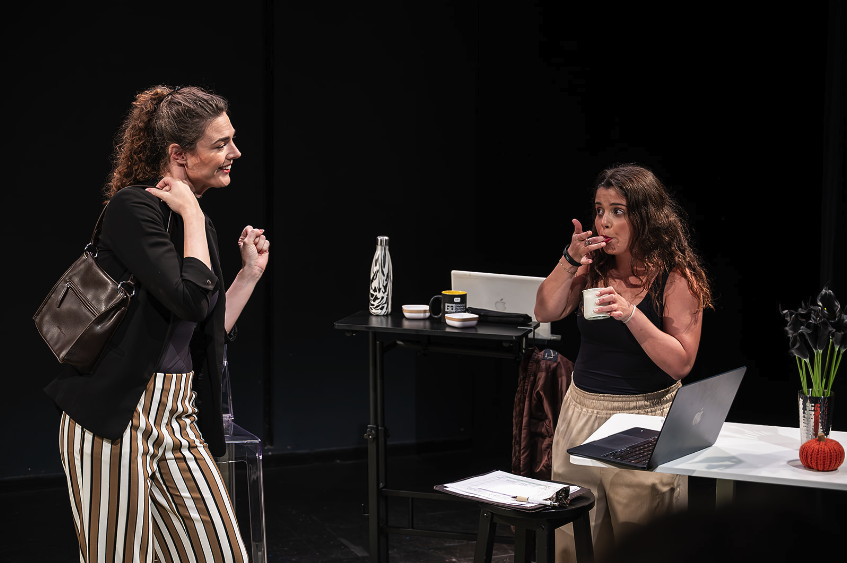
Danielle Augustine and Jacquie Bonnet in The Glitch; photo by Thomas Mundell

As Hailey the holographic daughter, Hannah Rose Doherty is a revelation, striking the perfect vocal tone of a tween at once loving and frustrated.  At times she was little more than 3’ from me.  Covered in silvery sparkles, she remained engaged and reactive: physically exploring her “projected” body, flipping her hair before she was given arms, and quivering with excitement as she was allowed to develop.  The comic relief lands primarily in the feet of Jacquie Bonnet’s Wendy.  Both the actress and the character deserve a more meaningful domain given the story arc.  A grounded Sunny Makwana brings warmth and the right touch of neurosis to the Omar Sharif-loving Wyatt, providing sufficient credibility to the string of coincidences in the story.  This makes for a less persuasive connection with Danielle Augustine whose Amy sounds forced.  To be fair, the actress is challenged by prolonged interaction with a disembodied voice and having to express a complex emotional life based on falsehoods.  The commanding presence of Aurora is given breadth and wit by Amilia Shaw, who takes a well deserved bow with the rest of the three dimensional cast.  

At a time when so many playwrights are exploring current events with fear and loathing, it’s refreshing to see playwright Koenig take a different path.  The Glitch proposes that with kindness and compassion tempered by a dose of healthy skepticism we are still capable of doing good for one another.  You can experience this for $50 ( $70 if you’d like to increase your support to premium level).  Performances are 2PM Wednesdays, 4PM Fridays and 6PM Sundays.  The limited engagement at The Theater Center, 210 West 50th near Broadway, ends November 2nd.  Visit https://theglitchplay.com/ for a sneak peek and purchasing information.