
Theater aficionados have long considered Paula Vogel a treasure. Her plays — including Pulitzer Prize winner How I Learned To Drive — are generally unnerving and always thought-provoking. Her work has given voice to the typically powerless: those who have been oppressed and abused. Her teaching at Brown and Yale has nurtured another generation of powerful female voices, including Sarah Ruhl and the most recent Pulitzer winner, Lynn Nottage (for Sweat.) With this impressive biography it is hard to believe that Indecent marks Ms. Vogel’s Broadway debut. Fortunately it is an impressive one, with a story made more poignant by recent cultural shifts.
The events depicted stem from the development of another play: Yiddish playwright Sholem Asch’s God of Vengeance. As newly inserted and much needed program notes explain, Ms. Vogel first read Asch’s piece as a graduate student. The tender and natural love scene between two women moved the budding gay rights activist to her core. Nearly thirty years later, director Rebecca Taichman stumbled across God of Vengeance and, as a descendant of a Yiddish poet, longed to understand why it had eventually been renounced by its creator. She reached out to Vogel and the two eventually had the opportunity to collaborate on Indecent, exploring the entire lifecycle of the groundbreaking and controversial piece.
It took 7 years and 40 drafts for Indecent to finally land on Broadway. The results are as significant and disquieting as Asch’s was in its time. Here is a play that takes place at a time when immigrants remade the City of New York landing just when immigrant populations are being targeted by a fresh wave of intolerance and xenophobia. Director Taichman said in an interview with The New Yorker, “My heart is broken at how much more relevant this play is today than when it opened at Yale, a mere year and a half ago.”

Production photo by Carol Rosegg
It is fitting that Vogel and Taichman share “created by” credit. Vogel’s words and Taichman’s vision are so deeply entwined it is impossible to imagine how one would work without the other. We are taken on a 50 year journey that starts in Asch’s bedroom with a reading and ends with his retirement from theater. The actors play multiple roles much as they would have in a touring troupe of that period. Beautifully crafted exchanges are interspersed with lilting traditional Jewish music composed by Lisa Gutkin and Aaron Halva. Dialogue beats are enhanced with projections in Yiddish, German and English designed by Tal Yarden.
The cast works so seamlessly together that it is difficult to call anyone out. Richard Topol has been nominated for his featured role as Lemml, the stage manager who often serves as our narrator. Katrina Lenk has also received nods, perhaps because she plays the graceful “older women” in the play within. However she, along with Mimi Lieber, Max Gordon Moore, Tom Nelis, Steven Rattazzi and Adina Verson are named simply “Actor” in the Playbill. Truly grace and strength course through every performance. Most of the ensemble transferred to The Cort Theater from a run Off-Broadway. Perhaps that explains why they seem so comfortable portraying a long-term well-respected road company.
This wrenching and precious play is currently set to run through September 10 at The Cort Theater. If you value theater that will change you, visit http://indecentbroadway.com for tickets and information.
 An equally important character is the set by Nigel Hook. Every piece has impeccable timing. Not since Alan Ayckbourn’s Bedroom Farce have I seen furniture collapse so slowly and perfectly. (I will not give away any of its more clever secrets.) The purposeful fiasco is deftly staged by director Mark Bell. His training at Ecole Internationale de Theatre and experience teaching at LAMDA likely influence the more overt style of this buffoonery.
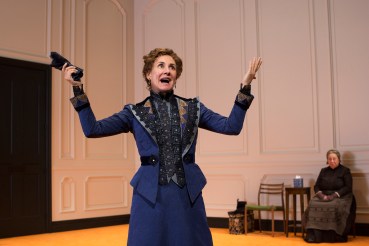 Nora Helmer’s exit from Henrik Ibsen’s A Doll’s House was the door slam heard around the world. Since 1879, scholars, sociologists, and others have speculated about her fate. Now playwright Lucas Hnath attempts to reveal what came next in A Doll’s House, Part 2, using modern language and the commanding Laurie Metcalf to deliver a post-feminist message about marriage, freedom and self-knowledge.
![[4]_Jenn Colella and the cast of COME FROM AWAY](https://theunforgettableline.com/wp-content/uploads/2017/03/4_jenn-colella-and-the-cast-of-come-from-away.jpeg?w=370&h=270) When the air space above New York closed on 9/11, nearly 7000 passengers were diverted to Newfoundland off the coast of eastern Canada. That airport had retained several large runways dating from a time when flights between the United States and Europe had to stop and refuel. Suddenly inhabitants of this 43,000 square foot island had to prepare to double their population for an unknown duration.
When the air space above New York closed on 9/11, nearly 7000 passengers were diverted to Newfoundland off the coast of eastern Canada. That airport had retained several large runways dating from a time when flights between the United States and Europe had to stop and refuel. Suddenly inhabitants of this 43,000 square foot island had to prepare to double their population for an unknown duration.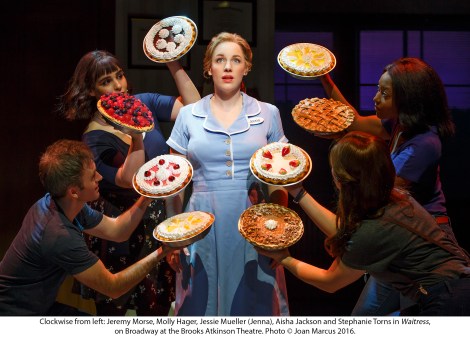 The sweet story of a sorrowful originator, the soaring melodies of Sara Bareilles, and the soulful voice of Jessie Mueller blend like butter, sugar, and flour. Together they produce a tasty joy-inducing creation that was nominated for four Tony Awards in 2016. Regular readers of this column know I am not the world’s biggest fan of modern day musicals, but I honestly can’t wait to see Waitress again. And I’m not just saying that because the entire theater smells like pie.
 The supremely talented Cate Blanchett has come to Broadway. Unlike many film celebrities who flounder on stage, Ms. Blanchett is the former co-artistic director of the Sydney Theatre Company, where she also made her theater debut nearly 25 years ago. The same incredible nuance she brings to her on-screen characters is alive and in proper proportion in her role as Anna in The Present, a modern reinterpretation of an unpublished play by Anton Chekhov. I would recommend this show simply for the opportunity to bathe in her deeply considered and exceptional work.
 In Transit is a delightful bon-bon box of a musical. A loose structure of interconnected stories holds together 11 appealing New Yorkers and 16 catchy production numbers. A prerecorded introduction by the producers reminds us that all the sounds we hear are created by human voice. The pieces are performed a cappella and the “orchestra” is a beatboxing whiz appropriately named Boxman.

 The Unforgettable Line