
The American Theatre Critics Association (of which I am a member) promotes theater as a resource to communities throughout the country. EPIC Players takes this goal a step further by opening the craft to an underserved company of performers. An acronym for Empower, Perform, Include and Create, this talented troupe is neuro-diverse: composed of actors over the age of 16 who are on the spectrum of autism. Casting calls are open, though priority is given to company members. Rehearsals are conducted over an extended period, which allows the cast and crew to co-create a particularly supportive environment. The results are not only empowering for the artists, but expansive for the audience as well.
With its sprawling cast and blended genre of horror and comedy, Little Shop of Horrors is a masterful choice for EPIC’s current season. The story follows Seymour Krelborn and Audrey, two fragile outsiders working in a skid row flower shop, and presents them with wit and affection. The pair is brought together by a demanding plant named the Audrey II, who has troubling intentions. The music is by Alan Menken with lyrics and a book by Howard Ashman, the team behind Beauty and the Beast and Aladdin. While the work can be viewed as a piece of social commentary, it is unquestionably a wildly good time.

EPIC Players’ Nicole D’Angelo and Ben Rosloff in Little Shop of Horrors
Equity member Ben Rosloff performs the underestimated Seymour with the gentleness this lead role requires. Slipping into Audrey’s leopard prints is Nicole D’Angelo, who replicates Ellen Green’s ultra-high-pitched speaking voice and sweet singing style. Her sadistic boyfriend is played with glee and a touch of menace by Dante Jayce, who also makes the most hysterical entrance. Michael Buckhout takes on flower shop owner Mr. Mushnik with appropriate slapstick asides. In many productions, the Audrey II is represented by a series of ever-larger puppets. Here, a booming Nick Moscato appears to be having a blast portraying the full grown plant, which heightens the character’s ability to engage. The chorus of street urchins has been expanded to five expressive and funny singer/dancers (Imani Youngblood, Justin Phillips, Aria Renee Curameng, Melissa Jennifer Gonzalez and Kathryn Cristofano) who enliven every moment they are on stage. Music is performed by a live four piece band under the direction of keyboardist Jonathan Ivie. Whitney Blythe, Gianluca Cirafici, Brianna Freeman, Jessy Leppert, Samantha Elisofon, Nick Amodio, Gideon Piankor, and Eric Zimmer are the supporting players with Andrew Kader, Kim Carter, Meggan Dodd, and Amaker Smith making up the ensemble.
The performance I attended was a final dress rehearsal and there were a few timing and technical issues. Even with those difficulties, the production sparkled with imagination. Directed by EPIC’s Executive Artistic Director Aubrie Therrien with assistance from Max Baudisch and Zach Lichterman, the staging makes fabulous use of the Black Box space. Aisles and overhead platforms are filled with residents of the downtown streets and Audrey II’s many admirers. You might even be offered a bag of “cocaine” or gifted with an Audrey II plant clipping. Clever costumes by Cat Fisher include Audrey II’s enticingly and colorful garb. The effective set by Tim Catlett is topped with projection screens that enhance the play with classic horror clips and horticulture documentaries.
This production of Little Shop of Horrors radiates joy from its very roots, serving to shatter any preconceived notions held by uninitiated theater-goers. Noise canceling headphones are available for sensitive audience members, and anyone needing a break is invited to decompress in the lobby. Runtime is 94 minutes with one 10 minute intermission. It plays through Sunday, June 16 in the Black Box Theater at the Sheen Center on Bleecker Street. Tickets are $27-$57 and can be purchased at https://ci.ovationtix.com/34409/production/1007814?performanceId=10390542. EPIC — a 501c3 non-profit — holds auditions year round and provides professional development classes and workshops free of charge to all who are accepted. You can also support their work by visiting https://www.epicplayersnyc.org/support.


 As Broadway musicals go, the small scale charmer of a flick Groundhog Day doesn’t seem the most obvious of inspiring sources. The comedic drama relies heavily on Bill Murray’s ability to deliver a stinging blow that is somehow forgivable. With the film’s move to the stage, that burden falls on Olivier Award winner Andy Karl as weatherman Phil Conners. He is charismatic and a joy to watch, but his wonderful performance isn’t quite enough to balance out the slightness of the material. The overall experience is theatrical cotton candy: ultimately sweet and instantly vanishing.
![[4]_Jenn Colella and the cast of COME FROM AWAY](https://theunforgettableline.com/wp-content/uploads/2017/03/4_jenn-colella-and-the-cast-of-come-from-away.jpeg?w=370&h=270) When the air space above New York closed on 9/11, nearly 7000 passengers were diverted to Newfoundland off the coast of eastern Canada. That airport had retained several large runways dating from a time when flights between the United States and Europe had to stop and refuel. Suddenly inhabitants of this 43,000 square foot island had to prepare to double their population for an unknown duration.
When the air space above New York closed on 9/11, nearly 7000 passengers were diverted to Newfoundland off the coast of eastern Canada. That airport had retained several large runways dating from a time when flights between the United States and Europe had to stop and refuel. Suddenly inhabitants of this 43,000 square foot island had to prepare to double their population for an unknown duration.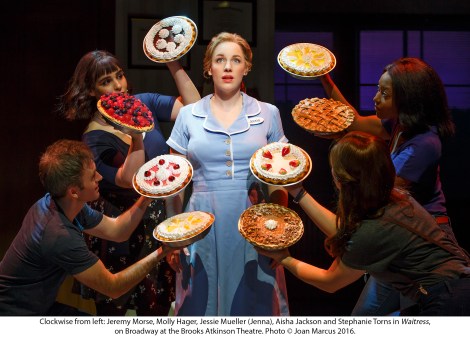 The sweet story of a sorrowful originator, the soaring melodies of Sara Bareilles, and the soulful voice of Jessie Mueller blend like butter, sugar, and flour. Together they produce a tasty joy-inducing creation that was nominated for four Tony Awards in 2016. Regular readers of this column know I am not the world’s biggest fan of modern day musicals, but I honestly can’t wait to see Waitress again. And I’m not just saying that because the entire theater smells like pie.
 In Transit is a delightful bon-bon box of a musical. A loose structure of interconnected stories holds together 11 appealing New Yorkers and 16 catchy production numbers. A prerecorded introduction by the producers reminds us that all the sounds we hear are created by human voice. The pieces are performed a cappella and the “orchestra” is a beatboxing whiz appropriately named Boxman.


A Letter to Harvey Milk
A Letter to Harvey Milk is a slightly flawed gem of a musical, giving voice to some little seen characters. The work is based on a Lesléa Newman’s short story which follows mildly eccentric but loving Jewish characters as they discover and embrace their identities as lesbians. In this case the seeker is Barbara, a Connecticut transplant earning a little extra money by teaching a writing class at the JCC in San Francisco. Her unexpected partner in self exploration is Harry, a widowed retired butcher who finds himself drawn to her classroom and her energy. What binds them is the titular letter that Harry composes as an assignment. The honest love and sincere appreciation expressed to his activist friend pulls Barbara into Harry’s story. She revels in the company of someone who is seemingly so comfortable with his choices. Their developing friendship takes them both to unexpected places.
Adam Heller and Julia Knitel with Aury Krebs in the background. Photo by Russ Rowland
The book by by Jerry James, Ellen M. Schwartz, Cheryl Stern and Laura I. Kramer provides enough detail to follow both Harry’s and Barbara’s struggles with love and loneliness. Throughout are two culturally significant threads about homosexuality and Judaism through time and in context. There are a few small gaps in logic such as how Barbara can be making any money with only one student, but those are easy to set aside. What doesn’t come through with sufficient clarity is the critical figure of Harvey Milk. He is painted in such broad strokes, those unfamiliar with his ground-breaking achievements will see a badly dressed kook with terrible eating habits. Perhaps the script suffered from too many cooks. Lyrics by Ellen M. Schwartz work better to move the story along and provide atmosphere. Music by Laura I. Kramer isn’t very memorable, but it does suit the words, particularly the Yankee Doodle Dandy treatment of some of Harvey’s most famous speeches.
Generally, the women in the cast outshine the men. Julia Knitel — who previously starred as Carole King in the touring company of Beautiful — has a soothing voice and magnificent articulation as she shapes Barbara’s story. As Frannie, Harry’s deceased wife who is by his side for the journey, co-lyricist Cheryl Stern is the comic relief, delivering Elaine Stritch-style patter and emphasis. And in her one big number, Aury Krebs is a dream. Michael Bartoli captures Harvey Milk’s patterns and mannerisms, but as described earlier, he isn’t given enough to work with. Supporting players Jeremy Greenbaum and CJ Pawlikowski do a fine job playing multiple roles. The weak link is Adam Heller who was off key as a singer and lacked sufficient variation as an actor. He has extensive Broadway experience, so perhaps it was just an off night.
Evan Pappas’s staging is clever, especially in the more intimate moments. The charming set by David L. Arsenault captures the feel of the Castro district of San Francisco complete with muted colors and a big Bay window. The orchestra, under the direction of Jeffrey Lodin, is perched on a balcony above so they are in view and adding to the ambiance. The costumes by Debbie Hobson are pitch-perfect, notably Barbara’s anklets and sweater vest and Frannie’s tidy suit. Christopher Akerlind’s lighting effectively changes color palette to the match the mood of each scene.
While A Little to Harvey Milk is still at a “great potential” stage of development, it is already a genuine crowd pleaser (for the right crowd) and impressive bang for the buck. Struggling with shame and the need for self-truth resonants even with those who are straight and/or gentile. It runs through May 13, 2018 at the Acorn, part of Theater Row. Tickets are $79 – $99 and can be purchased at Telecharge.com or by calling 212-239-6200.