Category Archives: Off-Broadway

All The World’s a Stage: First Look

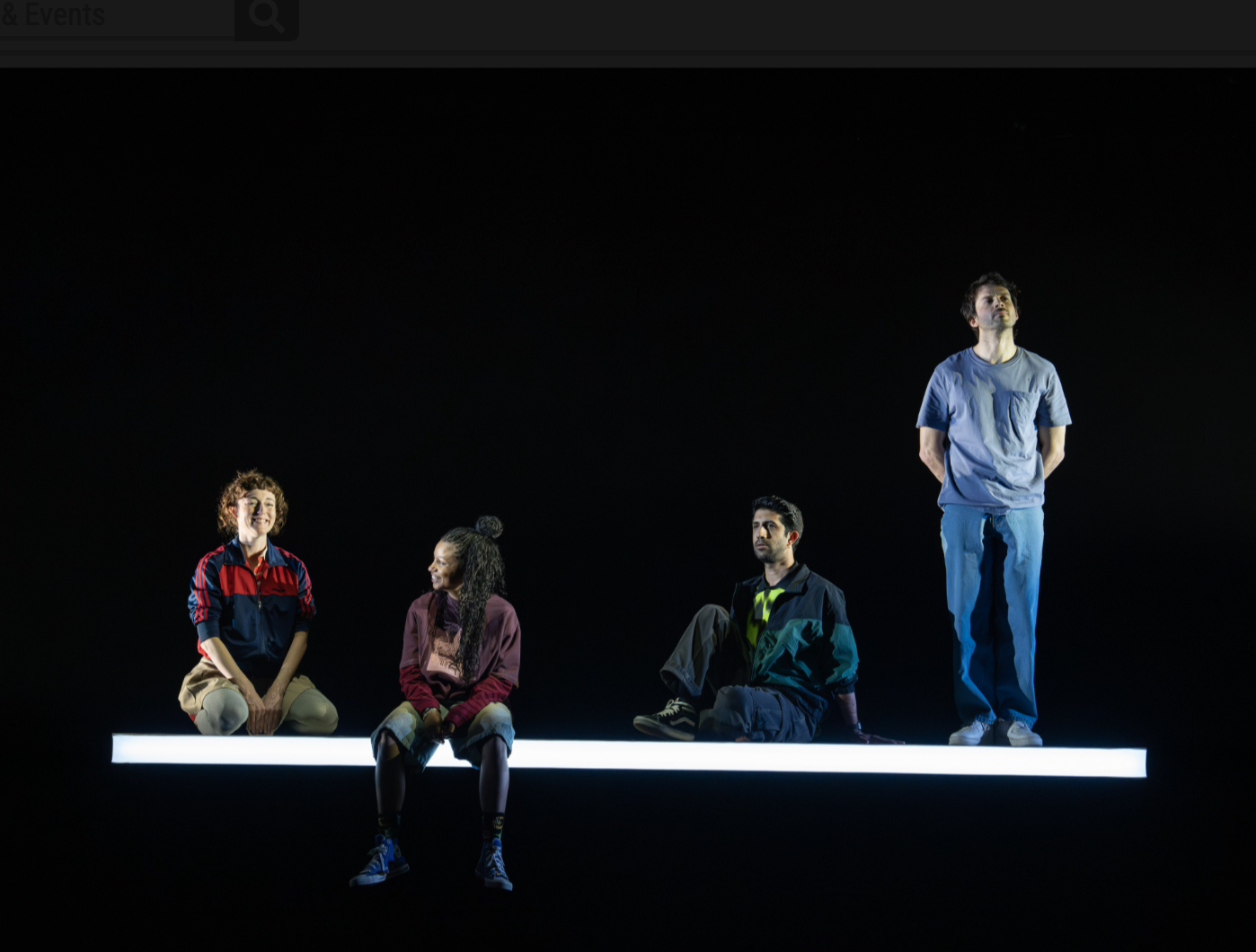
Only two weeks into previews, the World Premiere of All the World’s a Stage is developing into a warm and enjoyable spring offering.  Though set in 1996 in small-town Pennsylvania, sadly the themes covered could be ripped from today’s headlines.  Adam Gwon’s lyrics are dense and expressive, but despite the many complex subjects he explores — bullying, book banning, religious indoctrination, and the very human need to be seen — it is hopefulness that is heard above them all.  Pair that with a memorable score and a quartet of talented performers, and this tale of a gay math teacher and the unusual student he mentors add up to a winning piece of entertainment.

The actors work together like four limbs of the same magical being.  Eliza Pagelle is wonderfully squirmy, adrift in her baggy cloths as unpopular high school senior Sam.  Matt Rodin embraces both the nerdiness and attractiveness of her protective closeted teacher Ricky.  Jon-Michael Reese and his big bold voice are perfectly suited to self-possessed bookstore owner Michael, who is out accompanied by trumpets and klieg lights.  And Elizabeth Stanley puts a relatable chink in the armor of by-the-book administrator Dede.  

Matt Rodin, Elizabeth Stanley and Eliza Pagelle in All the World’s a Stage at Theatre Row
Production Photography: Richard Termine

Keen Company’s Artistic Director, Jonathan Silverstein, takes the helm as the director of this lovely work.  The effect employed to create the unseen school principal is an example of his clever approach to promoting the big things in this small package.  Set designer Steven Kemp has made the most of the tight space in Theatre Row’s Theater 5, placing a short cinder block wall around the musicians and steps downstage to add more dimension.  Jennifer Paar has built an impressive wardrobe for each of the four central characters giving them even more to work with.   

Gwon’s book is filled with cultural references that have traveled well through time, especially the admiration for Tony Kushner’s Angels in America which was recently revived in New York and London.  Many lines earn a laugh of recognition from the audience.  (Who among us didn’t prefer listening to the cast album of Chess over following the stock market?)  His love for and knowledge of the theater is particularly needed at this time when the art form has been under attack.  The musical numbers cover a wide range of styles from the jingly “Saturday Night in a Small Auditorium”, through the campy “The Show Must Go On,” to the heartfelt “Mirrors” which had the hulk of a man sitting next to me weeping hard enough to wiggle my seat.  The four musicians under the direction of Andrea Grody stay wonderfully engaged with the onstage happenings without calling attention to themselves.

All the World’s a Stage packs a lot of emotion and life lessons into its current runtime of an hour and 40 minutes without getting preachy or losing its humanity.  It’s a compact work with enough heart to feel expansive.  Performances continue at Theatre Row thought May 10.  Tickets beginning at $25 can be purchased  online at www.keencompany.org, by phone at 212-714-2442 ex 45, or at Theatre Row Box Office at 410 W 42nd Street.  

Amerikin

With his promising recent promotion, loyal best friend, and gorgeous new baby, Jeff Browning seems to be well on the way to living the life he’s always dreamed of.  The acceptance of his application to a local organization — The World Knights — is almost assured, making him and his fragile wife, Michelle, members of a supportive community.  Despite all he has, a deep sense of belonging remains a missing piece.  True, the Knights are dangerously anti-Black, but Jeff doesn’t consider himself a bigot.  He would never have called his dog a racist slur if he lived within hearing distance of a person of color.  Yet Jeff is rocked to the core when his required DNA test reveals he is 14% Subsaharan African.

These events unfold in the first few scenes of Amerikin, a new work by Chisa Hutchinson presented by Primary Stages.  With its highly provocative and uncomfortable themes, it’s no wonder this production became a target of the current administration and lost its NEA grant.  But for those who enjoy their live performances dexterously delivered and dowsed with hot sauce, the play provides enough rousing dialogue and surprising twists.

Playwright Hutchinson has much that she wants to communicate and she uses both sharp wit and emotional intelligence to largely accomplish her goals.  The simultaneous display of past and present makes for engaging storytelling.  Well-earned laughter breaks up the mounting tension.  The breaking of the fourth wall by several characters is a less effective short-cut and too frequently employed.  

Tobias Segal and Daniel Abeles in Primary Stages’ 2025 production of AMERIKIN;
photo by Justin Swader

Housed primary in a perfectly scuffed up set by scenic designers Christopher Swader and Justin Swader, the production is shaped by intuitive director Jade King Carroll and a skillful acting ensemble. Daniel Abeles takes the lead in Act 1, imbuing Jeff with alternating waves of swagger and vulnerability.  Act 2 is anchored by Victor Williams as a dauntless clear-eyed Black Washington Post reporter, Gerald, and Amber Reauchean Williams as his self-assured college age daughter, Chris.  The seasoned political journalist is looking for a fresh angle, preferable one that is Instagrammable.  Chris’s life has been more profoundly impacted by the execrating pace of police brutality against her race.  Their banter-filled car rides between D.C. and Jeff’s home in small-town Maryland compellingly illuminate a generational divide and are highlights of the script.  

The outsiders are the ones who bring the schism between Jeff’s sense of self and harsh reality into focus.  Additionally, Tobias Segal as best friend “Poot” is sweetly well meaning, expressing what many in the audience are thinking.  His character is a welcome counterbalance to Luke Robertson’s solid but offensive sponsor, Dylan.  His “Black Labs Matter” T-shirt (costumes by Jen Caprio) says it all.  Jeff’s wife and ex-girlfriend, portrayed by Molly Carden and Andrea Syglowski respectively, are plot-fillers written with limited range.

Amerikin is to be praised both as a springboard for productive and thoughtful conversation as well as an evening of quality ensemble acting.  The program notes contain several warnings including discussion of postpartum depression and suicidal ideation and the ending is so punishing it diminishes what came before.  Runtime is 2 hours plus a 15 minute intermission.  Performances continue through April 13 as part of the AMPLIFY Festival being celebrated at 59e59 Theaters at 59 East 59th Street.  Tickets begin at $66 and can be purchased at https://www.59e59.org/shows/show-detail/amerikin/#show-info.  In honor of their founding year, Primary Stages has also made $19.84 lottery tickets available through the TodayTix app for every performance.

My Man Kono

For nearly 20 years, Toraichi Kono worked for Charlie Chaplin during the period when the silent film star rose to prominence and notoriety.  Originally hired as a driver, Kono became one of Chaplin’s most trusted confidantes: acting as his a social secretary, assisting with film production, and even playing a valet in three of Chaplin’s pictures.  Serving as a role model for other Japanese immigrants, Kono’s starry life was eventually upended by tragedy on the home front and a fishy arrest by J. Edgar Hoover’s FBI for suspected espionage.  Los Angeles based Asian American playwright Philip W. Chung has now melded the world of Hollywood with the immigrant experience in his captivating new work, My Man Kono, highlighting this man’s fascinating story.

Kono is presented as a rich and well-rounded character.  We see his early days in Japan as a charming film flam man wooing and winning over the woman of his dreams against his parents wishes. We celebrate his rise in a flashy and influential California circle while regretting his time away from loved ones.  Dinh James Doan has replaced Brian Lee Huynh in this pivotal role for the remainder of the play’s run.  He was still not completely at ease with the broad demands during Saturday’s performance, but there were only a few scenes in which he didn’t fully connect with the fine ensemble bolstering him.  Conlan Ledwith pulls off the physicality, charm, and smugness of Chaplin on screen and off also portraying the judge who holds Kono’s future in his hands.  Robert Meksin imbues lawyer Wayne Collins with the right amounts of warmth and gravity and Cody Leroy Wilson gives the buffoonish Alva Blake much needed grounding.  Emma Kikue is clearly having fun playing all of Chaplin’s wives including Paulette Goddard who drove a wedge between Chaplin and Kono.  Kiyou Takami does what she can with the underwritten part of Kono’s suffering wife Isami, countering her husband’s thirst for fame and fortune with one driven by honor and family.  James Patrick Nelson plays a variety of almost clownish enforcement heavies, while Jae Woo rounds out the cast playing suspected spy Itaru Tachibana among others.

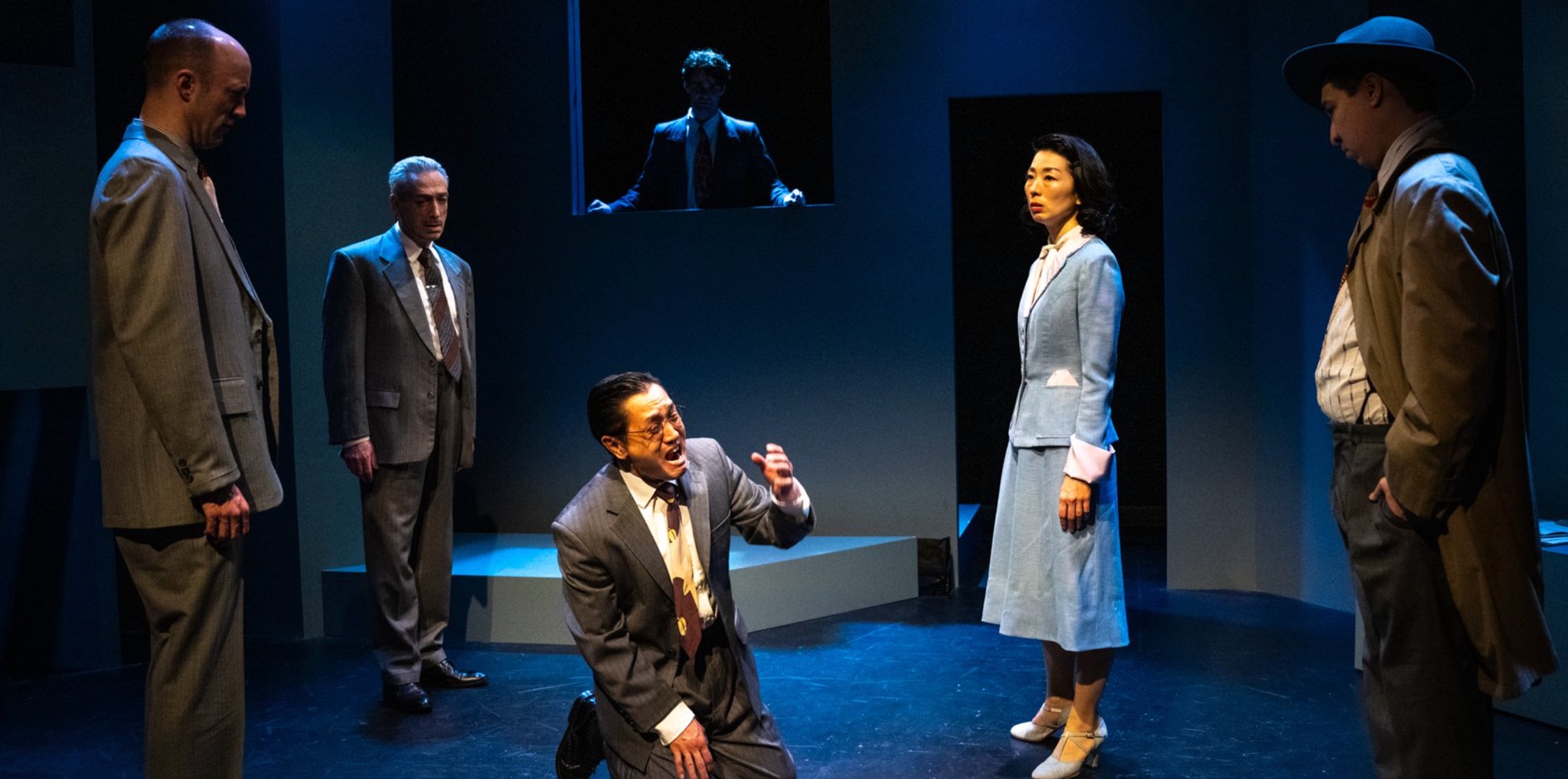
James Patrick Nelson, Robert Meksin, original cast member Brian Lee Huynh (kneeling), Conlan Ledwith (in window), Kiyo Takami, and Cody Leroy Wilson in My Man Kono; photo by Russ Rowland.

Director Jeff Liu has worked closely with set designer Sheryl Liu to make the most of the intentionally shallow configuration of the black box space.  Grey blocks with strategic cutouts are combined with Cinthia Chen’s projections to serve as everything from Chaplin’s elegant homes to a drab courtroom and represent geographically areas from across the US and Japan.  Sometimes the actors literally pop-up from the top or poke out through a window to grab attention.  Lighting designer Asami Morita supports this spirited concept.

Presented by Pan Asian Repertory as part of their 48th season, My Man Kono is a wildly engaging and informative piece of theater.  Sending American citizens — many of whom had offspring in our military — to internment camps because of their heritage is one of the most disgraceful chapters in our history.   Shameful questioning of what it means to be an American patriot reverberate in the present.  To see this period through the eyes of someone who was close to a Hollywood legend is an ingenious way to draw in a wider audience.  This World Premiere continues through March 9 at the A.R.T./NY Mezzanine Theatre on the second floor of 502 west 53rd Street.  Reserved seats are available at https://www.panasianrep.org/my-man-kono and are $35 for students, $60 for seniors and $70 for adults. 

Grangeville

Grangeville is the county seat of Idaho County and the setting for and title of Samuel D. Hunter’s latest play exploring life in his home state.  Older brother Jerry still lives in this town of slightly over 3000 people.  He is newly separated from his high school sweetheart Stacey, raising two kids, acting as healthcare proxy for his mother, and doing his best to support himself by selling RVs.  Younger half brother Arnold has distanced himself from all the bullying he received at the hands of his family and classmates.  Married for nearly 17 years to Bram, he lives and creates works of art in Rotterdam, the Netherlands.  The only thing these two seem to have in common is a little DNA.  But when it comes to light that their critically ill mother has made Arnold her Executor and granted him Power of Attorney, the siblings have no choice but to reconnect.

What follows is 90 minutes of stirring and often witty dialogue delivered by two versatile actors.  Similar to Arnold, Hunter has created a piece of art that both mocks and celebrates his birthplace.  This script is his usual blend of profound human insight and bookish humor.  If you’ve enjoyed my spoiler-free reviews, you should jump to the last paragraph.  There is simply no way to discuss this production without revealing something that is better experienced for the first time in the moment.  

Arnold and Jerry are so different they don’t even share similar memories from their past. Their search for and avoidance of common ground is enthralling.  In the meatier of the roles, Brian J. Smith portrays Arnold, the brighter and more settled of the brothers.  Smith’s ability to navigate Arnold’s swift transitions of emotional state is impressive and endearing.  Smith also plays Stacey just by adding a measure of softness to his tone and gestures.  Paul Sparks takes on Jerry, a man full of deep regret about his conduct as a younger man and consumed by unhappiness with his current circumstances.  At first, Jerry verbally tiptoes towards Arnold in their video chats.  As his need increases, so does the urgency in his language.  With a subtle change in posture and a waffling accent, Sparks then moves to the role of Bram.

Paul Sparks and Brian J. Smith in Grangeville; Photo by Emilio Madrid

With the precision of an orchestra conductor, director Jack Serio enables his actors to delicately build towards an inevitable crescendo.  Initially we sit in darkness, fully tuned in to their choice of words and reflective pauses.  Movement is added as the exchanges increase in temperature and truthfulness.  Like Hunter’s characters, the black textured walls and dirty white door of the set by dots don’t fill out until far into the journey.  Stacey Derosier’s lighting and Chris Darbassie’s sound have similarly calculated arcs.  Props by Addison Heeren add the perfect punctuation.

Grangeville is a smartly written work that takes full advantage of live theater as a communication and entertainment vehicle.  The Signature-commissioned World Premiere continues through March 23 at The Alice Griffin Jewel Box Theatre, 480 West 42nd Street.  The house is shallow and well raked with the legroom of an economy seat on Spirit Airlines.  Run time is 90 minutes with no intermission and no re-entry permitted.  Tickets are available at https://signaturetheatre.org/show/grangeville/  and begin at $78 including fees.  Arrive early to take advantage of the pleasant cafe and small bookshop on the second floor.

Liberation

Tony nominee Bess Wohl’s latest endeavor, Liberation, is a memory play in which the narrator describes events from someone else’s experiences.  She imagines what it was like for her own mother in the early days of the fight for women’s equality.  Through a series of talking circles with her mother’s friends, she attempts to shine a light on the connection between personal decisions and societal evolution and gain a better understanding of her own choices.

A zestful Suzannah Flood takes on future mom Lizzie, Lizzie’s daughter, our leading lady, and the voice of the playwright.  Flood has an endearing everywoman quality and relatability.  Her opening monologue weaving together all four women is a highlight of the evening.  She addresses the herd of elephants in the room, beginning with the political victories that are slipping away.  To better appreciate The Now, Lizzie’s daughter will role-play her own mother.  The path Lizzie chose in her twenties led to our host’s very existence and we should become deeply invested.  But the ensuing storytelling is like learning ballet by drawing the steps on a blackboard.  We grasp the ideas intellectually, but without experiencing any authentic movement.

We are transported to Ohio in 1970 where budding journalist Lizzie is endeavoring to form a consciousness-raising group for women.  Five strangers have responded to her flyer and arrived at the local rec center.  Margie (Betsy Aidem) is a married woman with grown children whose entire life is consumed by caring for her family.  Dora (Audrey Corsa) is a young secretary whose intellect has been overlooked because she’s pretty.  Celeste (Kristolyn Lloyd)  — the lone woman of color — is an Ivy League graduate whose career has been blown off course by her ailing mother.  Isidora (Irene Sofia Lucio) is an Italian immigrant with creative ambitions who married for a green card and now wants out.  And Susi (Adina Verson) is living in her car and feeling completely exhausted by life.  Two others pass through the room.  Bill (Charlie Thurston) will eventually become the husband/father.  And Joanne (Kayla Davion) who arrives in search of her son’s lost backpack.  Her involvement in Act 2 provides one of the few exhilarating scenes in a series of otherwise predictable beats.

We are told these women are friends, but despite literally stripping themselves naked before one another, they do not truthfully reveal themselves.  Lizzie is too fearful of making a wrong move to be a leader or even anoint one.  We are reminded of the many limitations women faced in the days when they couldn’t open a bank account and no fault divorce was only legal in California.  But with only descriptions to go by, we experience a glancing blow rather than an enduring punch.  Stuck in chat mode, they all remain types from the era and never reach our hearts.

Adina Verson, Irene Sofia Lucio, Audrey Corsa, Susannah Flood, Betsy Aidem and Kristolyn Lloyd in Liberation; photo by Joan Marcus

The cast is up for the creative exercise, playing their counterparts in both past and present and occasionally stepping into the role of Lizzie when a situation would be awkward for her daughter to recreate.  Director Whitney White provides as much variation as she can, using the gym equipment to change the composition of bodies.  Set designer David Zinn adds some color with an unlikely rainbow of gym mats while costume designer Qween Jean seems to have had a blast at the local thrift shops to reconstruct that fabulous 70s look.

To protect the actresses from having nude images of themselves released by the public, all audience members must place their phones into a locked Yondr Pouch.  Unfortunately, no one at the venue was responsible for assuring that devices had been silenced or turned off, so the performance was punctuated by rings and pings.  The woman next to me could only kick her purse more deeply under her seat and smile sheepishly.

Liberation would be more successful in its mission if the characters generated the same level of support towards one another as the actresses seem to.  The message that even a little gesture can move a cause forward is an encouraging one, especially in a time when many of us feel like we are losing ground.  Instead, these characters inflict a concept of equality upon one another that feels more like another form of repression.  

An Off-Broadway entry to Roundabout’s season, Liberation continues through Sunday, March 30 at the Laura Pels (111 West 46th Street).  Tickets are available at https://www.roundabouttheatre.org/get-tickets/2024-2025/liberation and begin at $80 including fees.  Running time is 2 ½ hours including a 15 minute intermission.

A Knock on the Roof

There are many ways in which the war in the Middle East has been brought into our lives, particularly over the last 15 months.  For a singular account, there is now A Knock on the Roof.  Written and performed by Khawla Ibraheem — a playwright, actor and director from the occupied Golan Heights — the piece avoids politics, focusing instead on the emotional casualties of the conflict.  Her collaborator and director is Oliver Butler, who previously worked with Heidi Schreck on the impassioned What the Constitution Means to Me.

The main character is Mariam, indicating that while the events portrayed are truthful this is not an autobiography.  She is living in Gaza with her husband, Omar, and young son, Nour, just trying to be “the cool mom” when war breaks out.  After Mariam refuses to move into the family building, her mother joins her in her small apartment.  The generational tensions add to the stress of an already fraught situation.

The title refers to the practice used by the enemy of dropping a small bomb on the rooftop to alert the residents that they have five minutes to vacate before their building will be completely destroyed.  Mariam prepares for this horror by packing a bag and practicing her evacuation, acquiring new knowledge, technique, and insight with each run.  Her cycle will be familiar to anyone who has faced a disaster that has the potential to take away “home” and everything that signifies.  The grinding anxious anticipation becomes as painful as the inevitable event.

This is not the type of one person show that makes you marvel at the actor’s ability to portray and interact with multiple characters.  Though she shifts her voice slightly when inhabiting family members, Ibraheem is a true solo performer, primarily sharing Mariam’s inner monologue.  Though the themes are heavy, the script contains moments of levity and Ibraheem makes the most of them.  Her exchanges with the audience feel warm, genuine, and even spontaneous.  She has been feeling “missing” since she gave up her studies to get married.  As she says about halfway through the piece, “I couldn’t share my real thoughts with me.”  She had wanted to move to Europe and get her Masters Degree.  Instead she has brought a sweet boy into a violent world with little hope.  Her words are a private knock on the roof: a warning of impending destruction. Much of what she expresses in her search for meaning, connection and safety is relatable. In addition to a gut-level understanding of the stresses of wartime, what we witness is a soul crushing personal reckoning.

This distinction from many first person plays becomes particularly significant towards the end of the piece when there is a jolting revelation.  The final section is so extreme that several women in the restroom — where much precious audience feedback is shared — said they found it unnecessary and even unrealistic.  While it doesn’t ruin all that came before, it certainly lessens the impact of universality of the other 95%.

Khawla Ibraheem in A KNOCK ON THE ROOF at New York Theatre Workshop;
Photo by Joan Marcus

The play is set against a plain brick wall (Frank J Oliva, scenic design) all the better to focus on Mariam.  Butler’s staging ensures that the entire space is used and no part of the audience is left out.  In cool colored clothes that belie her inner turmoil ( Jeffrey Wallach, costume design), she unfolds her story over the course of 85 minutes. The only prop is an armless chair which Ibraheem brings on stage with her.  The rest of the atmosphere is filled in by this vigorous actress along with lighting by Oona Curley augmented by Hana S. Kim’s effective projections. The high ceiling and lack of acoustical panels give a slight bounce to the sound, which intermittently makes Ibraheem difficult to understand.

The only side presented in the wartime setting of A Knock on the Roof is a human one.  Part of Under the Radar — a curated experimental theater festival that is playing across 30 New York City venues — it continues through February 16.  Tickets are available for as little as $30.  Performances take place at New York Theatre Workshop, 79 East 4th Street between Bowery and Second Avenue. Visit https://www.nytw.org/show/a-knock-on-the-roof/ to purchase and for more information.

The Antiquities – A First Look

When I heard that Playwrights Horizons, Vineyard Theatre and Goodman Theatre were co-producing a project, I jumped at a ticket to a late preview.  The Chicago-based Goodman — the oldest ongoing venue in the area — is a Regional Tony winner known for its community inclusiveness.  Vineyard Theater in Manhattan is renown for its support of new voices and unconventional works.  And the focus of Playwrights Horizons is to develop writers whose works promote conversation.  Recently they nurtured the seemingly impossible to stage Stereophonic which won a Tony for its Broadway transfer. 

Added to my incentive was that the playwright, Jordan Harrison, wrote two plays that have stayed with me over the years.  The characters in his Maple and Vine become so uncomfortable with the abundance provided by  modern technology that they move to a town filled with 1950s re-enactors.  In Marjorie Prime, which put Harrison on the short list for the Pulitzer Prize, a digitally generated companion assists an aging woman in recapturing her memories.  Both works are alternatively witty and chilling as they explore the relationship between technological advancement and what keeps us human.

While the performance I saw of Harrison’s latest occurred too early in the run for me to write an official review, I wanted to share a few thoughts.  In A Tour of the Permanent Collection in the Museum of Late Human Antiquities — or simply The Antiquities — two AI curators guide us through a museum built for preserving essential chapters in the human story.  The Playbill includes a quote by Oscar Wilde: “Every portrait that is painted with feeling is a portrait of the artist, not of the sitter.”  In this case, the artists are the systems into which we’ve fed everything from our grocery lists to sensitive photos and we are merely the byproduct of their process.

The trip forward begins in 1816 — when Mary Shelley concocted an original horror story that has since become a metaphor for many of man’s inventions —  and ends in 2240.  The journey is disjointed and abrupt, with some scenes lasting mere minutes.  The diverse cast, described only as Man/Woman 1-4 and Boy, moves with skill and comfort through roles and tone, though not all interactions land with the same level of impact.  For nearly an hour, Harrison relies on an intelligent and informed audiences to fill in blanks. The ride back to 1816 smashes the museum metaphor, but mostly succeeds in stitching together the incidents we’ve witnessed.  The conclusion leaves a stinging mark. 

Kristen Sier and Julius Rinzel in The Antiquities, opening February 4, 2025 at Playwrights Horizons; Photo by Emilio Madrid

The co-directors are multiple award winner David Cromer and ascending star Caitlin Sullivan. This creative pairing may explain the wide range of flavors imparted by each bite-sized chunk.  It will be interesting to see what changes are made by the artistic team before the show is frozen.  The scenic design by Paul Steinberg is composed of metallic walls shiny enough to make us feel included by not clearly reflected. They move to constrict the characters, and are enhanced with a few set pieces.  Tyler Micoleau’s lighting is harsh and eery, blending well with the occasionally distorted sound design of Christopher Darbassie. 

The Antiquities is not an easy show, but it is an admirable offering for the subscriber base of the collaborating producers and others who don’t mind doing some cerebral heavy lifting.  After opening on February 4, the World Premiere runs through March 2 at Playwrights Horizons, 416 West 42nd Street.  Tickets begin at $52.50 and can be purchased at https://www.playwrightshorizons.org/about/production-history/2020s/2425-season/the-antiquities-jordan-harrison.  A second production begins on May 3 at Goodman’s Owen Theatre in Chicago.

Welcome to the Big Dipper

Almost ten years ago, playwright Catherine Filloux took a break from delivering hard hitting dramas that deeply examine the human condition and began working on something far lighter.  The genesis was an episode from her mother’s life involving a busload of Amish and another carrying a troupe of crossdressing singers.  These vastly different groups were forced to stay at the same motel during a snowstorm.  

Now complete with music and lyrics by Jimmy Roberts (I Love You, You’re Perfect, Now Change) and a book co-written by John Daggett, the musical Welcome to the Big Dipper is having its World Premiere directed by DeMone Seraphin at the Theatre at St. Jeans.  Even with this unique origin story, almost everything about the dialogue, songs, and movement evokes memories of other shows.  Whether you find this humdrum or comforting will depend very much on your love of the musical form in general.

Strictly religious widower Amos King (Robert Cuccioli) is returning from a wedding with his daughter Rebecca (Mia Pinero) and their neighbor, Sarah (Jillian Louis).  Trans choreographer Carly (Jayae Riley, Jr.) is taking the Sirens of Syracuse (Pablo Torres and and Darius Harper) fronted by Jacky/Jake Barnes (Michael Yeshion) to The Ladies of the Lake singing contest.  After their buses collide during a blinding blizzard not far from Niagara Falls, the city of Bigelow finds them shelter at the Big Dipper Inn.  The inn’s owner — Black single mother Joan Wilkes (Debra Walton) — was about to sell her treasured family property to a development firm represented by Bonnie (Jennifer Byrne) in order to cover the cost of college for her brilliant son Dez (Christian Magby).  But she removes the “closed” sign from her desk and agrees to provide sanctuary to the travelers.  Though they have brought few possessions, there’s baggage aplenty.

Jillian Louis, Mia Pinero, Robert Cuccioli, Pablo Torres, Darius Harper, Jayae Riley, Jr., Michael Yeshion; Photo by Carol Rosegg

Despite their proximity and the wild set-up, there is almost no catalytic energy among the guests.  Doorways on wheels in Brian Pacelli’s scenic design facilitate moving between narratives, though the static elements of the set don’t meld easily with all storylines.  Slavery, religious devotion, personal ambition, and romantic attachments whiz by without much investigation.  Filloux’s drive to understand how people respond to one another in crisis occasionally pokes a hole in the thin fabric of plot.  The casting by Michael Cassara is deliberately and appropriately inclusive.  But with so many tropes employed, it is hard to determine who is being lifted up and who is being sent up.  This is not a reflection on the actors, who all seem committed to the constructs provided.  Musical numbers are delivered with polish and passion.  Post-performance discussions with represented community members including transgender social organization CDI and the production’s Amish consultant, J.P. Miller, should add much needed perspective. It’s just unfortunate not to be able to experience more of it directly from the work.

If the rush of the modern world has you feeling anxious, settling into the snowy surroundings of the Big Dipper Inn and the singing talents those walls contain provides 90 minutes of shelter from the storm.  Though little ground is broken, the kindness of the characters and bow-wrapped epilogue are well-suited to the holiday season. 

Welcome to the Big Dipper continues through December 29 at The Theatre at St. Jeans, 150 East 76th Street, between Third and Lexington. (No performance Thanksgiving or Christmas Day.) Tickets can be purchased at https://web.ovationtix.com/trs/cal/34375/1730433600000.  $20 senior and student Rush tickets are available in-person beginning one hour prior to performances, subject to availability. The York Theatre’s Gen York program also offers $30 tickets for patrons under 35. 

We Live in Cairo

In 2011, a number of Egyptian youth groups gathered together in Tahrir (Liberation) Square to protest the corrupt authoritarian rule of President Hosni Mubarak.  His 30 year stranglehold on power had led to economic stagnation, human rights violations, and media restrictions.  The young peoples’ acts of civil disobedience in concert with a series of labor strikes forced Mubarak’s resignation and brought about a democratic election.  Their victory was short lived, however, and Egypt now stands at a miserable 18 out of 100 on the Freedom House scale.  

Inspired by a photo of several of the activist artists, brothers Daniel and Patrick Lazour wrote We Live in Cairo, developing the score and book over ten years.  The results are inconsistent in their ability to sway the audience, primarily carried along on waves of tuneful music.  Most numbers combine instruments and musical themes from Egypt with traditional structures including love ballads and rock anthems.  Director Taibi Magar joined the collaboration to add depth and movement to song.  The voices of the all-Arab ensemble blend beautifully (vocal arrangements by Madeline Benson) even when their characters falter.  For the scene depicting the toughest days of uprising, the musicians join the actors center stage, enveloping them with melody.

Michael Khalid Karadsheh, Ali Louis Bourzgui, Rotana Tarabzouni, Nadina Hassan, Drew Elhamalawy and John El-Jor in WE LIVE IN CAIRO at New York Theatre Workshop; Photo by Joan Marcus

The atmosphere developed by the design team wraps the audience in the sights and sounds of the struggle for freedom.  Tilly Grimes’ set is kept simple with a collection of pillows, rugs, lamps and household items filling a few shelves. The visual emphasis is on the evocative projections designed by David Bengali, some of which appear overhead.  He and lighting designer Bradley King added their graphical layers to the look and feel when they joined the crew during the run at A.R.T. in Boston.

Unfortunately, the story, though it was restructured several times, lacks the same level of vibrancy.  While the idea of looking at this revolution through varying lenses of artistry, policy, and simple human compassion is an interesting concept, the issues are all frustratingly abbreviated and the actions poorly motivated. Initially apolitical and fearful, Layla (Nadina Hassan) suddenly turns her entire life inside out based on exposure to a single image.  The societal significance of her boyfriend, Amir (Ali Louis Bourzgui), and his brother Hany (Michael Khalid Karadsheh) living as Coptic Christians in the majority Muslim country is mentioned, but never meaningfully explored.  Fadwa (Rotana Tarabzouni) is so driven by her identity as the child of dissidents that her every opinion becomes a cause which muddies their significance.  The attraction between the majestic Karim (John El-Jor) and the tentative Hassan (Drew Elhamalawy) is covered over as quickly as one of Karim’s satiric murals.  The vagaries of this critical thread border on homophobic.  Even the impact from country’s former status as a British colony doesn’t receive more than a single line.

New York Theater Workshop, which has been helping to nourish this production for nearly 7 of the 10 development years, has done what they can to broaden the world of the play beyond the walls of the theater.  E-tickets include the promotion of local Egyptian restaurants, invitations to post-show topical talkbacks at their sister space, and lighter cultural fare like a hummus-making contest.   A brief historical timeline and the “origin story” of the production are inserted into the program.

Like the ending of the Arab Spring it depicts, We Live in Cairo ultimately fizzles.  But it leaves behind a feeling of purpose that makes the experience worthwhile at this delicate point in our own history.  The Off-Broadway premiere continues through November 24 at New York Theatre Workshop, 79 East 4th Street in Manhattan. The performance runs 2 ½ hours with one intermission and contains images and sounds of a violent nature.  Tickets begin at $49 and can be purchased at https://www.nytw.org/show/we-live-in-cairo/tickets/ or by calling the NYTW box office at 212-460-5475.  You will get a better sense of place seated further back from the stage.  This is the first play of four in the NYTW 2024-25 season and subscriptions are still available for as little as $230.

HOTHOUSE

Fringe Festivals are known for launching imaginative artists and exploring unconventional art forms.  Content is uncensored and therefore often provocative, sometimes to the point of discomfort.  Those traits are true of HOTHOUSE, a performance work from 2023’s Dublin Fringe.  Written by Carys D. Coburn (co-founder of the award-winning collective, Malaprop), the theatrical statement piece loosely strings together generational abuse, repressed feelings, and Rachel Carson’s 1962 book Silent Spring, which led to the discontinued use of DDT in farming and the creation of the Environmental Protection Agency.  

Ebby O’Toole Acheampong , Maeve O’Mahony, Peter Corboy, Thommas Kane Byrne, and
Bláithín Mac Gabhann in HOTHOUSE; Photo by Nir Arieli

Entering the well-raked, friendly JL Greene Theatre, we are greeted with a medley of “bird” songs from Bye Bye Birdie to Bird is the Word.  This motif continues into Section 1, a performance within a performance on the cruise ship Crystal Prophecy.  Scenes from the life of Ruth — a young girl growing up in an abusive household who finds solace in Carson’s writing — are played out in cabaret style.  Periodically a species of Las Vegas Showgirl “bird” goes dramatically extinct with a little help from the Captain.  The palette and mood tonally shift in Section 2 as our Captain undergoes a “shamanic transformation.” It is the near future and Ruth’s daughter, Ali, is a passenger cruising on the Crystal Prophecy to see the last of the ice caps.  The epilogue moves us further forward into a time when Annie’s great grandson is growing up in a new normal.  Years are displayed boldly within the burning sun stage left to help us keep track.

The family functions more as a container for Coburn’s thoughts on our rapidly changing world, with issues overtaking narrative and character development.  Along the path we hit stock Irish cultural touchstones from whiskey to Enya.  That doesn’t stop the ensemble from quite literally leaving it all on the floor.  For the full 90 minutes, they work as a unit: dancing, singing, and switching roles in an array of campy life-vest orange costumes designed by Molly O’Cathain from the original Irish production and fabulous wigs by Carina Metz from the U.S.creative team.  Director Claire O’Reilly, a Malaprop co-founder, ignores gender and age in leveraging the talent.  The way she stages a flurry of activity towards the end of Section 2 is particularly clever.  Peter Corboy’s Captain functions as the rudder with Thommas Kane Byrne the most fluttery of the sails.  Maeve O’Mahony (another Malaprop co-founder), Bláithín Mac Gabhann, and Ebby O’Toole-Acheampong breathe life into characters who are tragically emotionally out to sea even on dry land.  While it is unlikely you will whistle any of Anna Clock’s songs upon leaving the theater, the tunes do work to connect the various jigsaw pieces.  

Even with little that would pass as realistic dialogue, HOTHOUSE is certain to spark conversation.  Though short on structure, it is long on dizzying feeling and visual impact (The original festival iteration won for Best Ensemble and Best Production Design.)  The North American debut runs through November 17 at the Irish Arts Center, 726 11th Avenue.  Tickets start at $25 and can be purchased at https://irishartscenter.org/event/malaprop-hothouse.