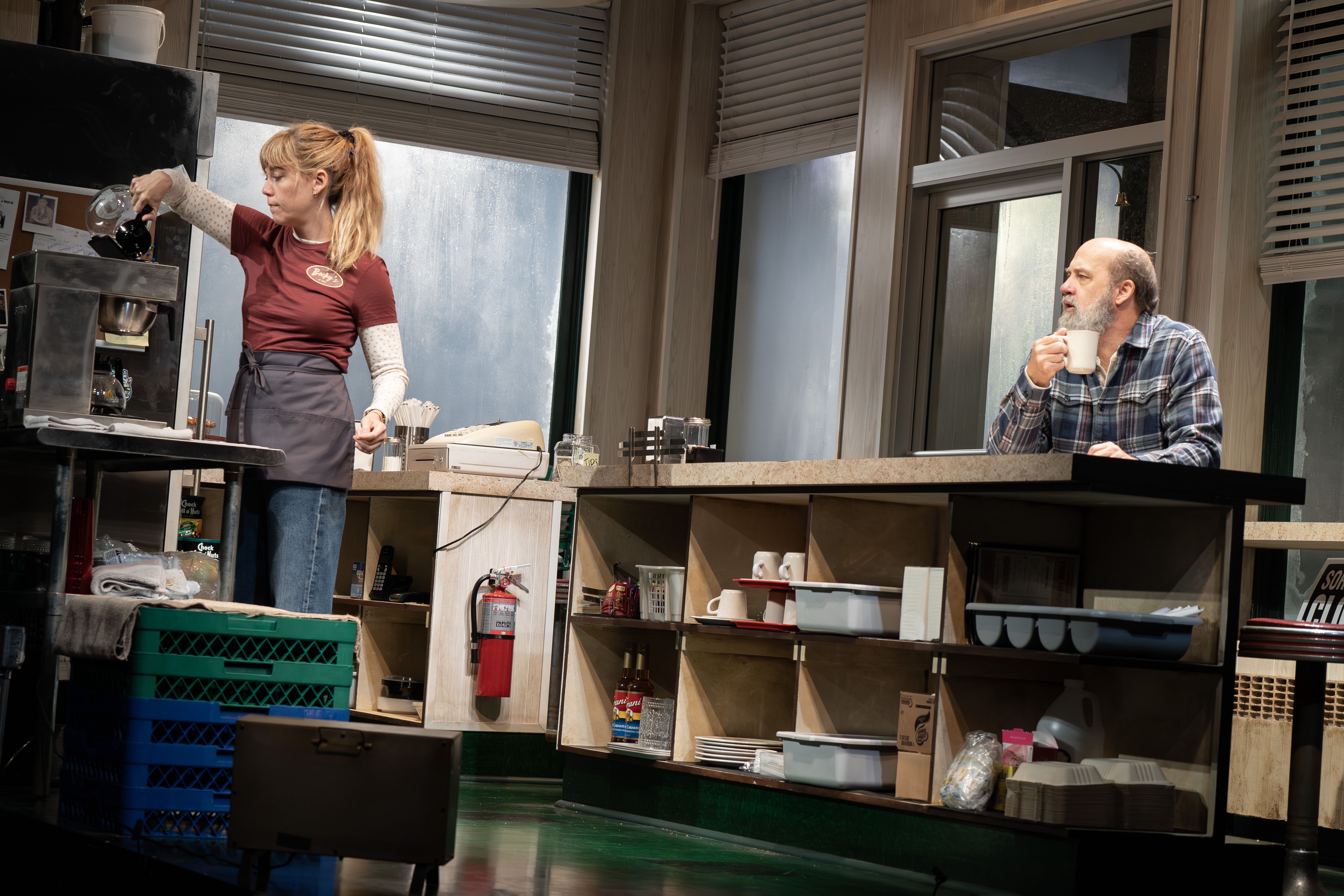
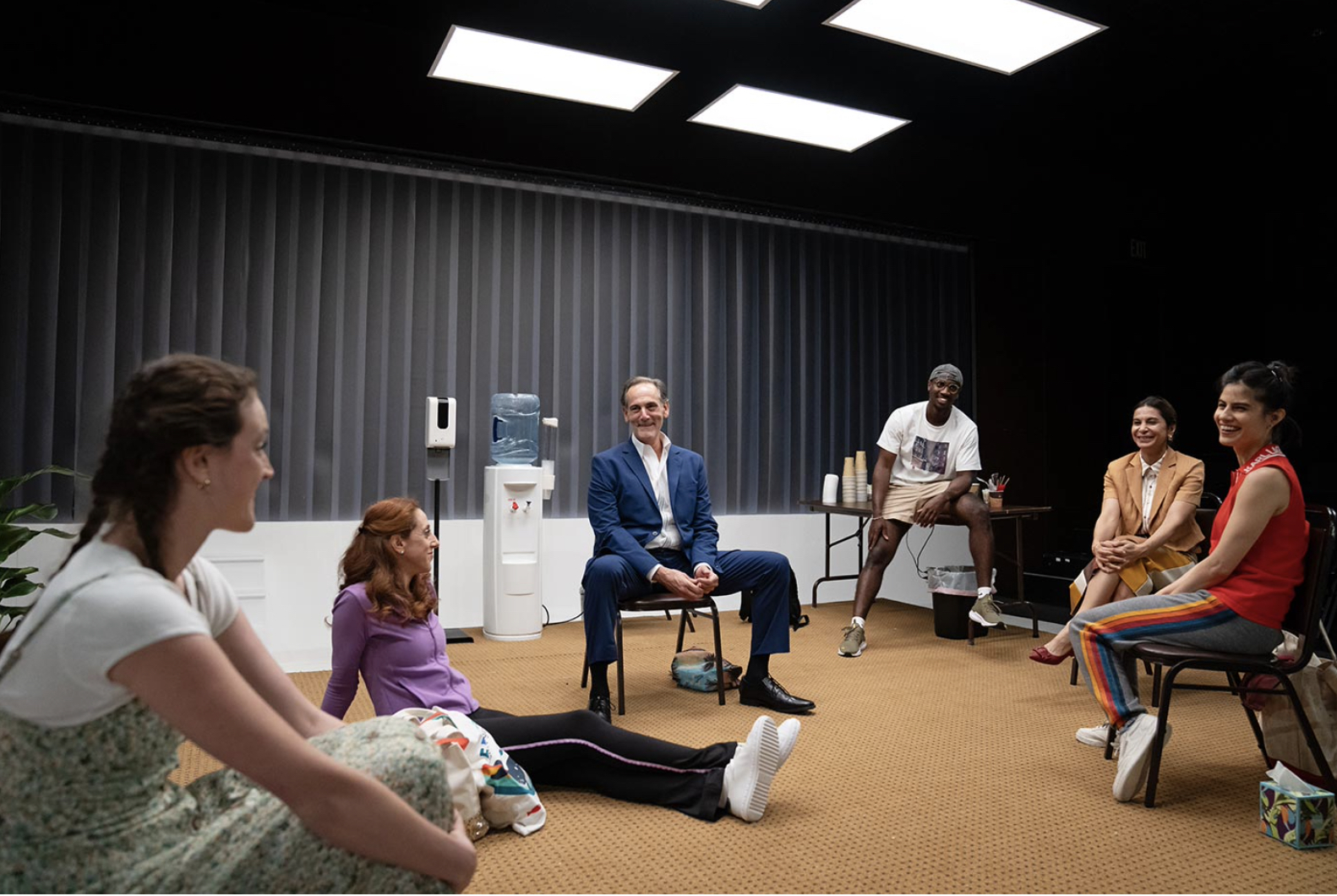
Category Archives: Off-Broadway

Staff Meal

A staff meal at a typical restaurant is an opportunity for the entire crew to be treated as equal members of a “family.”  However, in Abe Koogler’s Staff Meal currently being served up at Playwrights Horizons, there is something odd transpiring around the table.  While the enthralled servers moan in delight, what we see is unremarkable.   The true source of their reaction is imperceivable to outsiders.

At this same unnamed venue, Ben (Greg Keller) and Mina (Susannah Flood) are out on a what would strike most of us as a dreadful first date, though they seem quite comfortable with each other’s horror-tinged stories.  Their waiter (Hampton Fluker) is on a mesmerizing walk through the dark, deep, and disorganized wine cellar.  And the Servers (Jess Barbagallo and Carmen M. Herlihy) are just giddy to be employed by the elusive Gary Robinson (Erin Markey who is also — somehow — the chef and a vagrant) a man of wealth whose philosophy is what keeps them full.  Along the way, these characters don’t just break the fourth wall, they bulldoze it, build a fresh one, and then smash that one with a mallet as exemplified by Audience Member (Stephanie Berry).

Vagrant (Erin Markey) goes job hunting in Staff Meal; photo by Chelcie Parry

Similar to many artistic endeavors that were completed during the pandemic, Koogler’s piece is much more intent on capturing an unfamiliar mood than it is on telling a story.  The restaurant at its center is a unique universe with a distinct environment and even — it would seem — its own gravitation pull.  Individual scenes are like a Matryoshka Doll in reverse, with each character revealing a bigger, more colorful veneer without changing much of the plot’s shape.  Koogler imbues them all with astoundingly vivid and detailed memories and imaginations.  Poetic meditations on food, love, the past, and being of service are passionately delivered.  But while the people on stage search for common ground, you too might be casting about in hopes of feeling a connection. 

Under the hand of director Morgan Green, the artistic team functions in concert to support the absurdist tenor of the work.  Comparable to quarantine at COVID’s height, time spirals and sense of place becomes illusive.  Jian Jung’s papered walls are both elegant and nondescript.   The costumes by Kaye Voyce start off as commonplace and morph into outright bizarre.  As the players grow increasingly wary, Masha Tsimring’s lighting follows that tone.  Tei Bow’s sounds and music complete the vague and uneasy landscape.

Not unlike the restaurant that is Staff Meal’s home base, this play serves up some novel flavors. If you are willing to hover somewhere between drama and performance art, you might savor the experience without the need to define each morsel.  But also akin to dining in that central establishment, the undertaking might leave you feeling hungry for something more solid.

Staff Meal continues through May 19 at the Peter Jay Sharp Theater on the 4th floor of Playwrights Horizons at 416 West 42nd Street.  Running time is one hour and 35 minutes with no intermission.  Tickets are $51 – $91 and can be purchased at https://my.playwrightshorizons.org/events/staffmeal.

Agreement

The younger generations in America may not remember “The Troubles,” a violent nationalist, religious and political conflict in Northern Ireland that lasted over 30 years and reverberated through England and mainland Europe. It was declared at an end on Good Friday of 1998 after a long and difficult negotiation led to an agreement between factions.  The brave and complex process that led to the signing of this historical document is dramatized in Agreement, currently running at the JL Green Theatre in New York.

Senator George Mitchell (Richard Croxford) had been sent by then-President Bill Clinton to facilitate the proceedings.  He described it as simultaneously juggling knives and balloons.  For those unfamiliar with this historic event, the other participants in the room were:

Gerry Adams (Chris Corrigan): president of Sinn Féin, which was associated with the new Irish Republican Army

Bertie Ahern (Ronan Leahy): a Christian Conservative who served as the equivalent of Prime Minister of Ireland

Tony Blair (Martin Hutson): the newly elected and immensely popular British Prime Minister

John Hume (Dan Gordon): founder of the Social Democrats and Labour Party who won the Nobel Peace Prize

Mo Mowlam (Andrea Irvine): Secretary of State for Northern Ireland in Blair’s cabinet

David Trimble (Ruairi Conaghan): the leader of the Ulster Unionist Party who became the first leader of Northern Ireland

These introductions are covered in the first minutes of the play and characters frequently break the fourth wall to update the audience on their thinking and motivations.  Most of the cast members don’t look much like their real-life counterparts nor do they attempt imitation.  Rather they capture the essence of each person as seen through smiling Irish eyes.  With the gruff plain spoken delivery of his first line, Chris Corrigan’s Adams gets a knowing chuckle from the audience.  Dan Gordon’s John Hume, the realist of the group, delivers the clearest insider view. Martin Hutson plays Blair as a puffed up buffoon, high on his “mandate” stardom.  As Ahern, Ronan Leahy wonderfully performs the highest wire act both emotionally and politically.  The lone woman, Andrea Irvine has some of the same struggles as her opposite number, not given enough to do to fully define herself.  

The cast of Agreement at the Irish Arts Center

Director Charlotte Westenra could have done more to vary her actors’ approach to the text, but her straight-line approach does help audience members remember who stands where on the thorny issues.  With the focus on playwright Owen McCafferty’s fiery exchanges of dialogue, the artistic craftwork is also kept to a minimum.  The set by Conor Murphy centers on an overhead projection screen of a slowly shifting cloudy night sky.  It also serves as a television monitor and timekeeper with videos designed by Eoin Robinson.  Desks and chairs are continually rearranged by the players, more to provide variety than to establish any particular sense of place.  May Tumelty turns up the heat and the lights at key moments, which are punctuated by the contributions of composer Kate Marlais.

It is significant that the work is simply called Agreement and not “The Good Friday Agreement” or even “*The* Agreement.”  At a time when civil discourse and true negotiation seem impossible, the happenings portrayed are a refreshing reminder that informed and motivated people can find their way to a middle ground if they stay true to the greater good.  Despite passionate disputes over critical areas, democratic principles held. Ah!

Agreement continues through May 12 at the newly christened JL Greene Theatre in the Irish Arts Center, 726 11th Avenue.  The venue opened at the end of 2021 and boasts comfortable seats, a welcoming café, and a conversational staircase.  The production comes to us from the Lyric Theatre of Belfast.  Running time is 1 hour and 48 minutes with no intermission. Tickets are $25-$90 and can be purchased at https://irishartscenter.org/event/lyric-theatre-agreement.  

Fish

We’ve heard the old proverb, “Give a man a fish and you feed him for a day; Teach a man to fish and you feed him for a lifetime.”  But what are you supposed to do if you don’t have the money for a rod, line, or bait?  That is the provocative question behind Fish, a world premiere play by Kia Corthron currently running at Theatre Row on 42nd Street in New York.

The story revolves primarily around Latricia, known as Tree, a sharp 18 year old senior attending a typical urban high school that is short on funds and long on drop outs.  The teen has much more on her plate than 100 word essays.  With her mother incarcerated for a minor drug violation, she is responsible for running the household and overseeing her high-energy asthmatic 11 year old brother, Zay.  To add to her burden, her best friend LaRonda has won a spot in the Peak and Pinnacle Academy Charter School.  While only on the 6th floor of the same building as the rundown public school, with its gleaming computer lab and health center it might as well be on Mars.  English teacher, Jasmine Harris, can see Tree’s intellectual curiosity and capability below the layers of tough talk and anger.  But she’s so overburdened by the “teach to the test” requirements of Common Core she doesn’t have the time or tools to draw them out.  

Director Adrienne D. Williams does a brilliant job of incorporating the posture and movement of today’s cellphone obsessed youth.  Scenic designer Jason Simms has divided the small stage into three sections with smudged walls, mismatched chairs, and familiar posters, so that the action can move seamlessly from classroom, to project, to the streets.  The sound design by Michael Keck incorporates the thumping beats that greet us at the theater door.  Nic Vincent’s lighting design includes flickering fluorescents, an illuminated metaphor for the overall decline.  Scenes are cleverly titled overhead with the names of typical high school classes, for example “Speech and Debate” for a heated argument between teacher and student.   

Torée Alexandre makes a very believable Tree.  Even though she captures the cadence of a typical teen, with the guidance of dialogue coach Xavier Clark she takes the speed of delivery down just enough to make every impassioned word come across to the oldest of ears.  Equally good is Mikayla LaShae Bartholomew as best friend LaRonda, especially with dialogue that emphasizes the girls’ genuine caring for each other.  Acting as a worthy foil in her exchanges with Tree is Rachel Leslie as Jasmine Harris.  The cast also includes Josiah Gaffney as a sweet and playful Zay and Morgan Siobhan Green, Margaret Odette, and Christopher B. Portley playing multiple classmates and teachers.

Josiah Gaffney and Torée Alexandre in Fish at Theatre Row

This scathing portrait of a failing system and the magic of having a teacher see the value within a student would have been enough to satisfyingly sustain the 105 minute runtime.  Instead, the storytelling becomes defused in the last 20 minutes, with several tangential issues introduced.  It’s unfortunate that after all the times she is let down, Latricia doesn’t get the full attention that she deserves from the audience either.

Fish — a co-production of Keen Company and Working Theater — is playing in Theatre 4 at Theatre Row through April 20.  The script contains mature language and tough themes and is most suited to those over 10.  Running time is 105 minutes with no intermission.  Tickets are being sold on a sliding scale starting at $0 and can be purchased online (https://bfany.org/theatre-row/shows/fish/), by phone (212-714-2442 ext. 45,) or in-person (410 W 42nd Street).  You can learn about how to pick the price point that suits your budget by visiting www.keencompany.org/tickets.

Sunset Baby

My first experience with Sunset Baby – Dominique Morisseau’s 2012 drama being revived at New York’s Signature Theatre – was a series of tweets from colleagues grumbling about the treatment of the playwright’s program insert. Indeed the tiny handout is a puzzling choice of physical manifestation for her enticing invitation to the audience to fully participate even vocally in her tale of a recently released social revolutionary, his traumatized daughter, and her loving thug of a boyfriend.  But it wasn’t so much that the “Permissions of Engagement” were on a 4×6 piece of paper in nine point font. The more disappointing aspect was that the production did not elicit so much as a peep from Sunday’s audience.

Russell Hornsby and Moses Ingram in Sunset Baby; Photo Credit, Marc J Franklin

The ability to fulfill Sunset Baby’s promise is boldly displayed in the concise history of the show’s world displayed on the wall outside the theater door. It is visible in Wilson Chin’s economical yet thoughtful scenic design with its peeling paint, well-used furniture, and intriguing choice of artwork.  The decision to move the proscenium forward and raise the rake between the rows increases the accessibility and brings the audience further into this room.  Small touches from a shower caddy (props by M. Picciuto) to the nearby train (sound by Curtis Craig & Jimmy Keys) bring the setting into clearer focus. The promise is most palpable in the emotive performance of Russell Hornsby as Kenyatta, who in warm and slightly trembling tones opens the show by vividly describing not only the struggles of his role in the Black liberation movement and resulting incarceration, but of the bigger challenge of trying to be a loving father. And it occasionally pokes its head out in Morisseau’s careful plotting such as the discovery that Kenyatta’s daughter Nina expands her world beyond her rundown room in East New York by watching the Travel Channel.  Indeed, Morisseau’s knowing and complex feelings about parenthood are strongly woven throughout the dialogue. But none of these sparks ever becomes flame in the frustratingly inert 90 minute runtime.

What seems to have put a dulled layer between the work and the experience of it are artistic choices by director Steven H. Broadnax III.   The pacing is slow and there are false notes along the way.  Nina comes home from her “job” as a fake hooker who helps her boyfriend, Damon, lure black men into dark alleys to rob them.  She slips off her shiny royal blue thigh-high boots — among the apt selections by costume designer Emilio Sosa — only to wrap her cozy pink bathrobe around her skin-tight leather mini. Is this a symbol for her constant discomfort or an inability to smoothly incorporate a wardrobe change?  The actress embodying Nina, Moses Ingram, has proven herself capable of deep emotional range.  But here she is stuck at the pitch of a petulant teen. Nina’s lack of full development is most notable in a pivotal scene between her and Kenyatta. It should play like a musical movement that shifts from minor to major.  Instead this sly turning point is tonally more like a repeated refrain.  As her literal partner in crime, J. Alphonse Nicholson is also wedged into a single groove when the character could be providing meaningful counterpoint. 

I deeply admire Signature Theatre as a surviving safe harbor of affordable, expansive community theater. The commitment to reexamine an older work by Dominique Morisseau that focuses on the personal impact of the socioeconomic divide is a timely one. But Sunset Baby 2024 misses an opportunity to more engagingly enlighten a new audience about the fallout from another period during which the Black community’s efforts to serve their own were villainized and politicized.  

The first of three offerings this season, Sunset Baby runs through March 10 in the Romulus Linney Courtyard Theatre at the Pershing Square Signature Center (480 W. 42nd Street).  Tickets are available at https://order.signaturetheatre.org/events and are $59/$79/$99/$119.

Merry Me

The new comedy Merry Me has plenty going for it.  The layered writing by Hanson Jung is packed with witty spins on pop culture and references to classicists from Euripides to Shakespeare all built around a structure most similar to a Restoration Comedy.  The cast — everyone making a New York Theatre Workshop debut — is masterful.  It would be easy to play up every clever note, which would also be exhausting.  Instead the punches are delivered in slowly rising waves under the direction of the always excellent Leigh Silverman.  It’s all quite attention getting and yet somehow lacks stickiness, which is not meant to be a sexy pun despite the prominence of bawdy humor in the dialogue.

Marinda Anderson, Esco Jouley, Shaunette Renee Wilson and Nicole Villamil in Merry Me; photo by Joan Marcus

The plot unfolds on the front lines of a war that has been paused by a well-known Angel (sassy  Shaunette Renée Wilson).  She introduces us to the interdependent characters as she and her cohorts manipulate their lives.  There is Lieutenant Shane Horne (magnetic Esco Jouléy) who having seduced the General’s Wife (pixieish Cindy Cheung) is on a quest for her next “Merry.”  Shane enlists the help of therapist Dr. Jess O’Nope (exuberant Marinda Anderson) to convince the rather dim General Memnon (David Ryan Smith with just the right amount of dopiness) that they are now heterosexual.  Meanwhile the General’s equally dim son Private Willy (Ryan Spahn taking the hit for cis white men everywhere) has smuggled his beautiful new wife Sapph (Nicole Villamil managing an incredible balancing act between allure and innocence) onto the base.  Bored out of her mind and her body, she dresses in “boy drag” in order to explore her surroundings and seek out Shane. 

Playwright Jung pulls in references from Illyria to Wakanda with a hefty serving of Kushner and a soupçon of E.L. James.  All of her characters are self aware and often speak in stage directions and subtext. The energy is that of an old-fashioned farce but the would-be cliches are almost literally turned on their heads.  Having directed many productions in the NYTW space, Leigh takes actions that would typical be horizontal and stages them vertically with wonderful results.  There is one tiny portable foley door that gets run in and out of, but for the most part that classic farcical piece is “performed” by a remarkable back wall designed by Rachel Hauck.  The effects are fully achieved with the help of Barbara Samuels lighting and Caroline Eng and Kate Marvin’s sound design.  

A combination of intellectual exercise and frank sexuality, unsurprisingly Merry Me is attracting an unusual blend of followers.  The age range of the audience was fresh out of college to well into AARP membership.  Faces represented the colors of the rainbow.  And reactions spanned from gently bobbing heads to energetic fist pumping.  Performances continue through November 19 at New York Theatre Workshop, 79 East 4th Street.  Runtime is 90 minutes with no intermission.  Full priced tickets are $65.  For more information visit https://www.nytw.org/show/merry-me/.    There is room in this world for something different even if it isn’t enduring.

Puffs (On Demand)

Imagine being one of the likely terrified lesser-known students at Hogwarts during the time of Harry Potter’s attendance.  That is the delightful conceit of Matt Cox’s Puffs, or Seven Increasingly Eventful Years at a Certain School of Magic and Magic, which ended its very successful New York run in August of 2019.  Wonderfully captured on film by its stage director Kristin McCarthy Parker with support from VirtualArtsTV, the show is coming to BroadwayHD beginning August 15.  Though performed with farcical pace and style, like the Boy Who Lived, Puffs never loses its soul.  The sendups are executed with obvious love for the original world and characters, which makes them far more potent and enjoyable for the true fans that make up the target audience.  

We are guided through the 7-year journey by a narrator (a quick and snappy A.J. Ditty) whose identity will eventually be revealed.  Around the time of Mr. Potter’s birth, another boy, Wayne Hopkins (a warm and sweet Zac Moon) was born and orphaned in England and then whisked away to his Uncle Dave in New Mexico.  One day, a passing owl drops a letter into their living room inviting the nerdy child to a school in his home country.  He finds himself sitting under a famed hat which determines he is a Puff, a House of seeming misfits. They are led by a very polite Cedric (an amusingly servile James Fouhey) and live in the school’s basement somewhere near the kitchen.  Wayne and his new friends Oliver Rivers (adorkable Langston Belton) and Megan Jones (Julie Ann Earls on the right side of edgy) hope to distinguish themselves and contribute to Cedric’s goal of “third place or nothing”.

(Front row) Jessie Cannizzaro, Zac Moon, James Fouhey, Stephen Stout, (Back row) Madeleine Bundy, Langston Belton, Andy Miller, Eleanor Philips (L-R); photo by HUNTER CANNING

Their story plays out Rosencrantz and Guildenstern-like, with that of Harry (a pointedly irritating Madeleine Bundy), Hermione (a wig) and Ron (a mop) unspooling in the background.  Cast members take on over three dozen characters with admirable range and assurance.  A knowledge of the Harry Potter film series is essential for truly appreciating the hilarious and multilayered impressions from Stephen Stout’s spot-on Alan Rickman as a Certain Potions Teacher to Eleanor Philips as a squeamish Death Eater.  Familiarity with a certain 2008 rom-com will add laughs to Nick Carrillo’s wild about-last-night improv.  The ensemble is rounded out by Jessie Cannizzaro and Andy Miller playing opposite ends of the outcast spectrum among other roles.

Cox’s inventive script is a total triumph. The visual wizardry emanates from director Parker’s stagecraft along with the talents of her remarkable artistic team. Magical elements  — including a Dementor so smartly designed it should get its own standing-o — are made possible by sets, props and costumes all impressively conceived by Madeleine Bundy.  These clever and colorful elements are supported by lighting effects by Herrick Goldman and original music by Brian Hoes that recalls just enough of John William’s themes.

Shown in theaters for only two nights, Puffs, or Seven Increasingly Eventful Years at a Certain School of Magic and Magic will be available On Demand at BroadwayHD.  The production is recommended for those 13+ and runs just short of 2 hours.  The mid-credit outtakes add an extra sprinkle of joy to the fun-filled viewing.

The Half-God of Rainfall

At a time when the performing arts are struggling, it is fitting that the wonderful New York Theatre Workshop is hosting a theatrical event that takes much of its inspiration from the early Greeks.  Similar to the dramas of that time, The Half-God of Rainfall combines elements of religious mythology, social commentary, and contemporary politics.

The piece opens with a nod to the ancient tradition of oral storytelling as the players introduce themselves with their real names along with their god-selves.  Working together, the performers weave a tapestry of poetry and dance as they tell the tale of Demi, the product of a particularly violent rape by Zeus: one of many abuses perpetrated by the King of the Gods against human women.  Having won a wager with Sàngó, a fellow god of Thunder, Zeus took as his prize Modúpé, who almost instantly gives birth to a half-god child, Demi.  His despair can make rivers rise and his rage can make it rain.  But his real power manifests on the modern basketball court where every shot is a winner. Despite his many victories, his smoldering rage against his father always burns.

In this realm, the gods of all traditions know one another and many are no better than the mortals over whom they have dominion.  Encompassing so many deeply felt themes occasionally bends the narration out of shape, but the dazzling visuals and all encompassing soundscape keep you enraptured. The audience was invested enough that towards the end they elicited a loud gasp at a critical moment.  While some familiarity with the various pantheons would be helpful, playwright Inua Ellams includes enough background information that the plot can be followed without it.  Even the basketball reference are based on pop culture and never “inside baseball” as it were.

Taibi Magar’s direction is masterful, filling the scene with otherworldly energy enhanced by movement director Orlando Patoboy.  She also incorporates Orisha movement choreographed by Beatrice Capote.  The set by Riccardo Hernández with projections designed by Tal Yarden is in constant motion with swirling images of clouds, water, and the cosmos itself.  The stage continues the natural theme, covered in black sand that moves and lets out a soft crunch beneath the actors’ feet.  The physical experience is expanded with the sound design of Mikaal Sulaiman and lighting designed by Stacey Derosier.  Costume designer Linda Cho builds on basic black towards the shimmering waters of a fertility goddess.

The ensemble moves with fluidity throughout the work, their disparate voices adding variation to the verse.  Mister Fitzgerald gives Demi a radiant joy.  Jennifer Mogbock brings both strength and warmth to Modúpé, her body moving with the combined powers of grace and strength.  Jason Bowen as Sàngó and Patrice Johnson Chevannes as Osún make a fittingly splendid couple under whose protection Modúpé lives.  Kelley Curran’s Hera and Michael Laurence’s Zeus employ unnecessary Greek accents, but the two shine in their other supporting roles.  Only Lizan Mitchell over-modulates, consequently distorting her lines as the trickster Elegba and several other deities. 

Mister Fitzgerald as Demi, The Half-God of Rainfall; photo by Joan Marcus

As many Greek heroes learned, a great adventure often begins by being blown off course.  This production was disrupted by COVID only to wind up in just the right hands.  The result is an ambitious epic that draws a diverse audience much needed by today’s theater world.  Despite its themes, The Half-God of Rainfall is a human-level spectacle born of collaboration and heart.  (There is a trigger warning for a depictions of sexual violence and a use of flashing lights and haze for dramatic effect.)  Performances continue at the New York Theatre Workshop (79 East 4th Street) through August 20 and $65 tickets are available at https://www.nytw.org/show/the-half-god-of-rainfall/.  Runtime is about 90 minutes and mask-only performances are available.  A co-production of NYTW and Harvard’s American Repertory Theater, the show will be moving next to Cambridge, MA in September.

Primary Trust

I usually don’t make my reviews personal, but my experience while watching Primary Trust and the themes within this gorgeously crafted play are inexorably intertwined.  With gentle brushstrokes, Eboni Booth introduces us to 38 year old Kenneth, one of the few Black people living in Cranberry, a suburb of Rochester, New York.  His ethnicity is only a minor contributor to Kenneth’s isolation.  Having lived an extremely restricted life since the death of his mother when he was only ten, Kenneth’s coping mechanisms are intricate and ritualized.  But somehow his idiosyncrasy has left him uniquely suited to meeting people at their own level.

There is a deliberate “let’s pretend” quality to the entire production.  From the opening moments, Kenneth speaks directly to us in his halting and self-reflecting style.  Long thoughtful pauses rest between effervescent bursts of storytelling.  All the activity comes with musical accompaniment composed by Luke Wygodny, punctuated by the ding of an “order up” bell.  Marsha Ginsberg’s whimsical scenic design takes the phrase “small town” and makes it literal, including a miniature church, bank, and big box store alongside Wally’s, the tiki bar that serves as Kenneth’s sanctuary.  Lighting by designer Isabella Byrd leaves long shadows on the ground well before winter sets in.  Costume designer Qween Jean employs a more muted color palate than her signature style until an essential jacket makes its appearance at a pivotal moment. Two actors play multiple roles, sometimes barely turning around before switching.  Yet the play is never anything less than genuine and heartfelt.  The entire audience was sufficiently swept up to respond emotionally to every turn.

William Jackson Harper is utterly perfect as Kenneth, balancing warmth, vulnerability, fear and heart.  It’s Harper’s first stage appearance since 2017 and it was my first live theater attendance since March of 2020.  Previously, theater played a major role in my life.  Many of my friends come from that world and it was often the way I entertained others.  Vacations have been planned around seeing a specific work or actor. The temporary loss of that pursuit was profound.  But Primary Trust is all about bringing people in.  At its core is the celebration of coming out of seclusion.  To have Kenneth welcome me as a member of the audience into his life could not have been more impactful. And though I don’t have much more in common with the character, I do share his deep belief in the power of one good friend.

Jay O. Sanders, William Jackson Harper, and Eric Berryman; photo by Joan Marcus

Director Knud Adams, who often works with new material, delicately mines Booth’s script, uncovering the layers of joy, sorrow and hope. Providing support and stability for Kenneth is his best friend Bert, played with sweet good nature by Eric Berryman.  Jay O. Sanders seems to be having the time of his life portraying (among other characters) Kenneth’s two very different bosses.  The first — the owner of a bookstore— has the difficult task of laying Kenneth off after twenty years of a comfortable relationship.  The loss of his job shatters the comfortable if confining structure of Kenneth’s life, and the chink of light shining through the holes is both frightening and filled with possibility.  Helping Kenneth step through the gap is April Matthis’s Corinna, the only one of a multitude of Wally Waiters who wants to see Kenneth as more than an eccentric customer.  Completing the ensemble is a Musician played by understudy Paul Lincoln in the performance I attended.  So essential is he in setting the beat and tone, that Mr. Lincoln received his own loud round of applause.

Roundabout has obviously worked to make this production inclusive.  The company offers clear and sensible guidelines to audience members and the staff makes themselves very available to help.  To get you in the mood for what is to come, the lobby has been decorated to resemble a tiki bar, complete with projected fish tank and artificial grass.  The ticket confirmation warns audience members not to arrive late.  I can only reemphasize their strong recommendation.  Missing any of the first few minutes of the show will leave you with quite the wrong impression of what is transpiring.

Primary Trust is a work of true beauty.  It was nurtured at the 2021 Ojai Playwrights Conference and is a recipient of an Edgerton Foundation New Play Award.  Running time is an absorbing 95 minutes with a realistic denouement.  It is playing at the Laura Pels Theater in the Harold and Miriam Steinberg Center for Theatre (111 West 46th Street) through Sunday, July 2.  (Note that Harper is out the weekend of June 9.)  Tickets start at $56.  $4.95 COVID cancelation insurance is available.  Visit www.roundabouttheatre.org for additional information including special performances.

From The Mint Vault — Days To Come

“Lost Plays Found Here.”  So says The Mint Theater punningly about their mission.  Founded in 1992 by Artist Director Jonathan Bank, the company gives new life to neglected plays primarily from the 1930s.  Always polished, frequently charming, and often stunningly relevant, the line-up has included The Voysey Inheritance by Harley Granville-Barker, Rachel Crothers’ A Little Journey, and several works by the nearly forgotten Teresa Deevy.  They have made their home in several comfortable venues around Manhattan, most recently City Center and Theater Row.  

Financially slammed like every other small theater during COVID, The Mint occasionally opens their vault of recorded shows as a passive income stream.  Their current offering is the intense drama, Days to Come.  Written by Lillian Hellman between two better known plays — The Children’s Hour and Little Foxes — the plot unfolds over the course of a month in 1936 during a strike against a factory in a small Ohio town.  Hellman chose to focus on the social impact the strike has on the close community.   She conducted interviews with workers and management of the Wooster Brush Company to help her create characters of depth and conviction without the aim of solving their issues.  Andrew Rodman, the owner, and Thomas Firth,  the most vocal of the workers, are friends.  Their long-term relationship makes their conflict more complex, especially when outside forces intervene.  As events unfold it becomes clear that simply knowing a person over time doesn’t guarantee you can anticipate their actions. 

Director J.R. Sullivan builds the tension between various pairs of characters, each with a distinct style and agenda.  Larry Bull is the heart of the show, imbuing Andrew with surprising sensitivity and self-awareness.  In contrast, Chris Henry Coffey’s Tom is all gut reaction.  Coming between them is Ted Deasy’s Henry Elliot, a lawyer who’s wealth and style mask a grimy interior.  In arguably the most difficult role, Mary Bacon successfully balances the symptoms of Andrew’s sister, Cora’s, mental illness with genuine if misguided concern.  The rest of the cast includes Janie Brookshire, Dan Daily, Roderick Hill, Betsy Hogg, Geoffrey Allen, Kim Martin-Cotten, Wendy Rich Stetson and Evan Zes.

Larry Bull, Chris Henry Coffey, Ted Deasy, Roderick Hill, and Janie Brookshire in Days to Come; Photo by Todd Cerveris

Recorded in August of 2018, the stream is very stable and there’s no log in process, though a valid email address is required.  Audio quality is excellent and subtitles easy to read. It is shot from the audience viewpoint with straightforward camera work which never distracts.  Costume designer Andrea Varga sets the tone with wonderful fabrics, which can be seen with increased clarity.   And even on a small screen, the Rodman’s living room designed by Harry Feiner is lush with decorative detail. 

The original Broadway production of Days to Come was a disaster.  The influential William Randolph Hearst stormed out and the run lasted a mere seven days.  While the work isn’t the most relatable or smooth of The Mint’s productions, it is well worth the two hour investment.  It’s available On Demand at https://minttheater.org/ free of charge though April 2.  A request for support will appear in the upper right hand corner at the end, by which time I hope you, too, are a fan.

MCC’s Space Dogs on BroadwayHD

Over the last few years in particular, streaming theater has developed into a genuine and distinct art form.  Done right, it marries the excitement of attending a singular event in person with a profound level of intimacy.  Many shows have traveled well from one medium to the other.  Some — like MCC’s Space Dogs — are arguably even better viewed up close and personal.

Developed and performed by actors/musicians Van Hughes and Nick Blaemire, Space Dogs covers in impressive detail the story behind the early days of the Space Race.  In order to learn the effects of lower gravity and increased radiation on life, Russia’s Sputnik program took 40 stray dogs off the streets of Moscow and used them for testing.  The most famous of these is Laika, who was the first animal to orbit the Earth.  But Space Dogs takes great care to honor each and every one of these four-legged heroines.  (Yes, they were all female.)

Anyone familiar with Laika’s story will be aware that this tale doesn’t have a happy ending.  However, there is still a great deal of joy to be experienced throughout the show’s 90 minute running time.  Against a six paneled projection wall designed by Stefania Bulbarella and Alex Basco Koch, the good-natured and talented duo guided by stage director Ellie Heyman fly through dozens of roles with high-energy and knowing winks.  Among his line-up, Blaemire gives gentle voice to Laika, an unwitting participant to scientific history. And as part of his array, Hughes takes on the role of Sergei Korolev, known contemporaneously only as The Chief Designer, portraying him as a man torn between his compassion for his trusting “volunteer” and the hectic pace and lack of funds imposed on him by Nikita Khrushchev and the Soviet State.  The dogs are wonderfully represented by malleable stuffed animals that have been given tremendous personality by creator Amanda Villalobos.  

The actors employ cameras and use miniatures and green screen in order to bring the audience into sections of their small scale fuzzy world.  It is these techniques that allow Joe Lukawski, who directed the production for the screen, to more easily expand the audience to include those of us from home.  Footage from the four main cameras in the theater are fluidly mixed with the direct feeds already integrated into the performance.  This level of rapport with our storytellers is a perfect match for a script built around secrets.  And the simple technical effects and stripped down props fit this unique lens.

Van Hughes, Little Gnat, Laika, and Nick Blaemire in MCC Theater’s 2022 production of SPACE DOGS; Photo by Daniel J Vasquez

Based on classified documents that were only released in 2002, the story of political intrigue — AND DOGS — is clear and enlivened with humor, making it appropriate for older children as well as adults.  The varied score with intricate lyrics incorporates rock, electronic dance, rap and ballads.  “A Brief History of Dogs” loudly celebrates those special supporting characters.  “Fill the Void” creates an enveloping soundscape worthy of outer space travel.  And “Fuzziest Loneliest” sung from Laika’s point of view presents a particularly poignant moment.  A taste of the full cast album is still available at https://mcctheater.org/tix/space-dogs/.

A thoroughly gratifying and impactful entry to the BroadwayHD library, Space Dogs manages to be not only informative but playful, and not just because of the dogs.  It can also serve to introduce a world wide audience to the marvelous MCC, one of New York’s leading nonprofit Off-Broadway companies.  Captured live in MCC’s Susan and Ronald Frankel Theater and available exclusively to BHD subscribers, this production was made possible through a collaboration with HMS Media.  The holiday rate of $99.99 for a full year of membership is available through December 8 ($129 after that date.) Visit https://www.broadwayhd.com for more information.