Long before Joni Mitchell decried the paving of paradise to put up a parking lot, Anton Chekhov’s emotionally paralyzed Ranevskaya family auctioned off their cherished cherry orchard to make way for summer homes. His last play, The Cherry Orchard, centers on Madame Lyubov who is hopelessly in debt after years of living in Paris. She and her daughters have returned to their estate for one last party and it is only then that they reflect on the once-prized fruit trees that will be chopped down to make way for modernization. Like many of Chekhov’s works, there is a sense that happier alternatives have simply slipped out of reach.
In Arlekin’s (zero-G) imaginative retelling, The Orchard, the work is simultaneously performed live and streamed to a global audience. Typically, live streams have been made available because there was no audience permitted at the theater or it was presented in a way meant to simulate as closely as possible the live experience. This is the first theatrical piece I’ve seen that deliberately gives those watching from home a different experience from those seated at the venue.
While it is simply wonderful to make this production available worldwide and Ukrainian director Igor Golyak has unique experience using virtual reality to enhance traditional theater, it seems unnecessary to have augmented this particular work with an interactive component. The video-game-like curtain-raiser features various rooms of the house containing Mikhail Baryshnikov as Chekhov reading some the author’s more personal words in the original Russian. Much of the interaction during the play involves being able to select something other than the main camera, though the few times I switched to another unit, it wasn’t revealing so much as disorienting. And it was impossible to avoid FOMO when just before the auction of the property — during which the audience makes non-binding bids with proceeds going to support the company — the home audience was addressed directly by matriarch Lyubov Ranevskaya while a completely different scene was taking place on stage.
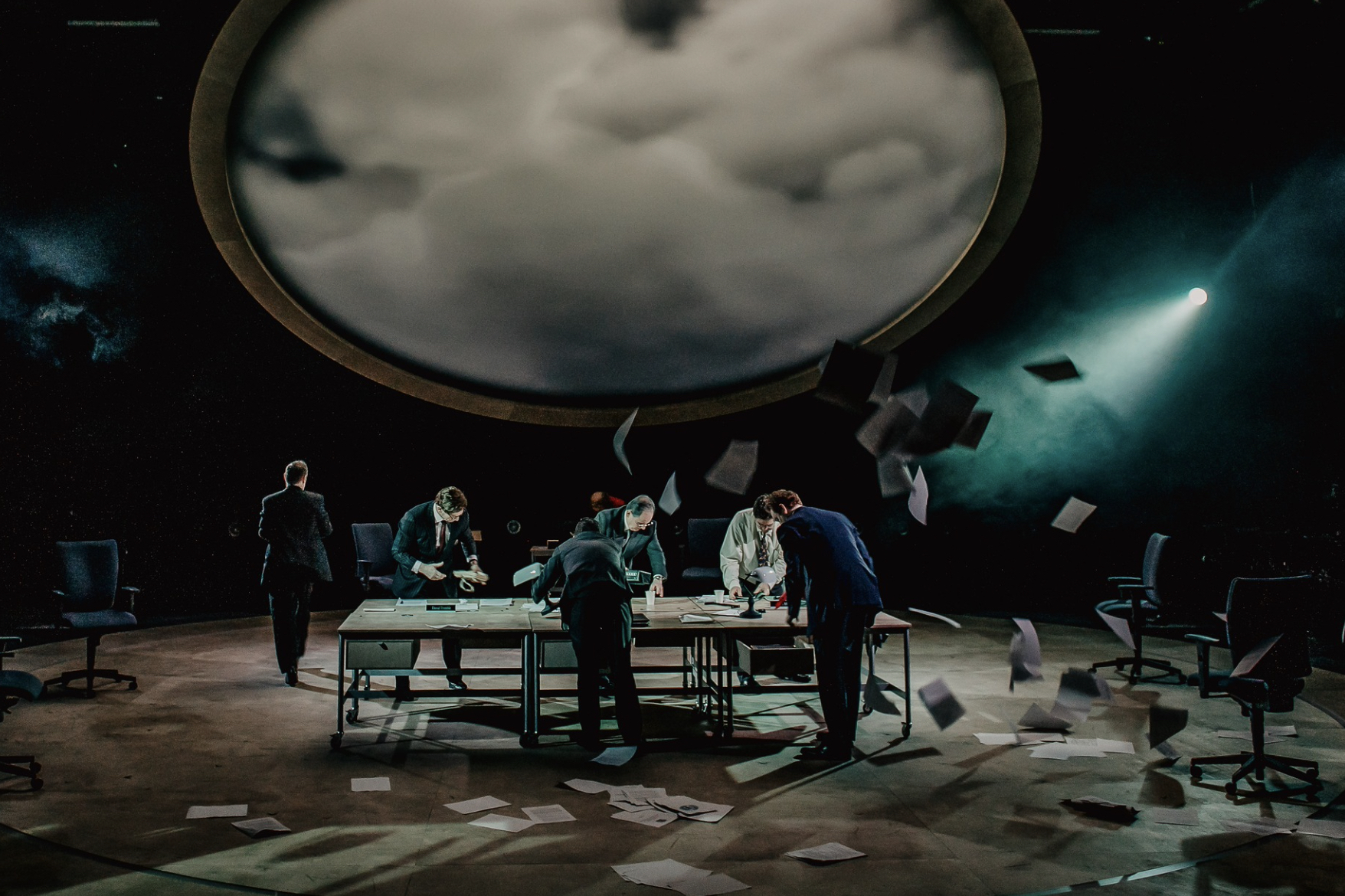
Furthermore, the production is straight-up terrific and needs no embellishment. Golyak, whose homeland is currently undergoing life changing destruction and loss, has harnessed those feelings of disconnection and grief and made additions to the work that are engaging and meaningful. The elegant script was translated by Carol Rocamora, who preserves the poetry while tightening the storyline and punching up the more farcical elements. On scenic designer Anna Fedorova’s all-blue stage, blossoms litter the floor and even the nursery room teddy bear and hobby horse appear melancholy. The backdrop envelops the players in dramatic projections by Alex Basco Koch, including lines of dialogue, stars and planets, and the faces of the enraptured audience. The onstage robotics by Tom Sepe lend an eery futuristic and fatalistic feel to the tale.
The cast is led by the sublime Jessica Hecht, who gives Ranevskaya’s delicacy meaning and tenderness. Baryshnikov appears again as Firs, the faithful older servant. His interpretation of an aging, submissive body practically collapses in on itself and he never stops being fully present, even providing a warm interaction with a mechanical dog. The clowning of Arlekin Players regular Darya Denisova as Charlotta the soon-to-be-displaced governess, adds appropriately discordant levity. While Nael Nacer’s booming voice is just perfect for sounding the alarm as Lopakhin, the man best positioned to win the orchard his ancestors tended to as slaves. John McGinty has been cast as Trofimov, though it’s unclear whether making the perpetual student deaf is a comment on communication between characters or Golyak just appreciates McGinty’s talent. Juliet Brett, Elise Kibler, Mark Nelson, and Ilia Volok round out the company.
As a fresh take on a classic, The Orchard blossoms under Golyak’s knowing hand. The themes of class division, misplaced materialism, and cultural loss are sadly timely and touching. A quick read of The Cherry Orchard will only deepen your understanding of events. Live performances run through Sunday, July 3, and take place at the Baryshnikov Arts Center at 450 West 37th Street (between 9th and 10th Avenues) . Showtimes are Tuesday – Thursday at 7PM, Friday – Saturday at 8PM, with matinees on Saturday and Sunday at 2PM. Proof of vaccination is required for entry and face masks must be worn throughout the two hour runtime. Prices for the intimate live show run from $39 to $125. The virtual experience — which requires a plugged-in laptop or desktop — is $29. There are bundles to purchase both live and streaming together. For tickets and additional information, visit www.TheOrchardOffBroadway.com.


Halfway Bitches Go Straight To Heaven
No one creates moments that are simultaneously unsettling and humorous quite like Stephen Adly Guirgis. Halfway Bitches Go Straight to Heaven is his first play since being awarded the Pulitzer in 2015 for Between Riverside and Crazy. This new work is a snapshot of the struggling residents of a New York City halfway house, surrounded by an unwelcoming neighborhood and staffed by those whose lifestyles aren’t much healthier. It’s a sprawling script with over a dozen main characters to track. Many of the transactional relationships include elements of genuine affection and the ride is a profound one. Ultimately, though, it is not so much a tapestry as a sewing kit with each thread slightly touching the one beside it.
As the play opens, a group session is in progress. This initial conversation hits many predictable beats — drug use, sexual exploitation, and abuse — but also provides a quick introduction to the characters with whom we’ll spend the next three hours. We learn Queen Sugar (Benja Kay Thomas) has gotten caught up in an Amway-style pyramid scheme while Munchies (Pernell Walker) is preoccupied with Nigerian caregiver Mr. Mobo (Neil Tyrone Pritchard). There are glimpses of Wanda Wheels’ (Patrice Johnson Chevannes) elegance, the stranglehold that mentally ill mother Sonia (Wilemina Olivia Garcia) has over her bright daughter Tiana (Viviana Valeria), and the familiar relationship pattern fragile Bella (Andrea Syglowski) is recreating with lesbian in command Sarge (Liza Colón-Zayas). Always quick to say, “no,no,no” is Rockaway Rosie (Elizabeth Canavan). Taking center stage at the top is the clever rapper Little Melba Diaz (Kara Young). In the corner is morbidly obese Betty (Kristina Poe) whose surprise connection and subsequent blossoming is a highlight. And on the edge (and on edge) is the transgendered Venus Ramirez (a glorious Esteban Andres Cruz) a ferocious voice for those who insist on their rightful place. That list doesn’t include the rest of the staff compassionately portrayed by Victor Almazar, David Anzuelo, Sean Carajal, Molly Collier and Elizabeth Rodriguez.
Elizabeth Canavan ( Rockaway Rosie ), Liza Colón – Zayas ( Sarge ), Kara Young ( Lil Melba Diaz ) and Pernell Walker ( Munchies ). Photo Credit/ Monique Carboni.
As with other Guirgis plays, a subtle but clear picture of the outside world is also drawn. The city’s system is failing and the shortages of both supplies and care are making these lives unnecessarily challenging. A flock of goats tending the grass in a park uptown receives more devotion and support than any of the humans who are simply looking for a chance.
To hold all these tales, a skeleton of the tenement house dominates the set. The sparsely decorated central room of Narelle Sissons’ design also represents the office of the dedicated and overworked manager and occasionally the bedroom of an occupant. The area between the first row and the stage serves as the surrounding alleyways. Director John Ortiz places much of the action on the house front steps audience left and a bench audience right making the viewing experience a bit like a tennis match. Additional focus is achieved with lighting design by Mary Louise Geiger while the mood rises and falls with sound and compositions by Elisheba Ittoop.
Haunting and moving, Halfway Bitches Go Straight to Heaven is like taking in a gallery filled with the faces of those whom New Yorkers breeze past every day. Though their full stories are not on the display, the images will sear into you. Note that the material is strictly adult, containing nudity and simulated sex and drug use. The limited engagement co-produced by LAByrinth Theater Company has already been extended through Sunday, January 5. Regular tickets begin at $70 and are available online at atlantictheater.org, by calling OvationTix at 866-811-4111, or in person at the Linda Gross Theater box office (336 West 20th Street between 8th and 9th Avenues).