
Many writers have examined tensions in the Middle East, a particularly thorny issue. Playwright Monica Raymond does so with a poetic eye in her new work, The Owl Girl. Taking the conflict to an absurdist extreme, she distills the historic schism down to two families — one Arab and one Israeli — and places them in the same dwelling. Both can reasonably claim ownership of the home. Zol and Leedya were raising their teenagers, Joze and Anja, in the house when they were all sent to a camp in the West Bank. Rav and Ora then purchased the property for their family, which includes daughter Stel and young son Capi.
Stel still feels the spirits of the other children in her room, where she chooses to keep two marks on the wall that indicate Joze and Anja’s heights at the time they were forced to leave. Meanwhile in the camp, Joze has also started to feel a draw, eventually convincing his father to give him the key to the old front door so he can visit one last time. He happens to choose a night when Stel is home alone and the two form an instant connection. Stel invites Joze to come back, but when he does, his parents and sister follow. Rav, Ora, and Capi return, and the eight decide to share the space as a cultural experiment.

Yaara Shilony and Julian Alexander as Stel and Joze in The Owl Girl
Raymond employs a number of metaphors to make her points about battles ideological, cultural, and territorial. The most graphic of these symbols is the Owl Girl of the title. Anja stopped developing at the age of 13, literally stunted by losing her place in the world. Stuck in exile, she fell under the spell of her rage-filled grandmother. Since Anja hasn’t matured into a woman, she tries on a number of animal personas, settling on the owl. These birds represent power and destruction in her culture, but also possess vision and insight. Returned to her rightful station, she not only starts menstruating, but swoops about the house, eventually sprouting literal wings in order to gain a better vantage point.
Ms. Raymond has been developing this piece for 15 years, and some sections flow with the passion she obviously feels for her subject. Her understanding of the thin line that can exist between enemies is well articulated, at one point represented by a literal string running down the kitchen. Her use of magic helps her reveal emotions that can be difficult to articulate. But she defuses her message by adding too many layers. There are aggressive chess matches, a hellish hidden room, and a jar of mysterious ointment. Then in the middle of the second act, Raymond introduces a subplot involving the lust Rav feels for Anja. Eventually, like a child’s painting, the metaphors are so thick that they turn muddy.
The Owl Girl is presented by THML, a majority female-run theatre company that promotes stories by and about women. It is therefore unsurprising that the exchanges that have the most rhythm are the ones between the two mothers. They share a frustration with their sexists husbands and are both raising challenging younger children. Ora and Leedya bond as almost any two women will eventually do, finding common ground and poking a little fun at their differences. Director Bryan Raanan Kearney who plays Ora has good timing and provides some comic relief. The other relationships don’t work at least in part because many of the actors are miscast. One in particular is the wrong age and ethnicity and has not gained mastery over an unnecessary accent. The exception is Julian Alexander, who brings a delightful softness and sense of wonder to Joze.
Having received awards from the Castillo Theater, Peacewriting, Portland (Maine) Stage, and the Jewish Plays Project, The Owl Girl is a promising work that still needs to find a clear voice. It is playing through March 20 at The Center at West Park, upstairs in the Balcony Theater. Tickets are $30 and can be purchased at https://www.eventbrite.com/e/the-owl-girl-tickets-53977563345.

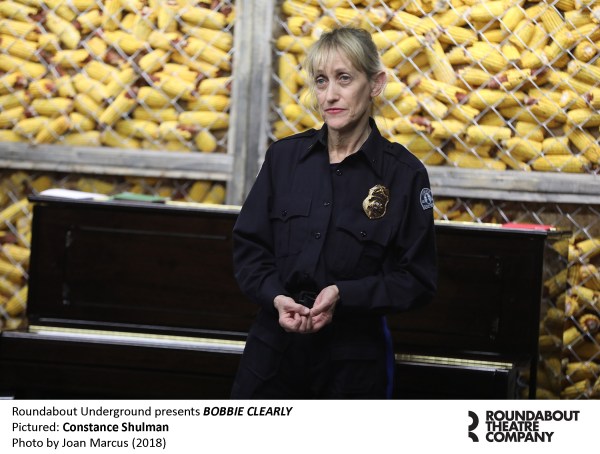

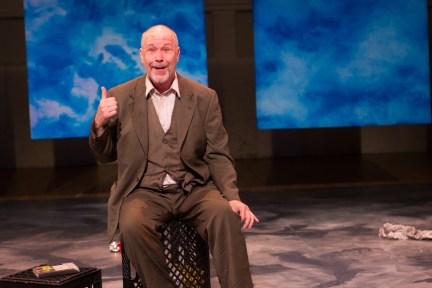 There is no denying that Richard Hoehler is a talented man. A winner of the The Off-Off-Broadway Review (OOBR Award) for Best Solo Performer, he knows how to own a room. In his latest monologue, I of the Storm, he tells tales, recites poetry, sings heartily and even dances a lick or two. You’re sure to take notice throughout even if it doesn’t quite all hold together in the end.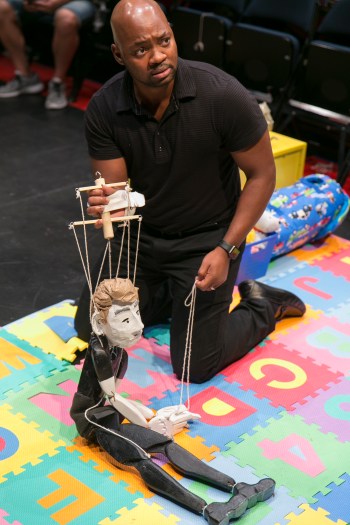
 Anyone looking to fill an evening this week with good theater that supports a great cause and an even better movement should head over to the Cherry Lane for the Project W Theatre Festival. Running June 6-10, this series of staged readings turns the spotlight on professional theater women in creative and business roles. Pay-what-you-wish donations will be given to Planned Parenthood of NYC, which provides reproductive healthcare and educational programs to women and their families throughout the five boroughs.


The Baby Monitor
The shattering impact of an “I love you” with a “but” clause is at the heart of The Baby Monitor, currently mounted as a workshop production at the 14th Street Y. The plot centers around the suspicions a woman harbors concerning her gay cousin’s treatment of the toddler son he shares with his husband. By fleshing out this nightmare scenario with all-too-common misunderstandings stemming from distinctions in race, class and religion, playwright David Stallings has delivered something far richer than an issues play. It is a thoughtful examination of the ways in which simply tolerating differences rather than embracing them can cause irreparable damage to our societal fabric.
The scene opens on a family Thanksgiving. Rejected by most of his strict Catholic family after coming out, Damon has invited his close cousin Claire and her husband Josh to join him and his husband Phillip to celebrate the holiday along with their two-year-old son and nanny. The evening includes a great deal of reminiscing and chardonnay and concludes with flipping through the new family’s photo album. A combination of tainted religious doctrine and personal frustration leads Claire to react inappropriately to one of the pictures. Her misguided good intentions have the potential to destroy the happiness of everyone involved.
David Stallings, Leo Goodman, Amanda Jones, and Hector Matias. Photo by Michael Dekker
Even at a time when gay marriage is legal and children stemming from these unions are not uncommon, it has been hard for many people to move beyond ingrained beliefs. Stallings realistically explores a variety of viewpoints stemming from these slow-to-shift societal norms. The genuine danger that can grow from preconceived notions is revealed in peeling layers. While there is certainly an ideology that skews left running underneath, the dialogue is stealthy, with little slips of the tongue that indicate early on that Claire’s love for Damon has many qualifiers attached to it. By making Phillip and the nanny Soledad immigrants from the Dominican Republic, Stallings can additionally explore the role culture and class play in the escalating tensions.
Stallings also stars as Damon, a performance infused with deep passion. Héctor Matias is positively dreamy as Phillip, accustomed to keeping up his guard except around the family he clearly adores. Stallings is less successful in his drawing of female characters. Though Amanda Jones strives to manifest Claire’s sympathetic backstory, the character is essentially unlikable and therefore challenging to portray. This is magnified in her scenes with Leo Goodman’s wonderfully nuanced Josh, who is most often given the voice of reason. Greta Quispe similarly struggles to give balance to Soledad, whose personal journey could make for an equally compelling play. However, Mel House is strong in her too-brief performance in the critical role of activist Shelly.
For this production, the black box theater has been set up in 3/4 round with a simple set of padded tiles and wooden boxes. Lighting designed by Kia Rogers is used to shift the setting and to mimic a violent climatic moment. Direction by Stallings’ husband Antonio Miniño is skillful, with an engaging blend of quiet touching moments and palpable strain.
As much as it is a powerful drama, The Baby Monitor is also an important conversation starter. Developed on both coasts of this divided country, it would be wonderful if this work could find its way into the middle. The production contains very brief partial nudity and is recommended for ages 16 and over. It is playing through December 16 at the 14th Street Y, 344 East 14th Street near 1st Avenue. General Admission tickets can be purchased by calling 646-395-4310 or by visiting www.differenttranslation.com. Prices are $25 for adults and $22 for seniors and students. $5 rush tickets are available 15 minutes before curtain for those living in zip codes 10003 and 10009.